

In the heart of the Middle East, the UAE has emerged as a global hub for innovation, with Dubai leading the charge in adopting cutting-edge technologies. As we step into 2026, the growth of augmented reality (AR) and virtual reality (VR) in the region is nothing short of remarkable. From immersive tourism experiences at the Burj Khalifa to virtual property tours in Abu Dhabi, AR and VR are reshaping how businesses operate and engage with customers.
Recent market data highlights this surge: the UAE’s immersive technology market, encompassing AR, VR, and mixed reality (MR), generated $178.9 million in revenue in 2023 and is projected to reach $958.8 million by 2030, growing at a compound annual growth rate (CAGR) of 27.1%.
This expansion is fueled by government initiatives like Dubai’s Metaverse Strategy and investments in smart cities, positioning the UAE as a leader in digital transformation. If you’re a business owner, startup founder, or enterprise leader exploring custom AR/VR app development services in UAE, this guide dives deep into why these technologies matter, how they’re applied, and what the future holds.
We’ll explore everything from foundational concepts to real-world applications tailored to the UAE market, backed by the latest research and trends, helping you make informed decisions for your next big project.
What Are AR & VR Technologies?
Before we delve into the specifics of custom AR/VR app development services, let’s break down what AR and VR actually mean. These aren’t just buzzwords they’re powerful tools that blend the digital and physical worlds in ways that enhance everyday experiences.
Augmented reality (AR) overlays digital information onto the real world through devices like smartphones or smart glasses. Think of it as adding a layer of interactive content to what you see around you. For instance, pointing your phone at a landmark in Dubai could display historical facts or navigation tips right on your screen. AR relies on computer vision, sensors, and GPS to align virtual elements with the physical environment seamlessly. In the UAE, AR is increasingly integrated with AI for applications like real-time language translation during events or enhanced shopping experiences.
Virtual reality (VR), on the other hand, creates a completely immersive digital environment that shuts out the real world. Using headsets like Meta Quest or HTC Vive, users are transported to simulated spaces—whether it’s a virtual meeting room or a 360-degree tour of the Dubai Mall. VR uses high-resolution displays, motion tracking, and spatial audio to make these experiences feel lifelike. Recent advancements include haptic feedback for tactile sensations, making VR ideal for training in high-risk industries.
The key difference? AR enhances reality, while VR replaces it. Both technologies are evolving rapidly, powered by advancements in hardware and software, making them accessible for businesses of all sizes in the UAE. With the rise of mixed reality (MR), which combines elements of both, we’re seeing even more hybrid applications emerging in 2026, such as interactive holograms in retail or collaborative workspaces.
Importance of Custom AR/VR App Development Services in UAE
In a competitive market like the UAE, off-the-shelf solutions often fall short. That’s where custom AR/VR app development services in UAE come into play. These tailored applications are designed to meet specific business needs, ensuring seamless integration with existing systems and a unique user experience.
Why is customization so crucial? Generic apps might offer basic features, but they lack the personalization that drives engagement and ROI. For UAE businesses, custom development allows for localization—incorporating Arabic language support, cultural nuances, and compliance with local regulations like those from the UAE’s Telecommunications and Digital Government Regulatory Authority (TDRA). Moreover, with the UAE’s focus on data security, custom apps can incorporate advanced encryption to align with the Federal Law on Personal Data Protection.
The benefits are tangible: increased customer engagement, improved training efficiency, and new revenue streams. According to recent reports, the AR/VR market in the Middle East is projected to grow at a CAGR of over 40% through 2030, driven by investments in smart cities like Dubai’s Expo City. Another study forecasts the UAE immersive technology market to hit $962.4 million by 2030 at a 29.3% CAGR, emphasizing hardware’s dominant role.
Startups can use custom AR/VR to prototype ideas quickly, while enterprises leverage them for large-scale operations, such as virtual simulations in oil and gas sectors. In 2026, policy standardization and AI integration are making custom solutions even more vital for staying compliant and innovative, as seen in initiatives like the UAE’s Metaverse Strategy.
AR & VR Solutions in Dubai for Different Industries
Dubai’s diverse economy makes it a fertile ground for AR & VR solutions in Dubai. These technologies aren’t limited to entertainment; they’re transforming industries by solving real problems and creating opportunities.
In real estate, custom AR/VR app development services in Dubai enable virtual property tours. Developers like Emaar use VR to let buyers explore off-plan projects from anywhere, reducing the need for physical site visits and speeding up sales. For example, agencies in Dubai are using AR to allow potential buyers to visualize furniture in empty spaces or customize interiors in real-time, which has led to a 20-30% increase in conversion rates. Imagine a startup in Abu Dhabi using AR to overlay furniture in empty apartments via a mobile app—it’s a game-changer for personalization.

Tourism thrives on immersion. The UAE’s Department of Culture and Tourism has embraced VR for virtual visits to attractions like the Louvre Abu Dhabi, especially post-pandemic. AR apps guide tourists through Dubai’s streets, highlighting hidden gems with interactive maps. A notable example is Atlantis, The Palm’s 360-degree VR tours, which showcase hotel features to boost bookings. With Dubai’s focus on smart tourism, VR is used for cultural preservation through digital twins of historical sites.
Healthcare in the UAE benefits from VR training simulations for surgeons at facilities like Cleveland Clinic Abu Dhabi, minimizing risks in real procedures. AR assists in patient education, showing 3D models of anatomy during consultations. Recent integrations include VR for medical assisting skills training, partnering with companies like The Glimpse Group.
Retail and e-commerce see boosts too. Brands in Dubai Mall use AR try-on features for virtual fitting rooms, reducing returns and enhancing shopping experiences. IKEA’s AR app allows UAE customers to visualize furniture in their homes, reporting up to 20% sales boosts.
Education is another frontrunner—universities in Sharjah employ VR for virtual field trips, making learning interactive for students. In manufacturing and construction, companies like Siemens use AR for on-site guidance and VR for safety training in Dubai’s free zones. Emerging use cases in 2026 include VR for cultural preservation and AR for enhanced event experiences at venues across the UAE. Across these sectors, AR/VR drives efficiency, with studies showing up to 30% cost savings in training and marketing.
Virtual Reality App Development Services: Features & Benefits
Focusing on virtual reality app development services, these offerings create fully immersive worlds that can revolutionize business processes. Key features include high-fidelity graphics, real-time interaction, and multi-user collaboration—think shared virtual spaces for remote teams. Advanced elements like haptic feedback for touch sensations and eye-tracking for intuitive navigation enhance realism.
Benefits are multifaceted. For enterprises, VR reduces training costs by simulating high-risk environments, like offshore platforms in the UAE’s energy sector. Startups can prototype products in VR, iterating designs without physical builds. In Dubai, companies like those in the Dubai Silicon Oasis are using VR for corporate events, hosting virtual conferences that cut travel expenses.
Technically, VR apps are optimized for devices like Meta Quest, with scalability for future updates. In 2026, integrations with Web3 platforms are adding new layers, such as tokenized VR concerts, as seen with recent partnerships in the entertainment space. Higher retention rates—users remember 90% of VR experiences versus 20% from traditional methods—make it a powerful tool for UAE businesses.
Augmented Reality Apps in UAE: Business Use Cases
Augmented reality apps UAE are particularly versatile for on-the-go applications. Unlike VR, AR doesn’t require specialized headsets, making it ideal for mobile-first markets like the UAE, where smartphone penetration exceeds 90%.
Business use cases abound. In manufacturing, AR overlays assembly instructions on machinery, as seen in Dubai’s free zones where companies like Siemens use it for maintenance. Retailers employ AR for product visualization—IKEA’s app lets UAE customers see furniture in their homes before buying. Education and training shine here too. Schools in Dubai use AR to bring textbooks to life, animating historical events or scientific concepts. For startups, AR gamification boosts marketing; a UAE-based food brand could create an AR filter for social media, engaging users interactively.
Real-world example: During Dubai Expo 2020 (with influences extending into 2026), AR apps enhanced visitor experiences by providing interactive pavilions. Benefits include boosted sales (up to 20% in retail) and data collection for personalized marketing. Looking at 2026 trends, AR is increasingly used in social platforms and events, with companies developing custom filters and overlays for brand activations, including virtual try-ons for fashion in Dubai’s malls.
Top Custom AR/VR App Development Companies in Dubai
When implementing these technologies, choosing the right partner is key. In 2026, Dubai boasts a vibrant ecosystem of AR/VR specialists. Based on recent rankings, top firms include PROVEN Reality, a dedicated VR & AR solution provider serving UAE and KSA markets, known for immersive healthcare and education apps. Ortmor Agency focuses on industrial applications, offering tailored AR/VR for construction and manufacturing.
Other notables are GameIN, specializing in healthcare and education simulations, and Branch Software House, which excels in custom immersive event experiences across MENA. Firms like Groove Jones and Treeview are recognized for ROI-driven XR solutions, with portfolios spanning advertising and training. Digital Gravity provides end-to-end services including AR/VR alongside AI and web development. These companies often integrate AI and metaverse elements, making them ideal for businesses seeking cutting-edge custom AR/VR app development services in Dubai.
Why Choose a Custom AR/VR App Development Company in Dubai
Selecting a custom AR/VR app development company in Dubai offers strategic advantages. Local firms understand the UAE’s regulatory landscape, ensuring compliance with data privacy laws under the UAE Federal Law on Personal Data Protection.
Dubai’s ecosystem home to tech hubs like Dubai Internet City fosters collaboration with global talents. These companies provide end-to-end services, from ideation to deployment, with agile methodologies for quick iterations. For enterprises, this means reduced time-to-market; startups benefit from cost-effective prototyping.
Look for firms with portfolios in augmented & virtual reality development Dubai, emphasizing user-centric design and integration with AI or IoT for smarter apps. In 2026, many are also gearing up for events like GITEX Global, showcasing the latest in immersive tech.
Technologies & Tools Used in AR/VR Development
Behind every successful AR/VR project are robust technologies. Unity and Unreal Engine are staples for building immersive environments, offering cross-platform support for iOS, Android, and headsets.
For AR, Apple’s ARKit and Google’s ARCore handle real-world tracking. VR leverages Oculus SDK for Meta devices. Emerging tools like WebXR enable browser-based experiences, perfect for UAE’s high mobile penetration. Developers also integrate AI for object recognition and cloud services like AWS for scalable backend.
In Dubai, companies use these to create secure, high-performance apps, ensuring they’re future-proof. With advancements in optical modules, we’re seeing lighter, more efficient hardware driving adoption.
Future of Augmented & Virtual Reality Development in Dubai
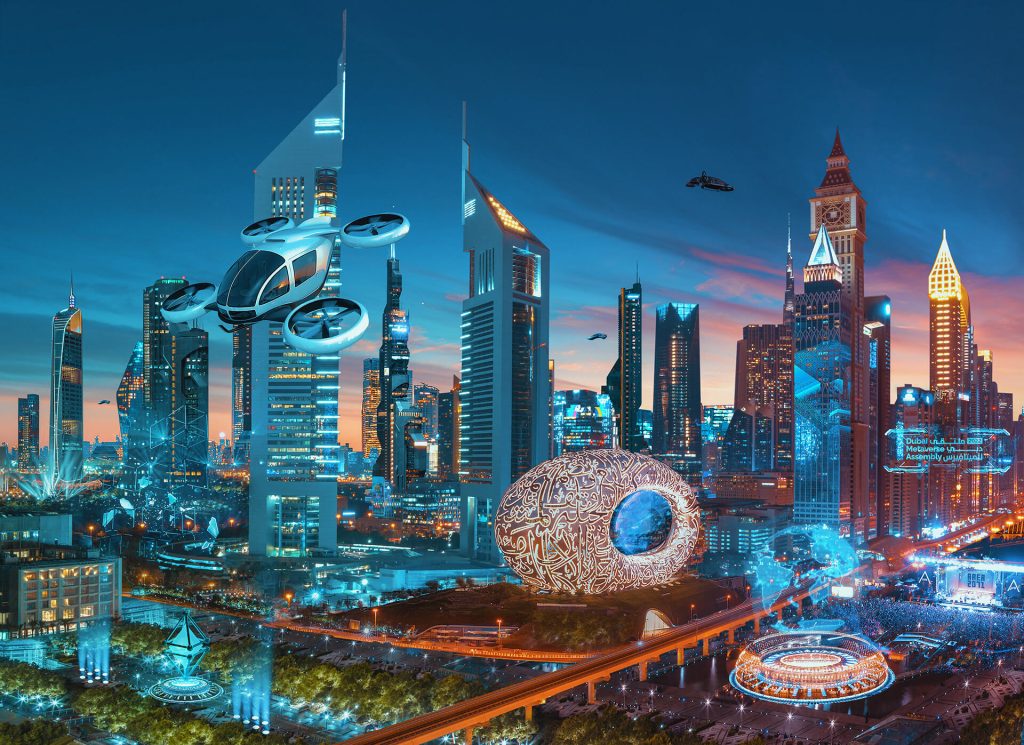
Looking ahead, the future of augmented & virtual reality development Dubai is intertwined with metaverses and 5G/6G networks. By 2030, expect widespread adoption in smart cities, with AR for urban planning and VR for remote work.

Trends include AI-enhanced personalization and mixed reality (MR) blending AR/VR. In UAE, government initiatives like Dubai’s Metaverse Strategy will drive investments, creating opportunities for custom solutions in finance (virtual banking) and entertainment. Expert predictions for 2026 highlight tech advances in immersive experiences, with market growth in areas like VR entertainment and AR for events. We’re also seeing innovations like VR concerts on Web3 platforms, bringing global artists to UAE audiences virtually.
Conferences such as GITEX Global in 2026 will spotlight quantum computing and spatial tech, further boosting the ecosystem. Challenges like hardware costs will diminish with advancements, making AR/VR accessible for SMEs. Recent X discussions highlight UAE’s push for AI-integrated VR in education and tourism, with events like GESS Dubai showcasing new hardware like zSpace’s Inspire 2 AR/VR laptop.
FAQs
What is the cost of custom AR/VR app development services in Dubai?
Costs vary based on complexity, ranging from AED 50,000 for basic apps to over AED 500,000 for enterprise solutions. Factors include features, platforms, and team expertise.
How long does it take to develop a custom AR/VR app in UAE?
Typically 3-6 months for MVPs, extending to 12 months for full-scale apps. Agile development in Dubai firms speeds this up.
Are AR/VR apps secure for businesses in UAE?
Yes, with encryption and compliance to TDRA standards. Reputable companies prioritize data protection.
Which industries benefit most from AR & VR solutions in Dubai?
Real estate, tourism, healthcare, retail, and education see the highest ROI.
Can startups afford custom AR/VR app development services?
Absolutely—many Dubai companies offer scalable packages starting small, with funding options from UAE accelerators.
What are the latest trends in AR/VR for UAE businesses in 2026?
Key trends include AI integration for personalized experiences, Web3 VR for tokenized assets, and mixed reality for training and events, as seen in recent partnerships and market reports.
How can AR/VR integrate with other technologies like AI in Dubai?
Custom developments often combine AR/VR with AI for smarter interactions, such as predictive maintenance in manufacturing or personalized retail experiences, enhancing ROI in UAE’s tech ecosystem.
Conclusion
As the UAE continues its digital transformation, custom AR/VR app development services stand out as a catalyst for innovation. Whether you’re enhancing customer experiences in Dubai’s bustling markets or streamlining operations in Abu Dhabi’s industries, these technologies offer unmatched value. Backed by explosive market growth and supported by a robust ecosystem of developers, AR and VR are not just tools—they’re essential for competitive advantage.
By partnering with a skilled custom AR/VR app development company in Dubai, businesses can stay ahead in a competitive landscape. If you’re ready to explore AR & VR solutions in Dubai, start by assessing your needs—the potential for growth is limitless.
Collaborating with an experienced custom AR/VR app development firm in Dubai enables companies to remain competitive. If you’re prepared to delve into AR and VR solutions in Dubai, begin by evaluating your requirements—the opportunities for expansion are boundless.