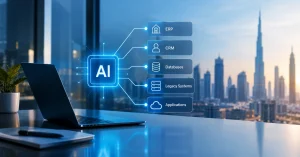


Imagine logging into your favorite project management tool, CRM, or email platform every morning — only to realize you’re still the one doing all the clicking, typing, and decision-making. Now picture this: you simply tell an intelligent system what you need, and it handles the entire workflow autonomously — researching, analyzing, executing tasks across tools, learning from outcomes, and even collaborating with other systems. No more switching tabs or manual updates.
This isn’t science fiction. It’s happening right now in 2026. Businesses worldwide are rapidly shifting from traditional software applications to autonomous AI agents. This transition isn’t just an upgrade — it’s a fundamental rewrite of how work gets done. Analysts project this AI-driven transformation could unlock trillions in economic value, with Gartner forecasting that AI agents will command over $15 trillion in B2B purchases by 2028 alone.
Companies are adopting AI agents faster than any previous technology because they don’t just assist — they replace repetitive, rule-based software with intelligent, goal-oriented systems. The result? Dramatic gains in productivity, lower costs, and entirely new business models. Welcome to the next $1 trillion tech shift: the era of AI replacing traditional software.
What Are AI Agents?
AI agents represent the evolution of artificial intelligence from passive tools (like chatbots or simple automations) to proactive digital workers that can plan, reason, act, and improve over time.
Definition of AI Agents
An AI agent is an autonomous software entity powered by large language models (LLMs) that perceives its environment, makes decisions, uses tools to take actions, and pursues specific goals without constant human input. Unlike traditional apps that wait for your commands, AI agents break down complex objectives into steps, execute them across multiple systems, and adapt based on results.
Think of them as “digital employees” you can hire on demand. You give them a goal — “handle all inbound customer inquiries today” — and they get it done end-to-end.
Key Components of an AI Agent
Modern AI agents are built from several interconnected parts that work together like a human brain and body:
- Large Language Models (LLMs): The reasoning core (e.g., GPT-4o, Claude 3.5, or newer 2026 models) that understands natural language, plans steps, and generates responses.
- Memory Systems: Short-term (conversation history) and long-term (vector databases storing past experiences, company data, and learned patterns) so the agent remembers what worked before.
- Tool Integrations: Connections to external APIs, software tools, databases, and browsers — allowing the agent to send emails, update CRMs, run code, or search the web.
- Decision Engines: Reasoning loops (often using chain-of-thought or ReAct frameworks) that evaluate options, handle uncertainty, and choose the best next action.
- Automation Workflows: Orchestration layers that manage multi-step processes, error recovery, and even collaboration with other agents.
These components make agents far more capable than yesterday’s scripts or bots.
Difference Between AI Agents and Traditional Software
Here’s a clear side-by-side comparison:
| Aspect | Traditional Software (SaaS/Apps) | AI Agents |
|---|---|---|
| Interaction Style | Manual: User clicks, fills forms, switches apps | Conversational & autonomous: Tell it the goal |
| Decision Making | Rule-based, predefined workflows | Dynamic reasoning and adaptation |
| Task Execution | Requires human oversight at every step | End-to-end automation with minimal supervision |
| Learning Capability | Static until manually updated | Improves through memory and feedback |
| Scalability | Limited by user licenses and manual effort | Scales infinitely with compute |
| Cost Model | Per-user/month subscriptions | Often pay-per-task or outcome-based |
| Example | Logging into Slack to send messages | Agent monitors inbox, drafts replies, posts updates automatically |
Traditional software is like a hammer powerful but requires you to swing it. AI agents are like a robot carpenter that plans the whole project.
Why Traditional Software Is Being Replaced
Traditional software has served us well for decades, but its limitations are becoming painfully obvious in a fast-moving world.
Limitations of Traditional SaaS Applications
Most SaaS tools are rigid, fragmented, and human-dependent:
- You need dozens of separate apps (CRM + email + analytics + project management) and spend hours copying data between them.
- Updates require developer work and downtime.
- They can’t handle exceptions or novel situations without human intervention.
- Scaling means hiring more people or buying more licenses.
In 2026, enterprises report that employees still waste 30-40% of their time on repetitive tasks across these tools.
You Should Also Read
Rise of Autonomous AI Systems
AI agents flip the script. They connect everything, reason through ambiguity, and act independently. One agent can replace multiple tools and the people operating them.
The Shift From Apps to Intelligent Agents
Instead of subscribing to five different apps, businesses are increasingly “hiring” AI agents. A single agent might manage your entire sales pipeline — qualifying leads, booking meetings, updating CRM, and forecasting revenue — all while learning your unique process. This shift from apps to agents is why we’re seeing early signs of a “SaaS-pocalypse,” with some legacy software stocks revaluing as agents threaten core workflows.
How AI Agents Actually Work
Understanding the mechanics demystifies why agents feel almost magical.
AI Agent Architecture
A typical agent follows a layered loop:
- User Request — You give a high-level goal in plain English.
- AI Reasoning — The LLM breaks it into steps, considers options, and plans (using techniques like chain-of-thought).
- Tool Execution — The agent calls tools (API calls, code execution, web browsing) to gather data or take action.
- Memory Learning — Results are stored in memory; the agent reflects on outcomes and adjusts future behavior.
- Iteration — If the goal isn’t met, it replans and continues until complete or human approval is needed.
This “perceive-plan-act-learn” cycle runs continuously.
Example Workflow of an AI Agent
Let’s take a customer support agent resolving tickets:
- User emails: “My order is late.”
- Agent reads the email (tool), checks order status in Shopify API, reviews shipping data in logistics tool.
- It reasons: “Delay due to warehouse backlog — offer refund or expedited shipping.”
- Sends personalized reply, updates Zendesk ticket, notifies warehouse team via Slack, logs everything in CRM.
- Learns: “Customer preferred refund option last time — prioritize next time.”
The entire process takes minutes instead of hours, with zero human touch for routine cases.
Real-World Use Cases of AI Agents
AI agents are already delivering measurable ROI across departments.
AI Agents in Customer Support
Companies like Klarna and major telecoms use agents to handle 70-80% of inquiries autonomously — reducing resolution time from minutes to seconds and cutting support costs dramatically while maintaining satisfaction scores.
AI Agents in Software Development
Autonomous coding agents (inspired by tools like Devin from Cognition AI) can debug code, write features, run tests, and even deploy updates. Development teams report 3-5x faster iteration cycles.
AI Agents in Marketing Automation
Agents research audiences, generate personalized campaigns, A/B test creatives across channels, schedule posts, and analyze performance — all while adapting in real time. One B2B company saw 18% higher conversion rates after switching from traditional tools.
AI Agents in Finance and Operations
In finance, agents monitor transactions for fraud, generate reports, reconcile accounts, and even execute small trades. Operations teams use them for supply chain optimization, invoice processing, and predictive maintenance — slashing manual work by 60%+ in some cases.
Industries That Will Be Disrupted First
Certain sectors are adopting AI agents fastest because their workflows are repetitive yet complex:
- Software Development: Coding, testing, and deployment are being automated.
- Customer Service: 24/7 support at scale without call centers.
- Data Analytics: Real-time insights instead of static dashboards.
- Enterprise Operations: HR onboarding, procurement, compliance, and finance workflows.
- Marketing & Sales: Lead qualification, personalized outreach, campaign management.
- Healthcare (non-diagnostic): Scheduling, patient follow-ups, records management.
These industries share one trait: high volumes of structured yet variable tasks — perfect for agents.
AI Agents vs SaaS: The Future of Software
We’re moving from Software-as-a-Service to Agents-as-a-Service (or outcome-based automation).
| Feature | Traditional SaaS | AI Agents (Agents-as-a-Service) |
|---|---|---|
| Delivery Model | Subscription per user/seat | Pay-per-task, per-outcome, or flat autonomy |
| User Role | Active operator | Goal-setter and overseer |
| Integration Effort | Manual API connections | Self-orchestrating across tools |
| Adaptability | Requires updates from vendor | Learns and evolves in real time |
| Primary Value | Features and dashboards | Results and efficiency |
| Future Outlook | Becoming “agent wrappers” | Becoming the new operating system |
SaaS won’t disappear overnight — many platforms are embedding agents (e.g., ServiceNow’s moves). But the center of gravity is shifting toward intelligent, autonomous layers.
The $1 Trillion AI Agent Economy
The numbers are staggering. While the direct AI agent software market is projected to reach $52.62 billion by 2030 (CAGR 46.3%), the broader economic impact is where the real $1 trillion+ shift lies.
Gartner predicts AI agents will intermediate $15 trillion in B2B spending by 2028. Broader AI (heavily agent-driven) could add trillions to global GDP, with IDC estimating $22.3 trillion cumulative impact by 2030. Venture capital is pouring in — over $76 billion in U.S. AI mega-rounds in 2025 alone, with agent-focused startups like Sierra, Harvey, and Cognition AI attracting billion-dollar valuations.
This creates an “automation economy” where companies replace human hours and software licenses with AI labor, unlocking new revenue streams and efficiency gains at scale.
Technologies Powering AI Agents
Several exciting breakthroughs have turned AI agents from experimental ideas into practical, reliable tools that businesses can use every day in 2026.
Large Language Models (The Brain)
These are the “thinking engine” inside every AI agent. Modern large language models (like GPT-4o, Claude 3.5, and newer 2026 versions) have become much smarter. They can understand long conversations, process images and documents, and plan complex tasks with far fewer mistakes than before. Think of them as the agent’s intelligent mind that figures out what to do next.
AI Agent Frameworks (The Building Tools)
You don’t need to be a coding expert to create powerful agents anymore. Ready-made frameworks make it easy and fast. The most popular ones include:
- LangGraph (from LangChain): Perfect for building agents that remember previous steps and handle complicated, multi-step workflows.
- CrewAI: Lets you create teams of agents, each with its own role — just like assigning tasks to different people in a real team.
- AutoGen (by Microsoft): Makes it simple for multiple agents to work together and collaborate.
- Newer options like OpenAI Agents SDK and other production-ready tools.
These frameworks let regular businesses build custom agents quickly without starting from zero.
AI Memory Systems (The Agent’s Long-Term Memory)
Agents need to remember things — just like humans do. Special databases (called vector databases) and hybrid memory systems store your company’s documents, past conversations, customer preferences, and lessons learned. This helps the agent get better over time and give personalized, accurate responses instead of forgetting everything after each task.
Tool Integrations and APIs (The Agent’s Hands)
AI agents can’t just think — they need to take action. They connect smoothly to hundreds of real-world tools (your email, CRM, Shopify, Slack, Google Sheets, etc.) using standard connections called APIs. This gives them the “hands” to send emails, update records, browse the web, or run calculations automatically.
Together, these technologies make AI agents feel like real digital employees that are smart, reliable, and easy to use.
Challenges and Risks of AI Agents
No new technology is perfect, and AI agents are no exception. Being aware of the challenges helps businesses use them safely and successfully.
Here are the main concerns and how smart companies are solving them:
- Hallucinations Sometimes agents can confidently give wrong answers or make up facts. Solution: Companies add “grounding” tools that force the agent to check real data before replying.
- Data Privacy Agents often handle sensitive customer or company information. Solution: Strong encryption, private servers, and strict access controls keep everything secure.
- Governance and Oversight When an agent makes a decision, who is responsible? Solution: Clear rules and approval workflows are set up so humans stay in control of important choices.
- Security Risks Bad actors could try to trick the agent with harmful instructions. Solution: Advanced security testing and “guardrails” protect against attacks.
- Human Oversight Needs Agents are great at routine tasks but can still struggle with unusual or high-stakes situations. Solution: Most successful companies use a “human-in-the-loop” approach — the agent works alone on simple tasks but asks for human approval on big decisions.
By using proper guardrails, monitoring systems, and step-by-step rollout, businesses are already using AI agents safely and seeing excellent results.
How Businesses Can Start Using AI Agents
You don’t need a huge budget, a big IT team, or a complete system overhaul to begin using AI agents. Most companies start small and see results surprisingly fast.
Here’s a simple, step-by-step guide that works for any business:
- Identify Repetitive Workflows Look at the daily tasks that waste the most time things like answering the same customer questions, entering data, creating reports, or following up on leads. Pick 1–2 processes that are repetitive but important.
- Choose Easy AI Frameworks Start with beginner-friendly tools like LangGraph or CrewAI. These let you build a working prototype in just a few days without needing to code everything from scratch.
- Connect to Your Existing Tools Link the agent to the software you already use your CRM (like Salesforce), email, Shopify, Slack, or databases. This is done through simple API connections, so the agent can read and update information automatically.
- Train the Agent with Your Company Data Feed it your internal documents, past emails, customer history, and process guides. This helps the agent understand your unique way of doing business and speak in your brand voice.
- Start Small and Deploy in Stages Begin with low-risk tasks (for example, just replying to simple support emails). Add a human approval step at first. Once it performs well, gradually give it more responsibility and more autonomy.
- Monitor Results and Keep Improving Track how well the agent is doing using simple metrics (time saved, error rate, customer satisfaction). Make small adjustments as needed so it gets smarter every week.
Many businesses see clear return on investment (ROI) within just a few weeks of their first pilot project often saving dozens of hours and reducing costs dramatically.
Future of AI Agents and Autonomous Companies
Looking ahead, we’ll see agent-to-agent collaboration swarms of specialized agents handling entire departments. Imagine a “digital workforce” where one agent manages sales, another finance, and they negotiate with each other autonomously.
Some visionary companies are already building toward fully automated operations. In the long term, we could see “autonomous organizations” where AI handles 80-90% of operations, with humans focusing on strategy and creativity. The line between software and employee will blur completely.
How AI Development Companies Help Build AI Agents
Building powerful AI agents sounds exciting — but doing it right can be complex. Most businesses don’t have the in-house expertise, time, or technical infrastructure to create secure, reliable, and scalable agents from scratch.
That’s exactly where specialized AI development companies come in. These expert teams act as your acceleration partner, turning your ideas into production-ready AI agents in weeks instead of months.
They provide complete end-to-end support, including:
- Custom AI Agent Development They build agents specifically designed for your industry and unique business processes — whether it’s a sales agent that qualifies leads your way or a support agent that speaks with your brand voice.
- Enterprise AI Solutions They seamlessly connect new AI agents with your existing legacy systems (like old CRMs, ERPs, or internal databases) so everything works together without disruption.
- Workflow Automation Platforms Instead of using 5–10 different SaaS tools, they create smart platforms where a single AI agent (or team of agents) handles entire workflows — from lead generation to invoicing — automatically.
- Seamless AI Integration & Ongoing Optimization They connect your agents to all your business tools (email, Slack, Shopify, Salesforce, etc.) and continuously monitor performance, fix issues, and improve results over time.
Partnering with an experienced AI development company dramatically speeds up adoption, reduces risk, strengthens security, and ensures your agents are reliable from day one. Most importantly, you get professional-grade agents without needing to hire a large team of AI engineers or learn complex frameworks yourself.
In short: you focus on your business goals they handle the heavy technical lifting.
Conclusion
The replacement of traditional software by AI agents isn’t a distant future — it’s the present reality reshaping business in 2026. From reducing costs and boosting productivity to unlocking entirely new capabilities, autonomous AI agents represent the most significant technology shift since the cloud.
As Gartner’s projections and real-world deployments show, the companies that embrace this change early will dominate their industries. The next $1 trillion tech shift is here — and it’s powered by intelligent agents that don’t just help you work smarter… they work for you.
The question isn’t whether AI agents will replace traditional software. It’s whether your business will lead the transformation or scramble to catch up.
FAQs
What are AI agents?
AI agents are autonomous systems powered by large language models that can plan, reason, use tools, and complete complex goals with minimal human input — essentially digital workers that replace manual software tasks.
How are AI agents different from traditional software?
Traditional software requires constant human direction and follows fixed rules. AI agents reason dynamically, learn from experience, act across multiple tools autonomously, and adapt to new situations.
Can AI agents replace SaaS tools?
Yes, in many cases. Agents are already replacing or augmenting entire workflows in CRM, project management, support, and marketing by handling end-to-end processes instead of requiring users to navigate multiple apps.
What industries will benefit from AI agents?
Customer service, software development, marketing, finance, operations, healthcare, and data analytics are seeing the fastest adoption and biggest gains in efficiency and cost savings.
Are AI agents safe for businesses?
With proper guardrails, memory controls, human oversight for critical decisions, and enterprise security measures, AI agents are safe and increasingly reliable. Most production systems include monitoring and approval layers to mitigate risks.