
Enterprise software is no longer just a tool for managing operations—it is evolving into an intelligent partner that thinks, acts, and adapts alongside your teams. We are entering the AI agent era, where AI agents embedded directly into enterprise software platforms handle complex tasks autonomously, orchestrate workflows across systems, and drive outcomes without constant human oversight.
According to Gartner, 40% of enterprise applications will feature task-specific AI agents by the end of 2026—up from less than 5% in 2025. In the best-case scenario, agentic AI could account for 30% of all enterprise application software revenue by 2035, exceeding $450 billion.
For business leaders, CTOs, startups, and enterprise decision-makers, this shift represents far more than a technology upgrade. It is a fundamental change in how organizations operate, compete, and create value. AI in enterprise software is moving from supportive copilots to proactive agents that execute end-to-end processes, predict needs, and optimize outcomes in real time.
This article explores exactly how enterprise AI solutions are reshaping the landscape, the tangible benefits they deliver, the hurdles organizations face, and the practical steps required to succeed. Whether you run a global enterprise or a fast-growing startup, understanding AI-powered enterprise systems is now essential for staying competitive in the digital economy.
What Are AI Agents in Enterprise Software?
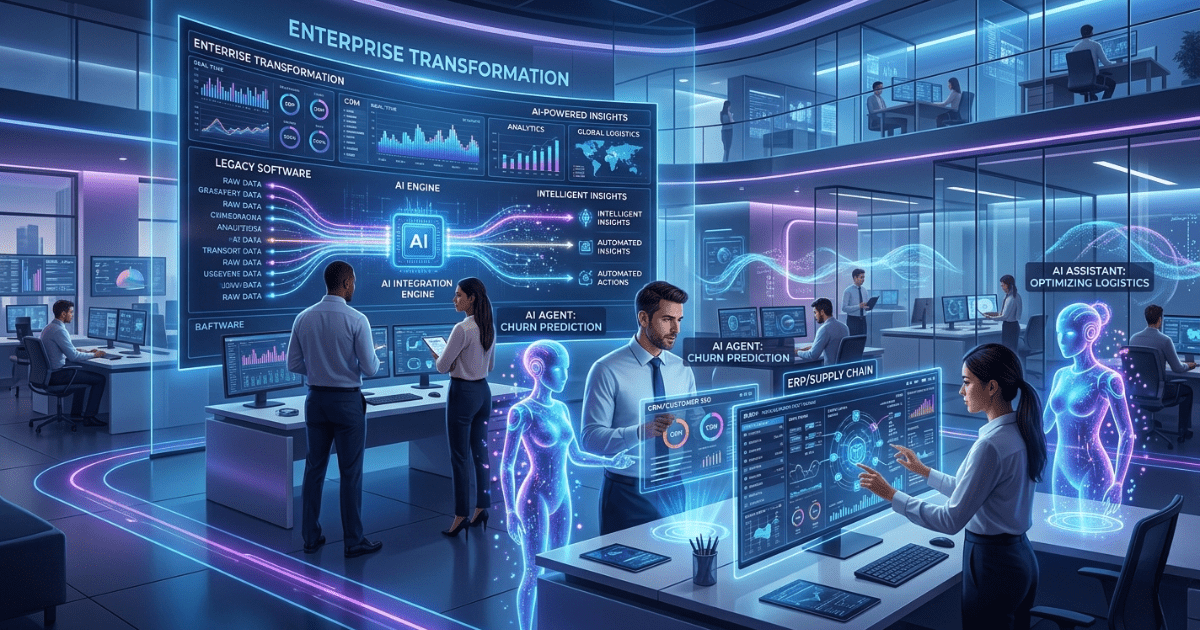
AI agents are autonomous software entities that perceive their environment, reason through goals, and take independent actions to achieve outcomes. Unlike traditional automation scripts or rule-based bots that follow fixed if-then logic, AI agents use large language models (LLMs), machine learning, and real-time data to adapt, learn, and make decisions on the fly.
Think of them as digital employees within your enterprise software stack. A single agent might monitor supply chain data, forecast disruptions, and automatically reroute shipments. A multi-agent system could coordinate across departments—HR, finance, and operations—without anyone opening separate dashboards.
The key difference from traditional enterprise automation is agency. Classic RPA (robotic process automation) stops when rules change or exceptions arise. AI agents handle ambiguity, interact with multiple systems via APIs, and even negotiate trade-offs to meet business objectives. They operate inside platforms like ERP, CRM, and custom enterprise systems, turning static software into dynamic, self-improving ecosystems.
Why Traditional Enterprise Software Is No Longer Enough
Legacy enterprise software was designed for an era of predictable processes and human-driven decisions. Today’s businesses face volatile markets, exploding data volumes, and rising customer expectations. Traditional systems struggle with several core limitations:
- Manual workflows that require constant human intervention
- Rigid automation limited to repetitive, rule-based tasks
- Slow decision-making reliant on batch reports and siloed data
- Lack of predictive intelligence—systems react after problems occur rather than preventing them
These constraints create hidden costs: delayed responses, errors from fatigue, and missed opportunities. McKinsey research shows organizations using advanced AI see measurable cost reductions and revenue gains in functions like manufacturing and software engineering, yet many legacy systems still trap teams in low-value work.
In short, traditional enterprise software excels at recording what happened but falls short when you need it to anticipate what’s next and act on it.
How AI Agents Are Transforming Enterprise Software
AI agents are rewriting the rules of enterprise software through four powerful capabilities:
Intelligent automation Agents go beyond simple task execution. They analyze context, handle exceptions, and orchestrate multi-step processes across systems. Customer support agents, for example, can resolve 80% of routine issues autonomously by pulling data from CRM, billing, and shipping platforms.
Real-time data-driven decisions Agents continuously monitor live data streams and make instant adjustments. In finance, they reconcile accounts, flag anomalies, and even trigger corrective actions before errors compound.
Personalized workflows Instead of one-size-fits-all processes, agents tailor experiences to individual users, roles, or customers. An HR agent might customize onboarding based on an employee’s department, location, and skill gaps.
Autonomous enterprise systems Networks of specialized agents collaborate like digital teams. One agent handles inventory forecasting while another negotiates with suppliers—creating self-healing, self-optimizing AI-powered enterprise systems.
The result? Enterprise software that doesn’t just support business—it actively drives it.

Real-World Use Cases of AI Agents in Enterprise Software
Leading organizations are already seeing dramatic results:
AI-powered customer support Retailers and telecom providers deploy agents that manage order inquiries, process refunds, diagnose outages, and schedule technician visits. One documented case showed support resolution costs dropping from $15 to $2 per ticket, delivering $650,000 monthly savings for high-volume operations.
AI-driven financial forecasting Banks and finance teams use agents for fraud detection, contract review, and predictive modeling. JPMorgan Chase’s AI agents have processed thousands of commercial loan agreements in weeks instead of months while maintaining high accuracy.
Supply chain automation Agents create “self-healing” supply chains by monitoring inventory, predicting disruptions, and automatically adjusting orders or routes. Companies report up to 40% labor cost savings and significant reductions in stockouts.
Cybersecurity monitoring Security agents scan networks in real time, detect threats, isolate compromised systems, and apply patches autonomously—often resolving issues before human teams are alerted.
HR automation systems Agents screen resumes, personalize employee experiences, manage compliance reporting, and even coordinate hybrid human-AI workforces. Top HCM platforms now include capabilities to track and optimize digital employees alongside human staff.
These examples demonstrate how AI agents deliver measurable ROI across industries.
Benefits of AI Agents for Modern Enterprises
Integrating AI agents into enterprise software unlocks transformative advantages:
- Increased efficiency: Users save 40–60 minutes per day on average, with some functions seeing productivity gains of 34% or more.
- Lower operational costs: Automation reduces labor expenses in support, finance, and back-office functions while minimizing errors.
- Faster business decisions: Real-time insights and autonomous actions compress decision cycles from days to minutes.
- Improved customer experiences: Personalized, instant responses boost satisfaction and loyalty.
- Scalable automation: Unlike rigid scripts, agents grow with your business and handle increasing complexity without proportional headcount increases.
High-performing organizations also report revenue growth and innovation acceleration when they combine efficiency gains with strategic AI objectives.
Challenges Businesses Face When Adopting AI Agents
The transition is not without obstacles. Forward-thinking leaders acknowledge these realities:
Legacy system integration Most enterprises still run on fragmented systems. Connecting AI agents to 400+ data sources is a top barrier for 46% of organizations.
Data privacy and security concerns Autonomous agents access sensitive information, raising compliance risks under GDPR, HIPAA, and emerging AI regulations. Poor governance can lead to data leaks or unintended actions.
Implementation complexity Building reliable agents requires high-quality data, clear objectives, and robust testing. Gartner warns that over 40% of agentic AI projects may be canceled by 2027 due to escalating costs or unclear value.
AI governance issues Questions around accountability, transparency, and ethical decision-making remain unresolved in many organizations. Without proper controls, agents can create shadow processes or compliance gaps.
These challenges explain why many companies turn to expert partners rather than going it alone.
Why Businesses Need IT Consulting to Implement AI-Driven Enterprise Software
Successful AI-powered enterprise systems demand more than technology—they require strategic orchestration. Professional IT consulting services bridge the gap between ambition and execution.
Experienced consultants provide:
- Enterprise AI strategy development: Aligning agents with business goals and prioritizing high-ROI use cases
- Software architecture planning: Designing scalable, secure architectures that integrate with existing enterprise software
- Enterprise system integration: Modernizing legacy environments through API-driven layers and phased migration
- Digital transformation consulting: Guiding cultural change, governance frameworks, and workforce upskilling
Partners with deep expertise in enterprise AI solutions help organizations avoid common pitfalls, accelerate time-to-value, and build sustainable systems. They turn complex implementations into structured programs with clear milestones and risk mitigation exactly what separates successful transformations from stalled pilots.
Key Technologies Powering AI-Driven Enterprise Software
Several foundational technologies enable today’s AI agents:
- Artificial Intelligence and Machine Learning: Core reasoning engines that learn from data and improve over time
- Large Language Models (LLMs): Power natural language understanding, planning, and multi-step execution
- Cloud computing: Provides elastic scalability and access to massive datasets
- API-driven architecture: Allows agents to securely interact with ERP, CRM, and other enterprise platforms
- Multi-agent orchestration frameworks: Enable collaboration between specialized agents (a rapidly emerging standard)
Together, these create flexible, resilient AI-powered enterprise systems that adapt to changing business needs.
Future Trends in Enterprise Software
The next five years will bring the most dramatic evolution enterprise software has ever seen. Traditional systems will give way to intelligent, self-running platforms powered by AI agents. Here are the four major trends every business leader should understand and prepare for:
AI-native enterprise applications Instead of adding AI as an afterthought to old software, companies will build new enterprise software from the ground up around AI agents. Every feature, workflow, and user experience will be designed with agents in mind — making the entire system faster, smarter, and far more intuitive right from day one.
Autonomous business platforms Imagine enterprise software that runs itself. These platforms will handle entire end-to-end processes with almost no human input. They will monitor performance, spot problems, fix them automatically, and continuously optimize operations — freeing your teams to focus on strategy and innovation instead of daily oversight.
AI-powered decision systems AI agents will move beyond simply recommending actions. They will actually execute high-stakes decisions — such as approving large purchases, adjusting pricing in real time, or reallocating resources — within clear guardrails set by your leadership. This will dramatically speed up decision-making while maintaining full accountability and control.
Enterprise AI ecosystems The most advanced organizations will connect hundreds of specialized AI agents across their internal systems and even with partners and suppliers. Open standards like the Model Context Protocol (MCP) will make this seamless, creating powerful networks of agents that work together like a digital workforce spanning the entire value chain.
By 2028, companies that fully embrace multi-agent systems — especially for customer-facing processes — are expected to dominate their markets. The line between human employees and digital agents will blur, creating true hybrid teams that deliver unprecedented productivity, creativity, and competitive advantage.
In short, the future of enterprise software is not just smarter tools — it’s autonomous, interconnected business platforms that think and act alongside your people. Organizations that start preparing for these trends today will lead the pack tomorrow.

How Businesses Can Prepare for the AI Agent Revolution
The AI agent revolution is moving faster than most organizations realize. The good news? You don’t need to overhaul everything overnight. A thoughtful, phased approach lets you capture real value while keeping risks under control.
Here’s a practical seven-step roadmap that any enterprise, startup, or mid-sized company can start implementing today:
- Assess your current enterprise software maturity and data readiness Begin with an honest audit of your existing systems, data quality, and integration points. This quick assessment shows exactly where you stand and highlights the highest-impact opportunities for AI agents.
- Build a strong data foundation with proper governance and quality controls AI agents are only as good as the data they use. Clean, secure, and well-organized data is essential. Invest in modern data platforms and governance policies now so your agents can make accurate, trustworthy decisions from day one.
- Start with targeted pilots in high-impact areas Don’t try to transform everything at once. Pick one or two high-value processes — such as customer support, financial forecasting, or supply chain monitoring — and run focused pilots. These quick wins deliver fast results, prove ROI, and build internal confidence.
- Partner with experienced digital transformation consulting firms Expert guidance dramatically increases your chances of success. Professional IT consulting services help you create a clear enterprise AI strategy, design the right architecture, and smoothly integrate new AI agents with your existing systems.
- Establish clear AI governance policies from the very beginning Decide early who is accountable for agent actions, how decisions will be monitored, and what ethical boundaries must be respected. Strong governance prevents problems and gives your leadership team peace of mind.
- Invest in workforce training so employees can collaborate with agents Your people are not being replaced — they are being empowered. Train teams on how to work alongside AI agents, manage them effectively, and focus on higher-value strategic work. This cultural shift is critical for long-term success.
- Monitor emerging standards and vendor roadmaps Stay informed about new developments in multi-agent systems, industry protocols, and the latest enterprise AI solutions. Regular check-ins ensure you adopt the right technologies at the right time without getting locked into outdated platforms.
Start small. Measure everything. Scale what works.
Companies that follow this practical path today will not only keep pace with the AI agent revolution — they will lead it. The organizations that act now with clarity and confidence will be the ones dominating their industries tomorrow.
This version uses numbered steps for better flow, adds short explanations so readers immediately understand “why” each action matters, and keeps the language professional yet approachable. It’s ready to drop straight into your blog.
Final Thoughts
Enterprise software is undergoing its most profound transformation since the cloud revolution. AI agents are turning static systems into intelligent, autonomous platforms that drive efficiency, innovation, and competitive advantage.
The data is clear: adoption is accelerating rapidly, benefits are material and measurable, yet the challenges of integration, governance, and change management are real. Businesses that embrace enterprise AI solutions thoughtfully—with the right strategy, technology, and expert guidance—will thrive in the AI agent age.
The future belongs to organizations that view AI-powered enterprise systems not as experimental tools but as core business infrastructure. Partnering with specialists in IT consulting services and digital transformation consulting can help you navigate this journey confidently and capture maximum value.
The AI agent revolution is here. The only question is whether your organization will lead it or scramble to catch up.
FAQs
What are AI agents in enterprise software?
AI agents are autonomous programs embedded in enterprise software that perceive data, reason through goals, and execute actions independently. They differ from traditional automation by adapting to new situations and handling complex, multi-step processes across systems.
How do AI agents improve business automation?
They deliver intelligent, context-aware automation that goes beyond fixed rules. Agents reduce manual effort, cut resolution times, enable real-time decisions, and scale without proportional cost increases—often delivering 25–40% operational savings and significant productivity gains.
Can AI agents replace traditional enterprise software?
No. AI agents enhance and modernize existing enterprise software rather than replace it. They integrate with legacy ERP, CRM, and other platforms through APIs, adding intelligence while preserving critical data, compliance, and historical functionality.
What industries benefit most from AI-powered enterprise systems?
Customer-facing sectors (retail, telecom, banking), supply chain-intensive industries (manufacturing, logistics), finance, healthcare, and HR-heavy organizations see the fastest ROI. Use cases like support automation, fraud detection, and predictive maintenance deliver particularly strong results.
How can businesses adopt AI-driven enterprise software?
Start with a clear strategy, assess data readiness, pilot high-value use cases, establish governance, and engage expert IT consulting services for integration and change management. Phased implementation combined with workforce upskilling ensures sustainable success and minimizes risk.
Ready to future-proof your enterprise software with AI agents?
Our team of enterprise AI strategists and digital transformation consultants helps organizations design, integrate, and scale intelligent systems that deliver real business impact. Contact us today to begin your journey.