


In the heart of the UAE’s thriving digital economy, where Dubai’s skyscrapers symbolize innovation and Abu Dhabi’s oil giants pivot to smart cities, IT disruptions aren’t just inconveniences—they’re existential threats. Consider this: In 2024, the UAE faced a 32% spike in ransomware attacks, positioning it as the second most targeted nation in the MENA region, accounting for 12% of all regional cyberattacks. The financial toll is staggering: An average data breach in the Middle East costs $8.75 million, with UAE-specific incidents hitting $188 per compromised record, encompassing recovery, lost revenue, and regulatory fines. Meanwhile, IT downtime can drain up to $500,000 per hour for industrial sectors, and 90% of UAE businesses report losses exceeding $300,000 hourly from outages.
As digital transformation accelerates under UAE Vision 2031, with sectors like banking, healthcare, and logistics adopting AI and cloud at breakneck speed, the risk exposure outpaces protections. Cyber extortion and ransomware now drive over 50% of attacks in the region, per Microsoft’s 2025 data, underscoring the urgency for CIOs and owners to fortify their defenses. This guide demystifies IT risk management, offering actionable insights tailored to UAE’s unique regulatory and economic landscape. Whether you’re safeguarding patient data in a Dubai clinic or supply chains in Jebel Ali, proactive strategies can transform vulnerabilities into competitive edges.
What Exactly Is IT Risk Management?
In today’s hyper-connected UAE business environment, IT risk management extends far beyond firewalls and antivirus software. It’s a holistic discipline that identifies, assesses, and mitigates threats to an organization’s information technology assets, ensuring alignment with business goals while navigating evolving regulations like those from the UAE’s National Electronic Security Authority (NESA).
Traditionally, cybersecurity focused on perimeter defense—think VPNs and endpoint protection. But as UAE enterprises embrace hybrid cloud models and IoT for smart infrastructure, this approach falls short. Modern IT risk management encompasses the entire lifecycle: from threat prediction using AI to resilience planning amid geopolitical tensions in the Gulf.
Why does it matter now? UAE’s GDP growth, projected at 4.2% for 2025, hinges on digital adoption, yet business expansion widens the “risk surface.” A single overlooked vulnerability—say, in a third-party logistics API—can cascade into multimillion-dirham losses. Research from IBM’s 2025 Cost of a Data Breach Report highlights that organizations with mature risk programs save up to 18% on breach costs, a lifeline in a market where lost business alone averages $3.14 million per incident. For UAE CIOs, it’s not just about survival; it’s about scaling securely in a region where cyber threats spiked 25.6% around trade deals and disruptions in early 2025.
Core Pillars of Risk Management for IT
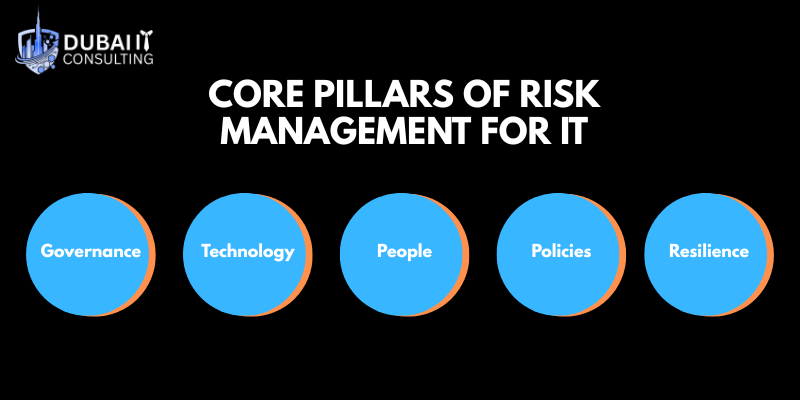
Effective IT risk management rests on five interconnected pillars, each tailored to UAE’s sector-specific demands. These aren’t abstract concepts; they’re battle-tested against real-world pressures like Dubai’s fintech boom or Abu Dhabi’s healthcare digitization.
Governance
At the helm, governance establishes oversight through board-level policies and risk committees. In UAE banking, for instance, where NESA mandates annual audits, weak governance led to a 2024 incident where a major lender faced $2 million in remediation after an insider leak—highlighting how aligned strategies prevent escalation.
Technology and Infrastructure
This pillar fortifies the backbone: Secure networks, encrypted storage, and redundant systems. Consider a Dubai real estate firm hit by a cloud outage in 2024; without multi-region backups, it lost 48 hours of transaction data, costing AED 1.5 million in deferred sales. Tools like zero-trust architectures, increasingly adopted in UAE’s free zones, reduce unauthorized access by 60%.
People and Access Control
Humans remain the weakest link—phishing accounts for 14% of Middle East breaches, costing SAR 28 million on average. In UAE logistics, train-the-trainer programs have curbed insider threats, emphasizing multi-factor authentication (MFA) and role-based access.
Policies, Compliance, and Auditing
UAE’s fragmented regs—NESA for critical infrastructure, DIFC Data Protection Law for finance—demand tailored policies. Non-compliance? Fines up to AED 10 million under Federal Decree-Law No. 34/2021. Regular audits, as in ADGM’s healthcare mandates, ensure traceability.
Resilience and Continuity
Business continuity plans (BCPs) with failover testing are vital. A 2024 GCC energy project faltered due to untested AI integrations, delaying operations by weeks and incurring $5 million in overruns—lessons now embedded in UAE resilience standards.
| Pillar | UAE Sector Example | Key Benefit |
|---|---|---|
| Governance | Banking (DIFC) | Reduces audit failures by 40% |
| Technology | Real Estate (Cloud) | Minimizes outage impacts |
| People | Logistics (Phishing) | Cuts insider incidents 50% |
| Policies | Healthcare (ADGM) | Avoids AED 1M+ fines |
| Resilience | Energy (AI Failures) | Ensures 99.9% uptime |
IT Risk Identification — Step-by-Step Breakdown
Spotting risks early is the cornerstone of IT risk identification, a keyword-driven process that scans for vulnerabilities before they exploit. In the UAE, where 73% of attacks stem from DDoS and supply chain weaknesses, proactive mapping is essential.
How IT Risks Originate
Risks emerge from code flaws, misconfigurations, or human error. A 2024 UAE telecom glitch from unpatched software exposed 10,000 users, costing $1.2 million in notifications.
Internal vs. External Risk Sources
Internal: Legacy systems or untrained staff (e.g., a Dubai SME’s email server breach). External: State-sponsored hacks or vendor lapses, with UAE seeing 21% of MENA targets in Q1 2024.
Mapping Digital Assets and Threat Exposure
Inventory assets via asset registers, then overlay threats using heat maps. UAE firms in logistics map IoT devices to counter 32% ransomware growth.
Tools and Methods for Risk Identification
Leverage SIEM (Security Information and Event Management) for real-time alerts, penetration audits for simulations, and attack surface scanners like Qualys. Costs start at AED 15,000 for comprehensive VAPT in UAE.
Common IT Risk Categories Every UAE Business Must Address
UAE businesses face a diverse threat landscape. Here’s a scannable breakdown, with loss examples grounded in regional data:
- Cybersecurity Threats: DDoS floods, up 73% in GCC; a 2024 logistics firm lost AED 800,000 in delayed shipments.
- Data Breaches & Privacy Violations: Average $8.75M cost; healthcare incidents under ADGM risk AED 500,000 fines.
- SaaS & Cloud Dependency Risks: Outages rose in 2025; UAE firms insured against $1M+ losses.
- Third-Party Vendor Risks: Supply chain attacks hit 32% of incidents; a GCC energy case delayed projects by months.
- Identity & Access Misuse: Phishing at 14%; SAR 28M average cost.
- Digital Downtime / Infrastructure Failure: $500K/hour in industry; 41% enterprises >$1M/hour.
- Application Vulnerabilities: Unpatched apps in fintech; 2024 breach cost a Dubai startup $3M.
- Insider Threats: 18% of ransomware via internals; training gaps amplify.
- AI-Driven Threats: Emerging in 2025; GCC energy AI failures led to $5M overruns.
| Category | Frequency in UAE (2024) | Potential Loss Example |
|---|---|---|
| Cybersecurity | 73% DDoS | AED 800K shipments |
| Data Breaches | 12% regional | $8.75M total |
| Cloud Risks | Rising 25% | $1M insured outage |
Cost of Not Implementing IT Risk Management (With Real-World Financial Impact)
Ignoring IT risks isn’t cheap—it’s catastrophic. System downtime alone costs UAE industrial firms $10,000–$500,000 hourly, with 44% of organizations tallying over $1 million excluding penalties. Breach recovery averages $4.44 million globally, but Middle East figures hit $8.07 million, driven by $3.14 million in lost business.
Reputation erosion? A 2024 GCC telecom outage eroded 15% customer trust, slashing retention by 20%. Legal hits under UAE laws: NESA violations up to AED 1 million, DIFC fines $10,000–$100,000, ADGM similar, and cybercrime penalties AED 250,000–1.5 million with jail time.
GCC Case Studies (Anonymized): A 2024 banking breach in the Emirates recovered $4.2 million amid regulatory scrutiny; a logistics firm’s ransomware halt cost $2.8 million in ransoms and delays, echoing regional trends where 56% of outages tie to cyber issues.
Practical IT Risk Management Frameworks — UAE-Applicable Comparison
Choosing a framework aligns global best practices with UAE compliance. Here’s a comparison:
| Framework | Best For | Industry Fit | Effort/Complexity |
|---|---|---|---|
| ISO 27001 | Security governance | All industries | Medium |
| NIST | Holistic risk & privacy | Public/enterprise | High |
| CIS | Zero-trust & access control | Multi-branch orgs | Medium |
| COBIT | Governance + business goal alignment | Large enterprises | High |
| UAE NESA | UAE compliance | BFSI, government, telecom | High |
Begin by assessing your industry requirements. For example, BFSI organizations often adopt NESA due to regulatory mandates, while large enterprises typically combine NIST and ISO to achieve both security maturity and scalability.
Next, conduct a detailed gap analysis—most cybersecurity consultants in the UAE offer this service for AED 5,000 to 10,000.
Keep in mind that NIST’s five core functions—Identify, Protect, Detect, Respond, and Recover—work well alongside ISO’s certifiable framework, whereas CIS offers actionable, quick-win controls for immediate security improvements.
4 Proven IT Risk Mitigation Strategies (With Real Examples)
Mitigation turns risks into managed variables. Here’s how:
- Risk Avoidance: Eliminate threats outright, e.g., shunning high-risk vendors. A UAE real estate firm avoided a $1M cloud breach by migrating off legacy SaaS.
- Risk Reduction: Layer controls like MFA; reduced phishing success by 70% in a Dubai bank.
- Risk Transfer / Sharing: Cyber insurance; UAE firms covered $1.33M median ransomware payouts in 2024.
- Risk Acceptance / Retention: For low-impact risks, budget reserves; common in SMEs for minor app vulns.
Business-Decision Table:
| Impact vs. Likelihood | High Impact/Low Likelihood | High Impact/High Likelihood | Low Impact/High Likelihood |
|---|---|---|---|
| Strategy | Transfer (Insure) | Reduction (Controls) | Acceptance (Monitor) |
| UAE Example | Rare DDoS: Policy coverage | Frequent phishing: Training | Minor downtime: Reserves |
Complete 7-Stage IT Risk Management Process Flow
This practical flow, in business terms, ensures execution:
- Identify Risks: Asset inventory + threat modeling (1-2 weeks, IT lead).
- Analyze and Classify Risks: Qualitative/quantitative scoring (e.g., $ impact; 2 weeks, risk team).
- Prioritize Risks: Heat map by severity (1 week, CIO oversight).
- Select Frameworks and Controls: Align to NESA/ISO (2-4 weeks, consultants).
- Implement & Automate Risk Controls: Deploy SIEM, zero-trust (1-3 months, ops team).
- Monitor and Report: Dashboards + quarterly audits (Ongoing, compliance officer).
- Continuous Optimization & Governance: Annual reviews + AI tuning (Yearly, board).
Sample Timeline & Team Matrix:
| Stage | Duration | Responsible | UAE Tool Example |
|---|---|---|---|
| 1-3 | 4-5 weeks | IT/Risk | SIEM scans |
| 4-5 | 3-7 months | Consultants/Ops | NIST implementation |
| 6-7 | Ongoing | Compliance/Board | Automated reporting |
What Does Industry-Leading IT Risk Management Look Like in 2025?
In 2025, UAE leaders integrate:
- Zero-Trust Architecture: Verify every access; cuts breaches 50%.
- AI-Assisted Threat Prediction: Forecasts attacks, vital amid 18% phishing rise.
- Identity Governance & Privileged Access Control: PIM tools for BFSI.
- Cloud Workload Protection: For Azure/AWS in Dubai hubs.
- Device & IoT Security: Securing smart city devices.
- Incident Response Automation: SOAR platforms reduce response time 40%.
- 24/7 SOC + Cyber Resilience: Outsourced for 99.99% uptime.
A GCC energy adopter of these saw 35% threat reduction post-2024 failures.
In-House vs Outsourcing: What Is More Efficient for IT Risk Management?
UAE businesses weigh options carefully:
| Parameter | In-House Team | Outsourced IT Risk Experts |
|---|---|---|
| Speed of Implementation | Slow | Fast |
| Cost | High | Predictable |
| Access to Expertise | Limited | Wide |
| Technology | Legacy | Latest |
| 24/7 Monitoring | Rare | Standard |
UAE Businesses Increasingly Prefer External IT Experts With 41% of enterprises facing $1M+ hourly costs, outsourcing delivers expertise amid talent shortages. In 2025, 60% of Dubai SMEs opt for it, gaining NESA-certified pros without AED 500K+ hiring overheads.
How to Choose the Right Partner for IT Risk Management

Select partners with ISO 27001/NIST certifications, proven UAE track records (e.g., BFSI implementations), and metrics like 99% uptime SLAs. Red flags: No local presence or vague pricing.
Most businesses prefer working with trusted consulting companies in Dubai that offer comprehensive IT Consultancy Services, ongoing monitoring, and risk governance instead of just one-time fixes. Look for 24/7 SOCs and free assessments to ensure alignment.
IT Risk Management Cost in UAE — Pricing Estimates & ROI Breakdown
Costs vary by scale:
- SMEs: AED 2,000–8,000/month (outsourced); AED 5,000–10,000 one-time assessments.
- Mid-Level: AED 15,000–50,000/month subscription; AED 50,000–150,000 for VAPT/full audits.
- Enterprise: AED 100,000+/month full outsourcing.
ROI Timeline: 6-12 months payback via 30% downtime reduction, 20% lower breach probability, and avoided AED 100K–10M penalties. A UAE bank recouped investments in 8 months post-2024 implementation.
| Model | SME Cost | ROI Example |
|---|---|---|
| One-Time | AED 5K-10K | Quick audit savings |
| Subscription | AED 2K-8K/mo | 25% threat drop |
| Outsourcing | AED 15K+/mo | Full compliance |
Final Checklist — Are You Protected Against IT Risks?
Score yourself (1 point per “Yes”; 0-20 = High Risk, 21-40 = Medium, 41-60 = Low):
- Conducted annual risk assessment?
- Implemented MFA across all accounts?
- Mapped third-party risks?
- Adopted zero-trust for cloud?
- Trained staff on phishing quarterly?
- Aligned with NESA/DIFC?
- Tested BCP in last 6 months?
- Using SIEM for monitoring?
- Audited IoT devices?
- Insured against cyber losses?
- Prioritized risks via heat map?
- Automated incident response?
- Reviewed vendor contracts for security?
- Integrated AI threat detection?
- Board-level risk oversight?
- Measured downtime costs?
- Compliant with ADGM privacy?
- Simulated breaches annually?
- Optimized legacy systems?
- Tracked ROI on controls?
Aim for 50+; revisit quarterly.
Conclusion — Strategic Advantage of Proactive IT Risk Management

Proactive IT risk management isn’t a cost—it’s UAE’s edge for resilience, scalable growth, unshakeable customer trust, and regulatory harmony. In a landscape where threats evolve daily, fortified defenses enable bolder innovation, from AI-driven logistics to secure fintech hubs.