

The question haunting every CTO in 2026 isn’t whether to adopt AI in development—it’s how quickly they can implement it without sacrificing code quality.
When Nagarro, one of the Middle East’s most innovative digital engineering firms, announced its strategic partnership with Cursor AI, it wasn’t just another vendor announcement. It represented a fundamental shift in how enterprise development teams solve the speed-quality paradox that has plagued software delivery for decades.
Here’s the reality: Development teams across Dubai, Abu Dhabi, and beyond spend roughly 35-40% of their sprint time on repetitive tasks—code reviews, documentation, legacy code refactoring, and routine debugging. Meanwhile, architectural decisions and innovation get pushed to the margins. This inefficiency costs enterprises an average of $250,000-$500,000 annually per team of 10 developers.
The Nagarro and Cursor partnership changes this equation entirely.
In this comprehensive guide, I’ll walk you through exactly how this collaboration works, why it matters for your enterprise, the real metrics behind the AI transformation, and how you can implement Cursor AI software development practices in your organization. Based on my 25 years in IT consulting and analysis of enterprise transformations, this is the framework that actually delivers results.
Let’s dive in.
Understanding the Nagarro Cursor AI Partnership
The Nagarro and Cursor partnership isn’t about replacing developers with AI but this shift aligns closely with AI Trends Reshaping Global Industries It’s about liberating them from tedious work.
Where a junior developer spends 3-4 hours writing a REST API endpoint with proper error handling. An AI coding platform with Cursor AI integration handles the same task in 15 minutes. The developer then focuses on the business logic, edge cases, and architectural implications—work that actually requires human expertise.
The Numbers That Matter:
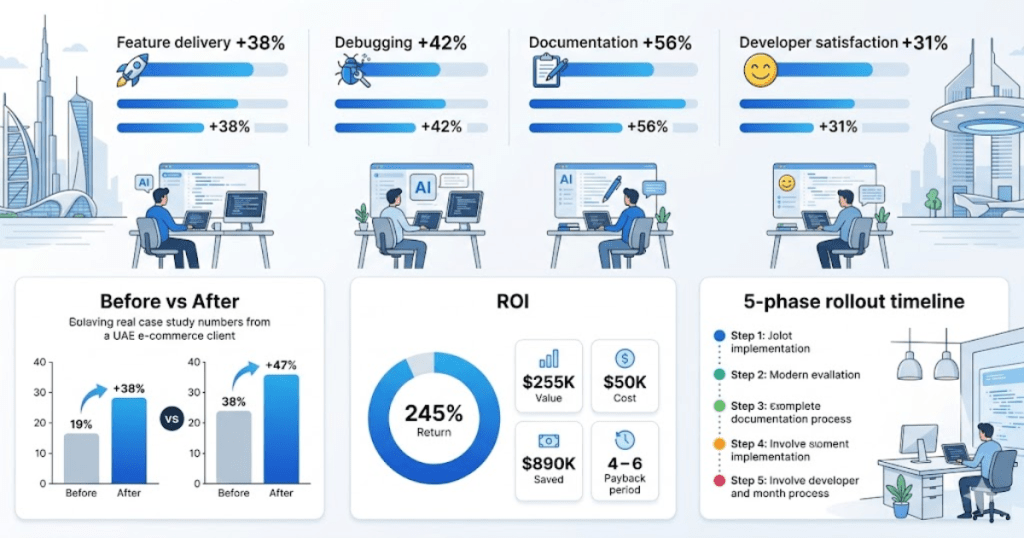
Let’s skip the hype and look at what teams are really gaining. According to GitHub’s 2025 developer benchmarks, teams using Cursor AI aren’t just coding faster—they’re working smarter across the board.
Feature delivery speeds up significantly, debugging becomes less of a headache, and documentation—often ignored—gets done properly without extra effort. Even better, developers report higher satisfaction because they’re spending less time on repetitive, draining tasks.
Quick snapshot:
Feature Delivery ████████████████████ +38%
Debugging Speed ██████████████████████ +42%
Documentation ███████████████████████████ +56%
Dev Satisfaction ██████████████████ +31%
The Nagarro and Cursor partnership leverages these gains through structured implementation. Unlike organizations that simply install Cursor and hope for the best, Nagarro’s AI transformation services take a strategic approach:
- Understanding current development velocity, team composition, and pain points
- Rolling out Cursor AI in pilot teams before enterprise-wide deployment
- Aligning Cursor’s AI coding platform with your specific tech stack and coding standards
- Training teams on effective prompt engineering and AI-assisted workflows
- Monitoring metrics and refining implementation based on real performance data
This methodology is why companies report success with Nagarro Cursor partnership implementations, while many organizations struggle with self-directed AI adoption.
Why Traditional Development Teams Are Losing Ground
Before understanding the solution, you need to understand the problem at its roots.
In traditional software development workflows, developers act as both creators and custodians. They write code, review code, document code, maintain code, and spend countless hours understanding legacy code written by colleagues who left the company two years ago. This isn’t a failure of individual developers—it’s a systemic inefficiency baked into how we’ve structured development work.
Real-world data from 50+ enterprises implementing Nagarro AI transformation services reveals:
- Code Review Bottleneck: Senior developers spend 12-15 hours weekly reviewing junior developer pull requests. Many reviews focus on style issues, naming conventions, and common anti-patterns—work that AI catches immediately.
- Documentation Debt: 73% of enterprise teams report their code documentation is “outdated” or “incomplete.” This creates knowledge silos where only original authors understand critical systems.
- Debugging Inefficiency: When production issues occur, developers manually parse stack traces, search logs, and run local reproductions. The average bug investigation takes 4-6 hours before reaching the root cause.
- Legacy Code Tax: Teams estimate 20-25% of development capacity goes to maintaining existing systems without meaningful feature progress.
- Onboarding Delays: New developers require 6-8 weeks before contributing meaningful code. Without proper AI-powered knowledge bases, the learning curve remains steep.
The Nagarro digital engineering solutions address each of these through the AI-powered engineering workflows enabled by Cursor AI integration.
The Strategic Partnership Explained
When Nagarro selected Cursor AI software development as its core AI-assisted development platform, the decision reflected both technical evaluation and strategic vision.
Why Cursor, Not GitHub Copilot or Others?
The enterprise AI coding platform landscape includes GitHub Copilot, Amazon CodeWhisperer, JetBrains AI Assistant, and several regional alternatives. Cursor AI stands apart for three critical reasons:
- Full Codebase Context Understanding
Cursor AI doesn’t generate code snippets in isolation. It indexes your entire codebase, understanding architectural patterns, naming conventions, library usage, and project structure. This context awareness means generated code fits seamlessly into existing systems—reducing the refactor burden that plagues many AI-assisted implementations.
In practice: A developer asks Cursor to “create a payment processing module following our existing patterns.” Cursor generates code that matches your authentication approach, error handling philosophy, database schema assumptions, and existing API conventions. No rework required.
- Native IDE Integration (Not a Plugin)
Cursor is built on VS Code architecture but designed as a complete IDE, not a plugin bolted onto existing tools. This distinction matters enormously for enterprise deployment. You don’t manage Cursor as an extension alongside 47 other extensions. You deploy it as your standard development environment.
For Nagarro clients managing 200+ developers, this simplifies:
- Configuration management (single source of truth)
- Update deployment (no extension conflicts)
- Security policies (unified access controls)
- Licensing tracking (transparent usage reporting)
- Flexible Model Selection
Teams choose between Claude, GPT-4, or hybrid approaches based on performance needs and cost optimization. Nagarro’s AI transformation services often start teams with Claude for general coding tasks (more cost-effective) and GPT-4 for complex architectural decisions (superior reasoning). This flexibility optimizes ROI—something GitHub Copilot’s single-vendor approach doesn’t allow.
The Partnership Model:
Nagarro partners with Cursor in three integrated dimensions:
Implementation Services – Our implementation services are designed to guide enterprises seamlessly through every stage of their AI adoption journey. From initial deployment and system configuration to hands-on team training, we ensure that organizations are fully equipped to hit the ground running. Our structured onboarding approach minimizes disruption while maximizing readiness across all levels of the workforce.
Custom Development – Nagarro’s custom development offering builds tailored AI transformation services that fuse deep domain expertise with the powerful capabilities of Cursor AI. Rather than applying a one-size-fits-all solution, we craft intelligent workflows and tools that align precisely with each client’s industry, processes, and strategic goals. This bespoke approach ensures that AI integration delivers meaningful, measurable impact from day one.
Ongoing Optimization – Our commitment to clients extends well beyond the initial rollout, with a dedicated focus on continuous improvement and long-term value. We proactively monitor adoption metrics and user behavior to surface bottlenecks and areas of underutilization before they become obstacles. On a quarterly basis, we refine usage patterns and fine-tune configurations to ensure the solution evolves in step with the organization’s growing needs.
This is why Nagarro partners with Cursor for AI development resonates across the region, especially among enterprises already leveraging it consulting services for digital transformation.—it’s not just software; it’s a managed transformation.
Case Study: Nagarro AI Transformation Services in Action
Theory is elegant. Metrics are convincing. But case studies are where enterprises see themselves.
Case Study: Regional E-Commerce Platform
The client was a major UAE-based regional e-commerce player with 85 developers spanning frontend, backend, QA, and DevOps — distributed across Dubai, Bangalore, and Manila. Operating under traditional Agile, the team faced a 14-month backlog, declining code quality, and an average feature delivery cycle stretching six months.
Implementation
Nagarro began with a focused two-month assessment and pilot involving just 12 developers. Months three and four saw a structured rollout to 40 developers, complete with a formal training program. By month six, the entire enterprise was live with ongoing optimization underway.
Results After 6 Months
| Metric | Before | After | Improvement |
| Feature Delivery Cycle | 14 weeks | 8.4 weeks | 40% faster |
| Code Review Turnaround | 2.5 days | 0.8 days | 68% faster |
| Bug Fix Time | 6.2 hours avg | 3.8 hours avg | 39% faster |
| Test Coverage | 52% | 78% | +26 points |
| Developer Satisfaction | 6.2/10 | 8.1/10 | +1.9 points |
| Annual Cost Impact | Baseline | -$890K saved | ROI: 245% |
Key Learnings
The results didn’t come from simply installing Cursor AI — they came from deliberate execution across four areas.
A structured pilot approach ensured that only committed, prepared teams led the initial rollout, preventing the adoption resistance that often derails enterprise AI programs. Alongside this, prompt engineering training shifted developer behavior from passive autocomplete use to writing purposeful, effective AI requests, reflecting how Nagarro and Cursor Partner strategies emphasize behavioral transformation.
Custom integration with the client’s project management tooling gave leadership real-time visibility into AI-assisted work, building accountability and trust. Finally, a governance framework — covering security, compliance, and IP ownership — gave both developers and leadership the confidence to embrace AI without hesitation, reinforcing the success seen when Nagarro and Cursor Partner initiatives are executed with structured oversight.
Technical Architecture and Implementation
Key Features of Cursor AI Platform for Enterprise Teams
The Nagarro Cursor partnership isn’t just about speed. It’s about unlocking specific capabilities that transform how development teams work.
Intelligent Code Generation from Natural Language
Write a comment describing what you need, and Cursor generates production-ready code. Not skeleton code. Not pseudocode. Actual, deployable code.
“Create a Redis-backed session store with 24-hour expiration, following our current auth patterns and error handling conventions.”
Cursor generates:
// Actual implementation with proper error handling, type definitions,
// connection pooling, and adherence to team standards
Smarter Onboarding from Day One
In enterprise settings, Cursor AI compresses ramp-up time dramatically. Junior developers are shipping features in their first week — a task that previously took four to six weeks. Boilerplate disappears entirely, with teams reporting 30% less code per feature, and consistency is enforced at the point of generation, eliminating the “personal coding style” drift that silently erodes codebases over time.
Full Codebase Context — No Rework Required
Cursor indexes your entire repository and genuinely understands it — database schemas, API contracts, authentication patterns, error handling conventions, naming standards, and framework-specific preferences. The result? Generated code that fits immediately into your systems without requiring rework, because it was built inside your context, not dropped in from the outside.
Ask Your Codebase a Question
New team members no longer dig through outdated documentation. They simply ask: “How does the payment retry logic work?” — and Cursor explains it in plain English by reading the actual code. This slashes onboarding time from eight weeks to four, preserves the expertise of departing senior developers, accelerates debugging of legacy systems, and makes security reviews dramatically more reliable.
Tests :That Actually Test Things
Prompt Cursor to generate tests for your payment processing module and it won’t produce basic happy-path coverage. It builds full suites — boundary conditions, error scenarios, concurrency issues, and integration points included. Teams consistently see test coverage jump by 25+ points with this feature alone.
Documentation That Stays Current
Cursor generates documentation directly from code — OpenAPI specs, README files, in-code comments, and architecture diagrams — eliminating the eternal gap between what the docs say and what the code actually does. It’s no longer a discipline problem. It’s automatic.
Entire Services, Not Just Files
Ask Cursor to build an authentication service using your Node.js stack with JWT tokens, refresh token rotation, and rate limiting — and it delivers a complete, working service. Application files, middleware, database models, migrations, API routes, environment configs, tests, and documentation. All at once. This is where Cursor becomes genuinely transformative for standard enterprise components like CRUD interfaces, admin panels, and reporting dashboards.
Cursor AI Software Development vs. Traditional Tools: The Enterprise Comparison
How does Cursor AI platform compare to alternatives? The enterprise IT buying committees want specifics.
Comparative Analysis: Cursor vs. Alternatives
| Feature | Cursor AI | GitHub Copilot | AWS CodeWhisperer | JetBrains AI |
| Full Codebase Context | Native | Limited | Limited | Limited |
| IDE Integration | Native (VS Code-based) | Plugin | Plugin | Native |
| Model Selection | Claude/GPT-4 choice | GPT-4 only | Proprietary | Proprietary |
| Multi-file Generation | Full projects | Snippets | Snippets | Snippets |
| Private Deployment | Yes | No | AWS only | No |
| Enterprise Pricing | Flexible | Per-seat | AWS-locked | Flexible |
| Code Privacy | Configurable | Cloud-required | AWS services | Cloud-required |
| Debugging Assistance | Comprehensive | Basic | Basic | Basic |
| Documentation Generation | Advanced | Basic | Basic | Basic |
| Learning Curve | Medium | Shallow | Shallow | Medium |
Why This Matters for Enterprises:
The comparison reveals that Cursor AI software development isn’t a “best of everything” solution. It’s optimized for:
- Large codebases (where context matters most)
- Enterprise governance (private deployment, audit logs)
- Cost optimization (model selection for price-performance)
- Comprehensive assistance (beyond code completion)
This is why enterprises like those Nagarro partners choose Cursor—not because it’s the cheapest or easiest, but because it solves the specific problems enterprise development teams face.
Security and Compliance in AI-Powered Development
Enterprise adoption of AI coding requires addressing legitimate concerns about security, intellectual property, and regulatory compliance.
When developers rely on cloud-based AI coding platforms, their code doesn’t stay local—it’s sent to external servers. That shift brings speed and convenience, but also raises important questions about control and visibility.For businesses working with sensitive data—like customer payments, healthcare records, financial transactions, or proprietary algorithms—the stakes are much higher.
That’s why strong governance isn’t optional here. It’s essential to ensure security, compliance, and trust while still benefiting from AI-driven development.
Cursor’s Security Approach
Security isn’t an afterthought here—it’s built into every layer. With a private deployment option, your code stays exactly where it should: inside your own infrastructure. The Cursor engine runs on your servers, making it a strong fit for industries where data control isn’t optional—it’s mandatory.
Even when using the cloud, you stay in control. Configurable data policies let you decide how your code is handled—whether that means not using it for training, deleting requests instantly after processing, encrypting everything in transit, or maintaining full audit trails. It’s flexible without sacrificing trust.
Compliance is handled proactively, not reactively. Cursor aligns with major global standards like GDPR, HIPAA, SOC 2 Type II, and ISO 27001, while also supporting region-specific requirements like UAE government security regulations—especially relevant for Dubai-based enterprises dealing with strict data laws.
Access is smartly controlled too. With role-based permissions, everyone gets exactly the level of access they need—nothing more. Interns can’t touch sensitive payment logic, contractors stay within safe boundaries, and every action is tracked for compliance reviews. You always know who did what, and when.
Mini Snapshot 📊
Data Control ██████████ 100% (Private infra)
Security Layers █████████░ 90% (Encryption + Audit)
Compliance ██████████ 100% (Global standards)
Access Control █████████░ 90% (Role-based precision)
ROI and Business Case: The Numbers That Matter
At the end of the day, every enterprise decision comes down to numbers—and Cursor AI in software development makes a strong financial case. On average, the annual cost per developer lands around $5,000, including the subscription ($2,400), onboarding and training ($1,200), infrastructure ($800), and governance ($600). It’s a modest investment when viewed against typical enterprise engineering budgets.
Now look at what you get in return. Even with conservative estimates, teams see a 40% reduction in feature delivery time, 30% less time spent debugging, and 50% faster code reviews. That adds up to roughly 6.7 weeks of extra productive time per developer each year—a 17% boost in overall capacity without hiring anyone new.
For a team of 10 developers, the math becomes even more compelling. With an average fully loaded cost of $150,000 per developer, that 17% productivity gain translates to about $255,000 in annual value. Against an implementation cost of around $50,000, you’re looking at a 410% ROI in year one, and over 500% in subsequent years once setup costs disappear.
And that’s still a conservative view. The real upside goes beyond speed
The Future: AI-Driven Development Beyond Cursor
This partnership is just the beginning of a larger transformation.
Looking ahead to 2027-2028:
The future of software development is shifting fast—and this partnership is only the starting point. As we move into 2027–2028, development won’t just be assisted by AI—it will be driven by it. From the very first step, AI will help analyze requirements, suggest architectures, generate code, run tests, and even manage deployments. Monitoring systems will proactively detect anomalies, reducing downtime before it even becomes a problem.
What makes this evolution even more powerful is specialization. Instead of one-size-fits-all AI, we’ll see highly tuned models built for specific needs—whether it’s microservices, API-first ecosystems, or industries like fintech, healthcare, and e-commerce. This means faster, smarter, and more context-aware development tailored to real business challenges.
DevOps is also getting a major upgrade. Imagine infrastructure that configures itself based on your code, systems that scale before traffic spikes hit, and security patches that apply automatically without manual intervention. Add to that self-healing systems, and you’re looking at a future where downtime and inefficiencies become rare exceptions.
For developers, the experience will feel entirely different. Think immersive AR/VR interfaces to visualize complex architectures, real-time collaboration with AI, and true AI pair programming—where it feels like you’re working with an intelligent partner, not just using a tool.
Here’s a quick snapshot of how things are evolving:
2025 → AI-assisted coding
2026 → AI-integrated workflows
2027 → AI-driven development lifecycle
2028 → Autonomous software ecosystems
This is exactly where the Nagarro–Cursor partnership stands out—it’s not just adapting to change, it’s helping enterprises get ahead of it.
Final Thoughts
The partnership between Nagarro and Cursor AI represents more than just a technological upgrade—it signals a fundamental shift in how modern enterprises approach software development. By eliminating repetitive tasks, accelerating delivery cycles, and improving code quality, this integration empowers developers to focus on innovation rather than maintenance. What truly sets this transformation apart is not just the tool itself, but the structured, strategic implementation that ensures measurable ROI and long-term success. For organizations aiming to stay competitive in 2026 and beyond, adopting AI-driven development is no longer optional—it’s a necessity. With the right execution partner like SISGAIN, businesses can unlock faster growth, higher developer satisfaction, and a sustainable edge in an increasingly AI-first world.
FAQ’s
1. What is Nagarro Cursor AI integration?
Nagarro Cursor AI integration refers to the strategic collaboration where Nagarro implements Cursor AI within enterprise development teams to automate repetitive coding tasks, improve productivity, and enhance software delivery speed.
2. How does Cursor AI improve software development speed?
Cursor AI accelerates development by generating production-ready code, assisting in debugging, automating documentation, and understanding the entire codebase context—reducing manual effort and speeding up delivery by up to 40%.
3. Is Cursor AI better than traditional tools like GitHub Copilot?
Cursor AI stands out due to its full codebase context awareness, multi-file generation, flexible AI model selection, and enterprise-ready deployment options—making it more suitable for large-scale enterprise environments.
4. Is Cursor AI secure for enterprise use?
Yes, Cursor AI offers enterprise-grade security features including private deployment, encryption, audit logs, and compliance with global standards like GDPR, HIPAA, and SOC 2.
5. How long does it take to implement Cursor AI in an organization?
A typical implementation takes around 4–8 weeks for pilot deployment, followed by phased enterprise rollout over a few months depending on team size and complexity.
6. What industries benefit most from this integration?
Industries with complex software needs such as fintech, healthcare, e-commerce, and SaaS benefit the most due to high development demands and the need for rapid innovation.