


In today’s digital era, artificial intelligence will become the backbone of digital transformation strategies across industries. Yet, despite massive investment, there is still a major gap between expectation and execution.
Recent industry estimates suggest that over 75% of enterprises are actively experimenting with AI, but fewer than one-third have successfully deployed production-grade multimodal AI in business workflows that deliver measurable ROI.
This gap reveals an uncomfortable truth: while the term multimodal AI in business is everywhere, real-world implementation is still limited, fragmented, and often misunderstood. Executives are being told that AI systems can now see, hear, read, and reason like humans. But in reality, most organizations are still relying on:
- Single-modal chatbots for customer support
- Basic image recognition tools for operations
- Isolated AI models that do not communicate with each other
This is where confusion begins. Multimodal AI is often marketed as a plug-and-play revolution, but in reality, it is an architectural shift that demands data maturity, infrastructure readiness, and strategic integration.
At the same time, AI investment continues to accelerate globally, crossing hundreds of billions of dollars in enterprise spending, especially in sectors like healthcare, finance, and retail. However, studies consistently show that only a fraction of companies report strong, repeatable ROI from advanced AI systems.
This raises a critical question:
What part of multimodal AI in business is actually real—and what part is just hype?
Before answering that, it’s important to understand what multimodal AI truly means in a business context.
What is Multimodal AI in Business?
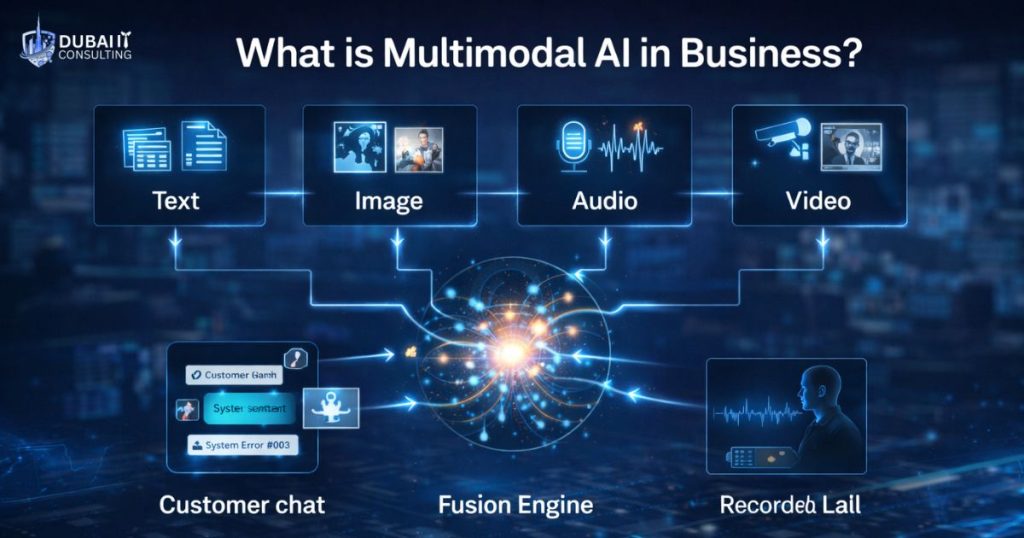
Multimodal AI in business refers to advanced artificial intelligence systems designed to understand and process multiple types of data at the same time. Instead of relying on a single input source, these systems work across different formats such as:
- Text – emails, documents, customer chats
- Images – medical scans, product photos, visual data
- Audio – voice calls, meetings, customer support recordings
- Video – surveillance footage, training sessions, operational videos
Unlike traditional AI models that operate within one data type, multimodal AI brings everything together into a single intelligent framework that can interpret context more accurately. The real breakthrough is not just processing multiple formats—it is cross-modal reasoning, where AI connects meaning across different data sources.
For example:
- A customer support system analyzing a chat message
- Combined with a screenshot of an error
- And a recorded voice call
Instead of treating these as separate inputs, a multimodal system understands them as one unified issue.
This is why multimodal AI applications in business are considered a major step toward intelligent automation.
However, most businesses still misunderstand this concept. They assume adding image recognition or voice processing to a chatbot makes it “multimodal.” In reality, true multimodal intelligence requires deep integration across data layers and reasoning systems.
How Multimodal AI Works in Real Enterprise Systems
To understand enterprise multimodal AI solutions, we need to break down how these systems are structured in real deployments.
1. Data Ingestion Layer
This is the foundational stage where the system connects with multiple enterprise data sources. It continuously gathers raw information from structured and unstructured environments such as databases, customer interactions, multimedia files, IoT sensors, and communication channels.
At this stage, data is not interpreted or analyzed—it is only collected in its original form for further processing.
Simplified understanding:
This is the system’s entry point where all types of business data are collected and brought together for further processing.
2. Representation Layer
Once data is collected, it must be transformed into a format that machines can understand consistently. The representation layer performs this conversion by turning different data types—text, images, audio, and video—into mathematical representations known as embeddings.
These embeddings allow the system to compare and analyze different types of data using a unified structure, even if the original formats are completely different.
In practical terms:
This layer converts all types of data into a common digital format so the AI can understand and process them together.
3. Fusion Engine
The fusion engine is where the system begins to develop true multimodal intelligence. Instead of analyzing each data type separately, it merges embeddings from different sources into a single contextual layer.
This enables the AI to understand relationships between different inputs—for example, connecting a customer’s written complaint with their voice tone and visual evidence.
What this means:
This stage connects different pieces of information so the AI can understand the full context, not just separate data points.
4. Reasoning Layer
This is the cognitive core of the system. The reasoning layer applies machine learning models to interpret the fused data and extract meaning from it. It identifies patterns, detects anomalies, generates predictions, and supports decision-making processes.
Unlike earlier layers, this stage focuses on understanding “what the data means” rather than just processing it.
From a business perspective:
This is the stage where the AI analyzes combined data and turns it into insights, predictions, or decisions that organizations can act on.
5. Output Layer
The final layer translates AI-generated insights into actionable results that can be used by businesses. These outputs may include alerts, recommendations, automated responses, dashboards, or real-time decision support.
This ensures that complex AI analysis is delivered in a practical and usable format for end users or enterprise systems.
In a real-world context:
This is where the system delivers final results that teams can directly use to make decisions or take action.
The Hype Side of Multimodal AI in 2026
The popularity of multimodal AI trends 2026 has led to aggressive marketing narratives that often exaggerate capabilities.
Some common claims include:
- Fully autonomous enterprise decision-making systems
- AI that understands human context perfectly across all formats
- Zero-human-in-the-loop business operations
While these ideas are compelling, they do not reflect current enterprise reality.
The truth is:
- Multimodal AI still struggles with contextual conflicts between data types
- Training and maintaining these systems is expensive and resource-heavy
- Latency becomes a serious issue in real-time applications
- Integration across enterprise systems is still highly complex
A key insight often ignored is this:
The more data modalities you add, the harder it becomes for AI to maintain consistent reasoning. This is why many so-called multimodal systems in the market today are actually hybrid pipelines—not fully integrated intelligence systems.
What is Real in Multimodal AI in Business
Despite the noise, multimodal AI in business is already proving its value—but in targeted, high-impact areas rather than across entire enterprises. According to industry reports, organizations using multimodal systems in specific workflows have seen 20–40% improvement in decision accuracy and faster processing times.
The key difference? These implementations focus on solving one problem deeply, not automating everything at once.
Healthcare
Multimodal AI is delivering real results in diagnostics by combining patient records, imaging, and lab data into a unified system. This improves early detection and reduces diagnostic errors.
- AI models analyze scans along with medical history to detect diseases earlier
- Clinical tools combine reports and symptoms for better treatment decisions, while solutions powered by generative AI in healthcare are helping automate clinical documentation and generate detailed medical reports..
- Hospitals are also leveraging this with generative AI in healthcare for automated clinical documentation
Real impact: Faster diagnosis, reduced human error, and improved patient outcomes
Retail and E-commerce
Retail is one of the fastest adopters of multimodal AI applications in business, using it to enhance customer experience and increase conversions.
- Visual search allows users to find products using images
- AI combines browsing behavior + visuals for hyper-personalized recommendations
- Customer insights improve targeting and reduce cart abandonment
Real impact: Higher conversion rates and better customer engagement
Finance
Financial institutions are using multimodal AI to strengthen fraud detection and risk analysis by combining multiple data signals.
- Systems analyze transaction data + behavioral patterns to detect fraud
- Risk models integrate historical and real-time activity
- Some solutions include voice and interaction-based verification
Real impact: Reduced fraud losses and improved risk accuracy
Manufacturing
In manufacturing, multimodal AI helps optimize operations by combining machine data with visual inspection and maintenance logs.
- AI detects defects using image recognition + sensor data
- Predictive maintenance reduces unexpected downtime
- Real-time monitoring improves operational efficiency
Real impact: Lower maintenance costs and increased production efficiency
Key Insight
The real success of multimodal AI use cases lies in focused execution, not full automation. Companies achieving strong results are not replacing entire systems—they are enhancing specific workflows where multimodal intelligence creates measurable value.
Multimodal AI in Business: Real vs Hype (2026)

| Aspect | What’s Real in 2026 | What’s Still Hype |
| Capabilities | Works well in specific, high-impact use cases like diagnostics, fraud detection, and recommendations | Fully autonomous AI that can run entire businesses without human input |
| Understanding Context | Can combine multiple data types for better insights in controlled environments | Perfect human-like understanding across all formats and scenarios |
| Decision-Making | Supports human decisions with data-driven insights | Completely independent decision-making without oversight |
| Implementation | Requires structured data pipelines and careful system design | Plug-and-play solutions that work instantly across enterprises |
| Cost & Resources | High investment but delivers ROI in focused applications | Assumed to be low-cost and easily scalable across all operations |
| Performance | Effective in semi-real-time or batch processing environments | Seamless real-time processing across all data types without latency |
| Integration | Works when integrated into specific workflows or systems | Easily fits into any existing enterprise ecosystem without complexity |
| System Design | Often built as hybrid or partially integrated systems | Fully unified, perfectly synchronized multimodal intelligence systems |
What This Means for Businesses
The reality of multimodal AI in business is not about replacing entire operations overnight. It is about strategically applying AI where it delivers measurable impact.Companies that focus on “real use cases” see ROI. Those chasing hype often face delays, high costs, and failed implementations.
Multimodal AI vs Generative AI: What Sets Them Apart
In today’s AI landscape, many businesses confuse multimodal AI in business with generative AI. While both are powerful and often used together, they serve very different purposes.
Generative AI focuses on creating new content—whether it’s text, images, code, or reports. It is widely used in tools like chatbots, content generation platforms, and design assistants. Its strength lies in producing outputs quickly based on learned patterns.
Multimodal AI, on the other hand, is designed to understand and interpret multiple types of data together. Instead of just generating content, it connects information across text, images, audio, and video to provide deeper insights and support decision-making.
In simple terms, generative AI helps businesses create, while multimodal AI helps them understand and act.
| Aspect | Generative AI | Multimodal AI |
| Purpose | Content creation | Contextual understanding |
| Input Type | Mostly text or image | Text, image, audio, video |
| Output | Generated content (text, images, code) | Insights, predictions, decisions |
| Core Function | Produces new data based on patterns | Connects and interprets multiple data sources |
| Business Role | Assistant tools (chatbots, content tools) | Intelligence systems for decision support |
| Adoption Stage | Widely adopted across industries | Emerging, used in specific enterprise use cases |
Generative AI creates outputs. Multimodal AI interprets reality across multiple data sources.Most businesses begin their AI journey with generative tools and gradually move toward enterprise multimodal AI solutions as their data ecosystem becomes more mature.
Key Multimodal AI Use Cases in Business
The real strength of multimodal AI in business becomes clear when you look at how it is being applied in practical, high-impact scenarios. Rather than broad automation, organizations are using multimodal systems to solve specific problems where combining different data types leads to better outcomes.
Some of the most effective multimodal AI applications in business include:
- Intelligent customer support systems that analyze chat, voice, and screenshots together for faster issue resolution
- Fraud detection systems in financial institutions that combine transaction data with behavioral patterns
- Medical imaging and diagnostics support that integrates scans, reports, and patient history
- Predictive maintenance in manufacturing using sensor data, visual inspection, and maintenance logs
- Enterprise search systems that can retrieve insights across documents, PDFs, images, and videos
In many organizations, these capabilities are also being strengthened with solutions like AI chatbot development services, which enhance customer interaction layers and support AI-driven service automation. These multimodal AI use cases clearly show that the technology is not just a future concept. It is already being embedded into modern enterprise workflows to improve efficiency, accuracy, and decision-making.
Multimodal AI Benefits for Enterprises
The growing adoption of multimodal AI in business is driven by its ability to bring multiple data sources together and turn them into meaningful, actionable insights. When implemented correctly, it does not just automate tasks—it enhances how businesses think, decide, and operate.
Core Benefits Businesses Are Seeing
Improved decision accuracy by analyzing multiple data types in a unified way.
Faster workflows as AI reduces delays in processing and interpreting information.
Lower manual effort, minimizing dependency on human data analysis.
Enhanced customer experience through more contextual and personalized interactions.
Stronger risk detection by identifying patterns across complex datasets.
What Most Businesses Overlook
While these multimodal AI benefits sound promising, they are not achieved automatically.The real value comes from integration, not just adoption. Many organizations adopt AI tools but fail to connect them with their existing systems and workflows. As a result, the impact remains limited.
The companies that see real results from multimodal AI in business are the ones that:
- Integrate AI with core business processes
- Build strong data pipelines
- Align AI outputs with decision-making systems
Without this foundation, even advanced AI solutions struggle to deliver meaningful ROI.
Multimodal AI ROI in Business
The question every executive eventually asks is unavoidable: does multimodal AI actually deliver ROI?
The honest answer is—yes, it does. But not in the way most businesses expect.
Multimodal AI is not a quick-win investment. It does not deliver overnight results or instant cost savings. In fact, many organizations start by understanding smaller, practical investments—like the AI chatbot development cost in UAE—before gradually moving toward more advanced multimodal AI capabilities. Over time, it builds value as systems learn, integrate, and begin influencing real business decisions.
Where ROI is Already Visible
- Healthcare – Better and faster diagnosis is helping improve patient outcomes
- Finance – More accurate fraud detection is reducing financial losses
- Retail – Personalized experiences are increasing conversions and customer retention
The reality is that multimodal AI ROI in business takes time to materialize. Most organizations begin to see measurable results within 6 to 18 months, as systems need to be integrated, trained, and aligned with multiple data sources.
What truly makes the difference is how the technology is used. Businesses that treat multimodal AI as a long-term capability—rather than a quick fix—are the ones that see meaningful returns. They focus on integrating AI into their core processes and using it to support real decision-making.
This is also where IT consulting becomes important, helping organizations move from experimentation to structured, scalable implementation. The ROI is real—but it comes from strategy, patience, and proper execution, not just adoption
Multimodal AI Trends 2026
The evolution of multimodal AI in business is becoming more visible in 2026, as organizations move beyond experimentation and start integrating AI into real workflows. The focus is no longer on isolated tools, but on building systems that can understand and act on multiple data types together.
Key Trends to Watch
- Real-time AI agents that process and connect text, images, audio, and video simultaneously
- Enterprise AI copilots embedded directly into business workflows and decision-making systems
- Edge-based multimodal AI enabling faster processing with minimal latency
- Industry-specific AI models tailored for domains like healthcare, finance, and manufacturing
- Privacy-first architectures ensuring secure and compliant data usage
These trends clearly show that multimodal AI applications in business are becoming more practical and deployment-ready. Companies are no longer just testing capabilities—they are aligning AI with operational goals and measurable outcomes.
However, the technology is still evolving. Challenges around integration, scalability, and maintaining consistent performance across multiple data sources continue to exist. This makes it clear that while adoption is accelerating, full maturity is still some distance away.
What stands out in 2026 is this transition phase—where early adopters are building competitive advantage, while others are still exploring possibilities. Businesses that invest in the right strategy and infrastructure today will be the ones defining the next stage of enterprise multimodal AI solutions. Multimodal AI is already shaping business operations—but its most powerful phase is still ahead.
Challenges and Limitations
While the progress of multimodal AI in business is impressive, the reality is far from seamless. Behind every successful implementation lies a set of complex challenges that many organizations struggle to overcome.
Where the Real Challenges Begin
High infrastructure and compute costs – Running multimodal systems requires significant processing power and investment.This makes scaling enterprise-wide AI adoption challenging for many organizations.
Data privacy and regulatory concerns – Managing sensitive data across multiple formats increases compliance risks, especially as organizations adopt advanced AI systems and explore validation frameworks like AI Detection Software in 2026.
Integration complexity – Connecting AI systems with existing enterprise tools and workflows is often difficult.Most legacy systems are not designed for real-time multimodal data processing.
Cross-modal hallucination risks – AI can misinterpret or create incorrect connections between different data types.This can lead to unreliable outputs if proper validation layers are not implemented.
Lack of standardized frameworks – There is no universal approach, making implementation inconsistent across industries.As a result, enterprises often rely on custom-built solutions that increase development time and cost.
These challenges explain why multimodal AI applications in business are not yet evenly adopted. While some organizations are successfully leveraging it in high-impact areas, many are still in early experimentation stages.
The gap is not just about technology—it is about readiness. Businesses need the right infrastructure, clean data pipelines, and a clear implementation strategy to unlock real value. Multimodal AI is powerful, but it is not plug-and-play. The complexity behind it is what separates hype from real-world success.
Final Verdict: Real vs Hype
Multimodal AI is real, but it is not fully mature yet. The technology is already delivering clear value in specific, high-impact use cases, but large-scale enterprise transformation is still evolving. Businesses that focus on practical implementations and integrate AI into real workflows are seeing results, while those chasing complete automation too early often face challenges. The opportunity is strong, but success ultimately depends on how strategically it is adopted and executed.
Conclusion
Multimodal AI in business is transforming how organizations understand and use data by connecting multiple inputs into a single, meaningful view. Instead of relying on isolated systems, businesses can now make decisions based on richer context and deeper insights.
However, the real value of this technology lies in how it is applied. It is not about using AI everywhere, but about using it where it truly adds impact. Organizations that focus on strong data foundations, clear use cases, and thoughtful implementation will be the ones that unlock long-term success.
As this space continues to evolve, multimodal AI will play a key role in shaping smarter, more adaptive businesses.
Frequently Asked Questions
1. What is multimodal AI in business?
Multimodal AI in business refers to AI systems that can process and understand multiple types of data—such as text, images, audio, and video—together to generate better insights and improve decision-making.
2. How is multimodal AI different from generative AI?
Generative AI focuses on creating content like text, images, or code, while multimodal AI focuses on understanding and connecting different types of data to provide context-aware insights and decisions.
3. Where is multimodal AI being used in real businesses today?
It is widely used in healthcare for diagnostics, in finance for fraud detection, in retail for personalized recommendations, and in manufacturing for predictive maintenance and quality control
4. What are the main benefits of multimodal AI for enterprises?
The key benefits include improved decision accuracy, faster workflows, better customer experience, reduced manual effort, and stronger risk detection across complex datasets.
5. Is multimodal AI fully ready for large-scale business use?
Not completely. While it is already delivering strong results in specific use cases, large-scale enterprise adoption is still evolving due to challenges like cost, integration complexity, and data infrastructure requirements.