


Compliance is No Longer Manual It is Now Software-Driven
The banking and financial services sector in the UAE is undergoing a structural transformation driven by rapid digital adoption and increasingly strict regulatory oversight from authorities such as the CBUAE, DFSA, and ADGM. As financial transactions become faster, more global, and more data-intensive, traditional compliance models are struggling to keep pace with modern operational demands.
For years, compliance in banks was treated as a manual, documentation-heavy process managed by dedicated back-office teams. However, this approach is no longer sufficient in an environment where financial fraud is becoming more sophisticated and regulatory expectations are evolving in real time. Today, even a minor delay in identifying suspicious activity can lead to significant regulatory exposure and financial penalties.
As a result, financial institutions are now shifting toward technology-first compliance frameworks where monitoring, reporting, and risk assessment are embedded directly into banking systems. This shift represents the rise of fintech compliance as a core operational capability rather than an external function.
In this new model, fintech and compliance are no longer separate domains. Instead, compliance logic is integrated into digital banking platforms, enabling real-time monitoring of transactions, automated risk scoring, and continuous regulatory alignment without manual intervention.
This transformation is not only improving accuracy but also enhancing scalability for banks operating across multiple jurisdictions. In fact, compliance is no longer a back-office legal function; it is now deeply embedded into the core architecture of financial software systems.
To understand how this shift is reshaping global financial ecosystems, it is important to explore broader digital transformation trends such as AI Trends Reshaping Global Industries, which highlight how artificial intelligence and automation are redefining enterprise operations across sectors, including banking and finance.
Understanding Fintech Regulatory Compliance in UAE Banking Ecosystem
The UAE financial ecosystem operates under a highly structured and evolving regulatory framework designed to ensure transparency, financial stability, and protection against financial crime. Institutions such as the Central Bank of the UAE (CBUAE), the Dubai Financial Services Authority (DFSA), and the Abu Dhabi Global Market (ADGM) play a central role in enforcing compliance standards across banking and fintech institutions.
CBUAE, in particular, has strengthened its focus on Anti-Money Laundering (AML) and Counter Financing of Terrorism (CFT) regulations, requiring financial institutions to implement advanced monitoring systems capable of identifying suspicious transactions in real time. Similarly, DFSA and ADGM have introduced robust compliance frameworks tailored for digital-first financial services, ensuring that fintech innovation does not compromise regulatory integrity.
As financial ecosystems become more interconnected, fintech regulatory compliance is evolving from a static reporting requirement into a continuous, data-driven process. Regulators now expect institutions to maintain real-time visibility into financial flows, customer behavior, and risk exposure across all digital channels.
Key areas of regulatory focus include AML monitoring expectations that require automated detection of unusual transaction patterns, KYC digital onboarding requirements that demand secure and verifiable identity validation processes, real-time reporting obligations that ensure instant communication of compliance data to regulatory authorities, and risk-based compliance frameworks that prioritize monitoring based on customer and transaction risk profiles.
In this context, fintech compliance regulations are becoming more stringent and technology-dependent, requiring banks to adopt systems that can continuously adapt to evolving compliance requirements without operational delays.
For financial leaders and strategy teams, understanding these regulatory shifts is essential for long-term planning and sustainable growth. A structured approach to this transformation aligns closely with Strategic Planning frameworks that help institutions integrate compliance requirements into broader business objectives and digital transformation roadmaps.
Why Traditional Financial IT Compliance Systems Are No Longer Enough
Despite years of investment in financial IT compliance systems, many banking institutions are discovering that legacy infrastructure is no longer sufficient to handle the complexity of modern regulatory environments. Traditional systems were designed for slower transaction speeds, localized banking operations, and periodic compliance reporting. Today’s financial ecosystem demands real-time responsiveness, cross-border visibility, and intelligent automation.
One of the major limitations of legacy systems is their fragmented architecture. Compliance data is often stored across multiple disconnected platforms, making it difficult to achieve a unified and accurate view of risk exposure. This fragmentation leads to inefficiencies in monitoring and increases the likelihood of compliance gaps.
Manual compliance processes further exacerbate the issue. Heavy reliance on human verification introduces delays in reporting and increases the risk of oversight, especially when dealing with high transaction volumes or complex financial instruments. In many cases, compliance teams are forced to work reactively rather than proactively, identifying issues only after they have occurred.
Additionally, managing cross-border transactions within UAE financial hubs adds another layer of complexity. As institutions operate across multiple jurisdictions, inconsistent data standards and regulatory requirements make it difficult for legacy systems to maintain seamless compliance coverage.
This has created a clear transition in the industry, moving away from traditional financial IT compliance models toward fully automated fintech compliance ecosystems. These modern systems are designed to integrate compliance directly into transaction flows, enabling real-time monitoring, automated risk assessment, and continuous regulatory alignment.
To address these challenges effectively, many financial institutions are now seeking expertise from Technology Consulting Firms in the Middle East that specialize in modernizing banking infrastructure and implementing scalable, compliance-driven digital solutions.
How Fintech Compliance Solutions Are Transforming Banking Operations
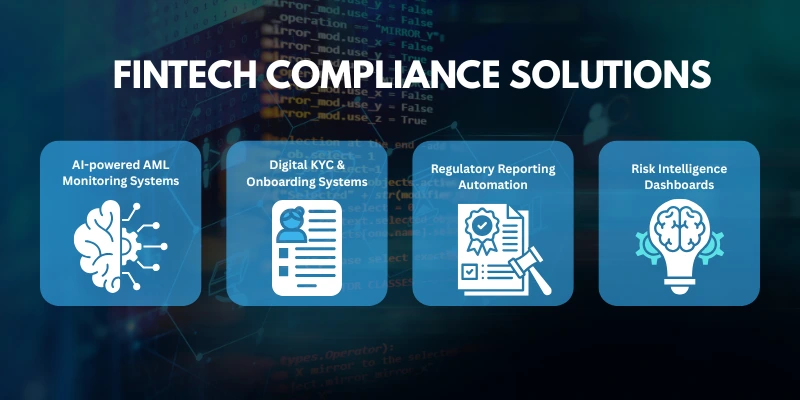
Modern banking operations are increasingly dependent on advanced fintech compliance solutions that are designed to automate, accelerate, and strengthen regulatory adherence across all financial activities. Instead of relying on isolated compliance checks, banks are now embedding intelligent systems directly into their operational workflows to ensure continuous monitoring and instant response to potential risks.
This transformation is redefining how fintech and compliance work together. Rather than functioning as separate departments or systems, compliance capabilities are now integrated into core banking operations through automation, artificial intelligence, and real-time data processing.
AI-powered AML Monitoring Systems
One of the most impactful innovations in fintech compliance is the deployment of AI-powered Anti-Money Laundering (AML) monitoring systems. These systems continuously analyze transaction data to detect unusual patterns that may indicate fraudulent or suspicious activity.
Unlike traditional rule-based systems, AI-driven models can learn from historical data and evolving fraud patterns, enabling more accurate detection and reduced false positives. This leads to faster identification of risks without overwhelming compliance teams with unnecessary alerts.
Key capabilities include real-time transaction tracking across multiple channels, intelligent suspicious pattern detection using behavioral analytics, and automated alert generation for compliance teams to investigate and respond promptly. This ensures that financial institutions maintain proactive oversight rather than reactive investigation processes.
Digital KYC & Onboarding Systems
Digital Know Your Customer (KYC) and onboarding systems are now a critical part of modern fintech compliance solutions. These systems enable banks to verify customer identities quickly and securely without relying on manual documentation checks.
Through identity verification APIs, financial institutions can validate customer data against trusted databases in real time. Document authentication automation further enhances accuracy by detecting forged or manipulated identity documents using AI-based validation techniques.
In addition, these systems play a crucial role in fraud prevention during onboarding by identifying high-risk applicants early in the customer lifecycle. This reduces exposure to financial crime and ensures that only verified customers gain access to banking services.
Regulatory Reporting Automation
Regulatory reporting has traditionally been one of the most time-consuming aspects of financial compliance. However, with modern fintech compliance systems, this process is now largely automated.
These platforms enable auto-generation of compliance reports based on real-time transaction data, ensuring that reporting is always accurate and up to date. Audit-ready transaction logs are maintained continuously, eliminating the need for manual data compilation during regulatory inspections.
By reducing manual reporting burden, banks can significantly improve operational efficiency while ensuring consistent adherence to regulatory requirements. This also minimizes the risk of human error in compliance documentation.
Risk Intelligence Dashboards
Risk intelligence dashboards provide financial institutions with a centralized and real-time view of their entire compliance and risk landscape. These dashboards aggregate data from multiple systems to deliver a unified perspective on potential threats and regulatory exposure.
Advanced analytics capabilities enable predictive risk scoring, allowing banks to anticipate potential compliance breaches before they occur. This proactive approach significantly enhances regulatory breach prevention and strengthens overall financial governance.
By integrating these capabilities into a single interface, fintech compliance solutions empower decision-makers with actionable insights that improve both operational control and strategic risk management.
For institutions looking to implement such capabilities at scale, partnering with providers offering fintech software development services in UAE can ensure that compliance systems are designed with both regulatory precision and enterprise scalability in mind.
Role of Fintech Software in Building a Compliance-First Banking Architecture
Fintech software is no longer a supplementary layer in banking systems; it has become the foundational architecture upon which modern compliance frameworks are built. In a compliance-first banking model, regulatory requirements are embedded directly into the system design rather than being applied after transactions are processed.
This architectural shift is driven by the need for continuous compliance enforcement across increasingly complex financial ecosystems. Modern fintech platforms achieve this through API-based integration with legacy core banking systems, allowing seamless data flow between traditional infrastructure and modern compliance engines.
Cloud-native compliance systems further enhance this capability by enabling scalable, real-time processing of large transaction volumes across multiple jurisdictions. These systems ensure that compliance checks are executed instantly, regardless of transaction size or geographical location.
Real-time monitoring across transactions is now a standard expectation rather than a competitive advantage. Banks are leveraging event-driven architectures to ensure that every financial activity is evaluated against compliance rules as it occurs, significantly reducing latency in risk detection.
The key insight driving this transformation is that modern banks are no longer adding compliance after system development. Instead, they are designing compliance into the system architecture itself, ensuring that regulatory alignment is maintained at every operational layer from the outset.
Risk Reduction and Business Benefits for UAE Financial Institutions
The adoption of advanced fintech compliance solutions delivers significant operational and strategic benefits for financial institutions operating in the UAE. One of the most immediate advantages is the reduction in AML-related penalties and regulatory exposure, as automated systems ensure continuous monitoring and early detection of suspicious activities.
Financial institutions also experience faster audit readiness, as compliance data is continuously recorded, organized, and made accessible in real time. This eliminates the delays typically associated with manual data gathering during regulatory reviews.
Improved fraud detection accuracy is another critical benefit, as AI-driven systems can analyze large datasets and identify complex fraud patterns that traditional systems often miss. This leads to stronger financial security and reduced risk exposure.
In addition, automation significantly lowers operational compliance costs by reducing dependency on manual processes and large compliance teams. Over time, this results in more efficient resource allocation and improved profitability.
Perhaps most importantly, these improvements strengthen investor confidence and regulatory trust, positioning financial institutions as secure, transparent, and technologically advanced entities within the UAE financial ecosystem.
Organizations seeking to modernize their compliance infrastructure often collaborate with software development firms in UAE that specialize in building scalable, secure, and regulation-ready financial systems tailored for complex banking environments.
How UAE Is Leading Global Fintech Compliance Transformation
The UAE has emerged as a global leader in fintech-driven compliance transformation, largely due to its proactive regulatory environment and strong emphasis on financial innovation. Regulatory bodies have created a framework that encourages the adoption of advanced technologies while maintaining strict oversight of financial activities.
One of the key drivers of this transformation is the UAE’s regulatory-first fintech ecosystem, which prioritizes compliance readiness as a prerequisite for financial innovation. This approach ensures that new fintech solutions are designed with regulatory alignment from the very beginning.
The country has also been at the forefront of adopting AI, blockchain, and cloud-based compliance systems to enhance transparency and operational efficiency across financial institutions. These technologies enable real-time monitoring, secure data management, and improved traceability of financial transactions.
Additionally, there is a growing push toward real-time regulatory reporting standards, where financial institutions are expected to provide continuous compliance visibility rather than periodic reports. This shift is reshaping how banks design their internal systems and data architectures.
RegTech adoption in banking is accelerating rapidly, with AI-driven compliance monitoring becoming a standard requirement for modern financial institutions. These advancements are positioning the UAE as a benchmark for global financial compliance innovation.
The integration of technologies such as blockchain is further strengthening transparency and auditability across financial systems, a transformation explored in depth in discussions around Blockchain Is Transforming FinTech Apps, which highlights the role of distributed ledger technologies in reshaping financial trust models.
Future of Fintech Compliance: What Banks Should Prepare For
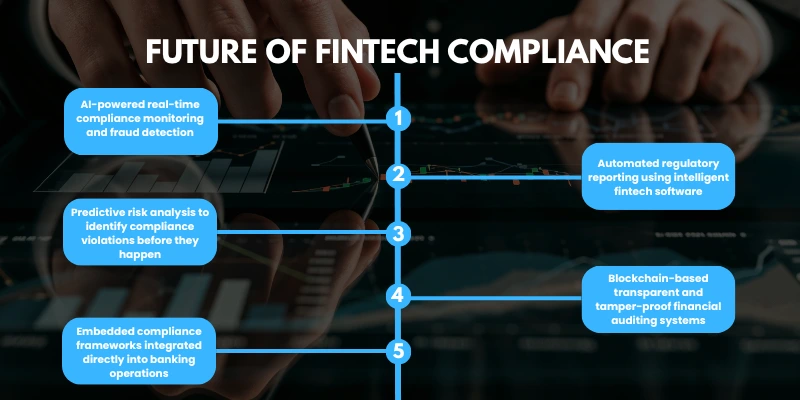
The future of banking compliance in the UAE is moving toward a highly intelligent and fully automated ecosystem where technology does not just support compliance teams but actively performs compliance functions in real time. As financial systems become more interconnected and data-driven, traditional rule-based compliance models will no longer be sufficient to manage emerging risks and regulatory complexity.
One of the most significant shifts expected in the coming years is the rise of AI-driven autonomous compliance systems. These systems will not only detect anomalies but will also initiate predefined compliance actions without human intervention, reducing response time and minimizing exposure to financial risk.
Another major evolution will be predictive regulatory risk detection. Instead of reacting to suspicious transactions after they occur, banks will increasingly rely on predictive analytics to identify potential compliance breaches before they happen. This will allow financial institutions to take preventive actions and strengthen their overall risk posture.
The industry is also moving toward fully digital audit ecosystems, where compliance data is continuously recorded, structured, and made instantly available for regulatory inspection. This eliminates the traditional audit preparation cycle and replaces it with always-on audit readiness.
In addition, compliance will become deeply embedded in every financial transaction. Rather than being a separate validation layer, compliance rules will be executed automatically within transaction flows, ensuring that every financial activity is assessed in real time against regulatory standards.
The overall direction of the industry is clear: compliance will shift from reactive systems that respond to issues, to predictive systems that anticipate risks, and ultimately to autonomous systems that manage compliance independently within defined regulatory boundaries.
Compliance Is Now a Technology Strategy, Not Just a Regulatory Requirement
The transformation of fintech compliance is fundamentally reshaping how banks and financial institutions operate in the UAE. What was once a manual, documentation-heavy regulatory function has now evolved into a dynamic, software-driven capability embedded within core banking systems.
Financial institutions that adopt fintech compliance solutions early are gaining a significant competitive advantage. They are not only reducing regulatory risk but also improving operational efficiency, strengthening fraud detection, and accelerating decision-making processes across their organizations.
As the financial ecosystem continues to evolve, software-driven compliance will become a critical enabler of scalability, security, and regulatory alignment. Institutions that fail to modernize their compliance infrastructure risk falling behind in an environment where real-time oversight and automation are becoming industry standards.
Ultimately, fintech compliance is no longer just a regulatory requirement. It is a core digital transformation strategy that defines the resilience, agility, and future-readiness of modern banking institutions.
Get Modern Fintech Compliance Solutions
Modern financial institutions require compliance systems that are not only robust but also intelligent, scalable, and fully aligned with evolving regulatory frameworks. SISGAIN specializes in building advanced fintech solutions designed to help banks and financial organizations achieve this transformation with confidence.
As a trusted partner in fintech software development services in UAE, SISGAIN delivers end-to-end solutions that integrate compliance automation, AI-driven monitoring, and secure financial architectures tailored to enterprise banking needs.
With deep expertise as a RegTech solutions provider and custom banking software development partner, SISGAIN enables financial institutions to modernize their compliance infrastructure while ensuring full alignment with regional regulatory standards.
Build a compliance-ready fintech ecosystem for your financial institution with scalable, secure, and AI-powered regulatory automation systems.
FAQS
What is fintech compliance in banking?
Fintech compliance in banking refers to the use of advanced financial technologies and automated software systems to help banks comply with regulatory requirements such as AML, KYC, fraud prevention, transaction monitoring, and financial reporting. Modern fintech compliance systems enable banks to monitor financial activities in real time while reducing manual errors and operational risks.
Why are UAE banks investing in fintech compliance solutions?
UAE banks are investing in fintech compliance solutions to meet evolving regulatory standards set by authorities such as CBUAE, DFSA, and ADGM. These solutions help financial institutions automate compliance monitoring, improve fraud detection, reduce AML risks, and maintain faster regulatory reporting across digital banking operations.
How does AI improve fintech and compliance operations?
AI improves fintech and compliance operations by enabling real-time transaction monitoring, suspicious activity detection, automated risk scoring, and predictive fraud analysis. AI-powered systems can process large volumes of financial data faster than traditional systems, helping banks identify compliance risks more accurately and efficiently.
What are the key fintech compliance regulations in the UAE?
Key fintech compliance regulations in the UAE include Anti-Money Laundering (AML) laws, Counter Financing of Terrorism (CFT) regulations, KYC requirements, digital identity verification standards, and real-time transaction monitoring obligations enforced by regulatory bodies such as CBUAE, DFSA, and ADGM.
How do fintech compliance solutions reduce banking risks?
Fintech compliance solutions reduce banking risks by automating regulatory monitoring, improving fraud detection accuracy, ensuring continuous transaction surveillance, and generating audit-ready compliance reports. These systems help financial institutions minimize regulatory penalties, operational inefficiencies, and financial crime exposure.
What is the future of fintech compliance in banking?
The future of fintech compliance in banking is expected to focus on AI-driven autonomous compliance systems, predictive risk detection, embedded compliance frameworks, and fully digital audit ecosystems. Financial institutions are moving toward intelligent compliance architectures where regulatory monitoring becomes an integrated part of every banking transaction.