

In today’s hyperconnected digital economy, businesses are under constant pressure to evolve faster than ever before. Markets shift overnight, customer expectations continue to rise, and emerging technologies like AI, cloud computing, and automation are redefining how organizations compete. Companies that operate without a clear strategic direction often struggle with operational inefficiencies, fragmented decision-making, wasted technology investments, and slow business growth.
This is where strategic planning becomes critical.
Modern enterprises can no longer rely on outdated yearly planning models or reactive business decisions. Without a structured roadmap, organizations risk losing market relevance, weakening customer trust, and falling behind more agile competitors. According to multiple business performance studies, companies with aligned strategic planning frameworks consistently outperform competitors in profitability, operational efficiency, and long-term scalability.
Today, strategic planning is not just about setting business goals. It is about aligning leadership, technology, operations, workforce, and innovation into one measurable growth strategy. From AI adoption and digital transformation to cybersecurity readiness and cloud scalability, organizations now require modern strategic frameworks that can adapt to rapidly changing business environments.
Whether you are a startup building a growth roadmap or an enterprise modernizing operations, understanding the strategic planning definition and implementation process is essential for sustainable success in the digital era.
What Is Strategic Planning?
Strategic planning is a structured business process used to define long-term organizational goals, align resources, improve decision-making, and create a roadmap for sustainable business growth. In simple terms, the definition of strategic planning refers to how businesses identify where they want to go, how they will get there, and what actions are required to achieve measurable success.
Unlike traditional business planning, which often focuses on short-term operations and immediate targets, strategic planning takes a broader and future-focused approach. It helps organizations anticipate market shifts, optimize technology investments, manage risks, and align departments toward a common business vision.
For enterprises operating in today’s digital-first economy, strategic planning has become a core business necessity rather than a management exercise. Organizations now use strategic planning frameworks to navigate digital transformation, AI-driven competition, evolving customer behavior, and increasing cybersecurity threats.
Businesses that fail to define strategic planning properly often experience:
- disconnected departments,
- unclear business priorities,
- poor resource allocation,
- delayed innovation,
- reduced operational agility.
Modern strategic planning enables organizations to stay proactive instead of reactive.
For example, Amazon continuously evolves its logistics, AI infrastructure, and customer experience strategy through long-term planning initiatives. Microsoft transformed its business model by strategically investing in cloud computing and AI ecosystems, while Netflix shifted from DVD rentals to a globally dominant streaming platform through strategic digital transformation planning.
These companies succeeded because they aligned innovation, technology, and business strategy under clear long-term objectives.
Traditional Business Planning vs Strategic Planning
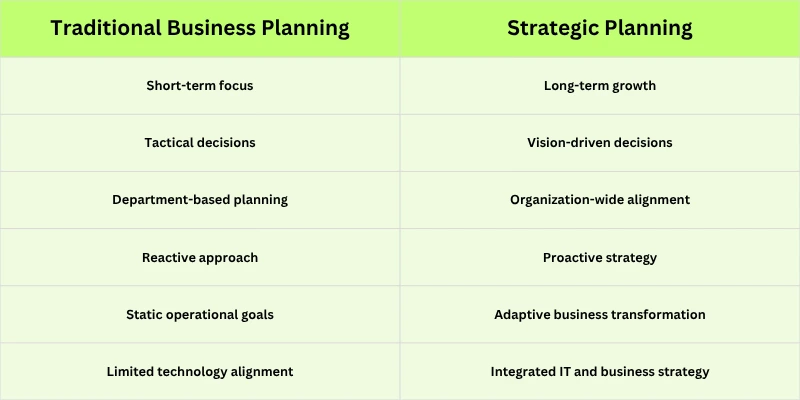
Today, businesses also integrate IT strategy and planning into their broader strategic framework to improve scalability, cybersecurity, operational efficiency, and digital resilience. As industries continue to evolve, organizations that embrace strategic planning gain stronger competitive positioning, faster decision-making capabilities, and greater long-term stability.
Why Strategic Planning Is Important for Businesses
In competitive industries, businesses rarely fail because they lack ideas or funding. Most organizations struggle because they lack strategic alignment. Departments operate in silos, leadership teams pursue conflicting priorities, technology investments are made without long-term planning, and operational decisions become reactive instead of data-driven.
This is why strategic planning is important for modern businesses.
A well-defined strategic planning framework creates operational clarity across the organization. It ensures that leadership, employees, technology teams, and business units work toward shared goals instead of isolated objectives. When companies align strategy with execution, they improve decision-making, accelerate growth initiatives, and reduce operational inefficiencies.
Strategic planning also plays a major role in business scalability. As organizations grow, unmanaged expansion can create process bottlenecks, communication gaps, cybersecurity risks, and infrastructure failures. Strategic planning helps businesses prepare for growth with scalable systems, workforce planning, and long-term technology alignment.
Another major advantage is revenue optimization. Businesses with strong strategic planning processes can identify profitable market opportunities faster, allocate budgets more effectively, and improve customer experience initiatives that directly impact revenue generation.
Technology alignment is now equally critical. Many enterprises invest heavily in digital tools but fail to achieve transformation goals because their IT infrastructure is disconnected from business strategy. Modern organizations require a unified approach that combines operational goals with digital innovation, cloud scalability, cybersecurity, and automation initiatives. This is where a Smart IT Strategy for Business Growth becomes essential for sustainable success.
Strategic planning also reduces business risks. Organizations that proactively plan for market shifts, cybersecurity threats, regulatory changes, and operational disruptions are significantly more resilient during periods of uncertainty.
Real Business Insight
Many businesses fail despite having strong budgets because:
- departments operate without shared KPIs,
- leadership lacks strategic direction,
- IT infrastructure planning is reactive,
- workforce goals are misaligned,
- technology investments are disconnected from long-term objectives.
Without strategic planning, growth becomes chaotic instead of scalable.
Strategic Planning Statistics Businesses Cannot Ignore
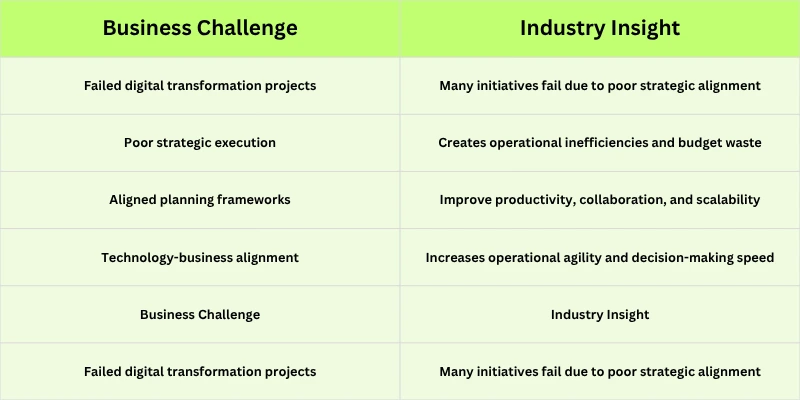
In today’s rapidly evolving economy, strategic planning is no longer optional. It is the foundation for sustainable growth, digital resilience, and long-term competitive advantage.
Our Blog Source – Define Strategic Planning
Core Components of Strategic Planning
An effective strategic planning framework is built on several interconnected components that guide organizational growth, operational efficiency, and long-term decision-making. Businesses that understand and optimize these core elements are better equipped to scale, innovate, and adapt to changing market conditions.
Mission Statement
An effective strategic planning framework is built on several interconnected components that guide organizational growth, operational efficiency, and long-term decision-making. Businesses that understand and optimize these core elements are better equipped to scale, innovate, and adapt to changing market conditions.
Strong mission statements create organizational focus and help leadership teams make decisions aligned with long-term business objectives.
Vision & Long-Term Goals
The vision component establishes where the organization wants to be in the future. Long-term strategic goals provide measurable targets related to:
- business growth,
- market expansion,
- digital transformation,
- customer experience,
- operational efficiency.
Modern enterprises often create multi-year strategic roadmaps to ensure business continuity and scalability.
SWOT Analysis
SWOT analysis is one of the most widely used strategic planning tools for evaluating:
- strengths,
- weaknesses,
- opportunities,
- threats.
This framework helps businesses identify internal capabilities while understanding external market conditions and competitive risks.
Organizations that regularly perform SWOT assessments are more prepared to adapt to industry disruption and emerging opportunities.
KPIs & Performance Metrics
Strategic planning without measurable outcomes quickly becomes ineffective.
Key Performance Indicators (KPIs) help organizations track:
- operational efficiency,
- revenue growth,
- customer acquisition,
- employee productivity,
- digital transformation progress.
Modern enterprises increasingly rely on AI-driven analytics dashboards and predictive reporting systems to monitor strategic performance in real time.
Resource Allocation
Effective strategic planning ensures businesses allocate resources efficiently across:
- workforce management,
- technology investments,
- operational budgets,
- innovation initiatives,
- infrastructure expansion.
Poor resource allocation often leads to delayed projects, reduced productivity, and budget overruns.
Technology & IT Alignment
Technology has become one of the most important components of strategic planning. Businesses today must align IT infrastructure with operational and growth objectives to remain competitive.
Modern strategic frameworks now include:
- AI-driven analytics,
- cloud infrastructure planning,
- cybersecurity strategies,
- enterprise automation,
- data management systems,
- digital transformation initiatives.
Organizations that ignore technology alignment often face scalability challenges, operational disruptions, and increased cybersecurity risks. Integrating proactive IT Risk Management into strategic planning helps businesses improve resilience while protecting critical digital assets.
Strategic Planning Components & Their Business Impact
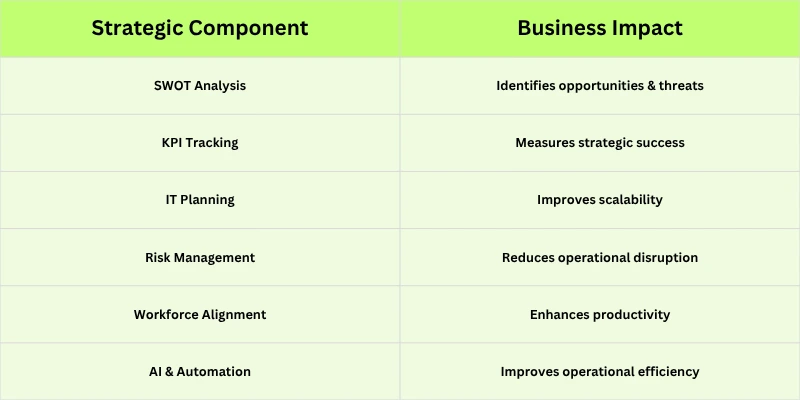
Businesses that optimize these strategic components create stronger organizational alignment, improve decision-making capabilities, and position themselves for sustainable long-term growth.
The 7-Step Strategic Planning Process
Successful organizations do not rely on assumptions or reactive decision-making. They follow a structured strategic planning process that aligns business goals, operational execution, workforce planning, and technology investments under one scalable framework.
Below is a proven 7-step strategic planning process used by modern enterprises to improve growth, agility, and long-term competitiveness.
Step 1 — Analyze the Current Business Position
Every strategic planning process begins with understanding the organization’s current state.
This includes:
- SWOT analysis,
- market research,
- customer behavior analysis,
- competitor benchmarking,
- operational performance reviews.
Businesses must identify both internal strengths and external threats before defining future strategies. Organizations that skip this stage often create unrealistic plans disconnected from market realities.
Strategic Insight:
Many enterprises fail because leadership teams rely on assumptions instead of data-driven market analysis.
Step 2 — Define Business Objectives
Once the current position is understood, organizations establish clear strategic goals.
These objectives should follow SMART principles:
- Specific
- Measurable
- Achievable
- Relevant
- Time-bound
Examples include:
- increasing market share,
- improving customer retention,
- accelerating digital transformation,
- reducing operational costs,
- expanding into new markets.
Measurable KPIs are essential because they help leadership track progress and maintain accountability across departments.
Step 3 — Align IT & Business Strategy
Modern strategic planning requires strong alignment between technology and business objectives.
This includes:
- digital infrastructure planning,
- cloud systems,
- enterprise software modernization,
- automation initiatives,
- cybersecurity readiness,
- AI integration.
Businesses that separate IT from strategic planning often experience scalability limitations and operational inefficiencies. This is why many enterprises now invest in professional it consulting solutions to align digital transformation initiatives with business growth strategies.
Executive-Level Challenge:
One of the biggest planning mistakes organizations make is treating technology as a support function rather than a strategic growth driver.
Step 4 — Create Strategic Roadmaps
Strategic goals must be translated into actionable execution plans.
A strategic roadmap outlines:
- timelines,
- responsibilities,
- department alignment,
- operational priorities,
- implementation milestones.
This stage ensures every business unit understands its role in achieving organizational objectives.
Without execution planning, even the best strategic ideas fail during implementation.
Step 5 — Allocate Resources Efficiently
Organizations must strategically distribute:
- workforce resources,
- operational budgets,
- technology investments,
- infrastructure capacity,
- leadership responsibilities.
Poor resource allocation is one of the leading causes of delayed business initiatives and failed transformation projects.
Enterprises that prioritize scalable resource planning improve operational agility and reduce unnecessary spending.
Step 6 — Execute & Monitor Performance
Implementation is where strategic planning becomes operational reality.
Businesses should continuously monitor:
- KPI dashboards,
- productivity metrics,
- revenue performance,
- customer experience indicators,
- operational efficiency.
Modern organizations increasingly use:
- AI-powered analytics,
- real-time reporting systems,
- automation dashboards,
- agile review frameworks.
Why Most Strategic Plans Fail:
Many companies create detailed plans but fail to establish continuous performance monitoring systems.
Without measurable accountability, execution weakens over time.
Step 7 — Optimize & Evolve Continuously
Strategic planning should never be treated as a one-time yearly exercise.
Markets evolve rapidly due to:
- AI disruption,
- economic shifts,
- changing customer expectations,
- cybersecurity risks,
- digital innovation.
Organizations must continuously optimize their strategies using:
- AI insights,
- predictive analytics,
- market intelligence,
- innovation forecasting,
- agile adaptation models.
Businesses that regularly refine their strategic planning frameworks are more resilient, scalable, and competitive in rapidly changing industries.
Common Enterprise Planning Mistakes
The most successful enterprises treat strategic planning as an ongoing business discipline rather than a document created once and forgotten.
Strategic Planning in Modern IT & Digital Transformation
In today’s technology-driven economy, strategic planning is no longer limited to operational goals or financial forecasting. Modern businesses must align digital transformation initiatives with long-term business strategy to remain competitive, scalable, and resilient.
Organizations across industries are rapidly investing in:
- cloud migration,
- AI adoption,
- cybersecurity frameworks,
- enterprise software modernization,
- automation systems,
- data-driven decision-making platforms.
However, technology investments alone do not guarantee business growth. Many digital transformation initiatives fail because organizations implement new technologies without a clear strategic framework connecting IT capabilities to business objectives.
This is why IT strategy and planning have become critical components of enterprise success.
Businesses that strategically align technology with operational goals improve:
- scalability,
- customer experience,
- workforce productivity,
- operational efficiency,
- innovation speed,
- competitive advantage.
For example, cloud infrastructure planning allows enterprises to scale operations faster, while AI-driven analytics help leadership teams make more accurate and proactive business decisions. Similarly, enterprise software modernization improves collaboration, workflow automation, and customer engagement across departments.
Cybersecurity is also now a strategic priority rather than just an IT concern. As businesses become more digitally connected, proactive security planning has become essential for protecting business continuity and customer trust.
Leading enterprises increasingly partner with experienced digital IT companies like SISGAIN to create integrated business and technology strategies that support long-term growth and digital resilience.
Strategic Planning Across Modern Industries
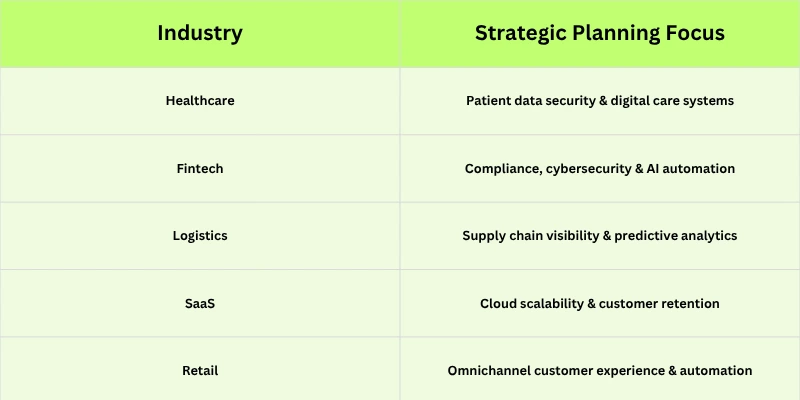
Different industries now rely heavily on strategic IT planning to remain competitive:
As technology continues to evolve rapidly, businesses that combine strategic planning with digital innovation are better positioned to lead their industries instead of reacting to disruption.
Common Strategic Planning Mistakes Businesses Make
Even organizations with strong budgets and talented leadership teams can struggle if their strategic planning process lacks clarity, adaptability, and execution discipline.
One of the most common mistakes businesses make is setting unclear objectives. When goals are vague or disconnected from measurable outcomes, departments operate without alignment and employees lose strategic direction.
Poor communication is another major challenge. Many organizations create strategic plans at the executive level but fail to communicate priorities across teams. This creates operational silos, inconsistent execution, and reduced accountability.
Another critical issue is ignoring IT infrastructure during strategic planning. In modern business environments, technology is directly connected to scalability, customer experience, operational efficiency, and cybersecurity. Companies that overlook digital transformation planning often experience system limitations, workflow inefficiencies, and failed modernization initiatives.
Additional strategic planning mistakes include:
- lack of KPI tracking,
- weak leadership alignment,
- reactive decision-making,
- failure to adapt to market changes,
- absence of risk management frameworks.
Why Outdated Strategic Planning Models Fail
Traditional yearly planning models no longer work effectively in rapidly changing markets.
Modern industries are influenced by:
- AI disruption,
- evolving customer behavior,
- cybersecurity threats,
- economic uncertainty,
- accelerated digital transformation.
Static planning frameworks cannot adapt fast enough to these shifts.
Today’s enterprises require agile strategic planning models that allow leadership teams to continuously evaluate performance, optimize operations, and adjust priorities based on real-time business intelligence.
Pro Tip: –
Businesses that revisit strategic plans quarterly adapt faster to market disruptions and improve long-term operational resilience.
Organizations that treat strategic planning as a continuous process instead of a one-time executive meeting are significantly more prepared for future growth and competitive change.
Best Strategic Planning Frameworks Businesses Use
Successful organizations use proven strategic planning frameworks to improve decision-making, align departments, and measure long-term business performance. These frameworks help enterprises simplify complex planning processes while creating structured roadmaps for growth and innovation.
SWOT Analysis
SWOT analysis helps businesses identify:
- strengths,
- weaknesses,
- opportunities,
- threats.
It is widely used for internal business analysis, competitive benchmarking, and strategic decision-making.
Balanced Scorecard
The Balanced Scorecard framework measures organizational performance across multiple business dimensions, including:
- financial performance,
- customer experience,
- internal operations,
- learning and growth.
Large enterprises often use this framework to align operational activities with long-term strategic goals.
OKRs (Objectives & Key Results)
OKRs help organizations create measurable and outcome-focused business objectives.
This framework is commonly used by technology-driven companies because it improves:
- accountability,
- goal tracking,
- cross-functional alignment,
- execution visibility.
PEST Analysis
PEST analysis evaluates external market influences, including:
- political factors,
- economic conditions,
- social trends,
- technological changes.
Businesses use this framework to prepare for market shifts and industry disruptions.
Blue Ocean Strategy
Blue Ocean Strategy focuses on creating uncontested market opportunities instead of competing in oversaturated industries.
This framework encourages:
- innovation,
- product differentiation,
- customer value creation,
- market expansion.
Companies like Netflix and Tesla are often cited as examples of businesses that successfully implemented innovation-focused strategic frameworks.
Strategic Planning Framework Comparison
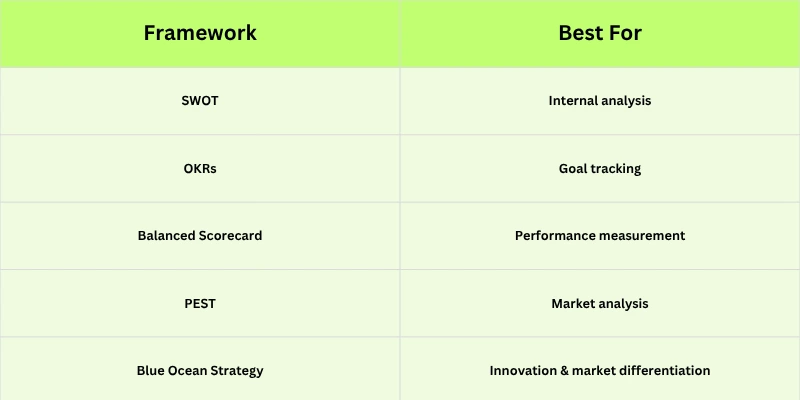
Enterprise organizations often combine multiple frameworks to create more adaptable and data-driven strategic planning systems.
How AI Is Transforming Strategic Planning

Artificial intelligence is rapidly reshaping how organizations approach strategic planning and business decision-making. Modern enterprises no longer rely solely on historical reports or manual forecasting models. Instead, AI-powered systems provide real-time insights that improve strategic accuracy, operational efficiency, and long-term forecasting capabilities.
Today, businesses use AI for:
- predictive analytics,
- automated reporting,
- AI-powered forecasting,
- business intelligence,
- scenario modeling,
- decision automation.
These technologies help executives identify market trends faster, detect operational inefficiencies, and respond proactively to changing business conditions.
AI-driven predictive analytics can forecast:
- customer behavior,
- market demand,
- supply chain risks,
- revenue opportunities,
- workforce trends.
This allows leadership teams to make faster and more informed strategic decisions with reduced uncertainty.
AI also improves operational efficiency through automated reporting and intelligent dashboards. Instead of waiting for quarterly reports, executives can monitor real-time KPIs and performance insights continuously.
Another major advantage is scenario modeling. AI systems can simulate different business outcomes based on changing market conditions, helping organizations prepare for risks and opportunities before they occur.
As AI adoption continues to grow, businesses that integrate intelligent analytics into their strategic planning process gain stronger forecasting accuracy, faster adaptability, and a significant competitive advantage.
Also Read – 20 Most Impactful AI Trends Reshaping Global Industries
How to Build an Effective Strategic Planning Framework
Building an effective strategic planning framework requires more than setting long-term goals. Modern businesses need a structured and adaptable system that aligns leadership, operations, workforce strategy, and technology initiatives under a unified growth vision.
The first step is leadership collaboration. Strategic planning becomes significantly more effective when executives, department heads, and operational teams work together instead of creating isolated business objectives.
Organizations should also prioritize strong IT alignment. Technology decisions must directly support business scalability, digital transformation, cybersecurity readiness, and operational efficiency.
An effective framework should include:
- measurable KPIs,
- agile review cycles,
- employee engagement,
- technology integration,
- risk management planning,
- continuous performance monitoring.
Businesses that track measurable KPIs consistently are better equipped to evaluate strategic success and identify areas requiring optimization.
Agility is equally important. Modern markets evolve too quickly for static planning models.
Strategic planning should never become a static PDF document sitting unused after quarterly meetings.
Successful enterprises continuously refine strategies using:
- performance analytics,
- customer insights,
- market intelligence,
- AI-driven forecasting,
- operational feedback.
Employee engagement also plays a critical role. When employees understand organizational goals and strategic priorities, execution becomes more aligned and productive across departments.
Ultimately, the most effective strategic planning frameworks combine business vision, technology innovation, workforce alignment, and continuous optimization into one scalable system.
Frequently Ask Questions ?
1. What is strategic planning in simple words?
Strategic planning is the process of defining business goals, aligning resources, and creating a roadmap to achieve long-term growth. It helps organizations decide where they are, where they want to go, and how to reach there efficiently.
2. What are the 5 stages of strategic planning?
The 5 stages include analyzing the current position, setting clear objectives, developing strategies, executing plans, and monitoring performance. These steps ensure businesses stay aligned, measurable, and adaptable to changing market conditions.
3. Why is strategic planning important?
Strategic planning provides direction, improves decision-making, aligns teams, and reduces risks. It helps businesses optimize resources, adapt to market changes, and achieve sustainable growth with a clear and structured roadmap.
4. What is the difference between business planning and strategic planning?
Business planning focuses on short-term operations and execution, while strategic planning is long-term and future-focused. It aligns goals, technology, and resources to drive growth, innovation, and competitive advantage.
5. What are the benefits of strategic planning?
Strategic planning improves efficiency, enhances decision-making, aligns teams, and supports scalability. It helps businesses identify opportunities, reduce risks, optimize investments, and achieve long-term growth in competitive markets.
6. How does IT strategy support strategic planning?
IT strategy aligns technology with business goals by supporting digital transformation, automation, and scalability. It improves efficiency, cybersecurity, and data-driven decision-making, ensuring technology investments drive long-term growth.
7. What tools are used in strategic planning?
Common tools include SWOT analysis, Balanced Scorecard, OKRs, PEST analysis, and AI-driven analytics. These frameworks help businesses evaluate performance, track goals, analyze markets, and make informed strategic decisions.
8. How often should a strategic plan be updated?
Strategic plans should be reviewed quarterly and updated annually or as needed. Regular updates help businesses adapt to market changes, improve performance, and stay aligned with evolving goals and technology trends.
Conclusion
Strategic planning has evolved far beyond traditional business forecasting. In today’s digital economy, organizations need agile, technology-driven strategies that align business goals with innovation, operational efficiency, and long-term scalability.
Businesses that invest in modern strategic planning frameworks gain stronger decision-making capabilities, improved risk management, better workforce alignment, and greater adaptability in rapidly changing markets. From AI adoption and cloud scalability to cybersecurity planning and enterprise automation, strategic planning now plays a direct role in business resilience and competitive growth.
Organizations that fail to modernize their strategic approach often struggle with disconnected operations, poor technology alignment, and slow adaptation to industry disruption.
The future belongs to businesses that combine strategic vision with digital transformation readiness.
If your organization is looking to modernize operations, improve digital readiness, and align technology with long-term business growth, partnering with experienced strategic and technology experts can help create a scalable roadmap for sustainable success.