


A few years ago, AR technology felt like science fiction. Today, it’s becoming part of everyday life faster than most people realize. From virtual sneaker try-ons to surgeons using digital overlays during procedures, augmented reality is transforming industries around the world.
Think about it this way: if the internet changed how we access information, AR is changing how we experience it.
The growth is massive. Industry reports predict the global AR market could surpass USD 1 trillion by 2033 as businesses invest heavily in smarter digital experiences. Companies are now using augmented reality applications to improve customer engagement, employee training, e-commerce experiences, and operational efficiency.
The rise of technologies like Apple Vision Pro and Microsoft HoloLens and innovations from Meta Reality Labs has accelerated global interest in immersive technology across healthcare, retail, manufacturing, education, and real estate.
But many people still don’t fully understand what augmented reality is, how it works, or why it matters for businesses today.
So, let’s break it down in simple terms.
What Is Augmented Reality?
The simplest augmented reality meaning is this: augmented reality, or AR, is a technology that overlays digital content onto the real world in real time.
Unlike virtual reality, which creates a completely digital environment, augmented reality enhances the physical world with computer-generated visuals, sounds, animations, or information.
For example, you can use AR to see how a sofa would look in your living room before buying it or help technicians view repair instructions through smart glasses. These are real-world augmented reality applications improving customer experiences and business operations.
As AR adoption continues growing, many businesses are also working with experienced IT consultants to develop scalable and user-friendly immersive solutions.
Today, AR is commonly experienced through the following:
- smartphones
- tablets
- smart glasses
- wearable devices
- AR headsets
- e-commerce apps
- navigation systems
As the technology evolves, businesses are increasingly partnering with trusted IT solutions companies to integrate immersive AR experiences into their digital strategies.
How Does Augmented Reality Work?
At first glance, augmented reality may seem magical, but behind the scenes, it works through a combination of advanced technologies operating together in real time.
Cameras and Sensors
Every AR system begins by analyzing the physical environment. Devices use technologies like:
- cameras
- GPS
- accelerometers
- gyroscopes
- depth sensors
to collect environmental and movement data. Your smartphone, for example, constantly tracks positioning and scans the space around you to create accurate AR experiences.
Computer Vision Technology
This is where the intelligence behind AR comes in. Computer vision helps AR systems recognize the following:
- surfaces
- objects
- faces
- hand movements
- physical environments
It allows digital content to stay anchored naturally in real-world spaces. For instance, when you place a virtual chair in your room using an AR app, computer vision ensures the chair remains fixed in the correct position even as you move around.
SLAM and Spatial Mapping
Many modern augmented reality applications use SLAM technology, which stands for Simultaneous Localization and Mapping.
In simple terms, SLAM helps AR devices understand:
- where they are
- what surrounds them
- how objects are positioned in space
This enables smooth, accurate, and interactive AR experiences.
AI-Powered AR Systems
Artificial intelligence is making AR far more advanced and personalized. AI helps AR systems:
- recognize objects faster
- track gestures
- understand environments
- personalize experiences
- improve voice interactions
The combination of AI and AR is now driving some of the biggest innovations in immersive technology.
AR Development Platforms
Developers create AR experiences using technologies such as:
- ARKit
- ARCore
- Unity
- Unreal Engine
- WebAR frameworks
These platforms help businesses build scalable and interactive augmented reality applications for mobile devices and enterprise environments.
Businesses exploring immersive technologies are increasingly partnering with DubaiITConsulting to build scalable and enterprise-ready AR solutions.”
Types of Augmented Reality
Not all augmented reality experiences work the same way. Different industries use different types of AR depending on their goals, customer experience strategies, and technical requirements.
Let’s explore the main types of augmented reality applications used today.
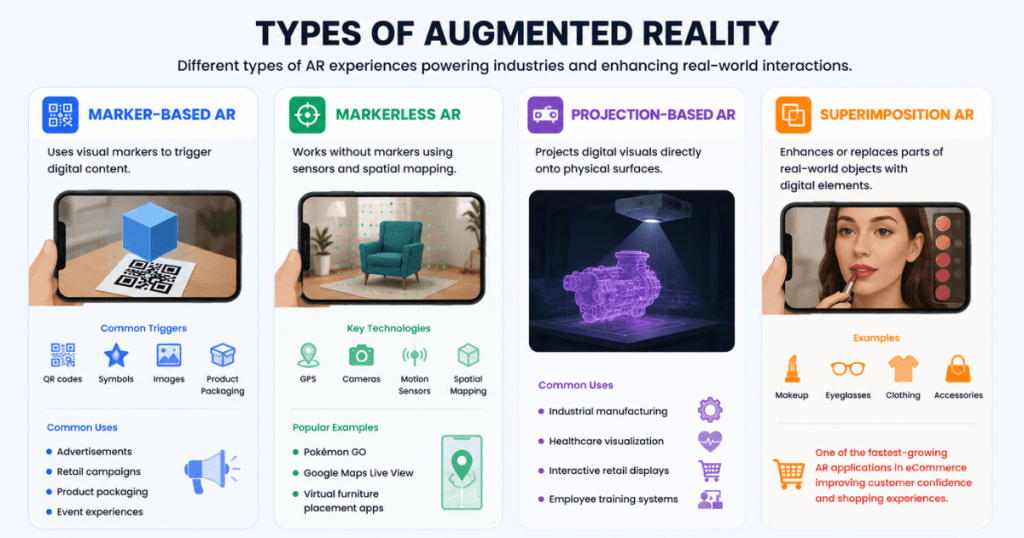
Marker-Based AR
Marker-based AR uses visual triggers such as the following:
- QR codes
- symbols
- images
- product packaging
When a device’s camera detects these markers, it overlays digital content onto the screen in real time.
This type of augmented reality is commonly used in the following:
- advertisements
- retail campaigns
- product packaging
- event experiences
Because it is simple and cost-effective, many businesses use marker-based AR for interactive marketing and customer engagement.
Markerless AR
Markerless AR is more advanced because it doesn’t require physical markers. Instead, it uses:
- GPS
- cameras
- motion sensors
- spatial mapping
to place digital objects naturally into real-world environments.
Popular examples include:
- Pokémon GO
- Google Maps Live View
- virtual furniture placement apps
This type of AR creates more immersive and flexible user experiences.
Projection-Based AR
Projection-based AR projects digital visuals directly onto physical surfaces instead of displaying them only on a screen.
It is widely used in:
- industrial manufacturing
- healthcare visualization
- interactive retail displays
- employee training systems
This helps businesses improve visualization and operational efficiency.
Superimposition AR
Superimposition AR enhances or replaces parts of real-world objects with digital elements.
For example, beauty and fashion apps allow users to virtually try on the following:
- makeup
- eyeglasses
- clothing
- accessories
This is one of the fastest-growing augmented reality applications in e-commerce because it improves customer confidence and shopping experiences.
Augmented Reality vs Virtual Reality vs Mixed Reality
People often confuse augmented reality (AR), virtual reality (VR), and mixed reality (MR). While these technologies are related, they offer very different experiences.
Think of them as different levels of digital immersion.
| Feature | AR (Augmented Reality) | VR (Virtual Reality) | MR (Mixed Reality) |
| Real World Visible | Yes | No | Yes |
| Experience Type | Enhances the real world | Fully virtual environment | Blends physical and digital worlds |
| Immersion Level | Medium | High | Very High |
| Devices Used | Smartphones, tablets, smart glasses | VR headsets | Smart glasses, MR headsets |
| User Interaction | Digital overlays on real surroundings | Complete virtual interaction | Interactive digital objects in real spaces |
| Common Use Cases | Ecommerce, navigation, retail, training | Gaming, simulations, virtual tours | Enterprise collaboration, industrial training |
| Mobility | Highly mobile | Limited by headset setup | Advanced real-world interaction |
| Popular Technologies | ARKit, ARCore | Oculus, HTC Vive, | Microsoft HoloLens, Apple Vision Pro |
Augmented reality adds digital elements to your real surroundings through smartphones, tablets, or smart glasses. In contrast, virtual reality completely immerses users inside a computer-generated environment using VR headsets.
Mixed reality takes things a step further by allowing digital objects to interact naturally with the physical world. For example, virtual objects can stay anchored to real spaces and respond to user movement in real time.
Technologies like Apple Vision Pro and Microsoft HoloLens are helping push mixed reality into mainstream business adoption. At the same time, Meta Reality Labs continues investing heavily in immersive computing technologies.
The future is rapidly moving toward spatial computing, where digital experiences exist naturally around us instead of being limited to traditional screens.
Augmented Reality Market Statistics and Industry Growth
The growth of augmented reality is accelerating rapidly as businesses invest in immersive digital experiences across multiple industries. Recent industry reports show that augmented reality applications are becoming a major part of digital transformation strategies worldwide.
According to industry forecasts, the global AR market is expected to surpass USD 1 trillion by 2033, driven by rising adoption in e-commerce, healthcare, manufacturing, education, and enterprise collaboration.
Several leading research firms have also highlighted the growing impact of AR technologies:
- Statista predicts massive long-term growth in the global augmented reality market as mobile AR and smart wearable adoption continue increasing.
- PwC reports that AR and VR technologies could contribute trillions of dollars to the global economy by 2030 through productivity improvements and immersive business applications.
- Deloitte has highlighted how immersive commerce experiences powered by AR improve customer engagement, product visualization, and buying confidence.
Some of the biggest AR growth trends include the following:
- rising smartphone AR adoption
- expansion of smart glasses
- immersive e-commerce experiences
- AI-powered visualization tools
- industrial AR training systems
- spatial computing technologies
One major reason businesses are embracing augmented reality is stronger engagement. Interactive AR experiences often keep users engaged longer than traditional digital interfaces.
Top Augmented Reality Applications Across Industries
This is where things get truly exciting. The real impact of augmented reality applications becomes clear when you see how different industries are using AR to solve real-world problems and improve customer experiences.
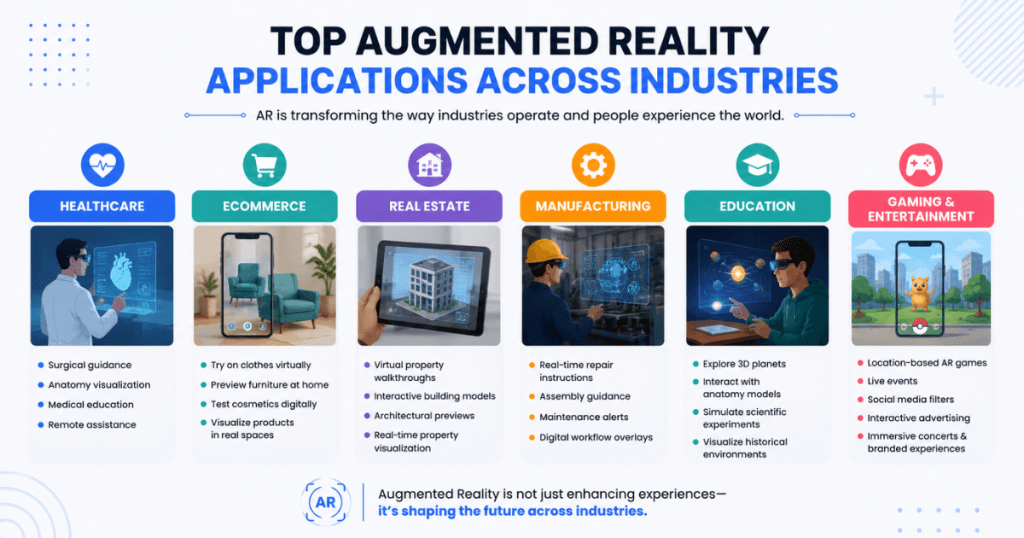
Augmented Reality Applications in Healthcare
Healthcare is one of the fastest-growing sectors for augmented reality. Doctors and surgeons now use AR for the following:
- surgical guidance
- anatomy visualization
- medical education
- remote assistance
Imagine a surgeon viewing 3D patient anatomy during a procedure like a live GPS system for surgery. AR also improves medical training by allowing students to interact with realistic simulations instead of relying only on textbooks.
Augmented Reality Applications in E-commerce
Online shopping has always struggled with one major challenge—customers cannot physically experience products before buying them.
AR solves this problem by allowing users to
- try on clothes virtually
- preview furniture at home
- test cosmetics digitally
- visualize products in real spaces
This improves customer confidence and helps reduce product return rates. One of the best-known examples is IKEA’s AR app, which lets customers place virtual furniture inside their homes before purchasing.
Augmented Reality Applications in Real Estate
The real estate industry is rapidly adopting immersive technologies to create more interactive property experiences.
AR helps businesses offer the following:
- virtual property walkthroughs
- interactive building models
- architectural previews
- real-time property visualization
This is especially valuable in luxury and off-plan real estate projects. The rise of AR/VR innovation in Dubai is also creating new opportunities for developers and technology providers.
Businesses working with DubaiITConsulting are increasingly building immersive real estate platforms that improve buyer engagement and support digital transformation.
Augmented Reality Applications in Manufacturing
Manufacturing companies use augmented reality applications to improve productivity and reduce operational errors.
Workers can receive:
- real-time repair instructions
- assembly guidance
- maintenance alerts
- digital workflow overlays
Imagine a technician repairing machinery while digital instructions appear directly on top of the equipment. Companies using industrial AR systems often report:
- faster employee training
- fewer operational mistakes
- improved efficiency
Augmented Reality Applications in Education
AR is making education far more interactive and engaging. Students can:
- explore 3D planets
- interact with anatomy models
- simulate scientific experiments
- visualize historical environments
Instead of simply reading information, students can experience learning in immersive ways.
Augmented Reality Applications in Gaming and Entertainment
Gaming remains one of the most recognizable AR sectors. Games like Pokémon GO showed how powerful location-based AR experiences can become.
Today, AR is expanding beyond gaming into the following:
- live events
- social media filters
- interactive advertising
- immersive concerts
- branded experiences
The entertainment industry is now blending physical and digital engagement like never before.
Real Company Case Studies Using AR
Real-world examples help demonstrate the true value of augmented reality applications across different industries. Many global brands are already using AR to improve customer experiences, streamline operations, and drive innovation.
IKEA and AR Commerce
IKEA transformed furniture shopping through AR visualization technology. Its AR app allows customers to place virtual furniture inside their homes before making a purchase.
This improved:
- customer confidence
- user engagement
- purchase decisions
- overall e-commerce experience
By helping shoppers visualize products in real spaces, IKEA reduced uncertainty and created a more interactive buying journey.
BMW and Industrial AR
BMW uses augmented reality to improve the following:
- manufacturing workflows
- maintenance support
- employee training
Workers receive real-time instructions through immersive AR systems, helping reduce operational complexity and improve efficiency on production floors.
Snapchat and AR Advertising
Snapchat revolutionized social media marketing with AR filters and branded lenses. These interactive experiences opened new opportunities for:
- immersive advertising
- digital brand engagement
- social commerce
Today, AR-based social experiences play a major role in modern digital marketing strategies.
Apple and Spatial Computing
The launch of Apple Vision Pro pushed immersive computing into mainstream business conversations. Apple’s focus on spatial computing highlights a future where digital experiences move beyond traditional screens and blend naturally into real-world environments.
Legal Compliance and Privacy in Augmented Reality
As augmented reality continues to evolve, privacy and compliance concerns are becoming increasingly important. Many augmented reality applications collect sensitive user information, including:
- location data
- facial mapping
- camera input
- user movement
- biometric data
This creates significant legal and security responsibilities for businesses developing AR solutions. Unlike traditional applications, AR systems interact directly with a user’s physical environment, making data protection and transparency even more critical.
To ensure safe and responsible implementation, companies must consider the following:
- GDPR compliance
- CCPA regulations
- biometric privacy laws
- healthcare data protection
- user consent policies
For healthcare-related AR systems, HIPAA compliance is especially critical to protect patient information and maintain data security. Similarly, e-commerce and retail AR platforms must ensure customer data is handled responsibly and securely.
Ethical AI practices also play a major role in building trust. Users want clear transparency about:
- how their data is collected
- where information is stored
- how tracking technologies operate
Ignoring these privacy concerns can seriously affect customer trust and brand reputation. That’s why many organizations work with experienced IT consultants to evaluate security, compliance, and risk management before deploying large-scale AR systems
Challenges Businesses Face With AR Adoption
Although augmented reality offers incredible opportunities, implementing AR solutions is not always simple. Many businesses underestimate the technical complexity, infrastructure requirements, and long-term investment involved in building scalable augmented reality applications.
Some of the most common AR adoption challenges include:
- expensive hardware
- high development costs
- compatibility issues across devices
- user adoption barriers
- battery limitations
- internet dependency
- 3D content creation expenses
Enterprise-grade AR systems also require:
- strong IT infrastructure
- cybersecurity planning
- scalable cloud environments
- continuous updates and maintenance
Another major challenge is accessibility. Not every customer or employee owns advanced AR headsets or smart glasses yet, which can limit adoption in certain markets.
Because of this, mobile-based AR experiences remain the most practical and widely accessible entry point for many businesses today. Smartphones already support many modern augmented reality applications, making AR easier to deploy at scale without requiring expensive hardware investments.
Why AR Adoption Is Growing in Dubai
Dubai is rapidly emerging as a hub for immersive technology and digital transformation. With major smart city initiatives and growing investments in innovation, businesses are increasingly adopting augmented reality applications across industries.
Some key sectors driving AR/VR innovation in Dubai include the following:
- real estate visualization
- luxury retail experiences
- tourism and hospitality
- healthcare technology
- smart infrastructure projects
Real estate developers are using augmented reality for interactive property walkthroughs and architectural previews, while retail brands are creating more immersive shopping experiences.
As demand for immersive technology grows, many businesses are partnering with trusted IT solutions companies and experienced IT consultants to build scalable AR strategies. Organizations working with DubaiITConsulting are increasingly exploring AR solutions to accelerate digital transformation and customer engagement.
Expert Insights on the Future of Augmented Reality
Industry experts believe augmented reality will become a core part of digital customer experience and enterprise transformation strategies over the next decade. As immersive technologies continue evolving, businesses are expected to use augmented reality applications not only for marketing and entertainment but also for training, remote collaboration, e-commerce, healthcare, and operational efficiency.
Technology leaders also predict that advances in AI, spatial computing, and wearable devices will make AR more accessible, interactive, and deeply integrated into everyday business operations.
The Future of Augmented Reality
The future of augmented reality looks incredibly promising — and in many ways, we’re still only at the beginning of its evolution. Over the next few years, AR is expected to become as common and essential as smartphones are today.
Several major trends are shaping the future of augmented reality applications, including:
- AI-powered AR assistants
- smart glasses
- spatial computing
- WebAR experiences
- immersive e-commerce
- industrial metaverse systems
- remote collaboration environments
Technologies like Microsoft HoloLens and Apple Vision Pro are already transforming how businesses interact with digital content and immersive workspaces. At the same time, ongoing innovations from Meta Reality Labs continue pushing the boundaries of immersive computing.
As AR technology becomes more advanced, accessible, and AI-driven, it is rapidly turning into a bridge between the physical and digital worlds. And with every new innovation, that bridge becomes even stronger.
Why Businesses Should Invest in AR Now
Waiting too long to adopt augmented reality may soon become a competitive disadvantage. Businesses investing early in augmented reality applications are already gaining the following:
- stronger customer engagement
- immersive brand experiences
- improved operational efficiency
- smarter digital transformation strategies
AR is no longer just a futuristic technology—it’s becoming a practical business solution across industries.
Companies working with trusted IT solutions companies can build scalable AR strategies aligned with long-term business growth. Organizations partnering with DubaiITConsulting are increasingly using immersive technologies to improve customer experiences and drive digital innovation.
Ready to Build Innovative AR Solutions?
Connect with DubaiITConsulting to develop scalable augmented reality applications for your business.
Conclusion
Augmented reality is no longer a futuristic concept sitting in research labs or sci-fi movies. It’s becoming part of how businesses operate, how consumers shop, how students learn, and how industries innovate.
From healthcare and manufacturing to e-commerce and real estate, augmented reality applications are reshaping the digital landscape at an incredible pace.
The combination of AI, spatial computing, smart devices, and immersive interaction is creating entirely new opportunities for businesses worldwide. Technologies powered by companies behind Apple Vision Pro, Microsoft HoloLens, and Meta Reality Labs are accelerating this transformation even further.
At the same time, successful AR adoption requires thoughtful planning, compliance awareness, strong infrastructure, and user-focused experiences.
Businesses that invest strategically today are positioning themselves for the next era of digital interaction.
And in many ways, that future has already started.
FAQ’s
1. What is augmented reality in simple words?
Augmented reality is a technology that adds digital content, like images, animations, or information, into the real world using devices such as smartphones, tablets, or smart glasses.
2. What are the most common augmented reality applications?
Some popular augmented reality applications include virtual try-ons, AR gaming, interactive learning, industrial maintenance systems, navigation apps, healthcare visualization tools, and real estate property walkthroughs.
3. What is the difference between AR and VR?
AR enhances the real world with digital overlays, while VR completely replaces the real world with a virtual environment using immersive headsets.
4. Is augmented reality expensive for businesses?
The cost depends on the complexity of the project. Mobile AR applications can be relatively affordable, while enterprise-grade AR systems involving smart glasses and custom infrastructure may require larger investments.
5. Why are businesses investing heavily in augmented reality today?
Businesses are investing in AR because it improves customer engagement, enhances training, supports digital transformation, increases operational efficiency, and creates more immersive user experiences across industries.