


Key Takeaways
- Managed IT replaces reactive, call-when-it-breaks support with proactive monitoring, patching and backup, so your team loses less time to downtime.
- A good provider improves efficiency by handling helpdesk, security and cloud administration, which frees staff to work on revenue rather than printers and passwords.
- Employee and customer experience improves when systems stay fast, secure and available, and when support answers within a defined SLA.
- Competing in Dubai’s fast-moving market means scaling IT without hiring a full in-house team for networking, cloud, security and helpdesk.
- Indicative SME budgets run from roughly AED 500 to AED 12,000+ per month, depending on users, SLAs and security depth.
- Compare scope, exclusions and 12-month total cost, never the headline monthly price alone.
- 24/7 monitoring and a SOC are not automatically included in every contract. Ask in writing.
Picture a 30-person trading firm in Business Bay. A laptop gets hit by a phishing link on Sunday night. Nobody notices until Monday at 9 a.m., when half the team can’t open shared files. That’s the break-fix model: you pay after the damage is done.
More Dubai companies are moving away from it. With managed IT services Dubai providers, a partner watches your systems continuously, patches them before attackers find the gaps, and answers the phone when something does go wrong.
The pressure behind the shift is real. Ransomware and phishing keep climbing, cloud setups have become a patchwork of Microsoft 365, Azure, AWS and on-premises servers, and hiring a full in-house team of network, cloud, security and helpdesk specialists is expensive. Managed services give you that bench on a predictable monthly fee.
There’s no single “best” provider, though. The right fit depends on your headcount, industry, cloud environment, security requirements and budget. This guide covers what managed IT includes, why it matters in the UAE, how we shortlisted providers, profiles of 15 companies, indicative AED pricing, and a checklist you can use before signing anything.
What Do Managed IT Services Dubai Providers Actually Offer?
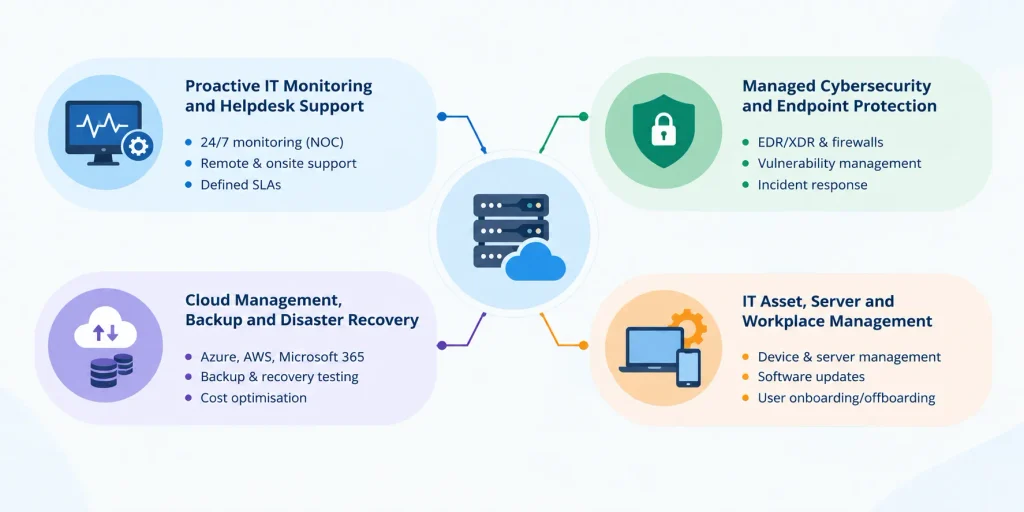
A managed IT services provider (MSP) takes ongoing responsibility for part or all of your technology under a monthly contract with defined service levels. Traditional IT support waits for a ticket. An MSP works from a schedule of monitoring, maintenance and reporting, and treats the ticket as the exception.
Most packages combine the four areas below. Scope varies a lot between providers, so treat this as a map of what to ask about, not a guarantee of what every contract contains.
Proactive IT Monitoring and Helpdesk Support
Monitoring is the heart of the model. Through a Network Operations Centre (NOC), engineers watch servers, networks and endpoints for warning signs such as failing disks, full storage, unusual traffic and expired certificates. Fixing a disk before it dies is cheaper than recovering data after.
The support side usually covers remote troubleshooting, onsite visits, ticket management and escalation to specialists. Everything hangs on the service-level agreement (SLA), which sets how fast the provider must respond and resolve issues at each severity level. A vague SLA is the most common weakness in cheap contracts.
Managed Cybersecurity and Endpoint Protection
Security services range from basic antivirus management to full Endpoint Detection and Response (EDR) or Extended Detection and Response (XDR), managed firewalls and continuous log monitoring. Good providers also run vulnerability scans, apply patches on a schedule, support incident response and train staff to spot phishing.
A dedicated Security Operations Centre (SOC) with SIEM monitoring is the premium layer. It makes sense for regulated industries, firms handling sensitive client data, and businesses large enough that one breach would be a board-level event. Smaller offices often get enough protection from managed EDR, email security and solid backups.
Cloud Management, Backup, and Disaster Recovery
Providers administer Microsoft 365, Azure, AWS, hybrid setups and remaining on-premises servers. The valuable part is backup that’s actually tested. A backup nobody has ever restored is a hope, not a plan. Ask how often recovery is tested, and what your recovery time and recovery point objectives are.
Cost control belongs here too. Cloud bills creep, and a provider that reviews unused licences and oversized virtual machines can pay for part of its own fee.
IT Asset, Server, and Workplace Management
This layer covers device inventory, software updates, access management, server administration and employee onboarding and offboarding, plus Microsoft 365 or Google Workspace administration. New starter on Monday? Their laptop, accounts and permissions should be ready before they arrive.
One caution: hardware purchases, software licences, cloud consumption and major migrations are often billed separately from the monthly fee. We’ll come back to that in the pricing section.
Why Dubai Businesses Need Managed IT Services
Cybersecurity Risks and Business Continuity
Dubai’s concentration of finance, real estate, logistics and hospitality makes it an attractive target. Ransomware, phishing and unpatched endpoints are the usual entry points, and a day of downtime hits payroll, client delivery and reputation at once. Continuous monitoring and tested recovery shorten the outage and, in many cases, prevent it.
Hybrid Cloud and Digital Transformation
Few companies run a single, clean environment. A typical SME has email in Microsoft 365, a finance system in the cloud, a file server in the office, and staff working from three countries. Someone has to keep identity, security and backup consistent across all of it.
That’s also where your wider technology stack comes in. If you’re building customer-facing apps alongside your infrastructure, a specialist mobile app development company Dubai businesses trust can design the application layer while your MSP keeps the environment underneath it secure, patched and available. Two partners, clear boundaries, fewer finger-pointing meetings.
Access to IT Expertise Without Hiring a Full Team
A single in-house IT generalist can’t be an expert in networking, cloud, security and helpdesk, and can’t cover holidays and sick days. Hiring one specialist per discipline is out of reach for most SMEs. Outsourced IT services UAE companies use give you a team for roughly the cost of one or two salaries, with cover when someone’s away.
UAE Compliance and Data Protection Considerations
Your provider will touch personal data, so compliance matters. Three regimes are worth knowing:
- Federal PDPL: Federal Decree-Law No. 45 of 2021 on the Protection of Personal Data came into force on 2 January 2022 and applies to onshore businesses, and to foreign companies processing data of people in the UAE.
- DIFC and ADGM: Entities inside these financial free zones follow their own data protection frameworks (DIFC Law No. 5 of 2020 and the ADGM Data Protection Regulations 2021), not the federal PDPL.
- Sector rules: Healthcare, financial services and government-related organisations may face additional requirements.
Data residency is a common point of confusion. Whether data must stay in the UAE depends on the applicable law, your sector, your contracts and the type of data. It’s not a blanket rule for every business. Ask your provider where data and logs are stored, and take legal advice for your specific case.
Quick Question: “Is managed IT just outsourced helpdesk?”— No. A helpdesk answers problems after they appear. Managed IT adds proactive monitoring, patching, backup management and often security, all under an SLA.
How We Evaluated the Managed IT Services Providers in Dubai
We built this list the way a buyer would shortlist: start from what’s published, then check the claims against more than one source. If you’re comparing the top IT companies in Dubai, a consistent method matters more than a long list.
Evaluation Criteria
- Relevance to SMEs and larger businesses.
- Breadth of managed IT and cybersecurity services.
- Cloud, backup and disaster recovery capabilities.
- Dubai presence and local support availability.
- Industry experience, certifications and technology partnerships.
- Pricing transparency, service scope and SLA clarity.
Important Note About the Provider List
This is an editorial shortlist. It isn’t a paid ranking, and it isn’t an independently audited performance ranking. Service portfolios, certifications and pricing change, so ask each provider to confirm current services, references and local delivery arrangements in writing. SISGAIN, which publishes this guide, appears first as an editorial choice. As its profile explains, its core strength is software and technology development, not a 24/7 helpdesk.
Top 15 Managed IT Services Providers in Dubai for Businesses and SMEs
Providers differ sharply in who they suit. Some are built for 10-person offices, others for Microsoft-centric mid-market firms, others for security-heavy enterprises. Each profile below covers what the company does, who it fits, where it’s strong and what to check.
1. SISGAIN Technologies
Positioning: Technology partner for businesses evaluating software-led IT solutions and digital transformation.
SISGAIN is a Dubai-based software and AI development company, founded in 2009 according to its Manifest profile, with a mid-sized team and work spanning artificial intelligence, AR/VR, blockchain and e-commerce. Its own materials describe custom software, mobile applications and enterprise systems.
That profile makes SISGAIN a different kind of entry from the infrastructure specialists below. If your technology plan includes building or modernising business applications, integrating systems, or planning a roadmap, it’s a natural conversation. For businesses with those needs, its custom software development Dubai services sit alongside the infrastructure support you’d still source from an MSP.
- Ideal for: Businesses whose needs centre on application development, software integration and connected business systems.
- Considerations: Software development and application support are not the same as a full managed IT contract with a 24/7 helpdesk, NOC or SOC. We haven’t verified those services for SISGAIN, so don’t assume them. Ask what’s covered before you rely on it.
- Next step: Describe your requirements and ask SISGAIN to confirm where it’s a fit and where you’d need a separate infrastructure partner.
2. Bluechip Computer Systems
Positioning: Broad managed IT and technology services for SMEs and enterprises.
Headquartered in Dubai with offices in Sharjah and Abu Dhabi, Bluechip says its 24/7 operations centre provides IT support and server monitoring to small and medium-sized organisations. Its service list includes helpdesk, IT outsourcing, server backup and disaster recovery, network infrastructure security and managed support.
- Ideal for: SMEs and enterprises wanting one provider across support, backup and infrastructure.
- Considerations: Confirm SLA terms, what “24/7” covers in practice, and whether onsite visits are included.
3. Pinnacle Computer Systems
Positioning: Infrastructure, virtualisation, backup and IT management.
Pinnacle has operated in the UAE since 1995 and reports more than 2,000 clients. Its listed services include virtualisation, backup and recovery, cloud migration and cybersecurity, plus ERP and CRM applications. That longevity suggests deep infrastructure experience, which is worth testing with references.
- Ideal for: Growing SMEs that need dependable infrastructure and recovery planning.
- Considerations: Confirm the included support scope and who pays for licensing.
4. Burhani Managed Services
Positioning: Microsoft-focused business IT and cloud services.
Burhani, headquartered in Oud Metha, Dubai, describes itself as a Microsoft partner focused on Microsoft 365, Azure and Dynamics 365, with managed IT support, backup and security. In 2017 it was announced as CompTIA’s first Premier Member in the Middle East, an industry-association credential rather than a service guarantee.
- Ideal for: Microsoft-centric SMEs and mid-market companies.
- Considerations: Check whether cloud optimisation, security monitoring and after-hours support are inside the monthly fee.
5. BlueRidge IT
Positioning: Cloud-first IT infrastructure and integration.
BlueRidge IT, based in Dubai Silicon Oasis with operations across the GCC, lists virtualisation, Azure, cloud migration and colocation among its services, with Microsoft, Oracle, HPE, HP and Dell as partners. Client testimonials on directory sites mention Office 365 migrations and Azure setups.
- Ideal for: SMEs pursuing cloud migration or hybrid infrastructure.
- Considerations: Verify current Dubai operations, service boundaries and migration fees.
6. IT Max Global
Positioning: Network, cloud and infrastructure support.
IT Max Global is positioned around managed networking, SD-WAN, DevOps and email security. Reliable connectivity matters most when you run several offices, warehouses or retail sites, since one weak link can stall a whole branch.
- Ideal for: SMEs with multi-site, network-heavy or cloud-connected operations.
- Considerations: Confirm which services are monitored continuously and which are project-based.
7. Create IT Dubai
Positioning: Business IT support with Microsoft 365 and security specialisation.
Create IT Dubai describes itself as a managed services company that speaks your language, with Microsoft 365 and cybersecurity as specialities. Directory listings show virtualisation, Azure, backup and recovery, and email security, with Microsoft, Ubiquiti, Webroot and SonicWall among its technology partners. Dubai workplaces are multilingual, so language support can matter in day-to-day service.
- Ideal for: SMEs needing accessible local IT assistance.
- Considerations: Confirm language availability, response commitments and onsite coverage.
8. Xedos Technology
Positioning: IT maintenance and support for smaller businesses.
Xedos is positioned around IT annual maintenance contracts (AMC) alongside infrastructure and managed IT support. An AMC and full proactive management are different products, and the cheaper one isn’t a smaller version of the other.
- Ideal for: Startups and small offices with straightforward IT needs.
- Considerations: Verify the advertised AMC price, included devices, visit limits, exclusions and emergency charges.
9. Meta Techs
Positioning: Security-led IT and infrastructure services.
Meta Techs leads with security alongside infrastructure management. If a breach would seriously hurt your business, such as a firm holding client financial records, security capability should weigh heavily in your choice.
- Ideal for: SMEs prioritising security alongside routine IT management.
- Considerations: Verify incident response coverage, monitoring arrangements and escalation procedures.
10. GSIT / Global Surf IT Infrastructure
Positioning: Cloud migration, modern workplace and data infrastructure.
GSIT focuses on modern workplace services, cloud and storage. Managed workplace services can simplify device rollouts, collaboration tools and employee support in one package.
- Ideal for: SMEs modernising collaboration and infrastructure.
- Considerations: Confirm the current service portfolio and exactly which responsibilities stay with you.
11. VRS Technologies
Positioning: IT support plus workplace technology services.
VRS Technologies delivers IT solutions and device rentals across the UAE, with managed IT, backup, cybersecurity, consulting and managed printing in its range. Bundling office technology can suit companies with mixed needs.
- Ideal for: SMEs needing several types of IT and office technology support.
- Considerations: Check whether IT support and managed printing sit under separate contracts.
12. iTAG Technologies
Positioning: Business IT, networking, enterprise systems and security.
Formed in 2004 and operating from Dubai, iTAG lists networking and Wi-Fi, managed IT, IT consulting, identity management, ERP and cybersecurity. Partners include Microsoft, Cisco, IBM and HPE. The ERP link is useful if you want operational systems and infrastructure handled by people who understand both.
- Ideal for: SMEs and enterprises with integrated business technology needs.
- Considerations: Confirm managed support depth, third-party responsibilities and service-level commitments.
13. Help AG
Positioning: Cybersecurity-focused services for security-intensive organisations.
Help AG, the cybersecurity arm of e& enterprise, is headquartered in Dubai. Its SOC achieved Dubai Electronic Security Center (DESC) CyberForce SOC certification, and the company has been named a Leader in the IDC MarketScape for Middle East Managed Detection and Response in both 2024 and 2025. Help AG reports a team of about 200 analysts and engineers in its managed security operations. That’s strong, independently referenced evidence for security depth, though it’s a security specialist, not a general helpdesk.
- Ideal for: Enterprises and regulated organisations with substantial cybersecurity requirements.
- Considerations: Compare service tiers, monitoring scope, onboarding costs and fit for smaller budgets.
14. ZainTECH
Positioning: Enterprise cloud, hybrid infrastructure, security and digital transformation.
ZainTECH is Zain Group’s Dubai-based digital solutions arm, established in 2021. It acquired managed cloud provider BIOS Middle East, which had served 300+ clients since 2002, and launched an AI-powered managed security service backed by SOCs in the UAE, Saudi Arabia and Jordan. Its portfolio spans hybrid and multi-cloud, disaster recovery, cybersecurity and data services.
- Ideal for: Mid-market organisations and enterprises with multi-platform requirements.
- Considerations: Confirm minimum engagement size, service availability and total contract cost.
15. Alpha Data
Positioning: Enterprise IT integration and managed technology services.
Alpha Data was established in 1981 and is listed on the Abu Dhabi Securities Exchange. It reports Solutions, Services and Talent segments, with managed services, support and maintenance, and consulting in the services line. It launched its Alpha Cloud public cloud service in the UAE in 2015, and was named Microsoft’s UAE Country Partner of the Year that same year.
- Ideal for: Mid-market and enterprise organisations.
- Considerations: Confirm the precise managed services scope, Dubai delivery arrangements and SLA structure.
Managed IT Services Dubai Comparison Table
Use this table to shortlist two or three providers, then request written proposals from each. The columns reflect what each company publicly emphasises, not a verified performance score.
| Provider | Primary fit | Key capability to verify | Buyer priority |
|---|---|---|---|
| SISGAIN Technologies | Software-led technology requirements | Managed IT scope and infrastructure support | Application and integration needs |
| Bluechip Computer Systems | SMEs to enterprises | Managed IT and cybersecurity | Broad IT coverage |
| Pinnacle Computer Systems | Growing SMEs | Backup and infrastructure management | Resilience |
| Burhani Managed Services | Microsoft-centric SMEs | Microsoft cloud and support | Microsoft ecosystem |
| BlueRidge IT | Cloud-first SMEs | Azure and hybrid infrastructure | Cloud modernisation |
| IT Max Global | Network-heavy SMEs | Managed networking and cloud | Connectivity |
| Create IT Dubai | Bilingual SMEs | Workplace support and backup | Local assistance |
| Xedos Technology | Small businesses | AMC and proactive support | Budget control |
| Meta Techs | Security-conscious SMEs | Managed security capabilities | Risk reduction |
| GSIT | Modern workplace users | Cloud and workplace management | Collaboration |
| VRS Technologies | Mixed IT requirements | Managed IT and workplace services | Consolidated support |
| iTAG Technologies | SMEs to enterprises | Networking and integrated systems | Business systems |
| Help AG | Security-first enterprises | SOC, MDR/XDR and SIEM | Advanced security |
| ZainTECH | Mid-market and enterprise | Hybrid cloud and DR | Complex infrastructure |
| Alpha Data | Mid-market and enterprise | Integrated managed IT | Broad technology portfolio |
This is a preliminary editorial comparison. Verify current capabilities before you decide.
How Much Do Managed IT Services Dubai Cost?
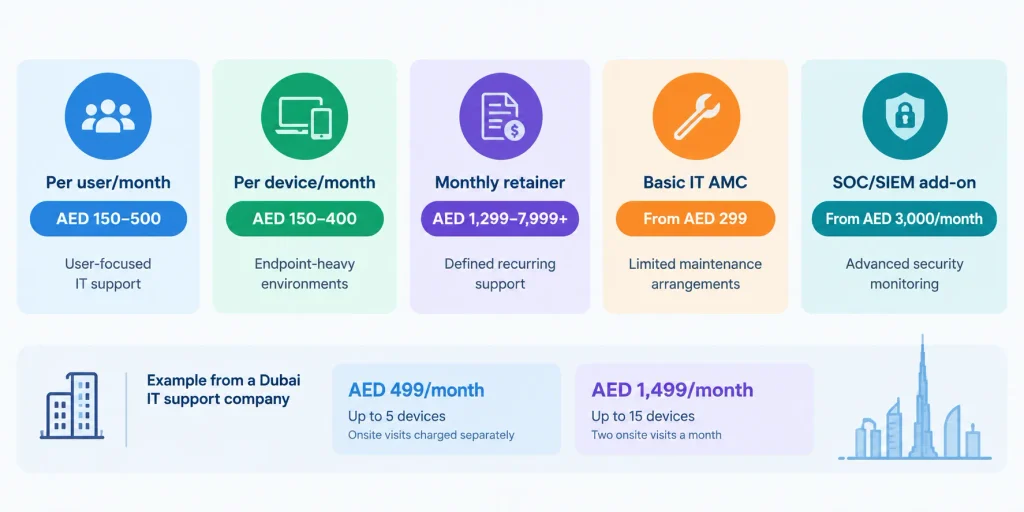
Short answer: it depends on your user count, device count, servers, office locations, security requirements, support hours and SLA commitments. Two companies with 25 staff can pay very different fees if one needs a SOC and the other doesn’t.
Typical Managed IT Services Pricing Models
| Pricing model | Indicative range | Typical use |
|---|---|---|
| Per user/month | AED 150–500 | User-focused IT support |
| Per device/month | AED 150–400 | Endpoint-heavy environments |
| Monthly retainer | AED 1,299–7,999+ | Defined recurring support |
| Basic IT AMC | From AED 299 | Limited maintenance arrangements |
| SOC/SIEM add-on | From AED 3,000/month | Advanced security monitoring |
These figures are indicative market ranges from our research, not quotes from any listed provider. For a real-world reference point, one Dubai IT support company publishes plans from AED 499 a month (up to 5 devices, onsite visits charged separately) and AED 1,499 a month (up to 15 devices, two onsite visits a month). Note how much the small print changes what you’re actually buying.
Estimated Monthly IT Support Budgets for SMEs
| Business size | Indicative monthly budget | Likely requirements |
|---|---|---|
| Micro office, up to 10 users | AED 500–1,500 basic; around AED 1,300+ for fuller support | Helpdesk, patching, basic endpoint security |
| Small business, 10–40 users | AED 1,500–4,000 | Monitoring, backup, broader support |
| Mid-market, 40–150 users | AED 4,000–12,000+ | Tighter SLAs, extended coverage, possible SOC |
Hidden Costs to Check Before Signing
- Onboarding fees and infrastructure audits.
- Microsoft 365, security, backup and other software licences.
- Cloud consumption, hardware and replacement equipment.
- Major migrations, after-hours callouts and onsite visits outside the agreed scope.
- Data recovery, incident response and third-party vendor fees.
Quick Question: “Should I pick the cheapest quote?”— Rarely. Compare what each quote includes first. A lower monthly fee with large exclusions often costs more across 12 months than a fuller plan.
IT AMC vs. Managed IT Services Dubai
An annual maintenance contract (AMC) and managed IT can look similar on a price list. In practice they behave very differently.
What Does an IT AMC Usually Include?
- Scheduled maintenance and break-fix support.
- Limited onsite visits or business-hours assistance.
- Basic troubleshooting, depending on the contract.
- A lower headline cost, but extra charges for work the contract excludes.
How Managed IT Services Differ
- Continuous or scheduled monitoring, depending on the agreed service.
- Proactive patching, asset management and preventive maintenance.
- Defined support SLAs, escalation paths, backup management and optional managed security.
- More predictable recurring costs when exclusions are clearly documented.
Which Option Is Right for Your Business?
- Basic AMC: Very small offices with simple infrastructure and limited operational risk.
- Managed IT: Growing SMEs that rely on technology daily and want predictable support.
- Co-managed IT: Businesses with an internal IT person or team that needs specialist backup and out-of-hours cover.
One point to underline: 24/7 monitoring and SOC coverage are not automatically part of every managed IT contract. If you need them, name them in the scope.
How to Choose the Best Managed Service Provider Dubai Businesses Can Rely On
The best managed service provider Dubai companies can pick is the one whose scope, SLAs and references match your situation. Here’s a practical framework.
Verify Dubai Presence and Support Availability
- Confirm the actual local office or delivery arrangement.
- Ask whether onsite engineers and a local account manager are available.
- Establish support hours, emergency coverage and escalation contacts.
Check Certifications, Partnerships, and Industry Experience
- Verify relevant certifications such as ISO 27001 or ISO 20000, where applicable.
- Confirm that claimed partnerships with Microsoft, Cisco, Fortinet, VMware or others are current.
- Ask for references from businesses of similar size and industry.
- Don’t treat a technology partnership as proof of service quality.
Larger organisations comparing technology consulting firms in the Middle East should also ask about regional delivery, because a multi-country SOC or cloud footprint changes what’s possible on data handling and support hours.
Review SLAs and Security Responsibilities
- Request response and resolution targets for each severity level.
- Define incident escalation, backup recovery objectives, patching responsibilities and reporting.
- Clarify who handles security incidents, regulatory notifications and third-party systems.
Compare Total Cost of Ownership
- Compare 12-month costs, including onboarding, licences, cloud consumption, security tools and out-of-scope work.
- Request a complete written scope rather than comparing headline monthly prices.
- Consider a paid pilot or short initial contract before committing long term.
Why Businesses Should Assess Their IT Needs Before Choosing a Provider
The lowest-cost provider may not meet your security, uptime or growth requirements. Before you request quotes, write down your current systems, your biggest pain points, known security risks, support expectations and growth plans for the next two years.
An independent review can sharpen that list. Many companies start with Technology Consulting Services in Dubai to map their environment, then shortlist providers against a clear brief.
With a documented needs assessment, you can compare IT support companies in Dubai on scope and measurable outcomes, such as response times, recovery objectives and coverage hours, rather than on price alone.
Frequently Asked Questions
How Much Do Managed IT Services Cost in Dubai?
Indicative market ranges are AED 150–500 per user per month, AED 150–400 per device per month, or a monthly retainer from about AED 1,299 to AED 7,999+. Your quote depends on scope and SLA, so ask for itemised proposals.
What Is the Difference Between IT AMC and Managed IT Services?
An AMC is typically reactive: scheduled maintenance plus break-fix support with limited visits. Managed IT is proactive and recurring, with monitoring, patching and defined SLAs. Inclusions vary by contract, so read the exclusions.
How Can I Find IT Support for Small Business Dubai?
Start by defining your user count, devices, business hours, onsite needs, security requirements and budget. Then compare two or three providers on written scope. For IT support for small business Dubai companies often need, the key questions are how fast the provider responds and what costs extra.
Are Outsourced IT Services UAE Businesses Use Suitable for SMEs?
Yes, in many cases. Outsourcing gives SMEs access to specialist skills and scalable support without hiring a full in-house team. It works best when responsibilities and SLAs are documented.
Do Managed IT Providers Need to Store Business Data in the UAE?
Not always. Data-location obligations depend on the applicable legislation, your industry, contractual commitments and the type of data. Ask your provider where data and logs are stored and seek legal advice for regulated sectors.
Can a Managed IT Provider Support an Existing In-House IT Team?
Yes. That’s co-managed IT. The provider handles specialist escalation, after-hours cover or security tooling while your team keeps day-to-day ownership. Define who owns what from the start.
What Should I Check Before Signing a Managed IT Contract?
Review the service scope, SLAs, security responsibilities, exclusions, renewal terms, data access and exit arrangements. Make sure you can retrieve your data and get transition help if you leave