

Key Takeaways
- A video-consultation app isn’t a clinical platform. Records, consent, access control and audit trails sit behind every call.
- Secure telemedicine platform cost in Dubai runs from an illustrative AED 80,000 to AED 1,200,000+, depending on scope, integrations and risk profile.
- The cheapest quote often leaves out EHR integration, security testing and disaster recovery. You pay for them later.
- Dubai adds DHA telehealth standards, NABIDH integration and UAE health-data rules to your scope, and each one affects budget.
- Compare vendors on a three-year total cost of ownership, not the build price alone.
- Budgeting security early cuts rework, speeds approvals and keeps you competitive as patient expectations rise.
Most telemedicine demos look finished. A patient books a slot, the doctor appears on screen, the call connects. Then a clinic owner asks where the consultation note goes, who can open it, and how the platform talks to the existing medical record system. The answers change the secure telemedicine platform cost.
That gap is why secure telemedicine platform cost is so hard to pin down from a first quote. Vendors can price the visible screens low and leave out EHR integration, consent management, identity controls, security testing, audit trails and hosting decisions. Those items aren’t extras for a clinical product. They’re the product.
This guide is a practical cost-planning tool for Dubai providers. It covers three deployment levels (a single-clinic MVP, a multi-clinic platform and an enterprise hospital deployment) and shows what each adds. If you’re weighing partners for Healthcare App Development Dubai, use it to test every secure telemedicine platform cost proposal you receive.
How Much Does a Secure Telemedicine Platform Cost in Dubai?
Secure telemedicine platform cost in Dubai typically falls between AED 80,000 and AED 1,200,000+ to develop. The spread depends on how many clinics, user roles, integrations and security controls the platform must support.
Estimated Development Cost by Platform Scope
These are illustrative planning ranges to validate during discovery. They aren’t official market tariffs or regulatory fees.
| Platform type | Illustrative development budget |
|---|---|
| Single-clinic telemedicine MVP | AED 80,000–180,000 |
| Multi-clinic telemedicine and EHR platform | AED 200,000–500,000 |
| Enterprise hospital deployment | AED 500,000–1,200,000+ |
Treat these secure telemedicine platform cost ranges as starting assumptions. Final numbers move with integrations, security depth, vendor rates, data migration and procurement requirements. They don’t imply that every DHA or NABIDH-related requirement is automatically covered. That’s something to confirm line by line.
What Is Included in These Estimates?
A realistic proposal at these levels covers:
- A patient-facing app or portal and a clinician dashboard
- Appointment scheduling, video consultations and notifications
- Backend development, database architecture and administrative tools
- Security controls, testing, deployment and documentation appropriate to the defined scope
- Integration work, but only where the proposal explicitly names it
That last line matters most. Anyone researching telemedicine app development cost should read the exclusions page before the price page. If a vendor and a UAE-based telemedicine app development UAE team quote the same feature list, the difference usually hides in what each assumes you’ll add later.
Why the Lowest Quote May Not Be the Lowest Total Cost
A basic proposal can leave out EHR integration, security testing, disaster recovery, access governance and ongoing monitoring. None of that disappears. It comes back as change requests, delayed go-live dates and a second vendor brought in to patch gaps. Rework on a live clinical system always pushes secure telemedicine platform cost above what planning it in at the start would have.
Why Standard Telemedicine App Quotes Miss the Real Cost
Quotes that understate secure telemedicine platform cost price a video application, while healthcare buyers need a clinical system. The difference is identity, consent, records, clinician access and evidence, none of which show up on a feature list.
Video Consultations Are Only One Part of the Product
A video-calling app connects two people. A clinical platform must also verify who each person is, capture consent, pull up the right medical record, support prescriptions where appropriate, control which clinicians see what, and store encounter documentation in a form the facility can defend later.
Security Must Be Designed Into the Architecture
Security bolted on after launch costs more and protects less. The architecture should account for:
- Encryption in transit and at rest
- Multi-factor authentication and role-based access
- Secure APIs and session management
- Audit logs and access monitoring
- Vulnerability assessments and penetration testing
Strong telemedicine security starts with these decisions at the design stage, before a single screen is built. Designing these controls in early keeps secure telemedicine platform cost lower than retrofitting them.
Compliance Readiness Requires Evidence
“Our software is secure” isn’t evidence. Hospital procurement teams and clinic owners increasingly ask for documented data flows, access matrices, security test results, incident-response procedures and supplier agreements. Producing those documents takes engineering and analyst time, and it belongs in the estimate.
A realistic healthcare software development cost estimate separates functional features from the engineering and operational controls that keep those features safe.
Seven Cost Components That Shape a Secure Telemedicine Platform
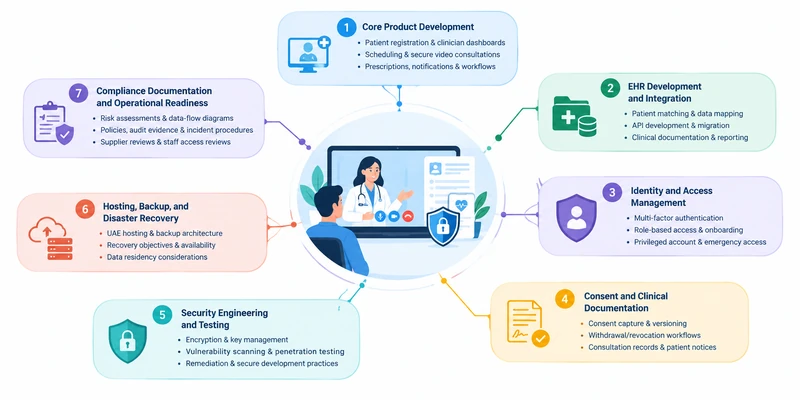
Here’s the core formula to use when comparing any proposal:
Total platform investment = core product + EHR/interoperability + security controls + compliance readiness + hosting and resilience + ongoing operations.
The seven components below show what each part buys and why scope changes secure telemedicine platform cost.
1. Core Product Development
This is the visible part: patient registration, clinician dashboards, scheduling, secure video, prescriptions where appropriate, notifications and administrative workflows. Effort climbs with custom workflows, Arabic and English interfaces and multiple user roles. A platform serving GPs, dermatologists and mental-health clinicians needs different consultation templates for each.
2. EHR Development and Integration
Building an EHR and connecting telemedicine software to one are very different jobs. Integration covers patient matching, clinical data mapping, API development, migration and integration testing. A full build adds clinical documentation, orders, results and reporting.
That’s why custom EHR software cost sits far above the cost of adding teleconsultation to a system you already run. Total EHR development cost depends heavily on which path you choose. If you’re shortlisting EMR software developers in UAE, ask each to price both options side by side.
3. Identity and Access Management
Multi-factor authentication, role-based access, clinician onboarding and offboarding, privileged-account management and emergency “break-glass” access all need design and testing. Policies grow complicated across facilities and specialties. A nurse at one clinic shouldn’t see a patient’s record from another unless a rule says so.
4. Consent and Clinical Documentation
Consent isn’t a checkbox. You need capture, versioning, withdrawal or revocation workflows, timestamps, patient notices and consultation records. Each requirement shapes both the interface and the backend data model. Changing it after launch means touching both.
5. Security Engineering and Testing
This workstream includes encryption, key and secrets management, API protection, vulnerability scanning, secure development practices, penetration testing and remediation. Your healthcare software security budget should list testing and remediation separately wherever the vendor treats them as separate workstreams. Findings from a penetration test are only useful if secure telemedicine platform cost includes paying someone to fix them.
6. Hosting, Backup, and Disaster Recovery
Cover UAE hosting assessment, backup architecture, recovery objectives, availability targets, monitoring and data-residency considerations. High availability and fast recovery add infrastructure and engineering effort to secure telemedicine platform cost. A clinic that can tolerate a few hours of downtime needs a different design from a hospital that can’t.
7. Compliance Documentation and Operational Readiness
Risk assessments, data-flow diagrams, policies, audit evidence, incident procedures, supplier reviews and staff access reviews all take effort. Software development supports compliance. It doesn’t independently guarantee regulatory approval, and any vendor who promises otherwise deserves a second look.
Quick question: “What’s the biggest hidden cost in a telemedicine project?”— EHR integration. Patient matching, data mapping and testing against a live record system routinely take longer than the video feature itself.
How DHA, NABIDH, and UAE Data Rules Affect Development Costs
Dubai’s rules turn consent, records, interoperability and hosting into budget lines. Some are legal requirements, some are recommended practice, and some are simply vendor choices. Keeping those three apart stops you overpaying or under-scoping.
DHA Telehealth Requirements and Clinical Workflows
The Dubai Health Authority published Standards for Telehealth Services (Version 4) with an issue date of 26 September 2025 and an effective date of 26 November 2025. Its chapters cover registration and licensure, health facility requirements, healthcare professional requirements, patient consent and health record management, among others. DHA circulated it to facilities under External Circular CIR-2025-00000212.
In practice, that influences consent flows, clinical documentation, provider workflows and patient communication. Read the current standard directly before you finalise scope, because standards get revised.
NABIDH Integration and Interoperability Planning
NABIDH is Dubai’s health information exchange, run by DHA. Connecting to it is where healthcare interoperability cost appears in the budget:
- Data mapping and supported interfaces
- Patient identity matching
- Clinical terminology and data validation
- Error handling and reconciliation
- Integration testing and operational monitoring
NABIDH publishes its policies on nabidh.ae, including audit and authentication and authorisation policies that affect how your system logs and controls access. Scope, technical prerequisites and onboarding requirements differ by provider and system, so confirm them with DHA for your facility. Teams that deliver HIE software development services in UAE will typically map this before quoting.
UAE Health-Data Hosting and Privacy Considerations
Federal Law No. 2 of 2019 on the use of ICT in health fields is the starting point. Under Article 13, health data related to services in the UAE can’t be stored, processed, generated or transferred outside the country unless an approved exception applies. Ministerial Decision No. 51 of 2021 lists those exceptions, such as data tied to patients treated abroad or samples sent to overseas labs.
Hosting, cross-border flows, supplier responsibilities and the UAE’s wider personal-data protection rules all need legal and technical review. No single hosting setup automatically satisfies every obligation. Get both a lawyer and an architect to sign off. You can search the federal texts on the UAE Legislation portal.
Why These Requirements Change the Budget
Each requirement adds design, integration, testing, documentation or maintenance work. Consent shapes the interface. NABIDH shapes the integration layer. Data-residency rules shape hosting and vendor choices. None of this is optional padding. It’s the part of secure telemedicine platform cost that comes from operating legally in Dubai.
Security and Compliance Cost by Deployment Scenario
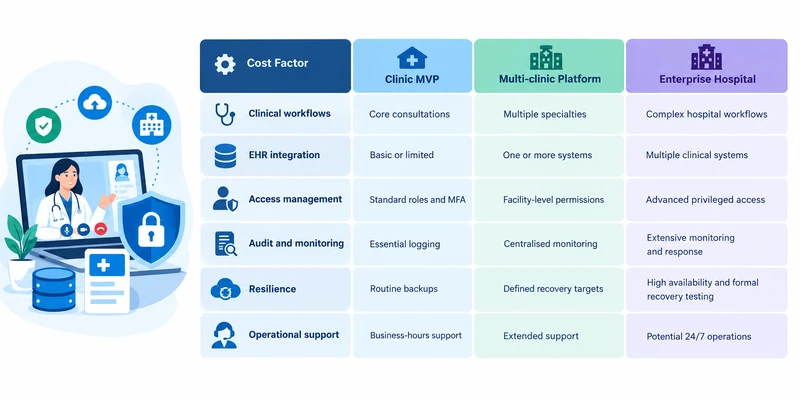
Scope drives secure telemedicine platform cost more than screen count. The table shows how the same platform changes as it grows.
| Cost factor | Clinic MVP | Multi-clinic platform | Enterprise hospital |
|---|---|---|---|
| Clinical workflows | Core consultations | Multiple specialties | Complex hospital workflows |
| EHR integration | Basic or limited | One or more systems | Multiple clinical systems |
| Access management | Standard roles and MFA | Facility-level permissions | Advanced privileged access |
| Audit and monitoring | Essential logging | Centralised monitoring | Extensive monitoring and response |
| Resilience | Routine backups | Defined recovery targets | High availability and formal recovery testing |
| Operational support | Business-hours support | Extended support | Potential 24/7 operations |
Which Deployment Model Should You Choose?
When you compare secure telemedicine platform cost across these three models, ask which one matches your clinical risk, not your ambition.
- Clinic MVP: Validates demand and launches a limited clinical workflow.
- Multi-clinic platform: Fits providers with several locations, specialties and existing EHR systems.
- Enterprise hospital deployment: Suits complex environments needing extensive integrations, resilience, governance and operational support.
An MVP should cut features, not security controls. A small clinic still handles identifiable health data, so the controls must match the actual clinical risk. Strong EHR security doesn’t scale down just because the user count does, and it affects EHR development cost at every tier.
One-Time Development Costs vs. Recurring Security Expenses
One-time costs get you to launch. Recurring costs keep you safe and compliant afterwards. Budget both in your secure telemedicine platform cost plan, because the second list is the one buyers forget.
One-Time Costs to Budget Before Launch
- Discovery and requirements workshops
- UX/UI design
- Application development
- Integrations and data migration
- Security architecture and testing
- Deployment and initial documentation
Recurring Costs After Go-Live
- Hosting, storage, backups and monitoring
- Security updates and vulnerability remediation
- Access reviews and privileged-account administration
- Periodic penetration testing and retesting
- Incident-response readiness and support
- Integration maintenance and regulatory change assessments
Before launch, a healthcare cybersecurity assessment gives you a baseline of risks and a prioritised remediation list, which makes the recurring healthcare software security budget far easier to size.
How to Estimate the Total Cost of Ownership
Judge secure telemedicine platform cost over three years, not by the first invoice. Ask each vendor to itemise setup fees, recurring service charges, usage-based fees, third-party licensing and change requests.
Three-year TCO = initial build + integration and setup + 36 months of operating expenses + planned upgrades and retesting.
Fill the formula with vendor quotes and your own workload assumptions. Generic percentages sold as universal benchmarks rarely fit a specific facility, and they distort secure telemedicine platform cost.
Quick question: “How often should penetration testing happen?”— At minimum before launch and after major changes, with a regular schedule set by your risk assessment and any applicable requirements. Retesting after fixes should be in the quote.

How to Compare Vendor Quotes for Secure Healthcare Software
To compare secure telemedicine platform cost fairly, ask every vendor the same questions and score what they won’t commit to in writing. Vague answers usually point to hidden cost.
Questions to Ask Before Signing a Development Contract
- Does the proposal include security architecture and threat modelling?
- Which EHR interfaces and NABIDH-related activities are included?
- Are consent workflows, audit logs, MFA and privileged access covered?
- Is penetration testing included, and who pays for remediation?
- Where will health data be stored, processed and backed up?
- What are the disaster-recovery objectives and support hours?
- Who owns the source code, documentation and integration assets?
- Which recurring charges and third-party fees are excluded?
Providers specialising in secure healthcare software development should answer all eight in writing, with deliverables attached.
Red Flags in a Healthcare Software Proposal
Be wary of phrases like “fully secure,” “100% compliant” or “all integrations included.” Without measurable deliverables and acceptance criteria, they say nothing about real secure telemedicine platform cost. Ask what test proves each claim and who signs it off.
Use a Scope-Based Cost Checklist
Use a checklist that makes you confirm feature scope, user volumes, facilities, integrations, security controls, documentation, hosting, testing and support before you request quotes. A downloadable version is useful for buyers preparing an RFP or comparing vendors.
Is HIPAA-Compliant App Development Cost Relevant to Dubai Healthcare Providers?
Sometimes, but not by default. HIPAA is a US law, and it isn’t a blanket requirement for every telemedicine product built or run in Dubai. Don’t let it inflate your secure telemedicine platform cost unless your scope truly requires it.
When HIPAA May Apply
HIPAA is relevant to covered entities, business associates and applicable US-linked arrangements. A Dubai clinic serving only Dubai patients under DHA licensing generally isn’t in scope. A platform that processes data for a US healthcare customer may be.
Separate HIPAA Scope From Local Regulatory Requirements
HIPAA compliant app development cost depends on the actual US compliance scope, contractual responsibilities, risk assessment, safeguards and evidence required. It doesn’t replace local obligations. UAE projects still need their own assessment of DHA requirements, NABIDH obligations, UAE health ICT legislation and relevant personal-data protection rules.
Define your operating markets and legal duties before you accept any compliance quote.
How to Reduce Development Costs Without Weakening Security
You reduce secure telemedicine platform cost by narrowing scope and planning properly, not by dropping controls.
Integrate With Existing Systems Where Practical
If your clinics already run a capable EHR, connecting to it is often cheaper than building a complete record-management platform. Rebuilding a record system only makes sense when the current one can’t be extended.
Prioritize Features by Clinical Risk and Business Value
Release in phases. Reuse components. Write clear integration specifications. Run early architecture reviews, when changes are still cheap. Teams that plan this way keep telemedicine app development cost predictable.
Avoid Paying Twice for Missing Requirements
Discovery workshops, acceptance criteria, security testing plans and explicit exclusions prevent redesigns. A modest, well-defined healthcare software security budget set at the start costs less than emergency fixes after an incident or failed audit.
Get a Dubai-Specific Estimate for Your Telemedicine and EHR Platform
A reliable secure telemedicine platform cost estimate starts with a clear brief. Before requesting a quote, prepare:
- Number of clinics, facilities, specialties and expected users
- Existing EHR/EMR systems and integration requirements
- Required patient and clinician features
- NABIDH scope and any known technical prerequisites
- Arabic and English interface requirements
- Hosting, backup, recovery and security expectations
- Support hours and ongoing maintenance needs
Build a Secure Telemedicine Platform With a Clearer Cost Plan
Request a tailored secure telemedicine platform cost estimate covering product development, EHR integration, healthcare security controls, compliance readiness and ongoing operations, not just video consultations. Whether you build with an in-house team or a partner, test your scope against the real requirements first, and bring in a Cybersecurity Company Dubai for an independent security review before you sign.
FAQs
How much does secure telemedicine platform cost in Dubai?
Illustrative planning budgets run AED 80,000–180,000 for a single-clinic MVP, AED 200,000–500,000 for multi-clinic platforms, and AED 500,000–1,200,000+ for enterprise hospitals. Final figures depend on scope, integrations and discovery.
What drives secure telemedicine platform cost the most?
EHR integration, identity and access controls, consent workflows, security testing, hosting resilience and compliance documentation usually add more than video features. Scope and integrations matter more than screen count.
Does a telemedicine platform in Dubai need NABIDH integration?
NABIDH is DHA’s health information exchange. Whether and how your facility connects depends on its licence type and systems, so confirm scope, prerequisites and onboarding requirements directly with DHA.
What is the DHA telehealth standard?
DHA’s Standards for Telehealth Services, Version 4, took effect on 26 November 2025. It covers licensure, facility and professional requirements, patient consent and health record management for telehealth in Dubai.
Can health data be hosted outside the UAE?
By default, no. Federal Law No. 2 of 2019 restricts storing or transferring health data abroad unless an approved exception applies, such as Ministerial Decision 51 of 2021. Seek legal advice.
Is HIPAA compliance required for telemedicine apps in Dubai?
Not by default. HIPAA applies to US covered entities, business associates and US-linked arrangements. Dubai providers must still assess DHA, NABIDH, UAE health ICT and personal-data protection requirements.
Why is the cheapest telemedicine quote often the most expensive?
Low quotes often exclude EHR integration, security testing, disaster recovery and monitoring. Those return later as change requests, delays and extra vendors, raising total cost above a properly scoped proposal.
What recurring costs should I budget after launch?
Budget hosting, backups, monitoring, security updates, access reviews, penetration retesting, incident-response readiness, integration maintenance and regulatory change assessments. Estimate them over three years rather than only the first invoice.
Is building a custom EHR more expensive than integrating with an existing one?
Usually yes. A custom EHR needs clinical documentation, orders, results and reporting, while integration mainly covers patient matching, data mapping, APIs and testing. Connect to a capable existing system when practical.
How do I compare vendor proposals for secure telemedicine platform cost?
Ask every vendor the same questions: what security architecture, EHR interfaces, testing, hosting location, recovery targets, source-code ownership and recurring fees are included. Reject vague claims like “100% compliant.”