

Key Takeaways
- Security is a lifecycle, not a feature. Secure healthcare software development covers design, build, release, operation and exit, so judge vendors on process, not on a badge.
- “HIPAA compliant” is not enough for secure healthcare software development in Dubai. DHA, NABIDH and UAE data-protection obligations need their own evidence.
- Vendor access is your exposure. Developers, support staff and cloud admins can reach patient data, so control and record that access.
- Ask for proof, not promises. Data-flow diagrams, pen-test summaries and redacted audit logs separate prepared vendors from polished ones.
- Score vendors on weighted criteria. A scorecard turns secure healthcare software development claims into numbers you can compare and speeds up approvals.
- Write security into the contract. If a promise influenced your decision, it belongs in the agreement.
- Early diligence saves money. Investing in secure healthcare software development up front beats fixing security after go-live, which costs more, slows clinicians down and gives competitors room to pull ahead in a fast-moving market.
Before You Sign a Healthcare Software Contract, Ask These Security Questions
A hospital CIO in Dubai once told us the worst part of a vendor review wasn’t finding a weakness. It was finding it after the contract was signed.
Healthcare software security isn’t about encryption or a “HIPAA-compliant” logo. In Dubai, you also have to account for DHA requirements, NABIDH interoperability, UAE data-protection law, vendor access, cloud hosting, AI processing, auditability and incident response. Miss one, and the gap becomes your problem.
That’s why choosing a healthcare software development company takes technical and operational due diligence, not just a demo and a price. Secure healthcare software development is a lifecycle responsibility. It starts at requirements and doesn’t end at go-live.
This guide gives you 15 questions to ask before you sign, the evidence to request, and the red flags that should slow you down. It’s built for healthcare software vendor due diligence, and for anyone accountable for secure healthcare software development decisions. Use it in procurement meetings.
What goes wrong when security questions come too late:
- Unclear data residency
- Offshore production access nobody disclosed
- Weak or missing audit trails
- Poorly controlled third-party components
- Patient data flowing into AI tools
- No tested disaster recovery
- Contracts that promise nothing measurable
IBM’s annual Cost of a Data Breach research has ranked healthcare as the most expensive industry for breaches for over a decade. The cost of asking questions early is small by comparison.
What Secure Healthcare Software Development Really Means in Dubai
Secure healthcare software development is the practice of building, testing, hosting and maintaining clinical or patient-facing software with security controls embedded at every stage, so patient data stays protected, auditable and compliant with local regulation.
That’s broader than application code. Secure healthcare software development includes the infrastructure, the people who touch it and the contract that holds the vendor accountable.
Security Must Cover the Entire Healthcare Software Lifecycle
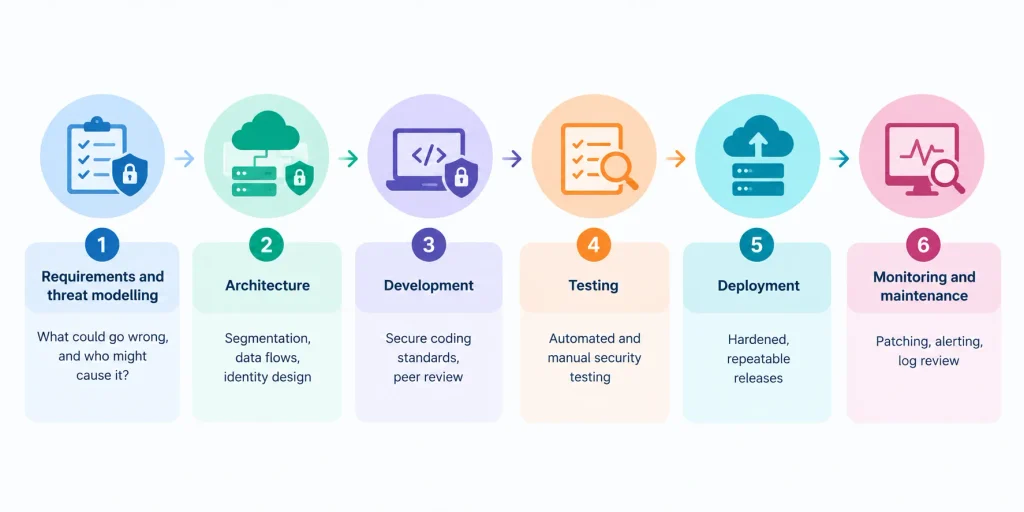
In secure healthcare software development, secure SDLC healthcare practice means security is present from the first requirements workshop through post-launch maintenance. A mature vendor can show you how each stage works:
- Requirements and threat modelling: What could go wrong, and who might cause it?
- Architecture: Segmentation, data flows, identity design
- Development: Secure coding standards, peer review
- Testing: Automated and manual security testing
- Deployment: Hardened, repeatable releases
- Monitoring and maintenance: Patching, alerting, log review
- Incident response and decommissioning: Evidence preservation, secure deletion
Compliance Is Only One Part of Vendor Security
Regulatory alignment, technical security, operational security, vendor security and contractual accountability are five different things. A vendor can be strong on one and weak on another.
A HIPAA claim alone doesn’t prove DHA or NABIDH readiness. HIPAA is a useful benchmark. It isn’t a Dubai licence to operate, and secure healthcare software development for this market needs separate evidence for each regulator.
Why Vendor Security Matters as Much as Application Security
Your application can be well coded and still be exposed. Developers, DevOps engineers, support teams, subcontractors and cloud administrators may all have a path into sensitive systems. Secure healthcare software development has to cover those people and processes, and a healthcare software vendor security assessment has to examine them, not only the product.
15 Security Questions to Ask a Healthcare Software Vendor
Use these questions to test how seriously a vendor treats secure healthcare software development in practice. Judge every answer through four lenses: the question, why it matters, the evidence to request, and the red flags. That structure turns a vague conversation into something you can score and compare.
1. Which Dubai and UAE Healthcare Requirements Does Your Solution Address?
Ask the vendor to name the DHA policies, NABIDH requirements, UAE health-data obligations and UAE PDPL provisions the product addresses. Add telehealth and AI requirements where they apply.
Why it matters: A vendor who can’t map features to regulations is guessing, and you inherit the risk. Real secure healthcare software development starts with knowing which rules apply.
Evidence to request: A regulatory control matrix linking each requirement to a specific control, owner and test result.
Red flag: “We’re HIPAA compliant, so everything is covered.” A serious healthcare software development company knows the difference.
2. Where Will Our Healthcare Data Be Stored, Processed, Backed Up and Monitored?
Data doesn’t sit in one place. Production databases, file storage, backups, disaster-recovery sites, logs, SIEM tools, test environments, support platforms, analytics and AI services can all hold patient information.
Why it matters: Secure healthcare software development begins with knowing where data lives. In custom healthcare software development, forgotten copies, like a log file or a support ticket attachment, are where leaks tend to start.
Evidence to request: A complete data-flow and data-location diagram.
Red flag: The vendor can’t say where backups, logs or support data are processed.
3. Can You Support UAE Data-Transfer and Data-Protection Requirements?
Ask whether any healthcare data leaves the UAE, which subprocessors can reach it, where support staff sit and what contractual safeguards apply. Ask whether international access can be restricted, and whether UAE-hosted infrastructure is available.
Why it matters: UAE rules on health-data localisation and cross-border transfer are specific. “It’s in the cloud” isn’t an answer, and secure healthcare software development for UAE buyers includes disciplined data-transfer controls.
Evidence to request: Data-processing agreement, subprocessor list, hosting-region details and cross-border transfer documentation.
Red flag: “Our cloud provider takes care of compliance.” Your provider secures its platform. Your vendor still configures and operates what runs on it.
Quick Question: “Does hosting in a Dubai or UAE data centre automatically make software compliant?”— No. Location helps with data residency, but compliance also depends on access controls, support-team locations, backups, logging and contract terms.
4. How Do You Implement Role-Based and Least-Privilege Access?
Look for role-based access control, department and facility-level segmentation, read/write separation, restrictions on sensitive records, controlled privileged accounts and scheduled access reviews.
Why it matters: DHA expects need-to-know access. A receptionist shouldn’t see a psychiatric note, and a developer shouldn’t see anything in production by default. In secure healthcare software development, least privilege is the starting point, not an upgrade.
Evidence to request: A role matrix, a sample access-review report and the process for removing access when staff change roles.
Red flag: Roles are “flexible” and set manually per customer with no review cycle.
5. Do You Support Zero Trust, MFA, SSO and Secure Remote Access?
Check for multi-factor authentication, enterprise SSO, session timeouts, device checks, short-lived credentials and a controlled break-glass process for emergencies.
Why it matters: Clinicians log in from clinics, homes and mobile devices. Secure healthcare software development treats remote access as a primary risk. For any telemedicine security design, remote access is the front door, and zero-trust principles mean no session is trusted just because it started inside your network.
Evidence to request: Authentication architecture, SSO integration documentation and the break-glass policy with its audit trail.
Red flag: MFA is “optional” or excluded for admin accounts. DevSecOps healthcare teams enforce it by default.
6. How Are Vendor and Support-Team Accounts Controlled?
This is one of the most revealing questions you can ask. Who can touch production? Are accounts individually named, with shared admin access banned? Does access need approval, expire automatically and get recorded? Are offshore teams disclosed? Is access revoked on the day someone leaves?
Why it matters: Third-party access is part of your security exposure. A regulator won’t care that the breach came through a vendor laptop. Secure healthcare software development covers the vendor’s own people, not just its code.
Evidence to request: Privileged-access policy, a sample access request with approval and expiry, and a sample session recording.
Red flag: Permanent vendor administrator accounts.
7. What Is Your Encryption and Key-Management Strategy?
Cover encryption at rest, in transit and for backups, database encryption, who owns the keys, rotation schedules, secrets management and the use of hardware security modules. Ask about tokenisation or pseudonymisation for analytics and testing.
Why it matters: Encryption is a baseline of secure healthcare software development, but without sound key management it’s a locked door with the key taped beside it.
Evidence to request: Architecture documentation. “Enterprise-grade encryption” isn’t an answer; a diagram showing algorithms, key custody and rotation is.
Red flag: The vendor holds all keys with no option for customer-managed keys.
8. How Will the Platform Integrate Securely With NABIDH and Other Healthcare Systems?
Ask about integration architecture, interoperability standards, API authentication and authorisation, input validation, consent handling, error handling, audit trails and testing. Strong FHIR security means scoped tokens, validated payloads and logged access to every resource, not an open endpoint behind a firewall.
Why it matters: Evaluate NABIDH readiness before development commitments are final. Redesigning integrations late burns budget and delays go-live. Secure healthcare software development for NABIDH means integration security is designed in, and a healthcare software development company with real Dubai experience will already have a pattern for this.
Evidence to request: Integration architecture, API security test results and a NABIDH testing plan.
Red flag: “Integration is a phase-two item.”
9. Can the System Produce Complete and Tamper-Resistant Audit Trails?
Logs should capture login attempts, PHI access, record creation and changes, exports, data sharing, privileged activity, break-glass use, API calls and vendor access. Good EHR security depends on being able to answer one question quickly: who saw this patient’s record, and when?
Why it matters: An audit trail has to be usable in an investigation, not merely exist. Secure healthcare software development treats logging as evidence, not housekeeping.
Evidence to request: A redacted audit-log sample, retention architecture, monitoring workflow and export capability.
Red flag: Logs can be edited or deleted by administrators without detection. That’s a core finding in any healthcare software vendor security assessment.
10. How Do You Test the Application Before Release?
Secure SDLC healthcare programmes test continuously. Look for threat modelling, secure coding standards, static analysis (SAST), dynamic testing (DAST), software composition analysis (SCA), API and mobile testing, container and infrastructure scanning, penetration testing and tracked remediation.
Why it matters: Secure healthcare software development depends on testing that never stops. DevSecOps healthcare teams build these checks into the CI/CD pipeline, so a vulnerable build can’t ship quietly. Security stops being a final checkpoint that gets squeezed when deadlines slip.
Evidence to request: A recent penetration-test summary, remediation report, secure SDLC policy and the vulnerability-fix SLA.
Red flag: A single pen test once a year, with no retest.
11. How Are Third-Party Libraries, APIs, Containers and Open-Source Components Managed?
Modern applications are mostly other people’s code. Ask about a software bill of materials (SBOM), dependency monitoring, open-source vulnerability handling, container scanning, API inventories, subprocessor reviews and end-of-life technology. Remote patient monitoring security adds another layer: connected devices, mobile apps and third-party data feeds all become part of the attack surface.
Why it matters: One unpatched library can undermine an otherwise strong platform, which is why secure healthcare software development includes supply-chain control.
Evidence to request: A current SBOM and a sample critical-vulnerability fix timeline.
Red flag: The vendor can’t provide a component inventory or explain how critical vulnerabilities get fixed.
12. What Is Your Breach-Detection and Incident-Response Process?
Ask how threats are detected, who receives alerts, how escalation works, how fast you’ll be told, how evidence is preserved, who handles regulator communication, whether tabletop exercises happen and whether forensic support is available.
Why it matters: This is operational resilience, not just compliance. Secure healthcare software development assumes incidents will happen and plans the response. Many organisations pair their vendor’s plan with broader Cybersecurity Solutions Dubai providers for monitoring and response, so confirm the handoffs are defined before an incident, not during one.
Evidence to request: The incident-response plan and customer notification workflow, with named roles and timelines.
Red flag: No commitment on how quickly you’ll be notified.
13. How Do You Secure AI Features and Prevent Patient Data From Entering Training Pipelines?
AI is in chatbots, clinical summarisation, ambient documentation, imaging, predictive analytics and patient-service automation. Each one creates a new data path.
Ask: Is PHI used for model training? Where are prompts and transcripts stored? Which model provider receives the data? Are embeddings kept? Can training use be switched off? Is human validation required? How are hallucinations handled? Can AI-related data be deleted?
Why it matters: Vendors who bolt AI onto a product often skip the data-governance work. Secure healthcare software development with AI needs governance designed in, and custom healthcare software development with AI needs it from the first sprint.
Evidence to request: AI data-flow diagram, model-provider terms and a deletion procedure.
Red flag: The AI provider is undisclosed.
14. What Are Your Backup, Disaster-Recovery and Business-Continuity Guarantees?
Ask for measurable commitments: recovery time objective (RTO), recovery point objective (RPO), backup frequency, immutable backups, redundancy, recovery testing, downtime procedures and clinical continuity plans.
Why it matters: Software can be technically secure and still create clinical risk if it’s unavailable when a clinician needs it. Availability is a patient-safety issue, and secure healthcare software development has to include resilience.
Evidence to request: Results from the last recovery test, not just the policy.
Red flag: Backups exist but have never been restored in a test.
15. Which Security Commitments Will Be Written Into the Contract?
This is the strongest procurement question. Security obligations, data ownership, hosting locations, subprocessors, audit rights, penetration testing, vulnerability SLAs, breach notification, vendor access, business continuity, liability, data export, secure deletion, exit assistance and regulatory cooperation should all be explicit.
Key takeaway: If a security promise influenced your decision, it should be specific enough to appear in the contract. A reliable healthcare software development company won’t resist that, and secure healthcare software development commitments you can’t enforce are only marketing.
Evidence to request: A draft security schedule, ready for your legal team.
Red flag: Verbal assurances, with “standard terms” that say nothing about security.
How to Score a Healthcare Software Vendor Before Signing
Answers feel persuasive in a meeting. Scores are harder to argue with. A weighted scorecard lets procurement, IT and clinical leads compare vendors on the same terms and gives your board a defensible record of the decision.
Rate each area from 0 to 100, apply the weight, then add the totals. The result measures how mature a vendor’s secure healthcare software development practice really is, and it turns your healthcare software vendor security assessment into something repeatable.
Healthcare Software Security Vendor Scorecard
| Evaluation Area | Weight |
|---|---|
| DHA and UAE regulatory alignment | 15% |
| NABIDH readiness | 10% |
| Data residency and transfer controls | 15% |
| IAM and access controls | 15% |
| Secure development and testing | 15% |
| Monitoring and auditability | 10% |
| Incident response | 10% |
| AI and third-party risk | 5% |
| Business continuity | 5% |
How to Interpret the Score
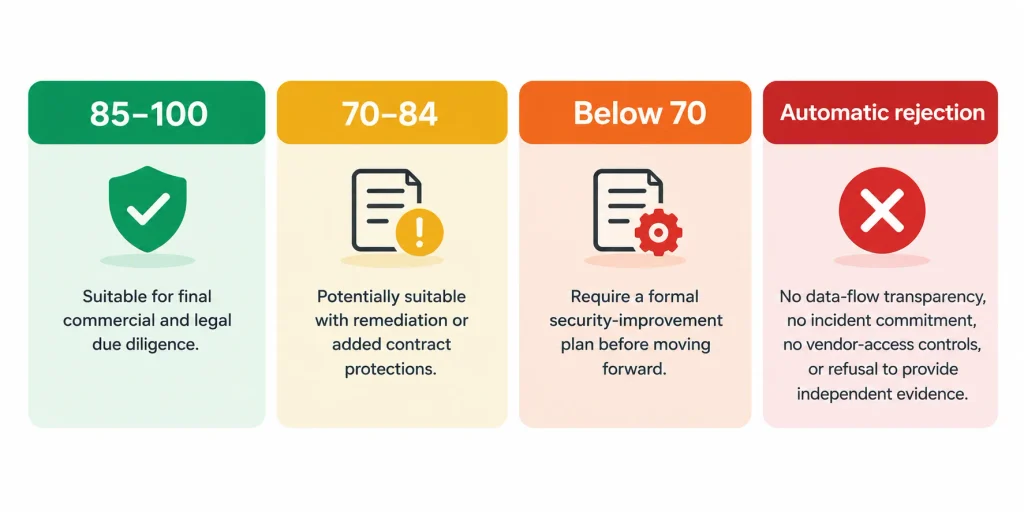
- 85–100: Suitable for final commercial and legal due diligence.
- 70–84: Potentially suitable with remediation or added contract protections.
- Below 70: Require a formal security-improvement plan before moving forward.
- Automatic rejection: No data-flow transparency, no incident commitment, no vendor-access controls, or refusal to provide independent evidence.
Quick Question: “Who should score the vendor?”— Use a small group: IT security, compliance or legal, and a clinical or operations lead. Score independently first, then compare.
Red Flags That Should Stop You From Signing
Some problems are fixable. These usually mean the vendor isn’t ready for secure healthcare software development at Dubai standards. Use the list as practical indicators in your healthcare software vendor due diligence.
Dubai Healthcare Software Vendor Red Flags
- “HIPAA compliant” presented as the only compliance evidence
- No clear data-flow diagram
- Unknown backup location
- Undisclosed offshore support
- Shared administrator accounts
- No MFA for privileged users
- Audit logs that can’t be exported
- Logs that can be modified without detection
- No current penetration-test evidence
- Undisclosed AI provider
- No breach-notification commitment
- No clear data-deletion process
- No customer audit rights
- No NABIDH integration plan. If a vendor is vague here, ask whether they’ve worked with an HL7 software development company in UAE or have delivered HL7 and FHIR-based integrations in Dubai themselves.
One red flag deserves a conversation. Three deserve a different vendor.
How to Choose the Right Healthcare Software Development Partner
Technical skill gets a vendor onto your shortlist. Security maturity should decide who wins. When you choose a healthcare software development partner, you’re choosing who gets long-term access to patient data, and who is accountable for secure healthcare software development once the system is live.
Look Beyond Development Capabilities
Evaluate healthcare domain expertise, security architecture, regulatory understanding, integration experience, cloud capability, AI governance, DevSecOps maturity and post-launch support. Teams offering Healthcare Software Solutions Dubai should show how those pieces fit together, not list them separately. Ask each shortlisted vendor to explain, in plain language, how secure healthcare software development works inside their delivery process.
Evaluate the Vendor’s Security Process, Not Just Its Portfolio
A portfolio shows what was built. It doesn’t show how it was protected. Ask prospective vendors to walk you through their architecture approach, secure SDLC, testing process, access-control model, monitoring, incident response, documentation and support governance. Ask to speak with a reference customer in a regulated market.
Custom Development Requires Stronger Due Diligence
With custom healthcare software development, ownership questions matter more. Who owns the architecture, source code, infrastructure, security tests, third-party dependencies, data, production access and maintenance? Settle that in writing, because secure healthcare software development depends on clear ownership.
Budget questions belong here too. Ask early what a secure telemedicine platform costs, and what drives it: hosting in the UAE, integrations, security testing, compliance mapping and ongoing monitoring. A quote that excludes these usually means they’ll arrive later as change requests.
Build Security Into Your Healthcare Software From Day One
Retrofitting security after deployment is usually more expensive and more disruptive than designing it in. You rework architecture, retest integrations and retrain staff while clinicians are using the system.
Secure healthcare software development brings together secure architecture, secure SDLC healthcare practice, DevSecOps healthcare pipelines, identity and access management, encryption, API security, auditability, cloud security, AI governance and continuous monitoring. It isn’t a one-time project. Secure healthcare software development is a continuous process across design, development, deployment and operations.
Take telehealth. Video, messaging, e-prescribing, payments and records all meet in one product. Teams delivering telemedicine app development services in UAE should be able to show how consent, identity checks, session security and record integration were designed together from the first sprint.
Done early, secure healthcare software development also makes your product easier to sell, easier to audit and quicker to scale.
Final Checklist Before You Sign With a Healthcare Software Vendor
Before signing, verify:
- Compliance: DHA, NABIDH and UAE requirements are mapped.
- Data: Hosting, backups, data flows and subprocessors are documented.
- Access: RBAC, MFA, SSO and vendor access controls are validated.
- Security: Penetration testing and vulnerability reports are available.
- AI: AI data flows and model-provider access are clearly documented.
- Continuity: Incident response, RTO, RPO and backup plans are confirmed.
- Contract: Security obligations, breach response, data deletion and exit terms are written into the agreement.
The safest procurement decision rests on evidence, not promises.
Secure Healthcare Software Development Assessment: Talk to a Healthcare Technology Team
Reading a checklist is one thing. Applying it to your own systems is another.
A healthcare technology team can help assess your platform across secure architecture, custom healthcare software development, healthcare APIs, interoperability, NABIDH-ready integrations, cloud infrastructure, AI solutions, security engineering, testing and post-launch support.
The assessment reviews your architecture, security controls, integrations, data flows and compliance requirements before you commit to a build or vendor. You leave with a prioritised gap list you can act on.
Request a Healthcare Software Security Assessment
Frequently Asked Questions
What makes healthcare software development secure?
Security comes from architecture, access control, encryption, auditability, secure development practices, monitoring, incident response and day-to-day operational controls working together. No single feature makes software secure. Secure healthcare software development is the combination of all of them, maintained over time.
How do I choose a healthcare software development partner?
Look at technical capability, healthcare experience, security evidence, regulatory understanding, integration expertise and contractual accountability. Ask for documents, not summaries, and ask how secure healthcare software development is built into their process.
What should I include in a healthcare software vendor security assessment?
Cover data flows, identity and access management, hosting, encryption, development security, testing, third parties, incident response, AI governance and business continuity. Score each area using the same criteria for every vendor.
Is HIPAA compliance enough for healthcare software in Dubai?
No. HIPAA is a useful benchmark, but it doesn’t establish alignment with DHA policies, NABIDH or UAE federal requirements. Secure healthcare software development in Dubai needs separate evidence for each.
Why is secure SDLC important for healthcare applications?
Security has to be part of requirements, architecture, coding, testing, deployment and maintenance. Fixing flaws late costs more and often means patient-facing downtime. A secure SDLC is the engine of secure healthcare software development.
What is DevSecOps in healthcare software development?
It means security testing and controls are built into development and deployment workflows, such as automated scans in the release pipeline, instead of being added at the end. DevSecOps is how secure healthcare software development keeps pace with frequent releases.