


Key Takeaways
- Infrastructure Management Services (IMS) help businesses manage, monitor, secure, and optimize their IT infrastructure.
- Modern infrastructure management covers networks, servers, cloud environments, cybersecurity, storage systems, and disaster recovery.
- Organizations in Dubai rely on Infrastructure Management Services to support digital transformation, cloud adoption, and business continuity.
- Outsourcing infrastructure operations reduces downtime, improves performance, and lowers operational costs.
- AI-powered monitoring and automation are transforming how enterprises manage complex IT environments.
What Are Infrastructure Management Services?
Technology is the backbone of modern business operations. From cloud applications and enterprise software to cybersecurity platforms and communication systems, organizations depend on a stable and secure IT infrastructure to maintain productivity and support growth.
As businesses expand, managing infrastructure becomes increasingly complex. Networks grow larger, cloud environments become more sophisticated, security threats evolve, and customer expectations for uninterrupted services continue to rise. This is where Infrastructure Management Services play a critical role.
Infrastructure Management Services (IMS) refer to the ongoing monitoring, administration, optimization, and support of an organization’s IT infrastructure. These services ensure that all technology components—including servers, networks, storage systems, cloud platforms, databases, and security solutions—operate efficiently and securely.
Rather than reacting to technical issues after they occur, Infrastructure Management Services focus on proactive monitoring and continuous optimization to prevent disruptions before they impact business operations.
For businesses in Dubai, where digital transformation initiatives are accelerating across industries, Infrastructure Management Services have become an essential component of long-term operational success.
Quick Answer: What Are Infrastructure Management Services?
Infrastructure Management Services are professional IT services designed to manage, monitor, secure, and optimize an organization’s technology infrastructure, including networks, servers, cloud environments, storage systems, databases, and cybersecurity frameworks.
The primary goal is to ensure:
- Maximum uptime
- Improved security
- Better system performance
- Regulatory compliance
- Business continuity
- Scalable technology growth
By leveraging Infrastructure Management Services, organizations can reduce operational risks while enabling their internal teams to focus on strategic business initiatives.
Why Infrastructure Management Matters in Dubai’s Digital Economy
Dubai has established itself as one of the world’s most technology-driven business hubs. Organizations across banking, healthcare, logistics, aviation, retail, government, and real estate sectors are investing heavily in digital transformation initiatives to remain competitive.
However, these digital investments create new infrastructure challenges.
Businesses today operate across multiple environments, including:
- On-premises data centers
- Private clouds
- Public cloud platforms
- Hybrid infrastructures
- Remote work environments
- Edge computing networks
Managing these environments requires specialized expertise, continuous monitoring, and robust security controls.
Without a structured infrastructure management strategy, organizations often face:
- Increased downtime
- Performance bottlenecks
- Security vulnerabilities
- Rising operational costs
- Compliance risks
- Poor user experiences
Infrastructure Management Services help businesses address these challenges while maintaining the agility needed to support innovation and growth.
Why Dubai Businesses Are Investing More in Infrastructure Management Services
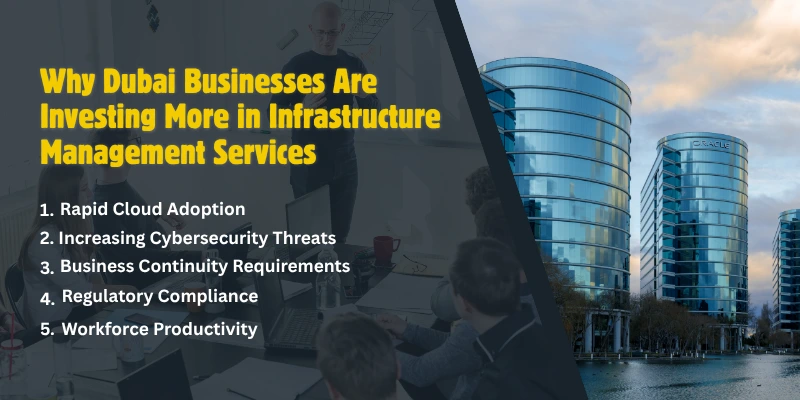
Several factors are driving the increasing demand for Infrastructure Management Services across Dubai.
Rapid Cloud Adoption
Organizations are migrating critical workloads to cloud environments to improve scalability, flexibility, and cost efficiency. Managing hybrid and multi-cloud infrastructures requires specialized expertise that many internal teams may not possess.
Increasing Cybersecurity Threats
Cyberattacks continue to evolve in sophistication. Businesses must continuously monitor infrastructure components, detect vulnerabilities, and implement security measures to protect sensitive data and business operations.
Business Continuity Requirements
Downtime can result in financial losses, damaged reputations, and decreased customer trust. Infrastructure Management Services help ensure high availability and disaster recovery readiness.
Regulatory Compliance
Industries such as healthcare, finance, and government face strict compliance requirements related to data security, privacy, and operational resilience. Effective infrastructure management helps organizations maintain compliance and reduce risk exposure.
Workforce Productivity
Employees rely on technology to perform daily tasks. Reliable infrastructure improves productivity by minimizing disruptions and ensuring seamless access to critical business systems.
Key Components of Infrastructure Management Services
Infrastructure Management Services encompass multiple technology domains that work together to support business operations.
Network Infrastructure Management
Networks form the foundation of enterprise connectivity. Infrastructure management teams continuously monitor network performance, bandwidth utilization, device health, and connectivity issues.
Key activities include:
- Network monitoring
- Configuration management
- Performance optimization
- Fault detection
- Capacity planning
- Network security management
Effective network management ensures reliable communication between users, applications, and systems.
Server Management
Servers host critical business applications, databases, and digital services. Any server-related issue can directly impact business operations.
Server management services include:
- Server monitoring
- Patch management
- Operating system updates
- Resource optimization
- Capacity management
- Performance tuning
Proactive server management helps maximize uptime while improving system performance.
Cloud Infrastructure Management
Cloud environments have become central to modern IT operations.
Cloud infrastructure management focuses on:
- Cloud resource monitoring
- Workload optimization
- Cost management
- Security configuration
- Backup and recovery
- Multi-cloud governance
Organizations increasingly seek Infrastructure Management Services to ensure cloud environments remain secure, scalable, and cost-efficient.
Looking to modernize your technology strategy?
Explore our Technology Consulting Firms in the Middle East solutions to align infrastructure investments with long-term business growth objectives.
Benefits of Infrastructure Management Services
Organizations invest in Infrastructure Management Services because they deliver measurable improvements in operational efficiency, security, system reliability, and long-term business growth. Whether a company operates a single office in Dubai or manages multiple locations across the Middle East, effective infrastructure management creates a stable technology foundation that supports day-to-day operations.
Below are some of the most significant benefits businesses can expect.
Reduced Downtime and Improved Availability
System outages can have a direct impact on revenue, employee productivity, and customer satisfaction. Even a short period of downtime can disrupt critical business processes and damage an organization’s reputation.
Infrastructure Management Services help reduce downtime through:
- 24/7 monitoring
- Proactive issue detection
- Automated alerts
- Preventive maintenance
- Rapid incident response
Rather than waiting for systems to fail, infrastructure teams identify potential issues before they become major problems.
This proactive approach helps businesses maintain higher levels of availability while minimizing operational disruptions.
Enhanced Cybersecurity Protection
Cybersecurity has become one of the most important priorities for modern organizations. As cyber threats continue to evolve, businesses require stronger security controls across every layer of their infrastructure.
Infrastructure Management Services typically include:
- Vulnerability assessments
- Security monitoring
- Threat detection
- Firewall management
- Endpoint security
- Access control management
- Security patching
By continuously monitoring infrastructure environments, businesses can identify suspicious activities early and respond quickly to potential threats.
For industries handling sensitive customer information, such as healthcare, banking, and government sectors, infrastructure security plays a critical role in maintaining trust and compliance.
Lower Operational Costs
Many organizations assume that managing infrastructure internally is more cost-effective. However, maintaining an in-house infrastructure team often requires significant investments in staffing, training, tools, and technology resources.
Infrastructure Management Services help reduce costs by:
- Eliminating unnecessary infrastructure expenses
- Improving resource utilization
- Reducing downtime-related losses
- Minimizing emergency repair costs
- Optimizing cloud spending
- Reducing hardware waste
Businesses gain access to experienced specialists without the overhead costs associated with building and maintaining large internal IT teams.
Improved Infrastructure Performance
Poorly managed infrastructure can lead to slow application performance, network congestion, and inefficient resource allocation.
Infrastructure Management Services continuously analyze performance metrics to identify opportunities for improvement.
This includes:
- Network optimization
- Server tuning
- Workload balancing
- Resource allocation improvements
- Storage optimization
As a result, employees experience faster systems, customers enjoy better service experiences, and organizations achieve greater operational efficiency.
Scalability for Business Growth
Business growth often introduces new technology demands. Expanding teams, increasing workloads, and launching new digital services require infrastructure that can scale quickly and efficiently.
Infrastructure Management Services help organizations:
- Expand infrastructure capacity
- Support cloud migrations
- Manage hybrid environments
- Integrate new technologies
- Accommodate growing user bases
This scalability enables businesses to pursue growth opportunities without worrying about infrastructure limitations.
Better Compliance and Risk Management
Organizations operating in regulated industries must comply with various security, privacy, and operational standards.
Infrastructure Management Services support compliance initiatives by implementing:
- Security controls
- Audit trails
- Data protection measures
- Backup policies
- Disaster recovery plans
- Access management procedures
This helps reduce compliance risks while simplifying regulatory audits and reporting requirements.
How Infrastructure Management Services Work
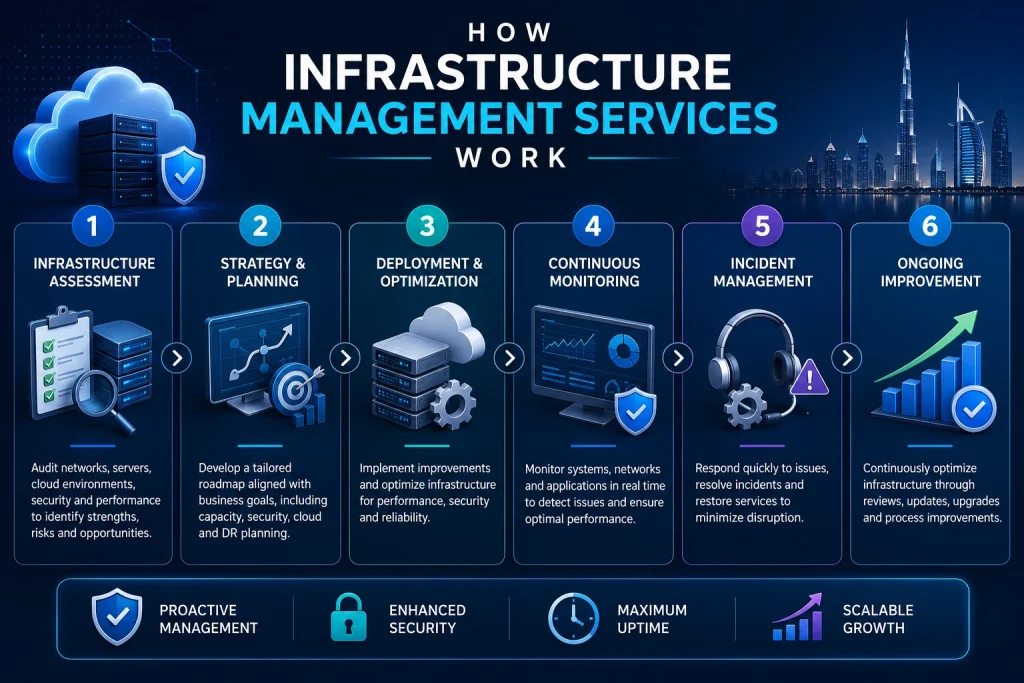
Understanding how Infrastructure Management Services operate helps organizations appreciate the value they bring to day-to-day operations.
Although service models may vary between providers, most infrastructure management engagements follow a structured process.
Step 1: Infrastructure Assessment
The process begins with a comprehensive review of the existing technology environment.
This assessment typically evaluates:
- Network architecture
- Servers and storage systems
- Cloud environments
- Security controls
- Performance metrics
- Business requirements
The objective is to identify strengths, weaknesses, risks, and improvement opportunities.
Step 2: Infrastructure Strategy and Planning
After completing the assessment, a roadmap is developed to align infrastructure capabilities with business goals.
Key planning activities include:
- Capacity planning
- Security strategy development
- Technology modernization planning
- Cloud migration strategies
- Disaster recovery planning
This strategic phase ensures infrastructure investments support long-term business objectives.
Step 3: Deployment and Optimization
Infrastructure specialists implement recommended improvements and optimize existing environments.
Examples include:
- Network upgrades
- Server optimization
- Cloud configuration improvements
- Security enhancements
- Monitoring tool deployment
This stage establishes a strong operational foundation for ongoing management.
Step 4: Continuous Monitoring
Continuous monitoring is one of the most important aspects of Infrastructure Management Services.
Advanced monitoring tools track:
- Network health
- Server performance
- Storage utilization
- Application availability
- Security events
- User experience metrics
Real-time visibility allows teams to identify and address issues before they impact operations.
Step 5: Incident Management and Support
When issues occur, infrastructure management teams respond quickly to minimize disruption.
Typical incident management activities include:
- Root cause analysis
- Problem resolution
- Escalation management
- Service restoration
- Post-incident reporting
A structured incident management process helps organizations maintain business continuity while reducing recovery times.
Step 6: Ongoing Improvement
Technology environments are constantly evolving. Infrastructure Management Services provide continuous optimization through:
- Performance reviews
- Security updates
- Capacity planning
- Technology upgrades
- Process improvements
This ensures infrastructure remains aligned with changing business needs and emerging technology trends.
Infrastructure Management Services vs Managed IT Services
Many organizations use the terms Infrastructure Management Services and Managed IT Services interchangeably. While the two are closely related, they serve different purposes.
| Feature | Infrastructure Management Services | Managed IT Services |
|---|---|---|
| Primary Focus | Core Infrastructure Operations | End-to-End IT Support |
| Network Management | Extensive | Moderate |
| Cloud Management | Advanced | Basic to Moderate |
| Data Center Operations | Included | Limited |
| Infrastructure Monitoring | Core Service | Secondary Service |
| Strategic Infrastructure Planning | Extensive | Limited |
| Help Desk Support | Optional | Core Service |
| End User Support | Limited | Extensive |
Infrastructure Management Services focus primarily on maintaining and optimizing the technology backbone of an organization.
Managed IT Services, on the other hand, often include broader support functions such as:
- Help desk services
- End-user support
- Device management
- Software troubleshooting
- IT procurement
Many enterprises combine both service models to create a comprehensive technology support strategy.
Infrastructure Management Services Cost in Dubai
One of the most common questions organizations ask is how much Infrastructure Management Services cost.
The answer depends on several factors, including infrastructure size, complexity, support requirements, and security needs.
Typical Cost Factors
Infrastructure Size
The number of servers, devices, users, and locations significantly impacts management costs.
Cloud Environment Complexity
Hybrid and multi-cloud environments require specialized expertise and monitoring tools.
Security Requirements
Organizations with advanced cybersecurity requirements often require additional monitoring and compliance services.
Support Coverage
24/7 monitoring and support services generally cost more than standard business-hours support.
Industry Compliance Needs
Highly regulated industries may require additional reporting, auditing, and security controls.
Looking for expert guidance on enterprise technology investments?
Our IT consultancy in Dubai helps organizations evaluate infrastructure requirements, optimize IT operations, and build future-ready technology environments that support sustainable business growth.
Industries Using Infrastructure Management Services in Dubai
As Dubai continues to position itself as a global technology and business hub, organizations across various industries are investing in Infrastructure Management Services to maintain secure, reliable, and scalable IT environments.
Different industries have unique operational requirements, but they all depend on high-performing infrastructure to deliver services efficiently and remain competitive.
Banking and Financial Services
Financial institutions manage massive volumes of sensitive data and transactions every day. Downtime, security breaches, or performance issues can have significant financial and reputational consequences.
Infrastructure Management Services help banks and financial organizations by:
- Maintaining high system availability
- Supporting secure digital banking platforms
- Enhancing cybersecurity defenses
- Managing cloud and hybrid infrastructures
- Supporting regulatory compliance requirements
With the growth of digital banking and fintech innovation across the UAE, infrastructure reliability has become a critical business priority.
Healthcare and Hospitals
Healthcare providers increasingly rely on digital systems to manage patient records, appointments, diagnostics, and telemedicine services.
Infrastructure Management Services support healthcare organizations by:
- Protecting sensitive patient data
- Maintaining Electronic Health Record (EHR) systems
- Supporting telehealth platforms
- Ensuring high system availability
- Implementing disaster recovery strategies
Reliable infrastructure helps healthcare organizations deliver uninterrupted patient care while maintaining compliance with healthcare regulations.
Retail and E-Commerce
Modern consumers expect seamless online shopping experiences and real-time service availability.
Infrastructure Management Services help retailers:
- Support online stores and mobile applications
- Manage seasonal traffic spikes
- Optimize customer experience
- Protect payment systems
- Ensure inventory management system availability
As Dubai’s e-commerce sector continues to expand, retailers require scalable infrastructure capable of handling increasing customer demands.
Aviation and Transportation
Dubai is home to one of the world’s busiest aviation ecosystems. Airlines, airports, and transportation companies depend on sophisticated digital infrastructure to manage operations efficiently.
Infrastructure Management Services help aviation organizations:
- Maintain operational systems
- Support passenger services
- Manage logistics platforms
- Improve network reliability
- Strengthen cybersecurity defenses
Reliable infrastructure directly impacts operational efficiency and customer satisfaction within the aviation sector.
Logistics and Supply Chain
Supply chain organizations increasingly depend on real-time visibility, automation, and connected systems.
Infrastructure Management Services support logistics businesses by:
- Managing fleet tracking systems
- Supporting warehouse technologies
- Optimizing transportation platforms
- Maintaining data integration environments
- Improving operational continuity
As supply chains become more digitized, infrastructure performance becomes essential for maintaining efficiency and competitiveness.
Government and Public Sector
Government agencies are rapidly digitizing services to improve citizen experiences and operational efficiency.
Infrastructure Management Services help public sector organizations:
- Support digital government initiatives
- Secure sensitive data
- Maintain public service availability
- Improve operational resilience
- Enhance cybersecurity readiness
Strong infrastructure management helps government entities deliver reliable and secure digital services.
Real Estate and Property Management
The real estate industry increasingly relies on digital platforms for property management, customer engagement, smart building operations, and transaction processing.
Infrastructure Management Services help real estate organizations:
- Support property management platforms
- Secure customer information
- Manage IoT-enabled smart building technologies
- Maintain business continuity
- Optimize digital customer experiences
As smart city initiatives expand across Dubai, infrastructure management becomes increasingly important within the real estate sector.
Common Infrastructure Challenges Businesses Face
Even organizations with experienced IT teams often struggle to manage increasingly complex technology environments.
Understanding these challenges highlights why Infrastructure Management Services have become essential for modern enterprises.
Legacy Infrastructure
Many businesses continue to operate outdated systems that were not designed to support modern digital demands.
Legacy environments often create:
- Performance bottlenecks
- Security vulnerabilities
- Integration challenges
- Higher maintenance costs
Infrastructure Management Services help organizations modernize legacy environments while minimizing business disruption.
Cloud Complexity
Cloud adoption offers significant benefits, but managing cloud environments can become challenging as organizations scale.
Common cloud challenges include:
- Cost overruns
- Resource sprawl
- Security misconfigurations
- Performance management issues
- Multi-cloud governance complexities
Effective infrastructure management ensures cloud investments deliver maximum business value.
Growing Cybersecurity Threats
Cyber threats continue to evolve in sophistication and frequency.
Organizations face risks such as:
- Ransomware attacks
- Data breaches
- Insider threats
- Phishing campaigns
- Distributed denial-of-service (DDoS) attacks
Infrastructure Management Services provide continuous monitoring and proactive security measures to reduce risk exposure.
Limited Internal Resources
Recruiting and retaining skilled infrastructure professionals remains a challenge for many organizations.
Infrastructure Management Services provide access to experienced specialists who can manage complex environments without the need for extensive internal hiring.
Downtime and Service Interruptions
Unexpected outages can result in:
- Revenue loss
- Productivity declines
- Customer dissatisfaction
- Reputational damage
Proactive monitoring and incident management help minimize downtime and improve service availability.
Future Trends in Infrastructure Management Services
Technology continues to evolve rapidly, and infrastructure management strategies must adapt to support new business requirements.
Several emerging trends are shaping the future of Infrastructure Management Services.
AI-Powered Infrastructure Monitoring
Artificial intelligence is transforming infrastructure operations by enabling systems to identify patterns, detect anomalies, and predict failures before they occur.
Benefits include:
- Faster issue detection
- Reduced downtime
- Improved operational efficiency
- Enhanced decision-making
AI-driven monitoring allows infrastructure teams to move from reactive support to predictive management.
Infrastructure as Code (IaC)
Infrastructure as Code enables organizations to manage infrastructure through software-based automation rather than manual processes.
Advantages include:
- Faster deployments
- Greater consistency
- Reduced configuration errors
- Improved scalability
As cloud adoption continues to grow, Infrastructure as Code is becoming a key component of modern infrastructure management.
Multi-Cloud and Hybrid Cloud Management
Organizations increasingly distribute workloads across multiple cloud providers and on-premises environments.
Infrastructure Management Services help businesses:
- Manage complex environments
- Optimize performance
- Control cloud costs
- Maintain security standards
Multi-cloud management is expected to become a standard requirement for enterprise infrastructure operations.
Zero Trust Security Architecture
Traditional security models are no longer sufficient for modern digital environments.
Zero Trust frameworks assume that no user or device should be automatically trusted.
Infrastructure Management Services support Zero Trust strategies through:
- Continuous verification
- Identity management
- Access controls
- Security monitoring
This approach strengthens organizational resilience against cyber threats.
Automation and Self-Healing Systems
Automation is helping organizations reduce manual workloads and improve operational efficiency.
Modern infrastructure environments increasingly use:
- Automated remediation
- Intelligent workflows
- Self-healing applications
- Predictive maintenance systems
These technologies help organizations improve reliability while reducing operational costs.
Why Businesses in Dubai Are Choosing Managed Infrastructure Partners
Many organizations recognize that infrastructure management is too critical to be treated as a reactive IT function.
By partnering with experienced infrastructure specialists, businesses gain access to:
- Enterprise-grade expertise
- Advanced monitoring capabilities
- 24/7 support services
- Improved cybersecurity protection
- Scalable infrastructure solutions
- Strategic technology guidance
This partnership model enables organizations to focus on innovation, customer experience, and business growth while experts manage the complexity of infrastructure operations.
Need Infrastructure That Grows With Your Business?
Explore our End-to-End Infrastructure Management That Scales With Your Business solutions designed to help organizations improve performance, strengthen security, and support long-term digital transformation initiatives.
Conclusion
Infrastructure Management Services have become a critical component of modern business operations. As organizations continue to adopt cloud technologies, digital platforms, and data-driven strategies, the complexity of managing infrastructure continues to increase.
From network monitoring and cybersecurity to cloud management and disaster recovery, Infrastructure Management Services provide the expertise and operational support needed to maintain secure, scalable, and high-performing technology environments.
For businesses in Dubai, investing in professional infrastructure management is no longer simply an IT decision—it’s a strategic business initiative that drives resilience, operational efficiency, and sustainable growth.
Organizations that proactively manae their infrastructure are better positioned to reduce risks, improve customer experiences, support innovation, and maintain a competitive advantage in an increasingly digital marketplace.
Frequently Asked Questions
What are Infrastructure Management Services?
Infrastructure Management Services are professional IT services that monitor, manage, secure, and optimize technology infrastructure, including networks, servers, cloud platforms, storage systems, and cybersecurity environments.
Why are Infrastructure Management Services important?
They help businesses reduce downtime, improve security, optimize performance, ensure compliance, and support long-term growth.
What is included in Infrastructure Management Services?
Typical services include network management, server administration, cloud management, cybersecurity, storage management, backup and disaster recovery, monitoring, and technical support.
How do Infrastructure Management Services improve cybersecurity?
They provide continuous monitoring, threat detection, vulnerability management, patching, access controls, and incident response capabilities.
What industries benefit from Infrastructure Management Services?
Industries including banking, healthcare, retail, aviation, logistics, government, manufacturing, and real estate benefit significantly from infrastructure management.
What is the difference between Infrastructure Management Services and Managed IT Services?
Infrastructure Management Services focus primarily on technology infrastructure, while Managed IT Services provide broader support that includes end-user assistance and device management.
Can Infrastructure Management Services support cloud environments?
Yes. Modern Infrastructure Management Services often include cloud monitoring, optimization, security management, migration support, and multi-cloud governance.
How do Infrastructure Management Services reduce downtime?
Through proactive monitoring, preventive maintenance, automated alerts, and rapid incident response processes.
Are Infrastructure Management Services suitable for small businesses?
Yes. Businesses of all sizes can benefit from infrastructure management by improving reliability, security, and operational efficiency.
How much do Infrastructure Management Services cost in Dubai?
Costs vary depending on infrastructure complexity, support requirements, security needs, cloud environments, and business size.
What are the biggest infrastructure challenges businesses face today?
Common challenges include cybersecurity threats, cloud complexity, legacy systems, skills shortages, compliance requirements, and increasing operational costs.
How do I choose the right Infrastructure Management Service provider?
Look for a provider with proven experience, strong security expertise, cloud capabilities, scalable solutions, responsive support, and industry-specific knowledge.