

Key Takeaways
- Islamic charity apps need dedicated zakat/sadaqah/waqf logic — not a generic donation platform with Arabic added on
- Zakat calculator (gold, cash, investments, business assets) is the most-used, highest-stakes feature — must be scholar-reviewed
- Dubai’s market is shifting toward regulated, verified, licensed giving platforms
- Real-time transparency and impact updates drive donor retention more than thank-you emails
- Ramadan traffic is the real stress test — payment redundancy and load testing are non-negotiable
- AI recommendations, blockchain transparency, and Arabic voice/accessibility set competitive apps apart
- Costs scale with specialist input: Islamic finance consultants, Arabic content, and compliance review
- Choosing a development partner is a compliance decision, not just a technical one
- Common failure points: weak zakat logic, no load testing, late compliance planning, Arabic as translation not design, skipped maintenance
Dubai’s charity sector is moving from collection boxes and bank transfers to something faster and far more accountable: purpose-built donation apps. A donor in Deira can now calculate zakat on their gold holdings, pick a verified orphan-support campaign, pay with Apple Pay, and get a digital receipt — all before their coffee gets cold. That shift didn’t happen by accident. It’s the result of smartphone penetration crossing critical mass across Muslim-majority markets, regulators pushing for verified fundraising, and donors simply expecting the same convenience from a charity that they get from a food delivery app.
This guide is the long version — the one you bookmark rather than skim. It covers what an Islamic charity app actually needs to do, which features separate a serious platform from a glorified payment form, what it costs to build one in the UAE at each tier, which technology choices hold up under Ramadan-level traffic, the compliance groundwork regulators expect, and how to pick a mobile app development company in Dubai that understands both the engineering and the religious obligations behind the product.
Why Islamic Charity Apps Are Becoming Essential in 2026
Mobile-first giving isn’t a trend anymore — it’s the default. Donors who once wrote cheques or handed over cash at the mosque now expect a donation flow that takes under sixty seconds, works in Arabic and English, and shows them exactly where their money went.
Dubai’s charity ecosystem is shifting in step with that expectation. Government bodies have pushed hard on regulated, verified fundraising channels, and donors have responded by moving away from informal collection methods toward platforms they can actually trust. That trust is the whole game. A donor who can’t see a fund utilization report after their zakat payment probably won’t give through that channel again.
This is why NGOs, Islamic foundations, and even commercial ventures are pouring resources into Islamic donation app development. Ramadan alone drives a spike in giving that most legacy systems simply can’t handle gracefully — servers buckle, payment gateways time out, and donors abandon the transaction halfway through. A well-built app absorbs that surge and converts it into completed donations instead of lost goodwill. Understanding app development cost in Dubai early on also helps organizations plan realistically instead of discovering mid-project that their budget only covers half of what they actually need.
There’s also a generational piece to this. Donors under 40 rarely carry cash, rarely visit a physical charity office, and rarely trust an organization they can’t verify online. For that cohort, an app isn’t a convenience layer bolted onto an existing charity — it’s the front door. If the front door is clunky, they simply don’t walk through it.
In this guide, you’ll learn what makes an Islamic charity app different from a generic donation platform, the features that actually move the needle for donors and organizations, a realistic development roadmap, compliance requirements specific to the UAE, and what you should budget for app development cost in Dubai depending on the complexity you’re aiming for.
Understanding Islamic Charity App Development
What Is an Islamic Charity App?
An Islamic charity app is a mobile or web platform built specifically to handle zakat, sadaqah, waqf, and other forms of Islamic giving — with the religious rules baked into the product, not bolted on afterward. That’s the core difference from a generic donation platform: a standard crowdfunding app doesn’t know that zakat has a nisab threshold, that it’s calculated differently on gold versus cash savings, or that certain categories of recipients are eligible under Sharia while others aren’t.
These apps support everything from a single Ramadan campaign to year-round humanitarian programs — food distribution, medical assistance, orphan sponsorship, and emergency relief — while keeping the donor informed at every step.
The practical distinction shows up in three places most people don’t think about until they’ve already started building. First, the data model: a generic donation record only needs an amount and a campaign ID, while an Islamic giving record needs to track which category of giving it belongs to, because zakat and sadaqah are reported, audited, and sometimes taxed differently depending on jurisdiction. Second, the eligibility logic: zakat has defined categories of eligible recipients under Sharia (the poor, the needy, those in debt, and several others), and a compliant app needs to verify a campaign or beneficiary actually qualifies before zakat funds can be routed to it. Third, the calendar: Islamic giving is tied to the Hijri calendar, not the Gregorian one, which affects everything from when a zakat reminder fires to when a Ramadan campaign countdown starts.
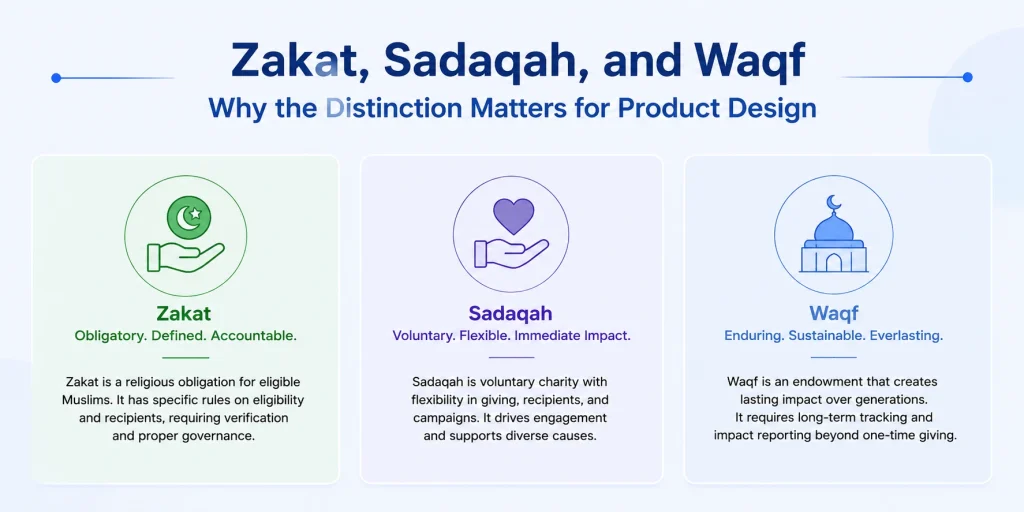
Zakat, Sadaqah, and Waqf — Why the Distinction Matters for Product Design
Most generic donation platforms treat every gift as identical: money in, receipt out. That approach breaks down fast in an Islamic context, because the three main forms of giving carry different obligations and different donor expectations.
Zakat is obligatory for eligible Muslims once their wealth crosses the nisab threshold, and Islamic law is specific about who can receive it. A zakat module needs eligibility checks on the recipient side, not just a calculator on the donor side — otherwise the organization risks distributing zakat funds to categories that don’t qualify. This also means zakat campaigns typically need their own approval workflow, separate from general sadaqah campaigns, since the bar for what counts as an eligible zakat recipient is stricter and usually requires documentation.
Sadaqah is voluntary charity with far more flexibility in who can give, how much, and to whom. This is where recurring donations, round-up features, and impulse-giving flows (a campaign shared on social media, tapped and paid in seconds) tend to perform best. Because there’s no eligibility gate to check, sadaqah campaigns can launch faster and iterate more freely on creative, storytelling-driven fundraising formats.
Waqf is an endowment — money or assets set aside to generate ongoing benefit, often in perpetuity. Very few charity apps handle this well because it requires tracking an asset over years or decades, not a single transaction — a waqf contribution to build a well, for instance, needs to show the donor how that well continues generating benefit five or ten years later, which is a completely different reporting model than a one-time donation receipt. Platforms that do build proper waqf tracking tend to attract larger, longer-term donors specifically because most competitors don’t offer it, and waqf donors in particular respond well to annual “your endowment’s impact this year” updates rather than a single thank-you message.
Getting this distinction right in the product architecture — not just the marketing copy — is what separates an app built by people who understand Islamic finance from one that’s a payment form with an Arabic translation.
Why Businesses and Charities Are Investing in Islamic Donation Apps
Smartphone adoption among Muslim communities has reached a point where mobile is the primary, not secondary, channel for giving. Add to that a growing preference for digital wallets over cash, and the case for an app builds itself.
Donors today ask a question their parents rarely did: where exactly did my money go? Transparency isn’t a nice-to-have anymore — it’s the deciding factor between a one-time donor and a recurring one. A donor who receives a specific update — photos from a food distribution drive, a beneficiary count, a completion date for a medical procedure they funded — is measurably more likely to give again than one who receives a generic “thank you for your support” email. That’s the entire business case for building impact tracking properly rather than treating it as a checkbox feature.
Ramadan campaigns and sudden emergency relief appeals (earthquakes, floods, conflict zones) also drive massive short-term traffic spikes, and organizations that can’t handle that volume on a mobile-optimized platform simply lose donations to competitors who can. A charity that’s still routing Ramadan traffic through a desktop-oriented website with a bolted-on mobile view is, in practice, competing with one hand tied behind its back against organizations that built mobile-first from day one.
There’s a commercial angle too. A handful of ventures have built multi-charity “super app” platforms that take a small processing margin across dozens of partner organizations — a model that only works if the underlying app is reliable enough that charities are willing to hand over their donor relationships to it. To build these platforms faster and at scale, many organizations are now leveraging mobile app development AI platforms to streamline development, accelerate deployment, and reduce overall costs. For a charity, joining one of these platforms trades some control for significantly lower development cost and instant access to an existing donor base; for the platform operator, the incentive is aligned around donor trust, since a single bad experience with one partner charity reflects on the whole marketplace.
Dubai and UAE Market Trends Driving Islamic Charity App Development
Growth of Digital Giving in Dubai’s Charity Ecosystem
The UAE government has actively supported digital contribution initiatives, nudging the charity sector toward regulated, verified platforms rather than informal fundraising. Online donation channels have grown accordingly, and donors increasingly favor apps tied to licensed, auditable organizations over anonymous social media appeals.
This regulatory push has an important side effect for anyone building in this space: verification isn’t just good practice, it’s becoming close to a market requirement. A charity app that can’t show a clean approval trail for its campaigns will struggle to earn the kind of donor trust that regulated competitors already have. It also changes the competitive landscape — smaller, informal fundraising efforts that used to rely on WhatsApp forwards and social media posts are increasingly funneled toward platforms that can demonstrate licensing, which concentrates donor attention (and donation volume) on fewer, better-built apps.
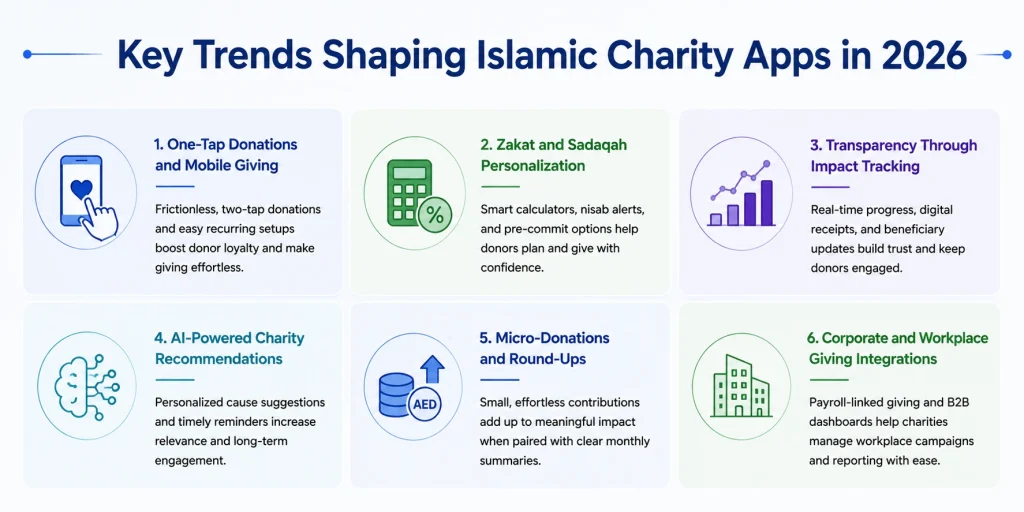
Key Trends Shaping Islamic Charity Apps in 2026
One-tap donations and mobile giving. Checkout friction kills conversions. The apps winning donor loyalty right now let someone donate in two taps — saved card, one confirmation, done. Recurring donation setups (monthly sadaqah, for instance) are becoming standard rather than an afterthought feature. The organizations getting this right also let a donor adjust or pause a recurring donation with the same two-tap simplicity used to set it up, because a rigid cancellation flow is one of the fastest ways to turn a satisfied recurring donor into a frustrated one who churns entirely instead of just reducing their amount.
Zakat and sadaqah personalization. A built-in zakat calculator that remembers a donor’s asset profile from last year, flags when nisab is met, and sends a reminder before Ramadan does more for retention than any marketing campaign. Some platforms are starting to go a step further, letting a donor pre-commit to a zakat amount months ahead based on their prior year’s calculation, then confirming or adjusting it once their actual figures are in — which smooths out the last-minute Ramadan rush on both the donor and platform side.
Transparency through impact tracking. Donors want to see real-time campaign progress, digital receipts, and — increasingly — actual beneficiary reports. “Your donation fed 40 families this week” beats a generic thank-you email every time. The strongest platforms tie this reporting to a cadence, not a one-off — a monthly or quarterly update for ongoing programs keeps a donor engaged well past the initial transaction.
AI-powered charity recommendations. Matching a donor’s giving history to relevant causes, and sending a smart reminder during Ramadan based on when they gave last year, is starting to separate mature platforms from basic donation forms. Done thoughtfully, this also means recognizing when a donor has stopped opening notifications and switching to a lighter-touch channel instead of escalating the frequency of reminders, which tends to backfire. Getting this right usually requires an AI app development company in Dubai that has actually shipped a recommendation engine before, rather than a team learning on your project.
Micro-donations and round-ups. Rounding a purchase up to the nearest dirham and routing the difference to a standing sadaqah campaign is a small feature that quietly generates a meaningful, steady revenue stream for charities without asking donors to make a single active decision each time. This works best when paired with a monthly summary showing the donor a cumulative total — “you’ve given AED 34 in round-ups this month” — since the individual amounts are too small to register on their own.
Corporate and workplace giving integrations. More UAE employers are experimenting with payroll-linked zakat and sadaqah deductions, which means charity apps increasingly need B2B-style dashboards for HR teams, not just consumer-facing donation screens. This is a genuinely different product surface — HR teams need bulk reporting, consolidated receipts for tax and compliance purposes, and the ability to manage a company-wide giving campaign, none of which a consumer-facing donation flow was designed to handle.
Essential Features of an Islamic Charity App
User Registration and Profile Management
Every donor needs an account that remembers their donation history, saved payment methods, and preferred causes. A supporter profile — showing badges, total contributions, or campaigns followed — also helps organizations build a returning donor base instead of one-off givers. Guest checkout should still exist for donors who don’t want to create an account, but the app should make account creation the path of least resistance immediately after a first donation, when intent is highest.
Profile management also needs to handle family or household giving sensibly. Many donors in the UAE give on behalf of a household rather than purely as an individual, so allowing a profile to track and report giving at a family level — while still keeping individual zakat calculations separate, since zakat obligations are personal — is a detail that generic app templates almost always miss.
Zakat Calculator and Islamic Financial Tools
This is often the single most-used feature in the entire app, and it’s where Zakat app development requires genuine religious knowledge, not just a currency converter. The calculator needs to handle several distinct asset categories rather than a single input field:
| Asset Type | Calculation Basis | Common Pitfall |
|---|---|---|
| Gold and silver | Current market value against nisab threshold in that metal | Using outdated fixed nisab values instead of live gold/silver rates |
| Cash and savings | Full balance held for one lunar year | Forgetting to net out short-term debt |
| Investments and shares | Zakatable portion varies by asset type | Treating all shares as fully zakatable regardless of the underlying business |
| Business inventory | Value of stock intended for trade | Excluding fixed assets that shouldn’t be included in the first place |
| Agricultural produce | Different rate depending on irrigation method | Applying the standard 2.5% rate where it doesn’t apply |
Beyond the calculation itself, donors expect annual reminders tied to the Islamic (Hijri) calendar, not the Gregorian one, and clear in-app guidance — reviewed by a qualified scholar — explaining why each figure was calculated the way it was. Skipping that explanatory layer is one of the most common shortcuts weaker development teams take, and donors notice.
It’s also worth building the calculator to save a donor’s inputs from year to year rather than starting from a blank form every time. Wealth composition doesn’t usually change dramatically year over year, so a returning donor should be able to update last year’s figures rather than re-enter everything — this alone measurably reduces how often people abandon the calculator halfway through.
Verified Charity and Campaign Management
Donors should never wonder if a campaign is real. That means registered charity profiles, a campaign verification process, uploaded documentation, and an approval workflow before any campaign goes live to the public. For platforms hosting multiple charities, this also means a tiered admin system: super-admins overseeing the whole platform, and organization-level admins who can only manage their own campaigns.
Campaign management also needs a clear lifecycle beyond simple approval: campaigns should be able to move through draft, pending review, live, paused, and closed states, with a visible audit trail of who changed what and when. This matters most during emergency relief situations, where a campaign might need to be paused quickly if a funding target is reached or a situation on the ground changes, and donors need to see that pause reflected accurately rather than continuing to donate to a campaign that’s quietly already fully funded.
Multiple Donation Categories
A serious platform covers more ground than a single “donate now” button: zakat, sadaqah, orphan support, medical assistance, food distribution, emergency relief, and education programs each deserve their own dedicated flow, because donors often want to earmark funds for a specific purpose. Each category also tends to attract a different donor psychology — emergency relief spikes on urgency, orphan sponsorship performs better as a recurring commitment, and education programs convert well with long-form storytelling. The app’s content and UX for each category should reflect that instead of using one generic template everywhere.
Orphan sponsorship in particular benefits from a dedicated, ongoing relationship model rather than a single transaction: showing the sponsor which child or program their recurring gift supports, with periodic (privacy-conscious) updates, is what turns a one-time sponsorship into a multi-year commitment. Emergency relief, by contrast, benefits from stripping the flow down to the fewest possible steps, since donors giving in response to breaking news want speed over depth.
Secure Payment Gateway Integration
UAE-specific payment gateways, card processing, digital wallets, bank transfers, and recurring payment support all need to work reliably — especially during a Ramadan traffic spike when payment failures are most costly. It’s worth building in gateway redundancy: if a primary processor fails or throttles under load, the app should be able to fall back to a secondary gateway without the donor noticing anything beyond a slightly longer loading spinner.
Retry logic matters just as much as redundancy. A card decline during a high-traffic moment shouldn’t dump the donor back to a blank form — it should preserve their entered amount and campaign selection and offer an immediate retry or an alternate payment method, since re-entering everything from scratch is exactly the kind of friction that causes an abandoned donation.
Donation Tracking and Transparency Dashboard
Once a donation is made, the donor should be able to check its status, see campaign milestones, view impact reports, and download a digital receipt without contacting support. The strongest implementations tie this dashboard directly to the organization’s own fund-disbursement records, so “impact updates” are pulled from real operational data instead of written by a marketing team months after the fact.
A well-built dashboard also gives donors a consolidated annual view — total given across all categories, broken down by zakat versus sadaqah — which matters both for the donor’s own record-keeping and, in many cases, for their own personal zakat accounting the following year.
Arabic and English Language Support
For a Dubai/UAE audience, bilingual support with proper right-to-left Arabic formatting isn’t optional. A significant share of donors will default to Arabic, and clunky translation undermines trust fast. This extends beyond text — currency formatting, date formats (Hijri alongside Gregorian), and even the direction icons and progress bars animate in all need RTL-aware design, not a mirrored English layout with translated labels pasted in.
Push notifications and transactional emails also need genuine Arabic localization, not machine-translated text dropped into an English template — a poorly translated zakat reminder undermines exactly the kind of religious credibility the calculator worked hard to establish.
Developing an Islamic charity app with features like bilingual support, zakat calculators, secure payment gateways, donation tracking, and campaign management requires deep technical expertise. Working with one of the best mobile app development companies in Dubai helps ensure the platform is secure, scalable, Sharia-compliant, and capable of supporting long-term fundraising initiatives.
Advanced Features That Make Islamic Charity Apps More Competitive
AI-based donation recommendations analyze a user’s past giving behavior and match them to causes they’re statistically likely to support — turning a generic campaign list into a personalized feed. Done well, this also flags lapsed donors automatically and triggers a gentle, well-timed nudge rather than a generic mass email blast.
Blockchain-based donation transparency gives donors visibility into how funds move, with immutable records that are difficult to dispute. For larger platforms handling significant volume, this has become a genuine trust differentiator rather than a gimmick — particularly for donors giving internationally who can’t easily verify a foreign charity through traditional means. The key implementation detail most teams get wrong is presenting the blockchain record in a way an average donor can actually understand, rather than exposing raw transaction hashes that mean nothing to someone outside a technical audience.
Voice-based donation assistance, particularly Arabic voice commands, opens the platform to donors who find typing on a small screen cumbersome — older donors especially. This also matters for accessibility more broadly, including donors with visual impairments, and pairs naturally with screen-reader support that many charity apps still overlook entirely.
Social sharing and community engagement — letting a donor share a campaign directly, or launch a small fundraising challenge among friends — turns individual donors into unpaid marketing channels. Community leaderboards for group campaigns (a mosque, a company, a school) tend to significantly outperform individual giving in total volume raised, because they introduce light social accountability without turning charity into a competition that feels distasteful if handled the wrong way.
Offline and low-connectivity support. A meaningful share of donations during emergency appeals happen from areas with poor connectivity — either the donor’s location or, in relief-focused apps, the field teams reporting impact data back. Queuing transactions locally and syncing once connectivity returns prevents lost donations and lost data, and this same offline-first approach is essential for field teams distributing aid who need to log beneficiary counts without a reliable signal.
Multi-currency support. Dubai’s donor base is genuinely international. Supporting AED alongside major currencies like USD, GBP, and EUR — with clear, real-time conversion shown before checkout — removes a quiet source of donor hesitation that’s easy to overlook if the initial build only targets a single currency.
Islamic Charity App vs. Generic Donation Platform
| Capability | Generic Donation Platform | Islamic Charity App |
|---|---|---|
| Zakat calculation | Not supported | Nisab-aware calculator across asset types |
| Recipient eligibility | Not tracked | Sharia-compliant eligibility checks for zakat recipients |
| Calendar reminders | Gregorian only | Hijri-aware reminders (Ramadan, Zakat due dates) |
| Language/layout | Often English-only, LTR | Native Arabic RTL plus English |
| Fund categorization | Single “donation” bucket | Zakat, sadaqah, waqf tracked and reported separately |
| Religious guidance | None | Scholar-reviewed in-app explanations |
| Compliance framing | Generic terms of service | Aligned with UAE charity licensing and fundraising regulations |
This table is the fastest way to explain to a stakeholder why a repurposed generic donation template — even a well-built one — usually falls short for an Islamic charity use case. The gap isn’t cosmetic; it shows up in the data model, the approval workflows, and the compliance posture, all of which are expensive to retrofit after the fact.
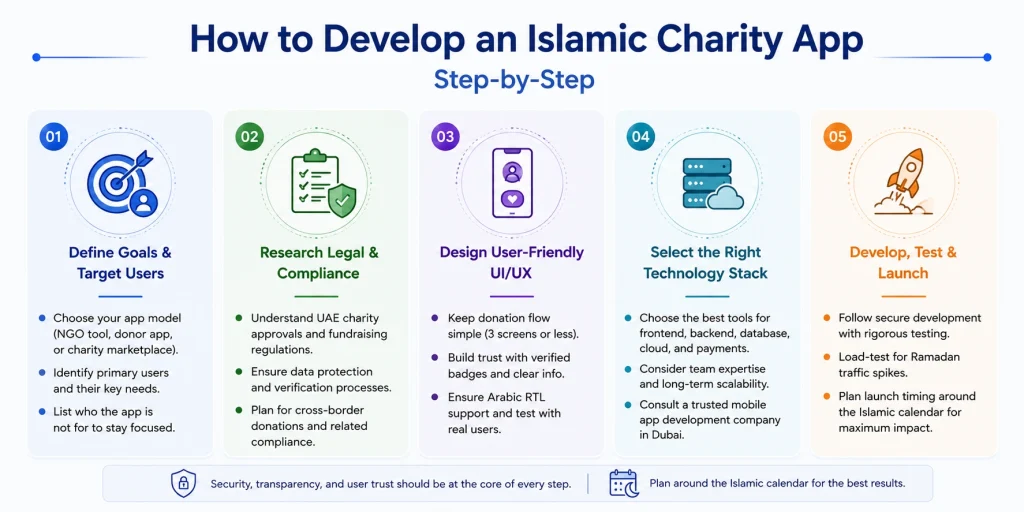
How to Develop an Islamic Charity App Step-by-Step
Step 1: Define Your Charity App Goals and Target Users
Decide early whether you’re building an NGO-focused internal tool, a donor-facing platform, or a charity marketplace connecting multiple organizations under one app. Each model has a different feature priority list and a different monetization or funding structure. A marketplace model, for instance, needs multi-tenant architecture from day one — retrofitting that later is expensive and disruptive.
This step should also produce a written list of who the app is explicitly not for. A platform trying to serve individual donors, corporate HR teams, and field relief workers all in one interface tends to serve none of them particularly well — it’s usually better to build a focused donor-facing app first and add a separate admin or field-reporting interface later, sharing a backend but not a single UI.
Step 2: Research Legal and Compliance Requirements
Before a single screen gets designed, map out the charity approvals you’ll need, applicable fundraising regulations, data protection requirements, and verification processes for both the organization and individual campaigns. This step should involve actual legal counsel familiar with UAE charity regulation, not just a checklist pulled from a generic app development guide.
It’s also the right time to decide how the platform will handle cross-border donations, since UAE-based donors often want to support causes outside the country. That introduces additional regulatory layers around international money transfer that need to be understood before development begins, not discovered during a payment gateway integration months in.
Step 3: Design User-Friendly UI/UX
The donation journey should be short — ideally three screens or fewer from “browse campaign” to “payment confirmed.” Trust-focused design (verified badges, clear organization credentials, visible security indicators) and proper Arabic RTL support both matter more here than in most other app categories. Wireframe the zakat calculator flow separately and test it with real users before committing to final visuals — it’s the feature most likely to confuse donors if the sequencing is off.
Usability testing at this stage should specifically include donors who aren’t especially tech-comfortable, since a meaningful share of an Islamic charity app’s audience skews older than the typical consumer app user base. A flow that feels intuitive to a design team in their twenties can still confuse a first-time app user in their sixties, and that gap only surfaces through real testing, not internal review.
Step 4: Select the Right Technology Stack
| Layer | Common Choices | Notes |
|---|---|---|
| Frontend (mobile) | Flutter, React Native | Single codebase for iOS and Android reduces cost and keeps feature parity |
| Backend | Node.js, Laravel, Django | Node.js suits real-time features (live campaign progress); Laravel/Django suit content-heavy admin panels |
| Database | PostgreSQL, MongoDB | PostgreSQL fits transactional donation data; MongoDB suits flexible campaign/content structures |
| Cloud hosting | AWS, Azure | Both offer regional data residency options relevant to UAE compliance |
| Payments | Regional UAE gateways plus card networks | Redundant gateway setup recommended for peak-season reliability |
The right choice within each row depends heavily on your team’s existing expertise as much as the technical merits — a technically “better” stack that your long-term maintenance team doesn’t know well tends to cost more in the long run than a slightly less optimal stack they can support confidently. This is usually the point in the project where organizations bring in a mobile app development company in Dubai to review the stack decision, since local teams tend to know which cloud regions and payment gateways actually perform well under UAE network conditions.
Step 5: Develop, Test, and Launch the Application
Development moves through defined phases with security testing and payment testing treated as non-negotiable gates, not final-week checkboxes — a payment bug discovered after launch during Ramadan is a disaster, not a minor fix. Load-test specifically for a simulated Ramadan traffic spike, not just average daily usage, since that’s the scenario that actually breaks under-provisioned platforms. App store deployment follows once both platforms pass review.
Plan the launch timeline around the Islamic calendar, not just internal readiness. Launching a zakat-focused feature set a few weeks before Ramadan, once the core platform has already been stable for a full quarter, tends to perform far better than a rushed launch during Ramadan itself, when there’s no room left to fix a critical bug without losing donations in real time.
Compliance Requirements for Islamic Charity Apps in Dubai
Importance of Charity Licensing and Verification
Working exclusively with approved organizations, actively preventing unauthorized fundraising on the platform, and maintaining clear audit trails all protect donor confidence — and, frankly, protect the platform operator from regulatory trouble. Unauthorized fundraising is a genuine enforcement risk in the UAE, and a platform that hosts even one unlicensed campaign can damage trust across every legitimate organization on it.
In practice, this means building a verification process that doesn’t just check a box once at onboarding. Licenses expire, organizations change leadership, and campaign scopes shift — a platform should periodically re-verify partner organizations rather than treating initial approval as permanent.
Data Security and Donation Privacy
Encryption for data in transit and at rest, secure transaction handling, and strict user data protection policies aren’t features you add later. They need to be architectural decisions from day one. This includes PCI-DSS alignment for any component that touches card data directly, even if the actual card processing is outsourced to a licensed gateway.
Donor privacy also has a specific dimension in the zakat context: some donors prefer their zakat contributions to remain anonymous even from the recipient organization’s public reporting, in keeping with a common preference for discretion in this form of giving. Building an anonymity option into the donation flow — not just at the campaign level but at the individual transaction level — respects that preference without requiring the donor to explain themselves.
Campaign Approval and Monitoring System
An admin approval workflow, active content moderation, and complete audit records for every campaign keep the platform accountable and give regulators (and donors) a paper trail if questions ever come up. Build the audit log as an append-only structure from the start — trying to bolt on tamper-evident logging after launch is significantly harder than designing for it upfront.
Monitoring should also extend to donor-facing content after a campaign goes live, not just at the initial approval stage. Campaign updates, photos, and progress reports posted by an organization after launch should ideally pass through the same moderation queue as the original campaign, since that’s where misleading or inaccurate claims are more likely to slip through unnoticed.
Ongoing Regulatory Monitoring
Charity and fundraising regulation shifts periodically, and a platform operating in this space needs someone — internally or through the development partner — responsible for tracking regulatory changes and updating compliance workflows accordingly. This isn’t a one-time step at launch; it’s a standing operational responsibility, and it’s worth writing it explicitly into whichever team’s job description covers platform operations rather than assuming it will happen informally. This is also exactly where knowing how to choose the mobile app development company in UAE pays off long after launch — a partner who understands local compliance won’t need to be re-briefed every time a regulation shifts.
Cost of Islamic Charity App Development in 2026
Factors Affecting Development Cost
App development cost in Dubai for a charity platform depends on app complexity, the number of platforms you’re targeting (iOS, Android, web), the depth of features like zakat calculators and campaign management, payment integration count, security requirements, and whether AI-driven recommendations are part of the build.
Team composition affects cost just as much as feature scope. A project that requires a dedicated Islamic finance consultant reviewing the zakat logic, an Arabic content specialist, and a compliance advisor alongside the core development team will naturally run higher than one where a general product team handles everything internally — and that specialist input is usually worth the added cost given how much credibility rides on getting the religious and regulatory details right. A premium mobile app development company will usually itemize these specialist costs separately in a quote rather than folding them into a vague lump sum, which makes it easier to see exactly what you’re paying for.
Estimated Development Cost Breakdown
| Tier | Core Includes | Best Suited For |
|---|---|---|
| Basic Islamic Charity App | Core donation features, user accounts, single payment integration | Small organizations running a limited number of campaigns without heavy customization |
| Medium-Level Platform | Zakat calculator, full campaign management, basic analytics, multi-currency support | Established NGOs needing more than a donation button but not enterprise infrastructure |
| Advanced Charity Super App | AI-driven recommendations, multi-organization integrations, blockchain transparency, compliance dashboards | Platforms aiming to become the default giving app across an entire community or region |
Exact figures vary widely based on your specific requirements, team location, and ongoing maintenance scope, so it’s worth getting a detailed scoping conversation with your development partner before locking in a budget. A useful exercise before that conversation: write down every feature from Sections 4 and 5 above and mark each as “must-have for launch” or “phase two” — this alone tends to cut inflated early quotes down to something realistic.
Where Costs Quietly Creep Up
A few areas consistently push budgets past initial estimates: Arabic content and scholar-review cycles for religious guidance text (often underestimated in project timelines), payment gateway redundancy setup, and post-launch load testing for Ramadan-scale traffic. Budgeting for these explicitly, rather than treating them as buffer, tends to produce a more accurate quote from the outset.
Ongoing costs deserve the same scrutiny as the initial build. Server scaling during Ramadan, annual content review by a scholar as rulings or guidance materials are updated, and payment gateway fees that vary based on transaction volume are all recurring line items worth modeling for at least the first two to three years, not just the launch year.
Choosing the Right Technology Partner for Islamic Charity App Development
Experience With Secure Donation Platforms
Look for a partner who can speak specifically to payment security, regulatory compliance in the UAE, and architecture that scales — not just a generic app portfolio. Ask them to walk through a real incident they’ve handled, such as a payment gateway outage during a traffic spike, and how their monitoring caught it. A vague answer here is a bigger warning sign than any gap in their feature checklist.
Ability to Build Islamic Finance and Charity Features
Zakat workflows and sadaqah management require actual religious and financial nuance. A premium mobile app development company working in this space should be able to walk you through how they’ve handled nisab calculations, asset categorization, and Sharia-compliant fund distribution in past projects — not just promise they “can build anything.”
It’s reasonable to ask directly whether their zakat logic has been reviewed by a qualified scholar, and if so, to see documentation of that review. A development team that hasn’t thought to ask this question themselves probably hasn’t built this feature properly before.
Post-Launch Support and App Maintenance
Security updates, ongoing feature improvements, and performance monitoring after launch matter as much as the initial build. A charity app that goes untouched for a year is a security liability waiting to happen. Ask prospective partners what their standard SLA looks like for a critical payment bug found during Ramadan — the answer tells you a lot about how seriously they take post-launch responsibility.
If you’re evaluating vendors and unsure where to start, understanding how to choose the best mobile app development company in UAE comes down to a few concrete checks: ask for references from similar fintech or donation projects, request a breakdown of their compliance process, confirm who owns the code and data once the contract ends, and ask to see a live demo of a zakat calculator they’ve actually shipped — not a mockup. An AI app development company in Dubai with genuine machine learning experience — not just a marketing claim — will also be able to show you real examples of recommendation engines or predictive features they’ve shipped, which matters if personalization is part of your roadmap.
Common Mistakes That Sink Charity App Projects
Treating the zakat calculator as a simple form. Teams without Islamic finance experience routinely under-build this feature, then discover post-launch that donors and scholars flag it as inaccurate — a credibility hit that’s hard to recover from. Fixing this after launch usually means pulling the calculator offline temporarily while it’s corrected, which itself damages trust during the correction window.
Launching without a load-tested payment flow. Building a beautiful app that falls over during the first Ramadan traffic spike is one of the most common — and most avoidable — failures in this category. The fix is straightforward in principle (simulate peak load before launch) but frequently skipped under deadline pressure, which is exactly when it’s needed most.
Skipping the compliance conversation until late. Legal and licensing requirements shape the data model, the admin workflows, and even the UX. Bringing compliance in after the design is locked usually means expensive rework, and in some cases means removing a feature entirely that regulators won’t permit as originally designed.
Treating Arabic as a translation task rather than a design task. RTL layout, Hijri dates, and culturally appropriate imagery all need to be part of the design brief from the start, not a localization pass at the end. Retrofitting RTL support into a layout built English-first almost always produces visible seams — misaligned icons, awkward text wrapping — that a native RTL build avoids entirely.
Underinvesting in post-launch support. A donation platform handles money and personal data continuously, not once at launch — treating maintenance as optional is how security incidents happen. Organizations that budget maintenance as an afterthought consistently end up paying more for emergency fixes than they would have for planned, ongoing support.
Future of Islamic Charity App Development Beyond 2026
AI-Driven Personalized Giving
Expect smart charity recommendations and automated reminders to get considerably more precise as platforms accumulate more donation history to learn from. Predictive models that estimate a donor’s likely zakat obligation before Ramadan — based on prior years’ giving, with the donor’s consent — are already emerging as a differentiator among more advanced platforms. The privacy dimension here matters as much as the technical one: any predictive feature dealing with a donor’s financial position needs a clear, easy opt-out, not a default-on setting buried in preferences.
Integration With Digital Ecosystems
Islamic charity apps will increasingly plug into government platforms, mainstream payment providers, and broader community applications rather than existing as standalone tools. Payroll-linked giving, discussed earlier, is one early example of this broader integration trend, and expect similar integrations to emerge with UAE digital identity systems, simplifying the verification step for both donors and charity organizations.
Rise of Charity Super Apps
The direction of travel points toward platforms that host multiple charities under one roof, giving donors a unified giving experience and organizations far greater transparency into how their sector performs collectively. Expect consolidation here — a handful of well-trusted super apps capturing donor attention rather than dozens of single-organization apps competing for the same install. For smaller charities, this shift makes the choice of platform partner one of the more consequential strategic decisions they’ll make this decade, since donor relationships increasingly live on the platform rather than with the individual organization.
Final Thoughts
Islamic charity apps are no longer a nice add-on for organizations that can afford it — they’re becoming the primary channel through which an entire generation of donors expects to give. Trust, compliance, and transparency aren’t separate concerns from good engineering; they’re the product.
If you’re planning to build one, the organizations that get the most value are the ones that treat this as a long-term platform, not a Ramadan campaign tool that gets forgotten in May. That means picking a technology partner who understands both the code and the religious obligations behind every transaction — and building with the next five years of growth in mind, not just the next launch date.
Frequently Asked Questions
Do I need separate apps for iOS and Android, or can one build cover both?
Most teams use Flutter or React Native to ship a single codebase across both platforms, which keeps cost and feature parity manageable unless you have a specific reason to build natively.
How long does it typically take to build an Islamic charity app?
A basic platform can launch in a few months; a medium or advanced-tier platform with AI features, multi-organization support, and full compliance workflows takes considerably longer — plan the timeline around the feature tier from Section 9, not a fixed industry average.
Does the zakat calculator need religious scholar review?
Yes. Even a technically accurate calculator can misrepresent Islamic financial rulings if the underlying logic wasn’t reviewed by someone qualified — this is not a step to skip or shortcut.
Can an existing donation platform be retrofitted with Islamic features, or is a rebuild usually necessary?
It depends on the underlying architecture. If fund categorization, recipient eligibility, and calendar logic weren’t designed with zakat and sadaqah in mind from the start, retrofitting is often more expensive than starting fresh — this is worth an honest technical audit before committing either way.
What’s the biggest ongoing cost after launch?
Security updates, payment gateway maintenance, and scholar-reviewed content updates tend to be the largest recurring line items, ahead of new feature development in most operating budgets.
Should zakat and sadaqah donations be processed through the same payment flow?
They can share the same underlying payment infrastructure, but the surrounding flow — eligibility checks, receipts, and reporting — needs to stay distinct, since donors and auditors both need to see the two categories accounted for separately.