


Keyword Takeaways
Before you read on, here are the core keywords this article targets — and why they matter for your AI procurement decision:
- Government AI procurement UAE — The primary concern for every federal and emirate-level decision-maker issuing tenders for AI solutions in 2026.
- AI RFP requirements UAE — The specific checklist elements that separate a compliant, value-generating AI purchase from an expensive mistake.
- AI vendor evaluation government—How public sector entities should score, assess, and shortlist AI solution providers before signing contracts.
- UAE AI strategy compliance—Aligning your procurement documents with UAE National AI Strategy 2031 and the UAE AI Charter 2024.
- public sector AI solutions Dubai—The growing market of AI tools and platforms purpose-built for government workflows in the UAE.
The UAE Government Is Already Buying AI—Is It Buying It Right?
There is no debate anymore about whether UAE government entities should adopt AI. That question was settled years ago.
The UAE has announced plans to move 50% of government services to autonomous AI within two years, and the UAE National AI Strategy 2031 projects that AI will contribute $91 billion (AED 335 billion) to the Emirati economy. Abu Dhabi alone has committed AED 13 billion to become the world’s first fully AI-native government by 2027, with over 100 AI use cases already in production across more than 40 government entities.
The real question is not whether to buy AI. It is how to buy it correctly.
Every year, government entities across Dubai, Abu Dhabi, Sharjah, and the wider UAE issue tenders and RFPs (Requests for Proposal) for technology solutions. But when it comes to AI, the standard procurement templates that worked for software, hardware, or IT services simply do not cover the ground they need to. AI is fundamentally different. It behaves differently, carries different risks, and demands a completely different level of scrutiny before the contract is signed.
This blog is written specifically for the procurement officers, IT directors, CIOs, and government policymakers who are responsible for issuing or evaluating RFPs for AI solutions. If you are preparing a tender, you need this checklist. If you are evaluating proposals, this article will help you separate the vendors who truly understand government-grade AI from those who are just pitching a product.
And if you are working through broader digital transformation services in the UAE, getting your AI procurement framework right is the single most important thing you can do before any implementation begins.
Let us get into it.
Why Standard IT Procurement Templates Fail for AI
Most government procurement teams are working from templates designed for software licensing or IT service contracts. Those templates ask the right questions for traditional software: What does it do? How much does it cost? What is the SLA? Who provides support?
AI procurement needs all of that — and then a great deal more.
Here is why. When a standard software application fails, a transaction does not complete or a report does not generate. When a government AI system fails, it may deliver incorrect information to a citizen about a tax deadline, a building permit requirement, or a compliance obligation — and that citizen may act on that information. The consequence can be a legal dispute, a failed audit, or serious reputational damage to a public institution.
AI vendors handle three things that traditional vendors do not: model behavior that can change with updates, data flows that include training and inference layers, and explainability requirements that affect compliance and decision-making workflows.
A Gartner survey of 138 government AI respondents found that 41% cited siloed strategies and 31% cited legacy systems as the top barriers to AI value — not the quality of the AI model itself. The binding constraint is cross-agency data integration, procurement cycles, and the absence of a unified governance framework.
In other words, even the best AI system will fail in a poorly structured procurement environment. The RFP is where you build that structure.
For entities looking at the broader ecosystem of government IT services in Dubai, this distinction between standard IT procurement and AI-specific procurement is increasingly critical as the UAE accelerates its adoption agenda.
Q. Does the UAE have specific regulations that govern how government entities must procure AI?
A: Yes and no. The UAE AI Charter (June 2024) outlines 12 ethical principles and is increasingly referenced in government procurement decisions. The DIFC’s Regulation 10 on autonomous systems has been in full enforcement since January 2026. At the federal level, the UAE National Strategy for AI 2031 shapes procurement expectations across ministries, and Abu Dhabi’s AIATC governs AI projects within the emirate. While there is no single horizontal statute like the EU AI Act, compliance with these frameworks is increasingly a de facto procurement requirement.
Define the Problem Before You Define the Solution
This sounds obvious, but it is the most commonly skipped step in government AI RFPs.
Many procurement documents arrive at vendors describing a solution — “we need an AI chatbot” or “we need predictive analytics software” — without first defining the problem they are solving. The result is that vendors respond to the specification rather than to the actual need, and the government entity ends up with a tool that technically meets the tender requirements but does not solve the operational problem.
Before you write a single line of your RFP, your team should be able to clearly answer:
What specific government service or workflow is underperforming, and what does “better” look like in measurable terms? What data currently exists that AI could work with, and what is the quality of that data? Who are the end users — government staff, citizens, or both — and what is their current workflow? What does success look like in 6 months, 12 months, and 3 years?
Every tool request must begin with a defensible business case. The requesting team should articulate a clear business problem or use case, demonstrate that existing approved tools cannot adequately address the need, and provide an estimated return on investment or productivity benefit.
In a government context, that ROI is not just financial. It includes service delivery time, citizen satisfaction scores, staff hours saved, and audit compliance rates. Make sure all of these are defined before the RFP goes out.
To understand what is already being done with AI across UAE government, the work being done on AI use cases in UAE government offers a useful benchmark for what outcomes other entities have achieved and what problem definitions have worked in practice.
The 10 Non-Negotiable Elements Every UAE Government AI RFP Must Include
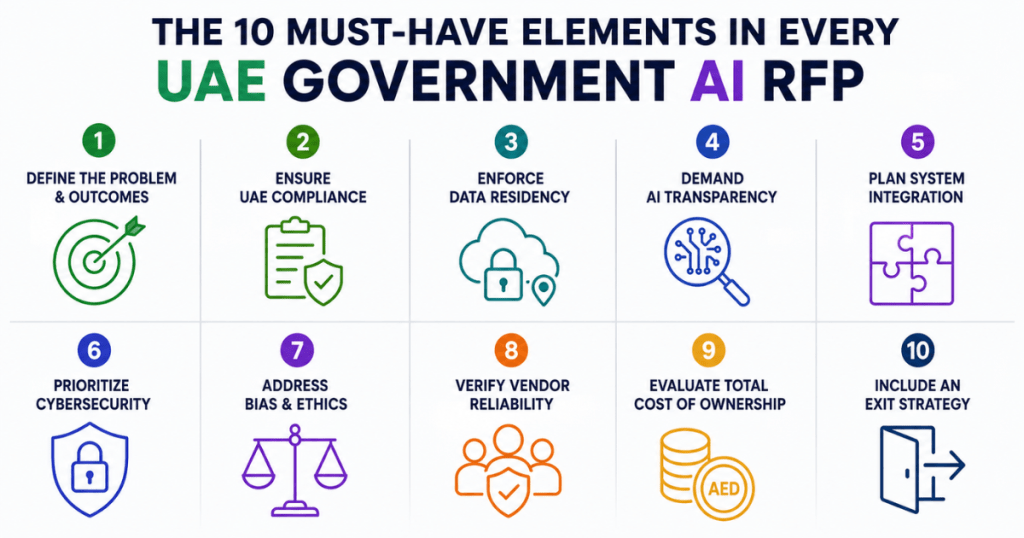
Here is the core of this article. These are not nice-to-haves. If your RFP is missing any of these, you are leaving the door open to purchasing an AI solution that will underperform, create compliance risk, or fail outright.
1. Clear Problem Statement and Measurable Outcomes
As discussed above — define the problem, not just the solution. State the current baseline (e.g., average time to process a permit application is 14 days) and the target outcome (reduce to 5 days with 95% accuracy). Vendors should respond with evidence of having achieved comparable outcomes elsewhere.
2. UAE Regulatory Compliance Requirements
Your RFP must explicitly require compliance with the UAE AI Charter 2024, the UAE Personal Data Protection Law (Federal Decree-Law No. 45 of 2021), and — where applicable — DIFC Regulation 10. If the solution will handle citizen data, biometric data, or data from critical infrastructure, these are not optional clauses; they are pass/fail criteria.
Documenting alignment with the UAE AI Charter’s 12 principles is increasingly common in vendor due diligence and government tenders, and serves as evidence of good-faith governance under sector-specific reviews.
Additionally, obtaining AI Seal certification is now mandatory for companies wishing to participate in AI projects for the Dubai and UAE governments — a requirement that raises market standards and streamlines procurement processes for public entities.
3. Data Residency and Sovereignty Clause
This is non-negotiable for UAE government entities. Your RFP must specify where citizen and government data will be stored, processed, and backed up. Cloud-based AI solutions must confirm UAE-based data centers or sovereign cloud environments. Vendors using foreign hyperscalers without UAE data residency should be disqualified for most government use cases.
In-country data processing has become a key requirement for regulated sectors in the UAE, with organisations needing to leverage AI with strong data residency and compliance safeguards.
As governments increasingly adopt intelligent digital platforms, the AI-powered enterprise software will depend on secure, sovereign cloud environments that protect sensitive data while enabling scalable AI-driven operations and regulatory compliance.
4. Explainability and Transparency Requirements
Government AI systems make — or support — decisions that affect citizens. For these decisions to be auditable, accountable, and legally defensible, the AI must be explainable. Your RFP should require vendors to document:
How the AI reaches its outputs (decision logic or reasoning chain). Whether outputs can be traced back to specific data inputs. How false positives and false negatives are detected and flagged. What human review processes exist for high-stakes decisions.
AI vendors should document model behavior, data flows, and explainability requirements — vendors that treat these as engineering details rather than procurement criteria are weaker candidates.
5. Integration Architecture with Existing Government Systems
UAE government entities operate a complex ecosystem of legacy and modern systems — from municipal databases to national identity platforms, e-government portals, and ministry-specific ERP systems. Your RFP must require a detailed integration plan that shows:
API compatibility with existing systems. Data migration approach (if applicable). Downtime risk during integration. Ongoing integration maintenance responsibility.
6. Security Architecture and Cybersecurity Standards
The UAE Cybersecurity Council’s 2024 report found that 50% of those surveyed experienced AI-enabled scams, and 87% of businesses are facing increased AI-related vulnerabilities, with 94% expecting AI to be the most influential factor shaping cybersecurity in 2026.
Government AI systems are high-value targets. Your RFP must require ISO 27001 certification or equivalent, documented incident response procedures, penetration testing records, and encryption standards for data at rest and in transit.
7. Model Bias Assessment and Ethical AI Compliance
The UAE AI Charter outlines principles including algorithmic bias mitigation, fairness, transparency, human oversight, governance and accountability, and inclusive access — all of which should be reflected in procurement requirements.
Your RFP should require vendors to demonstrate that their AI model has been tested for bias across demographic, linguistic, and cultural variables relevant to the UAE’s diverse population. For a multicultural society serving residents from over 200 nationalities, this is especially critical.
Organizations evaluating AI vendors should also assess the role of AI detection software in identifying bias, improving transparency, and supporting responsible AI governance throughout the model lifecycle.
8. Vendor Financial Stability and Government Track Record
AI platforms are not easily swappable after deployment. Knowledge bases are built, integrations are configured, staff workflows are organized around the system, and citizens come to rely on its availability. A vendor that cannot demonstrate financial stability represents a dependency risk that is difficult to unwind.
Require audited financial statements for the past 3 years. Require references from at least 2 government clients. Require a demonstration of sustained product investment and roadmap visibility.
9. Total Cost of Ownership (TCO), Not Just Licensing Cost
Government procurement often focuses on the headline license fee. For AI, this is a critical mistake. AI processing costs scale with volume in ways that traditional software licenses do not. Your RFP must require a detailed TCO breakdown including inference costs, API call fees (if cloud-based), training and retraining costs, integration and customization costs, annual maintenance fees, and staff training costs.
Understanding AI development costs in Dubai for 2026 is an important reference for any procurement team evaluating vendor proposals—particularly when assessing whether quoted costs are realistic or underestimated.
10. Exit Strategy and Data Portability
What happens when the contract ends or if the vendor fails? Your RFP must include:
Data export in a standard, machine-readable format. Transition support obligations. Intellectual property ownership of any custom models trained on your data. Timeline and cost for complete offboarding.
This is often treated as a legal afterthought. It should be a core procurement requirement.
Q: Should UAE government entities require AI Seal certification from all vendors?
A: For Dubai government AI projects, yes — AI Seal certification has been made mandatory. For federal and other Emirati entities, it is rapidly becoming a de facto standard. Even where it is not yet formally required, requiring it in your RFP significantly raises the quality of vendor responses and reduces the due diligence burden on your team.
Building the Vendor Evaluation Scorecard
Once your RFP is drafted and responses come in, how do you actually compare vendors? This is where many government procurement processes fall apart—defaulting to the lowest cost or brand recognition rather than substantive evaluation.
The most recognized AI brands are not necessarily the best fit for government deployments. Procurement based on brand recognition rather than documented government outcomes frequently produces implementations that underperform against the intended use case.
Here is a recommended weighting framework for a UAE government AI vendor evaluation:
Technical Capability and Architecture — 25% This covers the quality and appropriateness of the AI model, the deployment architecture, integration depth, and scalability.
Regulatory Compliance and Data Governance — 25% UAE AI Charter alignment, PDPL compliance, data residency, security certifications, and AI Seal certification all fall here. This is weighted equally with technical capability because in government, an AI system that is not compliant is not a system you can use.
Explainability and Ethical AI — 15% Bias testing results, decision transparency documentation, human oversight mechanisms, and alignment with the UAE AI Ethics Guide.
Government Track Record — 15% Prior deployments in UAE or GCC government entities, verifiable references, and case studies with measurable outcomes.
Total Cost of Ownership — 10% Full 5-year TCO, not just year-1 licensing costs. Volume-scaled cost models should be evaluated here.
Support, Training, and SLAs — 10% Arabic language support, local support teams, uptime guarantees, and staff training provision.
This scorecard approach ensures that compliance, governance, and real-world government experience carry as much weight as the flashiness of a demo—which is exactly how it should be for public sector procurement.
The evolution of AI development services in the UAE means there is now a robust local and regional ecosystem of specialized vendors who understand government requirements — which should be reflected in how you structure your evaluation.
The Pilot Phase — Why It Must Be in the RFP
One of the most common and costly mistakes in government AI procurement is moving straight from vendor selection to full deployment without a structured pilot phase.
A vendor can look strong in a demo but fail in real workflows, edge cases, data environments, permissions, or user adoption. In a government context, this failure carries public accountability that a private-sector organization simply does not face.
Your RFP should include a mandatory pilot phase requirement—typically 60 to 90 days—with specific pre-defined success criteria. Here is what the pilot scope should cover:
A defined subset of real government data (properly anonymized or consented). Specific workflows that represent the most common and most complex use cases. Named government staff who will test and validate the system. Pre-agreed accuracy thresholds that must be met before full deployment is approved. Documentation of any edge cases or failures encountered during the pilot.
Only vendors who agree to this pilot structure — with performance benchmarks built into the contract — should advance past evaluation. Any vendor unwilling to be tested on real government workflows is a vendor who lacks confidence in their solution.
For context on how AI is already transforming government service delivery in the region, the work being done on ai revolutionizing government operations in UAE provides strong evidence of what well-implemented AI can achieve when the procurement process is done right.
Q: What is the biggest mistake UAE government entities make when purchasing AI solutions?
A: The most common mistake is evaluating AI the same way they evaluate traditional software — focusing on features and price rather than data governance, explainability, government-specific track record, and total cost of ownership. The second biggest mistake is skipping or truncating the pilot phase to meet a project deadline. Both mistakes are expensive to correct post-deployment.
Arabic Language and Cultural Localization Requirements
This element is unique to UAE government procurement and is routinely underweighted in RFPs — often with serious consequences.
The UAE serves a population of over 11 million people across more than 200 nationalities. Arabic is the official language of government. Any AI system deployed in a citizen-facing or document-processing capacity must be able to handle:
Classical Arabic and Modern Standard Arabic (MSA). Gulf Arabic dialects, particularly Emirati and Khaleeji dialects. Transliterated Arabic in digital forms. Multilingual interfaces and responses, given the diverse expat population.
Most global AI vendors build primarily on English-language training data. Their Arabic-language performance is often significantly weaker — and this gap is not always visible in a standard product demo.
Your RFP must include specific Arabic NLP (Natural Language Processing) performance benchmarks tested on actual UAE government documents and citizen interaction samples. Require vendors to provide test results, not just claims, for Arabic language accuracy.
Linking AI Procurement to UAE National Strategy
A strong government AI RFP is not just internally focused. It should explicitly connect the proposed AI solution to the UAE’s broader national and emirate-level strategy.
The UAE AI Strategy 2031 aims to achieve 100% digital, predictive public services, mandate interoperable and secure datasets, and expand the next generation of AI talent — all through a flywheel of sector pilots, smarter regulation, and open data.
When your RFP ties the specific AI solution to these strategic pillars, two things happen. First, it signals to vendors that you understand the landscape and expect proposals that contribute to, not conflict with, national strategy. Second, it provides your own leadership and oversight bodies with a clear justification for the investment that goes beyond departmental efficiency.
Specifically, consider requiring vendors to demonstrate how their solution contributes to:
The UAE National AI Strategy 2031 goals for their relevant sector (healthcare, transport, education, etc.). Data governance frameworks that align with UAE PDPL and the emerging interoperability requirements under Abu Dhabi’s digital government strategy. Workforce capability goals — does the vendor provide AI literacy training for government staff, not just a tool?
The UAE’s move toward 50% AI-driven government operations is not a future aspiration — it is an active two-year roadmap. Every AI procurement decision made today either accelerates or impedes that roadmap.
Data Strategy as a Procurement Prerequisite
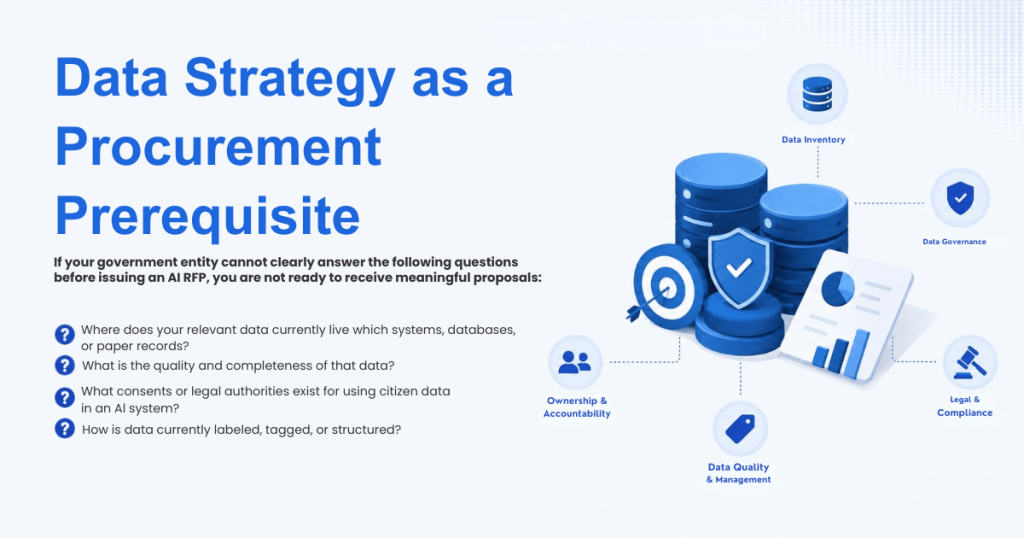
Here is something most government AI RFPs get backwards: they ask vendors to propose a data strategy, when in fact the government entity should have its own data strategy before the RFP is issued.
Deloitte found that 74% of procurement leaders say their data is not AI-ready, making data preparation the single largest barrier to realizing AI value.
If your government entity cannot clearly answer the following questions before issuing an AI RFP, you are not ready to receive meaningful proposals:
Where does your relevant data currently live — which systems, databases, or paper records? What is the quality and completeness of that data? Who currently owns data governance across departments, and is there a central data custodian? What consents or legal authorities exist for using citizen data in an AI system? How is data currently labeled, tagged, or structured?
Vendors who are asked to propose AI solutions on top of unresolved data challenges will either inflate their project costs (to cover data cleanup) or underestimate the complexity (and deliver underperforming systems). Either outcome is avoidable with upfront data readiness work.
One area where data strategy is especially powerful for government is predictive analytics in UAE government — from traffic management to healthcare resource allocation—but these applications are only as good as the data pipelines that feed them.
Post-Deployment Governance and Monitoring
Procurement does not end at go-live. For AI systems in government, it never really ends—because AI model behavior can drift, degrade, or change with updates in ways that traditional software does not.
Your RFP should include a mandatory post-deployment governance framework as part of the vendor’s scope of work. This should cover:
Performance Monitoring: Monthly reports on accuracy rates, false positive/negative rates, and system uptime. Any degradation against baseline benchmarks should trigger a mandatory review.
Model Update Notifications: Vendors must notify the government entity in advance of any model updates that could change system behavior. You should have the right to approve or delay updates in critical operational contexts.
Audit Trail: Every AI-assisted decision in a government context should generate a logged audit trail. This is not optional — it is required for accountability, legal defensibility, and future AI audits that the UAE regulatory environment will increasingly mandate.
Annual Re-evaluation: AI systems should be formally re-evaluated on an annual basis against their original success criteria. Systems that consistently underperform should face contract review.
This governance framework should be written into the contract, not left as a verbal commitment during the sales process.
Why Government-Specific AI Vendors Matter
There is an important distinction that gets lost in many government procurement processes: the difference between a great AI product and a great AI product for government.
Many of the most impressive AI platforms on the market today were built for commercial use cases—customer service chatbots, marketing personalization, and sales forecasting. They are excellent at those applications. They are frequently not excellent at the very different requirements of public sector deployment.
Government-specific AI requirements include multilingual compliance with Arabic-first interfaces, audit trail generation, integration with legacy government systems, citizen data protection under PDPL, transparency for public accountability, and alignment with national AI strategy.
Many government AI procurements do not include structured accuracy evaluation as part of the vendor demonstration process. The result is that all vendors look similarly capable during a sales demonstration, and differences in accuracy only become apparent after deployment when citizens start receiving incorrect information.
This is why your RFP must go beyond the demo. Require documented evidence of prior government deployments, not just generic case studies. Require references who can speak to the government-specific challenges the vendor helped solve.
For entities evaluating the landscape of AI platforms and wondering whether to build or buy, understanding the software development company landscape in UAE is a useful starting point to understand what local expertise looks like versus what a global platform vendor offers.
The Future-Proofing Question Every RFP Should Ask
AI is moving fast. The system you procure today will need to evolve — with new model versions, new capabilities, new regulatory requirements, and new integration needs — over a contract period that might span 3 to 7 years.
Your RFP should explicitly require vendors to address the following:
Upgrade Path: How will the system evolve over the contract term? What new capabilities are on the roadmap, and are they included or an additional cost?
Regulatory Adaptation: As UAE AI regulations evolve (and they will), how will the vendor ensure the system remains compliant without a full re-procurement?
Scalability: If usage scales by 5x or 10x — which is realistic for successful government AI deployments—does the pricing and architecture scale proportionally?
Interoperability: As more government entities adopt AI, can this system interoperate with adjacent government AI platforms under the UAE’s emerging AI governance framework?
The UAE Strategy for Artificial Intelligence aims to use an integrated smart digital system that can overcome challenges and provide quick, efficient solutions, making the UAE the first in the field of AI investments in various sectors. Your vendor must share that interoperability vision, not resist it.
It is worth noting here that AI is not replacing the need for thoughtful government IT — it is transforming what that looks like. For a deeper view on the broader shift, AI software is replacing traditional software is a useful read to understand what is driving vendor roadmaps right now.
Summary: The Complete UAE Government AI RFP Checklist
Here is the condensed version of everything covered above. Use this as an internal review checklist before your next RFP goes out:
Pre-RFP Requirements
- Clear problem statement with measurable baseline and target outcomes defined
- Data readiness assessment completed internally
- Alignment with UAE National AI Strategy 2031 documented
- Regulatory requirements confirmed (PDPL, AI Charter, DIFC Reg 10 if applicable)
RFP Core Elements
- UAE AI Seal certification requirement included
- Data residency and sovereignty clause included
- Explainability and decision audit trail requirements specified
- Arabic language NLP performance benchmarks required
- Integration architecture with existing systems required
- Security certifications required (ISO 27001 or equivalent)
- Bias and ethical AI assessment required
- Government track record references required (minimum 2 government clients)
- Full 5-year TCO breakdown required (not just licensing fee)
- Exit strategy and data portability clause included
Evaluation Framework
- Weighted scorecard with compliance and governance at 25%
- Government-specific use case references weighted heavily
- Mandatory pilot phase (60–90 days) with pre-agreed benchmarks in contract
- Arabic language testing on real government data included in evaluation
Post-Deployment Governance
- Monthly performance reporting required in contract
- Model update notification and approval rights included
- Annual re-evaluation clause included
- Audit trail requirements defined and enforceable
Final Thoughts
In the UAE’s AI-driven government landscape, the quality of your Request for Proposal is the most powerful variable you control. A weak RFP attracts weak proposals. A strong, government-specific, compliance-driven RFP attracts vendors who understand what you need and can prove they have delivered it before.
The UAE is moving fast — aiming to have 50% of government services running on autonomous AI within two years. That pace means procurement cycles need to be not just faster, but smarter. Getting the RFP right the first time is far less expensive than fixing a failed implementation.
If your entity is preparing to issue an AI procurement RFP and you want expert guidance on what to include, how to structure evaluation criteria, or how to assess vendor proposals against UAE regulatory standards—that is exactly the kind of work experienced AI and government technology specialists help with every day.
The decisions made in the procurement phase determine 80% of the implementation outcomes. Invest the time to get them right.
FAQ’s
Q1: What is the most important element to include in a UAE government AI RFP?
Data residency and regulatory compliance are the most critical, followed closely by explainability requirements. A technically impressive AI system that cannot demonstrate UAE data sovereignty compliance or decision transparency is not fit for government use. These two elements should be pass/fail criteria, not scoring criteria.
Q2: Does the UAE have mandatory AI procurement standards for government entities?
At the emirate level, Dubai requires AI Seal certification for vendors participating in government AI projects. At the federal level, the UAE AI Charter 2024 and the National AI Strategy 2031 set the framework that shapes procurement expectations, though a single mandatory horizontal statute has not yet been enacted.
Q3: How long should a pilot phase be for a government AI procurement?
A minimum of 60 days is recommended, with 90 days preferred for complex deployments. The pilot should test the system on real government data and workflows — not a curated demo dataset — and should have pre-agreed accuracy thresholds built into the contract that must be met before full deployment.
Q4: Should UAE government entities prefer local AI vendors over international ones?
Locality alone is not a procurement criterion, but local presence matters significantly for several legitimate reasons: UAE-based data centers for data residency compliance, Arabic language capability, familiarity with UAE regulatory frameworks, and availability of local support teams.
Q5: What is the difference between an AI RFP and a standard software RFP?
A standard software RFP focuses on features, price, and SLAs. An AI RFP must additionally address model transparency and explainability, data governance and training data provenance, algorithmic bias assessment, behavioral drift and model update governance, UAE-specific regulatory compliance, Arabic language performance benchmarks, and post-deployment monitoring frameworks.
Q6: How should a government entity handle AI vendor data requests during procurement?
Vendors should not require access to live citizen data during the RFP or evaluation phase. Require vendors to demonstrate capability using anonymized or synthetic data. Any access to real government data should only occur during a formally contracted and legally documented pilot phase, with PDPL-compliant data processing agreements in place.
Q7: What happens if an AI system underperforms after deployment?
This is exactly why post-deployment governance clauses must be in the contract before signing. Monthly performance reporting requirements, pre-agreed accuracy thresholds, and annual re-evaluation clauses give the government entity the contractual basis to require remediation, renegotiate, or exit the contract if the system consistently underperforms. Without these clauses, the government entity has limited recourse.
Q8: How do we align our AI procurement with the UAE National AI Strategy 2031?
Include a specific clause in your RFP requiring vendors to demonstrate how their solution contributes to the relevant sector goals under UAE AI Strategy 2031. Evaluate how the proposed solution aligns with the push for 100% digital public services, data interoperability, and citizen-centric AI outcomes.