

Quick answer: An OCR AI agent is an autonomous software system that combines optical character recognition (OCR) with large language models to read, understand, and act upon document data without human intervention. It extracts text, applies business logic, handles exceptions, and executes downstream actions directly within enterprise systems.
It does not take a massive back-office team to process enterprise documents anymore. Sometimes, it just takes an OCR AI agent. Traditional document processing relies on static rules and manual reviews. This creates bottlenecks. As document volumes scale, human error increases and processing speeds drop.
The solution is autonomous document processing. An OCR AI agent solution solves the variability problem by understanding context rather than just matching templates. This guide explains how an AI OCR system works, why it outperforms standard automation, and how USA-based enterprises deploy these agents to streamline operations.
What Is an OCR AI Agent?
Standard OCR tools perform a single function: converting document images into machine-readable text. They stop there. If an invoice format changes, the standard tool fails.
An OCR AI agent combines perception, reasoning, and action. When people ask what is OCR AI agent, the answer lies in its autonomy. It reads the document, understands the extracted data in context, makes decisions based on established business rules, and triggers the next step in the workflow.
This represents the final stage of evolution in document handling. Enterprises first moved from manual data entry to standard OCR. Then, they adopted intelligent document processing AI (IDP) to handle semi-structured data. Now, organizations deploy OCR AI agents to achieve fully autonomous operations where the software handles edge cases and self-corrects over time.
How an OCR AI Agent Works
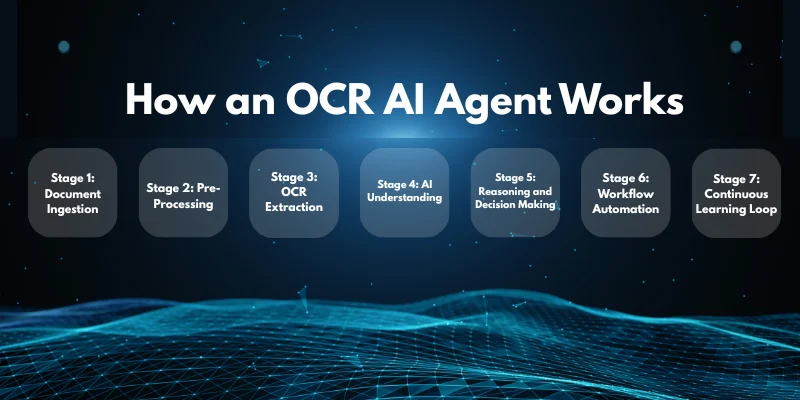
An OCR AI agent processes information much like a human analyst, but faster and without fatigue. The process follows a strict sequential workflow.
Stage 1: Document Ingestion
The agent monitors designated channels. These include email inboxes, API endpoints, or secure FTP folders. When a document arrives, the agent retrieves it automatically.
Stage 2: Pre-Processing
Computer vision algorithms clean the file. The software corrects skew, enhances contrast, and removes visual noise. Clean inputs ensure high extraction accuracy.
Stage 3: OCR Extraction
The AI OCR system reads the raw text. For clean enterprise documents, modern extraction achieves 99%+ OCR accuracy. The agent extracts both printed and handwritten text.
Stage 4: AI Understanding
Large language models (LLMs) and natural language processing (NLP) interpret the text. The agent determines what the document is and what the specific data fields mean in context.
Stage 5: Reasoning and Decision Making
The agent applies business logic. If extracting an invoice, the agent checks the total against the purchase order. It decides if the document meets approval thresholds or requires human review.
Stage 6: Workflow Automation
The agent executes the required action. It updates the enterprise resource planning (ERP) system, routes the document to the correct department, or triggers a payment schedule.
Stage 7: Continuous Learning Loop
If a human corrects an error in the review queue, the agent logs the correction. It updates its internal models to prevent the same error in the future.
The Architecture of OCR AI Agents
To truly address document variability, software must move beyond fragmented scripts to integrated cognitive layers. The architecture of an OCR AI agent consists of five distinct layers.
- Perception Layer: Handles the visual intake. It converts pixels into raw text and identifies structural elements like tables and signatures.
- Understanding Layer: Provides semantic meaning. It classifies the document type and maps extracted text to standardized data models.
- Reasoning Layer: Houses the business logic. It validates data against external databases and evaluates conditions to determine the next action.
- Action Layer: Executes tasks via APIs. This layer pushes data into CRM or ERP platforms and triggers downstream workflows.
- Memory Layer: Stores historical decisions. The agent uses this long-term memory to handle exceptions faster and improve accuracy over time.
OCR vs OCR AI Agent
Standard automation breaks when expected patterns change. AI agents adapt. Choose a standard OCR tool if you only need raw text extraction. Choose an OCR AI agent if your enterprise requires end-to-end workflow automation.
| Feature | Standard OCR | OCR AI Agent |
|---|---|---|
| Accuracy | High for templated, clean files. Fails on unstructured data. | 99%+ accuracy. Adapts to unstructured and varied layouts. |
| Intelligence | None. Only extracts raw text. | High. Understands context, sentiment, and semantic meaning. |
| Automation | Requires manual data routing and validation. | End-to-end automation. Integrates directly via APIs. |
| Decision Making | Cannot evaluate data or make choices. | Applies business rules, flags anomalies, routes exceptions. |
| Enterprise Usage | Basic digitization of paper archives. | Autonomous back-office operations and financial processing. |
Use Cases for Enterprise Automation in the USA
USA-based enterprises deploy document AI automation to eliminate bottlenecks in high-volume environments.
Banking and Finance
Banks process thousands of loan applications daily. Manual review is slow and compliance risks are high. An OCR AI agent reads income statements, verifies identities, and cross-references credit databases instantly. This accelerates loan origination and reduces compliance errors.
Healthcare Administration
Medical facilities manage complex patient records and insurance claims. Disparate document formats lead to billing delays. AI agents extract patient data, validate medical codes, and submit claims to insurance providers automatically.
Legal Operations
Law firms waste billable hours reviewing contracts for specific clauses. Human review is expensive. An OCR AI agent scans thousands of pages during discovery, flags high-risk liability clauses, and categorizes documents by relevance.
Logistics and Supply Chain
Freight forwarders deal with variable bills of lading and customs declarations. Missing data halts shipments. The agent extracts shipping details, verifies customs requirements, and updates tracking systems in real time.
Why OCR AI Agents Are Growing (2026 Insights)
The multi-billion-dollar growth of the Intelligent Document Processing (IDP) market reflects a fundamental shift in enterprise strategy. Cost pressures force organizations to optimize operational efficiency. Manual data entry is no longer financially viable.
This shift aligns with broader automation patterns. We see this heavily in a Streamlined IT Consulting & Service Workflow, where systematic software integration reduces overhead. Furthermore, Mid-sized businesses are replacing fragmented SaaS stacks with custom AI to consolidate operations and reduce vendor sprawl.
The demand for autonomous systems spans across sectors. You can deploy an AI Agent For Your Real State Business to process lease agreements, or rely on how Agentic AI Is Transforming Software Engineering to manage technical documentation. Ultimately, Enterprise Software in the Age of AI Agents focuses on autonomous action over manual input.
Key Benefits of OCR AI Agents
Implementing AI document processing delivers immediate, measurable impact to the bottom line.
- Cost Reduction: Enterprises see a 60–80% reduction in manual document processing costs within the first year of deployment.
- Time Savings: Processing cycles drop from days to seconds. Agents operate continuously without downtime.
- Accuracy Improvement: By eliminating manual data entry fatigue, agents maintain 99%+ OCR accuracy for clean enterprise documents.
- Scalability: AI agents handle sudden volume spikes without requiring additional hiring or overtime pay.
- Compliance Control: Agents log every decision. This creates a perfect audit trail for regulatory compliance.
The Future of OCR AI Agents
The transition from standard extraction tools to autonomous decision-makers will accelerate. Future OCR AI agents will rely heavily on multimodal LLMs capable of interpreting complex charts, handwritten notes, and technical schematics simultaneously.
Enterprise systems will become entirely autonomous. We are moving toward environments where global AI systems manage cross-border supply chain documentation instantly. Additionally, as security requirements tighten, the integration of OCR AI agents with Blockchain Technology in 2026 will provide immutable proof of document authenticity and processing history.
Key Takeaways
- An OCR AI agent combines text extraction with reasoning to automate end-to-end workflows.
- Standard OCR requires strict templates; AI agents adapt to unstructured and variable document formats.
- Modern AI OCR systems achieve 99%+ extraction accuracy on clean enterprise files.
- Deploying these agents results in a 60–80% reduction in manual processing costs.
- Enterprises across finance, healthcare, and logistics use agents to accelerate operations and eliminate human error.
Frequently Asked Questions
What is an OCR AI agent?
An OCR AI agent is an autonomous software system that uses optical character recognition and large language models to extract text from documents, understand its context, apply business rules, and execute downstream actions.
How is an OCR AI agent different from standard OCR?
Standard OCR only converts images into text. An OCR AI agent reads the text, understands its meaning, makes decisions based on the data, and automatically triggers workflow actions in enterprise systems.
Is an OCR AI agent better than RPA?
Yes, for document processing. Robotic Process Automation (RPA) follows strict scripts and breaks when document formats change. An OCR AI agent uses machine learning to adapt to new layouts and handle exceptions intelligently.
Where is AI document processing used?
Enterprises use it for accounts payable (invoice processing), banking (loan origination), healthcare (claims processing), legal (contract analysis), and logistics (customs documentation).
Is it safe for enterprise data?
Yes. Enterprise-grade OCR AI agents operate within secure cloud environments or on-premise servers. They encrypt data in transit and at rest, and maintain comprehensive audit logs for compliance.
What industries benefit most from an AI OCR system?
Data-heavy industries experience the highest ROI. This includes banking, insurance, healthcare, legal services, and supply chain logistics, where document volume and variability are high.