


Charitable giving has always been central to Muslim life, but the way people give has changed completely. A donor in Dubai can now support an orphanage in Karachi, calculate their annual Zakat, and track exactly where their Sadaqah went — all from a single app. This shift has pushed hundreds of NGOs, fintech founders, and religious organizations to ask the same question every week: what is the real Islamic charity app development cost, and what actually drives that number up or down?
If you have searched for charity app development cost or donation app development cost and found nothing but vague ranges, this guide is written to fix that. Based on current market data, feature complexity, and real project patterns from the UAE and South Asia, most Islamic charity apps cost between $8,000 and $60,000+, depending on features, platform, and design complexity. A simple MVP with a Zakat calculator and one payment gateway sits at the lower end, while a multi-country fundraising platform with AI-driven donor matching, blockchain transparency, and admin dashboards can cross six figures.
In this article, we break the cost down by app type — Zakat, Sadaqah, and fundraising — explain every factor that changes your final invoice, and show you how to plan a budget that doesn’t balloon halfway through development.
Key Takeaways
- Overall cost range: Islamic charity app development cost typically falls between $8,000 and $60,000+, depending on feature depth, platform choice, and design complexity.
- Basic MVP: $8,000–$18,000 — Zakat calculator, single donation flow, one payment gateway, basic admin panel.
- Mid-range app: $18,000–$35,000 — multi-currency support, campaign management, donor dashboard, push notifications.
- Advanced/enterprise app: $35,000–$60,000+ — AI recommendations, blockchain transparency, multi-NGO marketplace, advanced reporting.
- Zakat app development cost: $12,000–$30,000 — highest complexity due to Nisab calculations, live gold/silver rates, and Hijri calendar support.
- Sadaqah app development cost: $8,000–$20,000 — simpler donation and campaign flow, no complex religious math involved.
- Islamic fundraising app development cost: $20,000–$45,000 — multi-campaign, multi-NGO management with donor CRM and CSR integrations.
- Generic donation apps cost 15–25% less than Islamic-specific apps, since the Zakat/Sharia-compliance layer is what adds engineering hours.
- Biggest cost drivers: feature count, platform choice, UI/UX depth, backend architecture, payment gateway integration, security/Sharia compliance, team location, and ongoing maintenance.
- Maintenance cost: budget 15–20% of the initial development cost annually for updates, bug fixes, and compatibility patches.
- Must-have features: Zakat/Nisab calculator, multi-currency and multi-language support, secure payment gateway, donor dashboard, push notifications, admin/NGO verification panel, and increasingly, AI-based donor recommendations.
- Advanced/premium features like blockchain transparency and multi-NGO marketplace models push apps toward a “super app” direction — and a higher budget.
- Region matters: UAE-based teams cost more but offer stronger compliance and local payment gateway familiarity; South Asian teams are more budget-friendly for early-stage MVPs.
- Cost-saving strategy: start with an MVP, use cross-platform frameworks (Flutter/React Native), and outsource strategically to an experienced team rather than building in-house from scratch.
- Hidden costs to plan for: recurring currency/gold-rate API fees, longer app store review cycles for financial apps, and proper scholarly validation of Zakat calculation logic.
- The right partner matters more than the lowest quote: experience with Islamic apps specifically — not just generic fintech or e-commerce — prevents expensive post-launch fixes and builds long-term donor trust.
What Is an Islamic Charity App?
An Islamic charity app is a mobile or web platform that helps Muslims fulfil religious giving obligations — Zakat, Sadaqah, Fitrana, and Waqf — digitally, while giving NGOs and mosques a transparent way to collect and report on donations.
Unlike a generic donation app, an Islamic charity app has to account for:
- Nisab-based Zakat calculations tied to live gold and silver rates
- Hijri calendar support for religious accuracy
- Sharia-compliant fund distribution (Zakat can only go to specific categories of recipients under Islamic law)
- Multi-language and multi-currency support, since donors are spread across the Gulf, South Asia, and Western diaspora communities
This complexity is exactly why Islamic charity apps cost more to build than a standard donation app, and why founders need a proper islamic charity app development guide before writing a single line of code — planning the right feature set upfront prevents expensive rework later.
The category is also growing fast. Digital Zakat and Sadaqah payments have surged since 2020 as mosques and NGOs shifted from cash collection boxes to QR codes and in-app giving, especially during Ramadan and Hajj seasons when donation volume spikes 5–10x in a matter of weeks.
How Much Does It Cost to Build an Islamic Charity App?
Here is the direct answer: Islamic charity app development cost typically ranges from $8,000 for a basic MVP to $60,000+ for a fully-featured, multi-platform fundraising app.
The table below gives you a realistic breakdown by tier, so you can map your idea to a budget before contacting any development team.
| Tier | Cost Range | What You Get |
|---|---|---|
| Basic MVP | $8,000 – $18,000 | Zakat calculator, single donation flow, one payment gateway, basic admin panel |
| Mid-Range App | $18,000 – $35,000 | Multi-currency support, campaign management, donor dashboard, push notifications |
| Advanced/Enterprise App | $35,000 – $60,000+ | AI-based recommendations, blockchain transparency, multi-NGO marketplace, advanced reporting |
This is the same pattern seen across most Islamic donation app development cost estimates in the market today — the number rarely stays fixed because every NGO or founder has a different feature priority list. A mosque committee building a simple Sadaqah box replacement pays far less than a fintech startup building a regional Zakat distribution network.
Below, we break these figures down further by the exact type of app you’re building, since “Islamic charity app” actually covers three fairly different products.
Cost Breakdown by App Type
Zakat App Development Cost
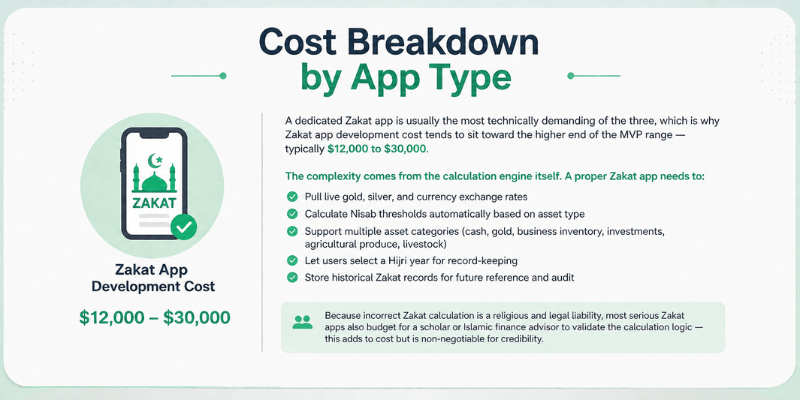
A dedicated Zakat app is usually the most technically demanding of the three, which is why Zakat app development cost tends to sit toward the higher end of the MVP range — typically $12,000 to $30,000.
The complexity comes from the calculation engine itself. A proper Zakat app needs to:
- Pull live gold, silver, and currency exchange rates
- Calculate Nisab thresholds automatically based on asset type
- Support multiple asset categories (cash, gold, business inventory, investments, agricultural produce, livestock)
- Let users select a Hijri year for record-keeping
- Store historical Zakat records for future reference and audit
Because incorrect Zakat calculation is a religious and legal liability, most serious Zakat apps also budget for a scholar or Islamic finance advisor to validate the calculation logic — this adds to cost but is non-negotiable for credibility.
Sadaqah App Development Cost
Sadaqah apps are generally simpler than Zakat calculators because there’s no complex religious math involved — it’s primarily a donation and campaign management flow. Sadaqah app development cost typically falls between $8,000 and $20,000.
Core functionality includes:
- One-tap and recurring donation options
- Campaign pages for specific causes (orphan sponsorship, water wells, education)
- Donation receipts and tax documentation (where applicable)
- Social sharing to boost campaign visibility
Because the logic is lighter, Sadaqah apps are often the starting point for NGOs testing the waters of digital giving before investing in a full Zakat or fundraising platform.
Islamic Fundraising App Development Cost
When an NGO wants to run large-scale, multi-campaign fundraising — think Ramadan appeals, Qurbani drives, or emergency relief funds — the scope expands significantly. Islamic fundraising app development cost usually lands between $20,000 and $45,000, depending on how many organizations or campaigns the platform needs to support simultaneously.
This tier typically includes:
- Multi-campaign and multi-NGO management
- Donor CRM with giving history and tax receipts
- Corporate CSR donation integrations
- Goal trackers and live progress bars
- Team fundraising / peer-to-peer donation pages
General Donation App Development Cost (Comparison)
It’s worth noting how donation app development cost and charity app development cost compare when Islamic-specific features are removed. A generic donation app (no Zakat calculator, no Hijri calendar, no Sharia-compliant fund routing) can be built for roughly 15–25% less than an equivalent Islamic charity app, simply because the calculation and compliance layer is what adds engineering hours. If your organization serves a purely Islamic donor base, the extra investment in religious accuracy pays for itself in trust and adoption.
Key Factors That Affect Islamic Charity App Development Cost
Once you know your app type, the final number still depends on several variables that can swing your budget by tens of thousands of dollars.
1. App Complexity and Feature Count Every additional feature — from push notifications to AI recommendations — adds design, development, and QA hours. A feature list agreed on paper before development starts is the single biggest cost-control tool available to you.
2. Platform Choice Building for iOS only, Android only, both natively, or cross-platform (Flutter/React Native) each carries a different price tag. Cross-platform development is usually the most cost-efficient route for charity apps with limited early-stage budgets.
3. UI/UX Design Depth A donation app lives or dies on trust — a cluttered or outdated interface directly reduces conversion rates. Investing properly in design isn’t optional here, but it does affect cost.
4. Backend and Database Architecture Apps handling live financial data (Nisab rates, currency conversions, donor records) need a more robust backend than a static content app, which increases both development and hosting costs.
5. Payment Gateway and Multi-Currency Support Integrating Stripe, Apple Pay, Google Pay, and region-specific gateways (especially in the Gulf) requires careful, tested implementation — this is one of the most sensitive parts of the build. Because donation apps process real money and personal data, working with a provider offering secure app development services uae is critical; a security lapse in a charity app doesn’t just cost money, it costs donor trust permanently.
6. Security and Sharia Compliance Beyond payment security, Zakat funds must be routed only to eligible recipients under Islamic law. Building this validation logic correctly requires both technical and religious review.
7. Development Team Location Hiring a team in the UAE, South Asia, or Eastern Europe changes hourly rates significantly compared to the US or UK, without necessarily changing quality — location should be evaluated alongside portfolio, not instead of it.
8. Maintenance and Post-Launch Support Industry-wide, ongoing maintenance for charity and donation apps runs 15–20% of the initial development cost annually — covering bug fixes, OS compatibility updates, and feature refinements. Budget for this from day one; it is not optional if you want the app to remain functional two years from now.
Must-Have Features in an Islamic Charity App
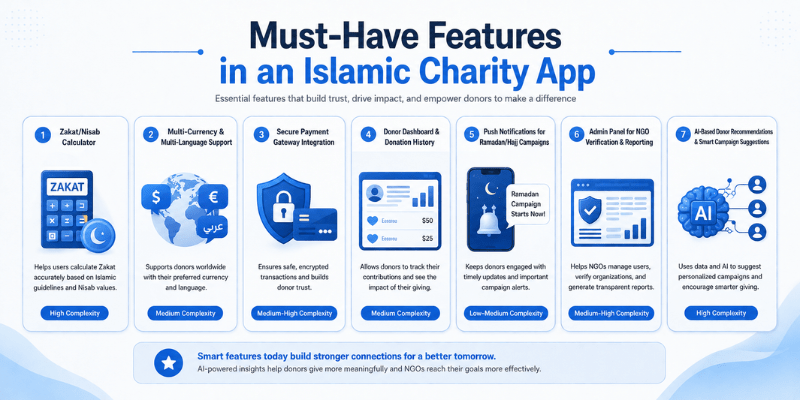
These are the features that appear in almost every serious Islamic charity app, along with a rough sense of how much complexity (and therefore cost) each one adds:
- Zakat/Nisab calculator — high complexity, core differentiator
- Multi-currency and multi-language support — medium complexity, essential for diaspora donors
- Secure payment gateway integration — medium-high complexity, non-negotiable for trust
- Donor dashboard and donation history — medium complexity, improves retention
- Push notifications for Ramadan/Hajj campaigns — low-medium complexity, high engagement value
- Admin panel for NGO verification and reporting — medium-high complexity, essential for transparency
- AI-based donor recommendations and smart campaign suggestions — high complexity, but increasingly expected by donors who want personalized giving suggestions rather than generic campaign lists
That last point is where many charity apps are heading next. Partnering with an ai app development company dubai can help NGOs implement smart features like predictive giving reminders, campaign recommendations based on past donation behavior, and automated fraud detection on transactions — all of which are becoming standard rather than optional in 2026.
Advanced Features That Increase Cost
If your ambitions go beyond a single-purpose donation app, a few advanced additions will meaningfully raise your budget — but also your platform’s ceiling:
- Blockchain-based donation transparency, letting donors trace exactly how their money moved from wallet to recipient
- Multi-NGO marketplace models, where multiple charities operate under one umbrella app, similar to how ride-hailing platforms expanded into food delivery and payments
- In-app Hajj/Umrah booking and Islamic finance tools, turning a single-purpose donation app into a broader Islamic lifestyle platform
This is essentially the cost of super app development uae conversation — many Islamic charity apps in the Gulf are evolving toward this “everything app” model, bundling donations, prayer times, Quran access, and even travel booking into one platform. This mirrors the broader super app revolution middle east, where regional players are consolidating multiple services into single, sticky platforms rather than competing as single-purpose apps. If this is your long-term vision, it’s worth planning your architecture for it from day one, even if you launch with a smaller feature set first.
Islamic Charity App Development Cost by Region
Where you build your app matters almost as much as what you build. Broadly:
- UAE-based development teams tend to charge higher rates than South Asia but offer stronger data protection compliance, faster time zones for Gulf-based stakeholders, and better familiarity with regional payment gateways.
- South Asian teams (India, Pakistan, Bangladesh) generally offer lower hourly rates, making them attractive for MVPs and early-stage NGOs with tighter budgets.
- Western teams (US/UK/Europe) sit at the top of the pricing scale, typically justified for large, well-funded institutional platforms.
For NGOs and founders based in the Gulf, understanding realistic app development cost in dubai benchmarks is essential before requesting quotes — rates here reflect higher operational costs but also come with stronger regulatory alignment for Sharia-compliant and Gulf-specific payment infrastructure. If your donor base is primarily UAE or GCC-based, working with a mobile app development company dubai also simplifies compliance with local data protection and financial regulations, which matters enormously for an app handling religious donations.
Comparison: Islamic Charity App vs Other Niche Apps
To put the cost in perspective, it helps to compare against apps with different complexity profiles. A content-focused app with lighter backend requirements — for example, a project to build manga reader app — usually costs significantly less than an Islamic charity app, because it doesn’t need payment processing, financial calculation engines, or compliance layers. The gap illustrates a simple rule: cost scales with financial and regulatory complexity, not just screen count. A donation app with five screens can easily cost more than a content app with fifty, because the underlying logic and security requirements are so different.
How to Reduce Islamic Charity App Development Cost
None of this means every NGO needs a $50,000 platform on day one. A few practical strategies keep costs realistic without sacrificing quality:
- Start with an MVP. Launch with a Zakat calculator and one payment gateway, then expand based on real user feedback rather than assumptions.
- Choose cross-platform frameworks like Flutter or React Native to cover iOS and Android from a single codebase.
- Outsource strategically. A well-vetted external team, especially a mobile app development company in dubai with Islamic app experience, often delivers better value than building an in-house team from scratch for a first project.
- Reuse validated calculation logic. Where possible, license or reference existing, scholar-approved Zakat calculation methodologies instead of building the religious logic from zero.
Why the Right Development Partner Matters
Cost estimates only mean something if the team executing them understands both the technical and religious dimensions of the product. This is where experience genuinely shows: a team that has built Zakat calculators before will anticipate edge cases — like mixed-currency assets or partial-year Zakat calculations — that a generalist team would miss entirely, often only discovering the gap after launch.
If you’re evaluating partners, look for a mobile app development company in dubai or region-specific team that can show you:
- Past Islamic app projects (not just generic fintech or e-commerce work)
- A clear approach to secure app development services uae-grade payment and data protection
- Willingness to involve a religious/Sharia advisor during the calculation-logic phase
- Transparent, itemized quotes rather than vague “starting from” pricing
A team combining strong ai app development company dubai capabilities with genuine Islamic finance knowledge is increasingly rare — and increasingly valuable, since the next generation of charity apps will differentiate on smart features, not just basic donation flows.
Real-World Lessons: What Most Cost Estimates Miss
Most online cost guides quote a single number and move on. In practice, the founders and NGO teams who get burned aren’t the ones who chose the wrong tier — they’re the ones who didn’t plan for the cost drivers that only show up mid-project. A few patterns are worth flagging honestly:
- Live currency and gold-rate APIs are a recurring cost, not a one-time build cost. Many first-time founders budget for the integration but forget that these third-party data feeds often carry monthly subscription fees that continue for the life of the app.
- App store review cycles for financial apps take longer. Because Zakat and donation apps handle real payments, both Apple and Google apply extra scrutiny during review, which can add one to three weeks to your launch timeline if documentation isn’t prepared in advance.
- Religious validation is a step, not a checkbox. Apps that skip proper scholarly review of their Zakat logic often have to rebuild core calculation flows post-launch after user or community feedback flags an error — a far more expensive fix than getting it right the first time.
- Donor trust drives retention more than feature count. Two apps with identical feature lists can have very different adoption rates simply because one clearly communicates fund transparency and the other doesn’t. Budget for a transparency/reporting screen even if it feels like a “nice-to-have” — for a charity app, it’s closer to a core feature.
These are the kinds of details that separate a rough estimate from a realistic budget, and they’re exactly why working with a team that has shipped Islamic charity apps before — not just generic e-commerce or utility apps — pays off well beyond the initial invoice.
Conclusion
Building an Islamic charity app is as much a trust exercise as it is a technical one. The real Islamic charity app development cost depends on which of the three core categories — Zakat, Sadaqah, or fundraising — you’re building, how many advanced features you add, and which region your development team is based in. For most founders and NGOs, the realistic starting range is $8,000 to $35,000 for a solid, trustworthy MVP, with room to scale toward a full super-app model as your donor base grows.
If you’re ready to move from planning to execution, get a detailed, itemized quote based on your exact feature list rather than a generic estimate — it’s the only way to know your real charity app development cost before development begins.
1. How much does it cost to build an Islamic charity app?
Most Islamic charity apps cost between $8,000 and $60,000+, depending on features, platform choice, and design complexity. A basic MVP with a Zakat calculator sits at the lower end; a multi-NGO fundraising platform with AI and blockchain features sits at the higher end.
2. What is the average Zakat app development cost?
A dedicated Zakat app typically costs $12,000 to $30,000, largely due to the complexity of Nisab calculations, live gold/silver rate integration, and Hijri calendar support.
3. How long does it take to build a Sadaqah donation app?
Most Sadaqah apps take 3 to 6 months to develop, depending on feature scope and how many payment gateways and languages need to be supported at launch.
4. What features increase Islamic charity app development cost the most?
AI-based donor recommendations, blockchain donation tracking, and multi-NGO marketplace functionality add the most cost, since they require significantly more backend engineering than a standard donation flow.
5. Is it better to build in the UAE or outsource abroad?
It depends on your donor base and compliance needs. UAE-based teams offer stronger regulatory alignment and faster local support; South Asian teams often offer lower rates for early-stage MVPs. Many NGOs start with a leaner outsourced build and later migrate to a regional team as they scale.