

Key Takeaways
Before you dive in, here’s what this article covers and why it matters to your business right now:
- Abu Dhabi has committed AED 13 billion (roughly USD 3.5 billion) to become the world’s first fully AI-native government by 2027 — a landmark shift that creates real procurement and partnership opportunities for enterprises of every size.
- The Abu Dhabi Government Digital Strategy 2025–2027 mandates 100% sovereign cloud adoption, full automation of government processes, and deployment of 200+ AI solutions across public services.
- The UAE has already recorded a world-leading 97% AI tool utilization rate across government entities—higher than any other country on earth.
- In April 2026, the UAE government announced that 50% of all federal government services will move to autonomous agentic AI within two years, accelerating the timeline even further.
- For B2B enterprises — from large conglomerates to growing SMEs — this transformation is not just a news story. It is an active vendor, partner, and technology opportunity that is open right now.
- Businesses that align their digital capabilities with UAE government AI requirements today will have a significant advantage in public sector contracts, regulatory approvals, and commercial partnerships tomorrow.
Most governments talk about digital transformation for years before anything meaningful happens. Abu Dhabi is doing the opposite. In January 2025, the emirate unveiled a plan so ambitious it stopped technology leaders globally in their tracks: to become the world’s first fully AI-native government by 2027.
Not a pilot. Not a phased experiment. A complete, end-to-end overhaul of how an entire government thinks, operates, and serves its people — powered by artificial intelligence.
If you run a business in the UAE or you’re planning to enter the UAE market, this is not background reading. This is strategy-critical information. The government is about to change what “working with the public sector” looks like in this country, and the enterprises that understand it earliest will be the ones that benefit most.
This article breaks down exactly what Abu Dhabi’s 2027 vision means, what technologies are driving it, and—critically—what it means for your organization.
What Is the Abu Dhabi Government Digital Strategy 2025–2027?
The Abu Dhabi Government Digital Strategy 2025–2027 is an AED 13 billion initiative implemented by the Department of Government Enablement (DGE) in collaboration with all Abu Dhabi government entities. Its stated goal, as announced by the DGE, is to make Abu Dhabi “the world’s first fully AI-native government across all digital services” by 2027.
This is not simply about putting more services online. It represents a fundamental reimagining of how government works — from reactive to proactive, from paper-based to fully automated, and from siloed to deeply integrated across every department and entity.
The strategy has three core pillars:
Digital Infrastructure: Building a sovereign, scalable digital backbone. This means 100% adoption of sovereign cloud computing for all government operations. No government process will run outside this infrastructure.
AI Integration at Scale: Deploying over 200 innovative AI solutions across government services. These are not chatbots. They include predictive service delivery, intelligent compliance systems, multilingual AI assistants serving Abu Dhabi’s diverse population in more than 15 languages, and automated approvals for routine applications.
People and Ecosystem Development: This is where the “AI for All” programme comes in. The government is investing in upskilling its own workforce—with over 95% of its 30,000-plus employees already completing comprehensive AI training—while simultaneously building the broader innovation ecosystem.
The Numbers That Matter
When decision-makers and enterprise leaders look at a government initiative, the first question is always scale. Here, the scale is hard to overstate:
- AED 13 billion in committed investment from 2025 to 2027
- AED 24 billion projected contribution to Abu Dhabi’s GDP by 2027
- 5,000+ new jobs being created to support the strategy, directly tied to Emiratisation goals
- 200+ AI solutions being deployed across government services
- 100% automation targeted for all government processes
- 95%+ of 30,000 government employees already AI-trained
These are not aspirational figures written into a policy document. As of late 2025, the DGE confirmed that Abu Dhabi’s government is already operating at scale in its use of artificial intelligence across all departments.
The Technologies Behind the 2027 Vision
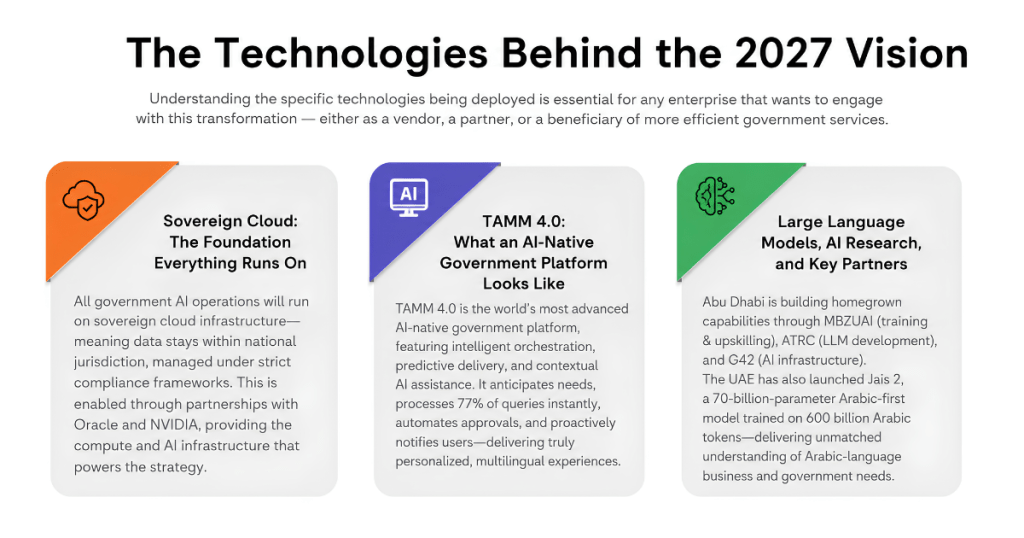
Understanding the specific technologies being deployed is essential for any enterprise that wants to engage with this transformation — either as a vendor, a partner, or a beneficiary of more efficient government services.
Sovereign Cloud: The Foundation Everything Runs On
The UAE government has been clear about data sovereignty. All government AI operations will run on sovereign cloud infrastructure—meaning data stays within national jurisdiction, managed under strict compliance frameworks. This has been made possible through partnerships with global technology leaders including Oracle and NVIDIA, who are providing the compute and AI infrastructure that powers the strategy.
For enterprises operating in the UAE, this has direct implications. If your business handles government data, processes government transactions, or integrates with government systems, you need to understand and align with the sovereign cloud requirement. This is not optional — it is the architecture.
TAMM 4.0: What an AI-Native Government Platform Looks Like
TAMM is Abu Dhabi’s unified government services platform. TAMM 4.0, launched at GITEX Global 2025, represents what the DGE describes as the most advanced AI-native government platform deployed globally. It is built around intelligent orchestration of services across government entities, predictive delivery through machine learning, and contextual AI assistance that provides personalized, multilingual guidance based on individual circumstances.
The system is designed to anticipate what a resident or business needs before they ask. It processes 77% of service queries instantly. It automates approvals for routine applications. It proactively notifies users about benefit eligibility and license renewals. This is AI for the UAE government in its most mature, operational form.
Large Language Models, AI Research, and Key Partners
Abu Dhabi is not relying solely on foreign AI models. The strategy includes the development of homegrown capabilities through partnerships with the Mohamed bin Zayed University of Artificial Intelligence (MBZUAI) for training and citizen upskilling, the Advanced Technology Research Council (ATRC) for large language model development, and G42 for AI infrastructure deployment.
The UAE has also introduced Jais 2, a 70-billion-parameter language model trained on the largest Arabic-first dataset ever assembled — 600 billion Arabic tokens. For enterprises operating in Arabic-speaking markets, this matters enormously. Government AI systems will increasingly understand Arabic-language business submissions, documents, and communications at a level of nuance that was not previously possible.
The Bigger UAE Picture—It Goes Beyond Abu Dhabi
Abu Dhabi’s 2027 vision is the most advanced piece of a much larger national picture. In April 2026, UAE Prime Minister Sheikh Mohammed bin Rashid Al Maktoum announced that the UAE would shift 50% of all government services to autonomous agentic AI within two years. He described AI as “our government executive partner to support decisions, enhance services, boost the efficiency of operations, and even evaluate results and introduce improvements in real time.”
This is a national commitment, not just an emirate-level one. All federal ministries and entities are now being assessed on their speed of AI adoption. Ministers and directors-general are being evaluated on how quickly they implement new AI standards. Government employees at every level are undergoing specialised AI training.
The UAE has also established a new Artificial Intelligence and Data Authority — a single national body responsible for overseeing all data, AI, and digital government initiatives, reporting directly to the UAE Cabinet. This centralisation signals that AI government strategy in the UAE is moving from planning to execution at speed.
For context, the UAE was already the world leader in government AI tool adoption, with a reported 97% utilisation rate among government entities in 2025 — the highest of any country on earth.
For enterprises seeking government IT Solutions in Dubai or across the UAE, understanding this centralised authority and its procurement implications is now a baseline requirement for doing business with the public sector.
The UAE’s rapid progress also reflects impactful AI trends that are driving digital transformation across governments, enterprises, and industries worldwide.
The Opportunity Window Is Open — And It Will Not Stay Open Indefinitely
When a government deploys AED 13 billion into AI and digital transformation, it does not do everything itself. It sources. It partners. It procures. The Abu Dhabi Government Digital Strategy requires technology vendors, systems integrators, AI solution providers, consulting firms, training organizations, data management companies, and cybersecurity specialists.
The enterprises that position themselves correctly — with the right capabilities, the right certifications, and the right understanding of the government’s requirements — will be the ones winning these contracts and partnerships over the next two to three years.
What the Government Is Looking For from Private Sector Partners
Based on the publicly available strategy documentation and the technologies being deployed, government entities in Abu Dhabi are actively seeking expertise in the following areas:
AI-powered process automation, particularly for high-volume, routine government workflows. Intelligent compliance and regulatory technology systems. Sovereign cloud migration and management. Multilingual AI assistant deployment. Data integration and unified ERP platforms. Cybersecurity for AI systems. Workforce AI training and upskilling programs.
If your business operates in any of these domains, the question is not whether there is an opportunity — it is whether you are visible and credible to government procurement teams.
As AI adoption accelerates across the public sector, organizations are increasingly embracing the future of enterprise software in the age of AI agents, where intelligent automation helps streamline administrative tasks, enhance decision-making, and deliver more personalized citizen experiences.
The Efficiency Dividend for Businesses Dealing with Government
Even if you are not a government vendor, Abu Dhabi’s AI transformation will affect your business. The government’s commitment to AI-powered public services UAE means that business licensing, regulatory approvals, tax submissions, permits, and compliance processes will increasingly be handled by automated, AI-driven systems that are faster, more consistent, and available around the clock.
For B2B enterprises, this translates directly into reduced administrative burden, faster approvals, and more predictable regulatory timelines. The government is, in effect, making itself a better business partner for the private sector.
SMEs Have as Much to Gain as Large Enterprises
It is tempting to see a headline figure like AED 13 billion and assume this only benefits large multinationals. That would be a strategic mistake. The UAE’s digital transformation agenda explicitly includes support for SMEs through initiatives like Hub71 in Abu Dhabi, which provides funding, network access, and a favourable innovation environment for technology businesses of all sizes.
Moreover, the government’s push for government automation UAE creates demand for specialised, niche technology capabilities that are often better served by agile SMEs than by large, slow-moving corporations. If you have a specific AI capability — in healthcare, logistics, finance, or education — there is very likely a government entity in Abu Dhabi looking for exactly what you build.
Engaging with an experienced digital transformation company in UAE can help your organization identify where these intersections lie and how to position for them effectively.
How to Align Your Business with the UAE Government’s AI Vision
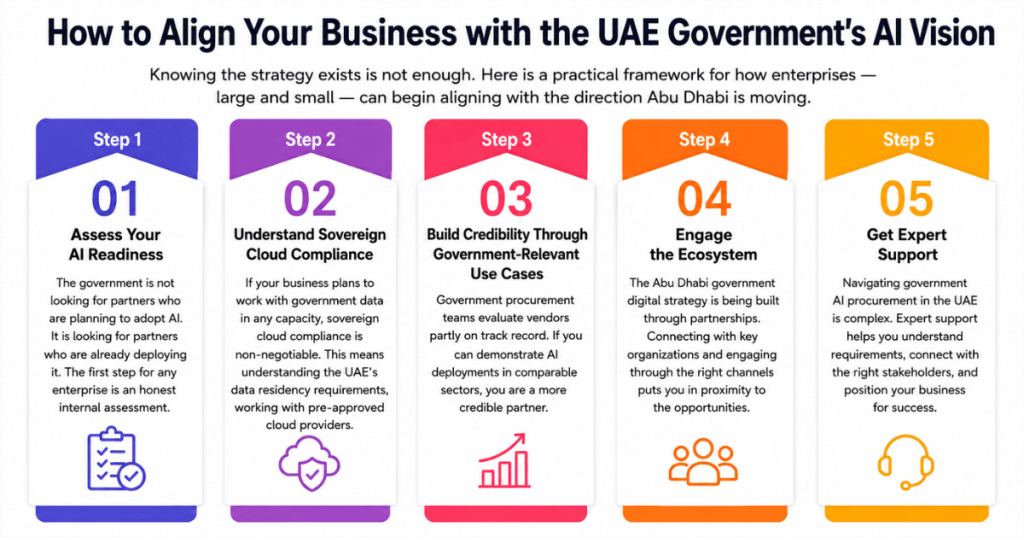
Knowing the strategy exists is not enough. Here is a practical framework for how enterprises — large and small — can begin aligning with the direction Abu Dhabi is moving.
Step 1: Assess Your AI Readiness
The government is not looking for partners who are planning to adopt AI. It is looking for partners who are already deploying it. The first step for any enterprise is an honest internal assessment: where are you on the AI maturity curve? What data do you have? What processes could you automate? Where are your gaps?
Step 2: Understand Sovereign Cloud Compliance
If your business plans to work with government data in any capacity, sovereign cloud compliance is non-negotiable. This means understanding the UAE’s data residency requirements, working with pre-approved cloud providers, and ensuring your data architecture can operate within those constraints.
Step 3: Build Credibility Through Government-Relevant Use Cases
Government procurement teams evaluate vendors partly on track record. If you can demonstrate AI deployments in comparable sectors—public services, regulated industries, large-scale data environments—you are a more credible partner. Start documenting your AI use cases in a way that speaks to government requirements.
Step 4: Engage the Ecosystem
The Abu Dhabi government digital strategy is being built through partnerships. MBZUAI, ATRC, G42, and global technology companies are all part of the ecosystem. Connecting with these organizations—attending GITEX, engaging with Hub71, working through established government IT channels—puts you in proximity to the opportunities.
Step 5: Get Expert Support
Navigating government AI procurement in the UAE is complex. Understanding regulatory frameworks, procurement processes, technical requirements, and the right contacts inside relevant government entities requires expertise. Working with an established AI app development company that understands the UAE government landscape can dramatically accelerate your positioning.
The Evolution — From E-Government to AI Government
To fully appreciate how significant Abu Dhabi’s 2027 vision is, it helps to understand the journey that led here. The UAE’s digital government evolution has moved through three distinct phases.
The first phase was e-government — moving paper-based processes online. This happened primarily in the 2000s and early 2010s. Services became accessible digitally, but the underlying processes were still largely manual.
The second phase was smart government — integrating mobile, cloud, and data analytics to make services smarter and more connected. The UAE’s National Digital Government Strategy 2021–2025 targeted 100% digital service delivery and 90% citizen satisfaction.
The third phase — the one we are now entering — is AI government. This is not an incremental improvement. It is a categorical shift. Government systems no longer just respond to requests. They anticipate needs. They process queries autonomously. They optimize in real time. They learn.
Ahmed Hisham Al Kuttab, Chairman of the Department of Government Enablement, described it this way: by incorporating AI, cloud technologies, and data-driven insights into the government’s DNA, Abu Dhabi will transform public service delivery, optimize government operations, and drive sustainable economic growth.
That statement, from the government’s own leadership, tells you everything about how seriously this is being taken. This is not a technology project. It is a fundamental reimagining of the government’s role in society and economy.
For enterprises working with or seeking to work with the public sector, consulting Dubai IT Consultancy services that are already embedded in these transformation conversations can provide a significant strategic advantage.
Risks, Realities, and What Enterprises Should Watch
No transformation of this scale is without complexity. For B2B enterprises planning around the UAE government’s AI vision, there are a few practical realities worth acknowledging.
Integration complexity is real. Deploying 200+ AI solutions across a multi-entity government is not simple. Legacy systems exist. Data silos exist. The government knows this—the strategy explicitly includes a unified ERP platform to address it—but enterprises should expect that some delays and adjustments will occur.
Cybersecurity is a non-negotiable parallel track. The UAE Cabinet has already established a Cybersecurity Excellence Centre in partnership with Google Cloud. Any enterprise operating in the government AI ecosystem needs to treat cybersecurity not as an afterthought but as a core competency. The government will expect it.
Workforce transition will create short-term friction. Even with 95% of government employees completing AI training, real-world adoption of AI tools across 30,000-plus civil servants takes time. Enterprises should anticipate some variability in how different government entities engage with AI-driven processes during the transition period.
The opportunity is time-sensitive. The AED 13 billion is being deployed through 2027. The bulk of vendor selection and partnership establishment will happen in 2025 and 2026. Enterprises that wait to position themselves will find the market more crowded and the windows narrower.
Enterprises looking to develop or integrate AI software solutions for government projects in the UAE should consider engaging early with Government IT Solutions Dubai specialists who understand the procurement and compliance landscape.
Final Thoughts
Abu Dhabi’s 2027 AI government vision is not a distant ambition. It is an active, funded, operationally progressing transformation that is already changing how government works in the UAE. TAMM 4.0 is live. AI training for government employees is largely complete. The sovereign cloud infrastructure is being built. The AED 13 billion is being deployed.
For B2B enterprises of every size, this creates a genuine, time-sensitive opportunity. Whether you are a technology company looking to supply AI solutions, a consultancy looking to guide government entities through transformation, a business looking to benefit from faster and more efficient public services, or an investor assessing the UAE’s long-term economic trajectory—Abu Dhabi’s AI government strategy is a signal worth acting on.
The UAE has already proven it moves fast. The question for your organization is, are you moving fast enough to be part of it?
If you want to explore how your business can align with and benefit from the UAE’s AI government transformation, our team of specialists is ready to help you navigate the landscape, identify the right opportunities, and build the capabilities you need.
FAQ’s
What is the Abu Dhabi Government Digital Strategy 2025–2027?
It is a government initiative funded by AED 13 billion that aims to make Abu Dhabi the world’s first fully AI-native government by 2027.
What does “AI-native government” actually mean?
An AI-native government is one where artificial intelligence is embedded into the core of how government operates—not as an add-on, but as the underlying system.
How does this create opportunities for private sector businesses?
When a government deploys billions into AI transformation, it does not build everything in-house. It sources AI solutions, cloud infrastructure, systems integration, cybersecurity, training, and consulting from the private sector.
What is artificial intelligence in the UAE government being used for right now?
Currently, AI in the UAE government is being used for automated service approvals, intelligent compliance checking, multilingual citizen assistance, and predictive service delivery.
Is this only relevant for large enterprises?
No. The UAE government’s transformation actively includes SMEs through programs like Hub71, and many of the specialized AI capabilities being sought by government entities are better served by agile, focused technology companies than by large multinationals.
What is a sovereign cloud, and why does it matter for businesses?
“Sovereign cloud” means government data is stored and processed within UAE jurisdiction, managed under national compliance frameworks. For any business that wants to supply technology to or integrate with UAE government systems, alignment with sovereign cloud requirements is mandatory.
How quickly is the UAE government moving on AI adoption?
Very quickly. The UAE already leads the world with a 97% AI tool utilization rate across government entities.
What is agentic AI and why is the UAE government adopting it?
Agentic AI refers to AI systems that can independently execute tasks, manage processes, and support decision-making without constant human intervention.
How should a B2B enterprise start engaging with the UAE government AI ecosystem?
Start with an internal AI readiness assessment. Then understand sovereign cloud and data compliance requirements. Build a portfolio of government-relevant AI use cases.
What role does the UAE National AI Strategy 2031 play alongside Abu Dhabi’s 2027 strategy?
The UAE National AI Strategy 2031 is the overarching federal framework, targeting AI’s contribution of up to 45% of national GDP by 2031 and fully paper-free government services across all emirates.