
Key Takeaways
- Mid-sized businesses are replacing fragmented SaaS stacks with custom AI software to reduce complexity, improve efficiency, and lower long-term costs.
- Disconnected software creates data silos, manual work, integration challenges, and slower decision-making.
- AI-assisted development has made custom software faster, more affordable, and more scalable than ever before.
- Custom AI platforms unify data, automate workflows, and provide greater control over security, compliance, and business operations.
- AI agents are transforming customer support, sales, operations, and knowledge management through intelligent automation.
- Organizations gain a competitive advantage when technology is built around their unique workflows instead of adapting processes to generic software.
- The most successful businesses will combine human expertise with AI-powered systems to drive innovation, agility, and sustainable growth.
For years, organizations expanded their software ecosystems to support growing business needs. As operations became more complex, companies adopted specialized tools for functions such as customer management, HR, support, analytics, and emerging AI capabilities.
While this enabled faster digitization and access to advanced functionality, it also created an unintended outcome—fragmented technology environments that are increasingly difficult to manage at scale.
Today, mid-sized businesses typically operate across 40+ SaaS applications. Industry studies indicate that nearly 60% of IT leaders face ongoing challenges with system integration and data consistency, while employees can lose up to 30% of productive time navigating between disconnected tools and manual workflows.
What was once designed to improve efficiency is now often a source of operational friction, slowing decision-making and increasing complexity across teams.
At the same time, AI-assisted development and generative AI have significantly reduced the time and cost required to build custom applications, improving development productivity by 30–50% in many environments. As a result, more organizations are turning to the best custom AI development services for medium-sized companies to create scalable, business-specific AI platforms that deliver greater efficiency, flexibility, and competitive advantage than traditional software solutions.
This shift is changing the economics of software strategy.
As a result, a key question is emerging for mid-sized enterprises:
Is a fragmented SaaS ecosystem still the most efficient model, or is it time to consolidate operations through custom AI software systems built around business-specific needs?
This is no longer just a technology discussion—it reflects a broader shift in how organizations define efficiency, control, and long-term competitive advantage in the AI era.
What Is Patchwork Software?
Patchwork software refers to a collection of independent applications that are connected through integrations, spreadsheets, manual workflows, and third-party connectors rather than functioning as a single unified system.
Most mid-sized businesses do not intentionally design such environments. Instead, these systems evolve gradually as the organization grows and new operational requirements emerge.
A typical company may begin with a core set of tools such as a CRM and an accounting platform. Over time, additional software is introduced to address specific business functions like marketing automation, customer support, human resources, inventory management, project tracking, business intelligence, AI-enabled tools, and communication platforms. Each solution is adopted to solve an immediate operational need, but collectively they often operate in isolation rather than as part of an integrated architecture.
As a result, the organization gradually transitions into a fragmented technology ecosystem where data and workflows are distributed across multiple disconnected systems.
Common Signs of a Patchwork Software Environment
In fragmented software ecosystems, operational inefficiencies gradually become more visible as the organization scales. These challenges rarely appear all at once but instead emerge as ongoing friction across teams, systems, and workflows.
- Duplicate or inconsistent data across systems
When multiple platforms store the same type of information independently, discrepancies naturally occur. Customer records, financial data, or operational updates may not match across systems, leading to confusion, reporting errors, and unreliable decision-making. - Limited real-time visibility between departments
Because data is distributed across disconnected tools, leadership teams often struggle to access a unified, real-time view of business performance. This delay in information flow can slow strategic decisions and reduce organizational agility. - Increasing reliance on manual processes
In the absence of seamless integration, employees frequently depend on spreadsheets, manual updates, and repetitive data entry. Over time, this not only reduces productivity but also increases the likelihood of human error. - Rising subscription costs and maintenance overhead
As the number of tools grows, so do recurring SaaS expenses, integration maintenance costs, and vendor management efforts. What begins as individual software investments often turns into a significant cumulative operational expense. - Integration failures between systems
Connecting multiple third-party applications introduces technical complexity. API mismatches, synchronization delays, and broken workflows can disrupt operations and require constant monitoring and fixes. - Security vulnerabilities from multiple entry points
Each additional software tool expands the organization’s attack surface. With data flowing through multiple systems, ensuring consistent security controls, access management, and encryption standards becomes increasingly difficult. - Challenges in maintaining compliance consistency
Regulatory requirements such as GDPR, HIPAA, or ISO standards require centralized control over data handling. In fragmented systems, maintaining consistent audit trails and compliance enforcement across platforms becomes significantly more complex.
In a mid-sized healthcare setup using separate systems for patient records, billing, scheduling, and communication, even small updates must be repeated across multiple platforms. This increases the risk of errors, slows operations, and adds ongoing maintenance overhead.
Over time, managing software starts to feel as complex as delivering core services, impacting overall efficiency and decision speed.
Fragmented systems scale complexity as businesses grow, creating operational friction instead of efficiency. Custom AI Software offers a more unified approach by aligning systems with actual workflows and reducing dependency on disconnected tools.
Why the Build vs Buy Debate Has Changed in 2026
For decades, software leaders operated on a simple principle: buying software was faster, cheaper, and less risky than building it internally.
Custom application development traditionally required significant engineering resources, long development cycles, infrastructure investment, and ongoing maintenance. As a result, most mid-sized organizations found purchasing software to be the most economically efficient choice.
However, this equation has changed significantly.
The New Economics of Software Development
Artificial intelligence has significantly transformed the software development process by introducing tools that streamline and accelerate every stage of development.
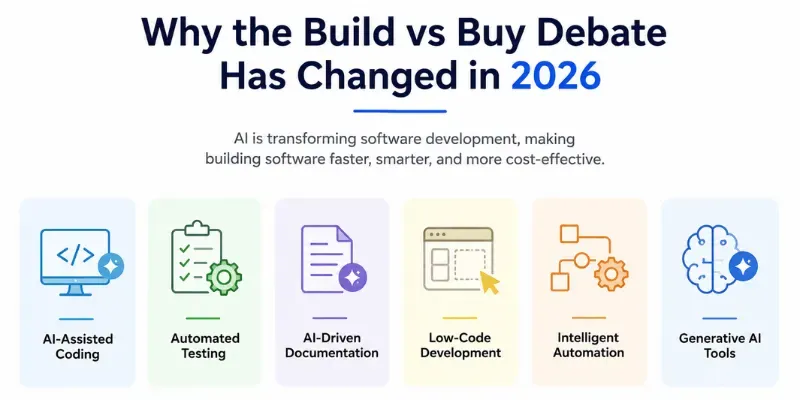
Modern development teams now leverage the following capabilities:
- AI-assisted coding
Developers use AI tools to generate, review, and optimize code faster. This reduces manual effort, speeds up development cycles, and helps identify errors early in the process. - Automated testing
AI-driven testing frameworks automatically detect bugs, run regression tests, and validate application performance. This improves software reliability while reducing manual QA workload. - AI-driven documentation
Technical documentation can now be generated and updated automatically based on code changes, ensuring consistency and reducing the time spent on manual documentation tasks. - Low-code development frameworks
These platforms allow developers to build applications using visual interfaces and prebuilt components, significantly reducing the amount of traditional coding required. - Intelligent workflow automation
AI enables systems to automate repetitive business processes such as approvals, data routing, notifications, and reporting without manual intervention. - Generative AI development tools
These tools assist in building entire application components, generating UI elements, APIs, and business logic based on natural language prompts. As a result, generative AI development services are helping businesses accelerate software development, reduce engineering effort, and deliver intelligent applications faster than traditional development approaches.
Tasks that previously required months of development effort can now often be completed in weeks.
This shift does not eliminate the need for skilled engineers. Instead, it amplifies their productivity, allowing them to focus on architecture, scalability, and complex problem-solving.
As a result, small development teams today can deliver outcomes that once required significantly larger engineering departments, fundamentally reshaping the economics of software development.
Traditional Development vs AI-Assisted Development
| Factor | Traditional Development | AI-Assisted Development |
| Development Speed | Slow | Significantly Faster |
| Resource Requirements | High | Moderate to Low |
| Customization | High | High |
| Maintenance | Fully Manual | Partially Automated |
| Scalability | Variable | Strong and Adaptive |
| Innovation Speed | Limited by timelines | Accelerated through AI tools |
This shift has made custom AI development increasingly attractive for mid-sized businesses.
Instead of relying on recurring subscription fees for generic software solutions, organizations are now able to invest in systems designed specifically around their operational needs and business workflows.
The result is improved operational efficiency, higher levels of automation, stronger compliance control, and a more favorable long-term return on investment.
Also Read: 9 AI Content Tools 2026 (Plus Enterprise Insights)
The 7 Reasons Mid-Sized Businesses Are Replacing Patchwork Software with Custom AI
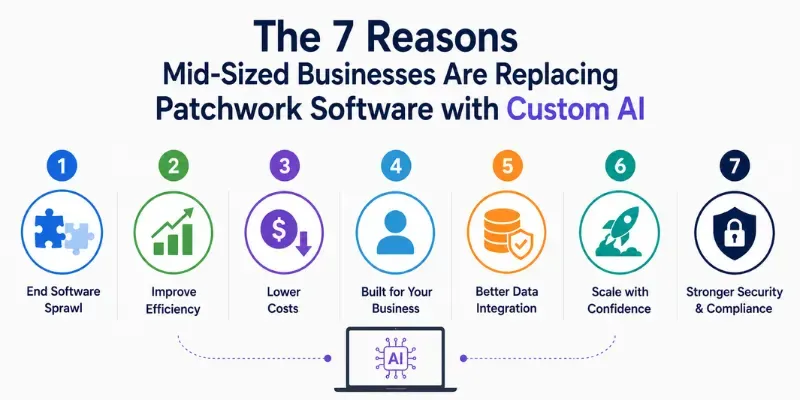
1. Rising SaaS Costs Are Becoming Unsustainable
Most software subscriptions appear cost-effective when evaluated individually. A CRM may cost a few thousand dollars annually, while customer support platforms, analytics tools, project management systems, communication platforms, automation solutions, and AI assistants each add their own recurring expenses.
However, the real challenge is not the individual cost of each tool but the cumulative financial impact.
As organizations scale, software spending often grows faster than revenue. Additional users require more licenses, advanced functionality is locked behind premium tiers, and critical integrations frequently demand enterprise-level upgrades. Over time, businesses find themselves paying substantial annual fees simply to sustain existing workflows.
The Hidden Cost of Software Fragmentation
Beyond subscription fees, fragmented software systems create significant operational overhead that is often overlooked.
Organizations must continuously manage:
- Integration management—Keeping multiple systems connected and functional requires ongoing effort and maintenance.
- Vendor coordination—Handling contracts, renewals, support, and updates across multiple providers increases administrative workload.
- Employee training—Each new tool adds onboarding time and reduces productivity during adoption.
- Data migration and syncing—Moving and aligning data across systems introduces errors and inefficiencies.
- Technical support—Maintaining performance and resolving issues across multiple platforms adds continuous cost.
- Security monitoring—More tools mean more access points, increasing security complexity.
When these costs are combined, many organizations discover that custom AI software development offers stronger long-term economics.
Instead of paying multiple vendors indefinitely, companies invest in a centralized platform aligned with their specific business objectives.
2. Data Silos Are Slowing Down Business Decisions
Data is one of the most valuable assets an organization can have. Yet, in a patchwork software environment, information often becomes trapped within isolated systems. Sales teams may rely on one platform, marketing on another, customer support on a separate tool, and finance on its own database.
This fragmentation makes it difficult for leadership to gain a comprehensive view of business performance. Critical insights remain scattered, decision-making slows, and valuable opportunities are frequently overlooked.
Why Unified Data Matters
Custom AI software platforms can consolidate data across departments, creating a single source of truth for the organization.
When data flows through a unified architecture, organizations gain:
- Faster reporting
Data from different departments is automatically consolidated, allowing organizations to generate reports in real time instead of manually collecting and compiling information from multiple systems. - Better forecasting
With access to complete and unified data, businesses can identify patterns more accurately, leading to improved predictions for sales, demand, and overall business performance. - Improved customer insights
A unified view of customer data helps organizations understand behavior, preferences, and interactions more clearly, enabling more personalized and effective engagement strategies. - Enhanced operational visibility
Leadership teams gain a clear, real-time overview of how different departments and processes are performing, improving coordination and resource planning. - More accurate decision-making
With reliable, centralized data, decisions are based on complete information rather than fragmented inputs, reducing errors and improving strategic outcomes.
AI systems become significantly more effective when they can access comprehensive organizational data rather than isolated information pools.
This is one reason why many companies pursuing AI transformation begin by replacing fragmented systems with integrated AI-powered platforms.
3. Generic Software Cannot Match Unique Business Workflows
Every successful business develops operational processes that differentiate it from competitors. These workflows are often the result of years of experience, customer feedback, and deep industry expertise.
However, most SaaS products are designed for broad market adoption. To serve a large customer base, vendors build standardized solutions that prioritize scalability over specificity.
As a result, businesses are often forced to adjust their internal processes to fit software limitations rather than the other way around. Employees develop workarounds, departments create unofficial processes, and overall productivity begins to decline.
Competitive Advantage Lives in Customization
Custom AI software reverses this dynamic.
Instead of forcing teams to adapt to rigid software constraints, the software is designed around specific business requirements and operational workflows.
This approach enables organizations to automate highly specialized processes, enhance employee productivity, and deliver more consistent and effective customer outcomes.
For example, a logistics company may require route optimization based on region-specific variables, a healthcare provider may need patient engagement workflows aligned with strict compliance requirements, and a financial services organization may require advanced risk assessment models tailored to its unique data structures.
Generic software often struggles to meet these specialized needs effectively.
Custom AI, however, can be designed to address them directly and precisely.
4. Compliance and Regulatory Requirements Are Increasing
Compliance is no longer just an IT responsibility—it has become a critical boardroom priority. Organizations operating in healthcare, finance, insurance, logistics, and other regulated industries face increasing obligations around data security, privacy, and governance.
Key regulatory frameworks include:
HIPAA (Health Insurance Portability and Accountability Act) sets strict standards for protecting patient health information in the healthcare industry, particularly in the United States.
GDPR (General Data Protection Regulation) is a European Union regulation that governs how personal data of individuals is collected, processed, and stored, with a strong focus on user consent and privacy rights.
PCI DSS (Payment Card Industry Data Security Standard) applies to organizations that handle credit and debit card transactions, ensuring secure payment processing and reducing fraud risk.
SOC 2 (Service Organization Control 2) is a compliance framework that evaluates how service providers manage customer data based on security, availability, processing integrity, confidentiality, and privacy principles.
ISO 27001 is an international standard for information security management systems, providing a structured framework for managing sensitive company and customer information through risk-based controls.
Together, these frameworks ensure that organizations maintain strong security, privacy, and governance practices while handling sensitive data across systems and platforms.
While SaaS vendors often provide compliance features, businesses remain responsible for how data is collected, processed, stored, and accessed.
This creates challenges when sensitive information moves across multiple software platforms.
Why Compliance Favors Unified AI Architectures
A custom AI platform gives organizations centralized control over data governance, access permissions, audit trails, encryption standards, data retention, and regulatory reporting.
Instead of managing compliance across multiple vendors, businesses can enforce consistent policies through a single governance framework, reducing risk and improving visibility.
For many mid-sized companies, compliance has evolved from a legal requirement into a strategic advantage that builds trust with customers and partners.
As regulatory demands increase, organizations with unified AI architectures are better positioned to outperform those relying on fragmented software systems.
5. AI Agents Are Transforming Business Operations
The rise of AI agents is one of the biggest reasons mid-sized businesses are rethinking their technology investments.
Unlike traditional software that requires users to manually perform tasks, AI agents can understand objectives, make decisions within predefined rules, and complete complex workflows with minimal human intervention.
This shift is changing how organizations approach productivity.
Instead of employees spending hours on repetitive administrative work, AI agents can handle many operational tasks automatically.
Common AI Agent Use Cases
AI agents are becoming an integral part of modern business operations by automating repetitive tasks, improving response times, and supporting decision-making across departments.
Customer Support Agents
AI agents can handle customer inquiries, resolve common issues, escalate complex cases when needed, provide 24/7 assistance, and significantly reduce response times, improving overall customer experience.
Sales Enablement Agents
In sales functions, AI agents help qualify leads, schedule meetings, generate personalized outreach, update CRM records, and identify potential upsell opportunities, enabling sales teams to focus on high-value interactions.
Operations Agents
Organizations are using AI agents to monitor workflows, track project progress, manage inventory, generate reports, and coordinate activities across teams, resulting in improved operational efficiency and visibility.
Knowledge Management Agents
Internal AI assistants help employees quickly access company information, locate documents, understand internal procedures, retrieve compliance guidelines, and accelerate onboarding processes, improving productivity and reducing dependency on manual support.
Businesses that partner with an experienced AI agent development company gain the ability to deploy these capabilities in ways that align with their specific objectives rather than relying on generic automation tools.
The result is greater efficiency, faster execution, and improved employee productivity.
6. Businesses Want Greater Control Over Their Data
Data is one of the most valuable assets an organization possesses, yet many businesses lose visibility and control when information is spread across multiple software platforms.
In fragmented environments, customer data, support records, financial information, and operational insights often reside in separate systems. This creates challenges such as limited visibility, data duplication, vendor dependency, migration complexity, and security risks.
As organizations increasingly rely on data-driven decision-making and AI, centralized data management has become a strategic necessity rather than just a technical preference.
The Importance of Data Ownership
Data is one of the most valuable assets in any organization. However, when information is spread across multiple software platforms, businesses often face limited visibility, duplicated records, vendor dependency, migration challenges, and increased security risks.
As organizations become more data-driven and AI-powered, maintaining control over data is no longer just an operational requirement—it is a strategic advantage that enables better decision-making, stronger security, and greater business agility.
Organizations must also ensure the integrity and authenticity of the information flowing through their systems. Modern AI detection software helps businesses verify AI-generated content, support governance initiatives, and maintain higher standards of data quality across enterprise operations
Custom AI software enables organizations to centralize data management while maintaining control over how information is accessed, processed, and utilized.
This becomes increasingly important as AI models depend on high-quality data to deliver accurate insights and recommendations.
Organizations that own their data infrastructure often gain a competitive advantage because they can generate unique intelligence unavailable to competitors using the same off-the-shelf software products.
7. Faster Innovation Is Becoming a Competitive Necessity
Business environments are evolving faster than ever. Customer expectations change, market conditions shift, and new regulatory requirements continue to emerge. Organizations that cannot adapt quickly often struggle to maintain their competitive advantage.
However, traditional software environments can slow innovation by creating dependence on vendor roadmaps. Even when businesses identify opportunities for improvement, they may have to wait months—or sometimes years—for the required features or capabilities to become available.
In a rapidly changing market, this lack of agility can limit growth, responsiveness, and long-term competitiveness.
Why Custom AI Accelerates Innovation
Custom AI platforms allow businesses to innovate at their own pace without being constrained by vendor roadmaps or platform limitations.
Organizations can:
Introduce new features rapidly. New capabilities can be developed and deployed based on business priorities rather than waiting for third-party software updates.
Automate emerging workflows. As operational needs evolve, businesses can quickly automate new processes to improve efficiency and reduce manual effort.
Integrate new technologies
Custom AI platforms provide the flexibility to adopt emerging tools, APIs, and innovations without major system disruptions.
Test ideas quickly—Organizations can experiment with new features, processes, and business models faster, enabling continuous improvement and innovation.
Respond to market opportunities. Businesses can adapt more quickly to changing customer demands, industry trends, and competitive pressures
This agility is particularly valuable for mid-sized businesses. Unlike large enterprises, they often cannot afford prolonged inefficiencies, and unlike startups, they operate at a scale where operational performance directly impacts profitability.
Custom AI software provides the flexibility to move faster while maintaining control over business systems and processes.
Custom AI vs Traditional SaaS: Complete Comparison Guide
One of the most important questions business leaders face today is whether custom AI platforms can deliver greater value than traditional SaaS solutions.
The answer depends on factors such as business complexity, growth objectives, operational requirements, and long-term digital strategy. However, as organizations scale, the limitations of fragmented software environments often become more apparent.
The comparison below highlights the key differences:
| Feature | Patchwork SaaS Environment | Custom AI Platform |
| Data Ownership | Distributed across multiple vendors | Centralized and business-controlled |
| Workflow Customization | Limited by platform capabilities | Tailored to specific business needs |
| Integration Flexibility | Moderate | High |
| Compliance Control | Shared across vendors | Fully controlled by the organization |
| Long-Term Cost Predictability | Variable and subscription-driven | More predictable over time |
| User Experience | Fragmented across multiple tools | Unified and streamlined |
| Innovation Speed | Dependent on vendor roadmaps | Driven by business priorities |
| AI Capabilities | Generic and standardized | Customized for specific use cases |
| Competitive Advantage | Limited differentiation | Significant strategic advantage |
| Scalability | Constrained by platform limitations | Designed around business growth |
While SaaS solutions continue to offer value in many scenarios, custom AI software platforms provide greater flexibility, control, and alignment with business objectives, making them increasingly attractive for mid-sized organizations seeking long-term competitive advantage.
When SaaS Still Makes Sense
A successful technology strategy does not require replacing every software application.
Certain functions are often better served by specialized SaaS platforms, particularly those built around standardized processes and regulatory requirements. Examples include payroll processing, tax management, industry-specific compliance systems, and general productivity tools.
The goal is not to eliminate SaaS altogether. The goal is to identify areas where custom AI can create measurable business value through automation, data unification, operational efficiency, and competitive differentiation.
In practice, the most effective digital transformation strategies combine carefully selected SaaS solutions with custom AI platforms that support core business operations and strategic growth initiatives.
Also Read: 10 Essential Steps for Successful AI Development in 2025
Industry Examples: Where Custom AI Is Delivering Results
The adoption of custom AI is no longer limited to technology companies. Across industries, organizations are using AI-powered platforms to streamline operations, improve decision-making, and create more personalized customer experiences.
Healthcare
Healthcare organizations manage large volumes of sensitive patient data while operating under strict regulatory requirements. Custom AI Software help providers improve patient engagement, automate appointment scheduling, streamline clinical documentation, support care decisions, and enhance operational efficiency.
By bringing patient records, communication systems, and workflow automation into a unified environment, healthcare providers can reduce administrative workload while delivering better patient outcomes.
Financial Services
Financial institutions face growing pressure to balance customer expectations with regulatory compliance. Custom AI platforms are helping organizations strengthen fraud detection, automate risk assessment, accelerate customer onboarding, simplify regulatory reporting, and improve portfolio analysis.
These capabilities increase accuracy, reduce manual effort, and support faster, data-driven decision-making.
Manufacturing
Manufacturers are increasingly leveraging AI to improve operational performance and supply chain efficiency. Common applications include predictive maintenance, inventory optimization, quality control, demand forecasting, and production planning.
With centralized AI platforms, manufacturers gain real-time visibility across operations, enabling faster responses to disruptions and improved resource utilization.
Logistics and Transportation
The logistics industry operates in a fast-moving environment where efficiency directly impacts profitability. Custom AI solutions help organizations optimize route planning, fleet management, shipment tracking, resource allocation, and demand forecasting.
These improvements contribute to lower operating costs, faster deliveries, and enhanced customer satisfaction.
Retail and E-Commerce
Retailers are using AI to create more personalized and efficient shopping experiences. Custom AI software platforms support intelligent product recommendations, automated customer support, dynamic pricing strategies, inventory forecasting, and customer journey optimization.
By leveraging AI-driven insights, businesses can improve customer retention, increase conversion rates, and drive sustainable revenue growth.
The BUILD Framework: A Simple Way to Evaluate Custom AI Opportunities
Many business leaders recognize the limitations of fragmented software environments but struggle to determine which systems should be modernized first.
To simplify the decision-making process, organizations can use the BUILD Framework, a practical model for identifying where custom AI software can deliver the greatest business value.
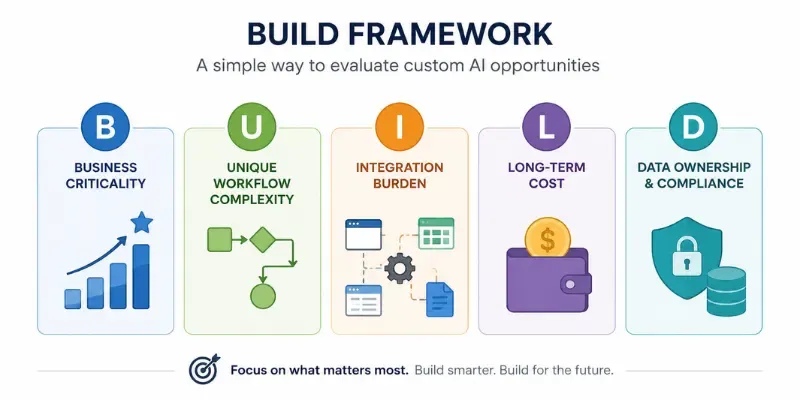
B — Business Criticality
How important is the system to daily operations?
Applications that directly impact customer experience, revenue generation, operational efficiency, or competitive differentiation should be prioritized for evaluation. The more critical the system, the greater the potential return from customization.
U — Unique Workflow Complexity
Does the organization rely on specialized processes that generic software struggles to support?
Businesses with highly customized workflows often face limitations with standardized SaaS platforms. In these cases, custom AI can provide a significantly better fit by aligning technology with actual operational requirements.
I—Integration Burden
How many systems need to communicate for work to get done?
When teams depend on multiple applications, integrations, spreadsheets, and manual processes to complete routine tasks, complexity increases and efficiency declines. High integration overhead is often a strong indicator that consolidation should be considered.
L — Long-Term Cost
Evaluate technology costs over a three-to-five-year period rather than focusing solely on annual subscription fees.
This assessment should include licensing expenses, integration costs, maintenance requirements, employee productivity impacts, and ongoing operational overhead. Many organizations discover that custom AI offers a stronger long-term return on investment than maintaining multiple disconnected software solutions.
D — Data Ownership and Compliance
Who controls the organization’s most valuable data?
As data governance, privacy, security, and regulatory requirements become increasingly important, organizations need greater visibility and control over how information is stored, accessed, and utilized. Custom AI architectures often provide stronger governance capabilities than fragmented software environments.
A Quick Decision Rule
If a system scores highly across all five BUILD factors—Business Criticality, Unique Workflow Complexity, Integration Burden, Long-Term Cost, and Data Ownership—it is often a strong candidate for modernization through custom AI development.
Rather than replacing software indiscriminately, the BUILD Framework helps organizations focus their investments where they can create the greatest operational and strategic impact.
Risks and Challenges of Building Custom AI
While custom AI offers significant advantages, successful implementation requires careful planning and a clear long-term strategy.
Initial Investment
Unlike off-the-shelf software, custom AI solutions require upfront investment in planning, development, and deployment. However, many organizations view this as a strategic investment that delivers long-term value through greater efficiency, automation, and operational control.
Change Management
Adopting new technology often requires adjustments to existing processes and workflows. To ensure successful adoption, businesses should focus on employee training, clear communication, and stakeholder engagement throughout the transition.
Governance and Compliance
AI systems require strong governance frameworks to ensure responsible and secure usage. Organizations must establish clear policies around data management, security, compliance, performance monitoring, and ongoing system oversight.
Talent and Technical Expertise
Developing and maintaining scalable AI solutions requires specialized skills in AI, data engineering, system integration, and architecture. For this reason, many businesses choose to partner with experienced AI development providers rather than managing complex transformations entirely in-house.
The Bottom Line
While implementing custom AI software comes with challenges, they are manageable with the right strategy, expertise, and governance framework. For many organizations, the long-term benefits—including greater efficiency, flexibility, and competitive advantage—far outweigh the initial investment and complexity.
Future Trends: What Comes Next?
The shift away from fragmented software ecosystems is still in its early stages. As AI capabilities continue to mature, several trends are expected to accelerate the adoption of custom AI platforms across industries.
1. AI-Native Businesses Will Gain a Competitive Edge
Organizations that build their operations around AI-driven workflows and automation will be better positioned to scale, innovate, and respond to market changes. As AI adoption increases, the performance gap between AI-enabled businesses and those relying on disconnected systems and manual processes is likely to widen.
2. AI Agents Will Become Core Business Infrastructure
Today, AI agents are often viewed as emerging technologies. Over the next few years, they are expected to become a standard part of business operations, supporting functions such as customer service, sales enablement, compliance monitoring, financial operations, human resources, and knowledge management.
Organizations that begin developing these capabilities now will be better prepared for large-scale adoption in the future.
3. Industry-Specific AI Platforms Will Replace Generic Solutions
Different industries face unique operational, regulatory, and customer challenges. As a result, businesses are increasingly moving beyond one-size-fits-all software in favor of AI platforms tailored to their specific needs.
Healthcare providers, financial institutions, manufacturers, logistics companies, and retailers are already exploring industry-focused AI solutions that offer greater flexibility and business alignment than generic software products.
4. Compliance-Driven AI Will Become Essential
As governments and regulatory bodies introduce new AI governance requirements, organizations will need stronger oversight and accountability mechanisms.
Future AI systems will be expected to provide explainability, auditability, transparency, security controls, and robust data governance. Businesses that incorporate compliance into their AI strategies from the outset will be better positioned to adapt to evolving regulations.
5. Data Will Become the Ultimate Competitive Asset
In the AI era, competitive advantage will depend less on software and more on the quality, accessibility, and usability of data.
Organizations that centralize and effectively manage their data will be able to build smarter AI models, generate deeper insights, improve forecasting accuracy, deliver better customer experiences, and accelerate innovation.
This is one of the primary reasons many businesses are moving away from fragmented software environments and investing in unified, AI-driven platforms designed around long-term growth.
6. AI-Powered Customer Experiences Will Become the Standard
Customer expectations are evolving rapidly, making intelligent engagement a competitive necessity. Organizations are increasingly investing in AI chatbot development service solutions to provide personalized support, automate customer interactions, and deliver seamless experiences across digital channels.
Businesses that successfully combine AI-powered engagement with human expertise will be better positioned to improve customer satisfaction and long-term retention.
Ready to Move Beyond Patchwork Software?
If your organization is struggling with growing software complexity, rising SaaS costs, disconnected data systems, or operational inefficiencies, now is the time to evaluate whether a custom AI software strategy can deliver greater value.
At SISGAIN, we help mid-sized businesses design, develop, and deploy scalable AI solutions tailored to their unique workflows, compliance requirements, and growth objectives. From intelligent automation and AI agents to enterprise-grade custom platforms, our solutions are built to improve efficiency, strengthen governance, and create sustainable competitive advantages.
The future belongs to organizations that own their innovation, control their data, and leverage AI as a strategic business asset—not just another software tool.
Take the Next Step
Whether you’re exploring AI adoption, modernizing legacy systems, or looking to replace fragmented software environments with a unified AI platform, our experts can help you identify the right opportunities and build a roadmap for success.
Schedule a consultation with SISGAIN today and discover how custom AI software can transform your business operations, accelerate innovation, and drive long-term growth.
Conclusion
The way businesses approach technology is changing rapidly.
For years, organizations relied on adding more software tools to solve new challenges. While effective in the short term, this approach often led to fragmented systems, rising costs, disconnected data, and operational complexity.
Today, Custom AI Software offers a smarter alternative. By unifying workflows, automating processes, and centralizing data, businesses can improve efficiency, strengthen compliance, and accelerate innovation.
The organizations that thrive in the coming years will be those that leverage AI strategically to create more agile, data-driven, and competitive operations.
The question is no longer whether AI will transform business operations—it is whether your business is prepared to take advantage of that transformation.

Frequently Asked Questions
What is patchwork software?
Patchwork software is a collection of disconnected tools connected through integrations, spreadsheets, or manual processes.
Is custom AI expensive for mid-sized businesses?
Custom AI typically requires a higher upfront investment than SaaS solutions. However, it can reduce long-term costs by eliminating multiple software subscriptions, improving efficiency, and automating repetitive tasks.
What can AI agents automate?
AI agents can handle customer support, sales tasks, reporting, and workflows.
Which industries benefit most from custom AI?
Industries like healthcare, finance, retail, logistics, and manufacturing benefit the most from custom AI due to high data use and automation needs. They use it to improve efficiency, reduce costs, and make better predictions and decisions.
Can custom AI replace all SaaS tools?
Not entirely. Most businesses combine custom AI with essential SaaS applications.