


Key Takeaways
- A healthcare cybersecurity assessment proves whether your controls work. A vulnerability scan only lists what might be wrong.
- Scope has to reach EHR/HIS, APIs, cloud, medical devices, vendors and recovery, not just servers and laptops.
- Demand six deliverables: executive report, evidence pack, data-flow inventory, regulatory crosswalk, 30/60/90-day roadmap and retest.
- Cost follows complexity (systems, integrations, testing depth, clinical constraints), not headcount.
- Clinical-safety rules keep testing from disrupting patient care, so clinicians and IT can keep working efficiently.
- Treat assessment as an ongoing programme. It keeps your organisation competitive as patients, partners and regulators expect more every year.
Ten years ago, a hospital’s security perimeter was a data centre and a firewall. Today, patient data moves through EHR and HIS platforms, APIs, telehealth apps, cloud workloads, mobile apps, PACS, LIS and RIS systems, connected devices and a long list of vendors. Each connection is an entry point.
That’s why a basic vulnerability scan can’t tell you whether you can protect patient information and keep clinics running. It tells you what’s missing a patch. It doesn’t tell you what an attacker could reach next.
A healthcare cybersecurity assessment is an evidence-based examination of technical controls, identities, applications, devices, vendors, data flows, governance and recovery capability. This guide explains what it should include, which deliverables to expect, how long it takes, and what drives the price, so you can buy the right scope the first time. Rising digital health platform security risks make that decision more important every year.
What Is a Healthcare Cybersecurity Assessment?
It’s a structured review that measures how well your organisation protects patient data, clinical systems and care continuity, then ranks the gaps by real-world risk. The output is a decision-ready picture, not a pile of scanner exports. For a CIO, that means knowing which five systems would hurt most if they went offline tomorrow. For a compliance officer, it means evidence that stands up in a review. For a clinic owner, it means a short list of fixes worth paying for first.
Some providers also call this healthcare security risk assessment services. The name matters less than what’s inside: technical testing plus operational and governance review. If you work with US partners or payers, you may also hear “HIPAA security risk analysis”. That’s a US requirement under the HIPAA Security Rule. It’s a useful reference model, but in Dubai your primary obligations come from DHA policies, NABIDH and UAE law.
How a Healthcare Cybersecurity Assessment Differs From a Generic Security Audit
A general IT audit asks whether the network is configured well. A healthcare assessment asks whether a ward can keep treating patients while the network is under attack. The differences are practical:
- Patient-data protection: the focus is where health information lives, moves and gets copied.
- Clinical availability: downtime is a patient-safety issue, not an inconvenience.
- Healthcare attack surfaces: EHR/HIS, healthcare APIs, IoMT and third-party access all need specialist handling.
- Regulatory evidence: findings must be defensible in front of regulators and procurement teams.
What the Assessment Is Designed to Prove
A good engagement answers seven questions. Where does sensitive health information reside? Who can access it? How do systems communicate? Which weaknesses could disrupt clinical operations? How do vendors connect? Do the controls work in practice? And can you detect, respond to and recover from an attack?
If a report can’t answer those, it’s an inventory, not an assessment.
When Does a Healthcare Organisation Need a Cybersecurity Assessment?
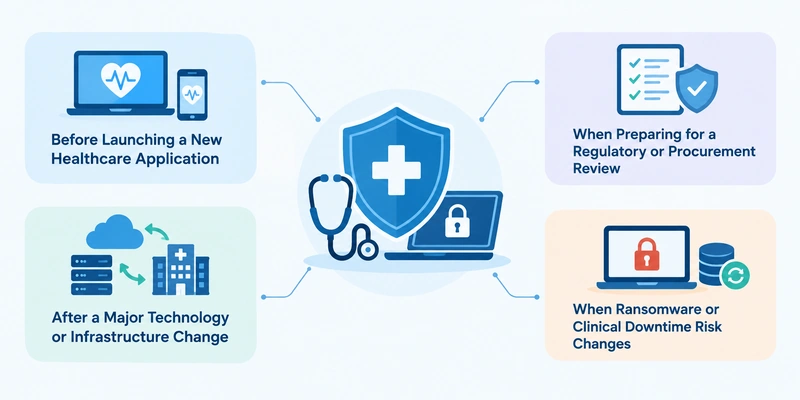
Not once a year because someone ticked a box. The right moments are tied to change and risk.
Before Launching a New Healthcare Application
Telehealth platforms, patient portals, mobile health apps, EHR integrations and cloud clinical systems should be tested before go-live. That’s where healthcare application security testing pays for itself: fixing an authentication flaw in staging costs a fraction of fixing it after patients are using it. Teams that follow secure healthcare software development practices catch many of these issues earlier, but an independent assessment still validates what was built.
After a Major Technology or Infrastructure Change
Cloud migrations, EHR replacements, new clinic locations, mergers and acquisitions, new medical-device deployments and new third-party integrations all reshape your attack surface. Controls that worked last year can quietly stop applying.
When Preparing for a Regulatory or Procurement Review
Regulators and enterprise buyers ask for evidence: policies, access records, risk registers, vendor controls and technical findings. Running an assessment first means you find the gaps before someone else does.
When Ransomware or Clinical Downtime Risk Changes
New dependence on a single system, a changed backup strategy or a flatter network all shift your exposure. The assessment should validate backups, RTO and RPO, network segmentation, incident response, recovery testing and your clinical downtime procedures.
Quick Question: “How often should a healthcare organisation run an assessment?”— At least annually for a full review, plus a targeted assessment after any major change, such as a new application, migration or vendor. High-risk systems like patient portals and APIs benefit from more frequent testing.
What Should a Healthcare Cybersecurity Assessment Cover?
This is where scopes succeed or fail. A credible healthcare cybersecurity assessment covers seven areas, and each one maps to a way real incidents start: a stolen credential, an exposed API, an unpatched server, a vendor’s remote-support tool, or a medical device nobody knew was on the network. If a proposal skips any of the seven, ask why.
Governance, Risk and Compliance
Reviewers examine security policies, risk registers, ownership, privacy practices, awareness training, incident-response procedures, evidence management and third-party clauses in contracts. Findings should then be mapped against applicable DHA and NABIDH requirements and UAE data-protection law, including the federal health data law on ICT in health fields.
Identity and Access Management
Most breaches involve a credential somewhere. Assess MFA, role-based access, privileged accounts, joiner-mover-leaver processes, service accounts, break-glass access, vendor accounts, remote access and periodic access reviews. The principle is least privilege with continuous verification, which is the core idea behind zero trust healthcare architectures.
EHR, HIS and Clinical Applications
Look at EHR/HIS configuration, LIS, RIS/PACS, pharmacy systems and patient portals. Check authentication, session management, audit logging, clinical workflows and unintended data exposure, for example a clinician seeing records outside their department.
APIs and Healthcare Integrations
Test API authentication, authorisation, encryption, input validation, token handling and logging, plus FHIR and HL7 interfaces and links to external systems. Assess the entire data path, not just single applications, because attackers follow data, not org charts.
Cloud and Infrastructure Security
Review servers, endpoints, network architecture, firewalls, segmentation, cloud configuration, storage, encryption, logging, backup infrastructure and monitoring. A healthcare vulnerability assessment belongs here: it identifies missing patches, exposed services and risky settings across these assets.
IoMT and Medical Device Security
Start with discovery. Many hospitals don’t have a complete list of connected devices. Then look at unsupported and legacy systems, segmentation, remote access, patching limits, monitoring and compensating controls. Conventional scanning can crash some clinical devices, so testing has to respect patient-safety constraints and be agreed with biomedical engineering.
Third-Party and Vendor Access
EMR vendors, cloud providers, managed service providers, telehealth vendors, remote-support tools, SaaS platforms and data processors all connect to your environment. Supplier risk becomes your risk, so vendor accounts, access paths and contract controls need review.
Healthcare Penetration Testing vs Vulnerability Assessment
Buyers often compare these two. They answer different questions.
What a Healthcare Vulnerability Assessment Finds
It identifies known vulnerabilities, missing patches, misconfigurations, exposed services, weak settings and vulnerable assets. It’s broad and fast, and it tells you what’s weak.
What Healthcare Penetration Testing Adds
Healthcare penetration testing tries to exploit those weaknesses, showing what an attacker could actually reach. Typical scope includes external infrastructure, internal networks, web applications, mobile apps, authentication and privilege escalation. API testing is increasingly central: FHIR security flaws such as weak token scopes or overly broad resource access can expose entire patient records through one endpoint.
Why Healthcare Testing Needs Additional Safeguards
Production systems can’t go down for an experiment. Mature providers agree rules of engagement, maintenance windows, exclusions for fragile devices, escalation contacts and patient-care dependencies in writing before touching anything.
| Vulnerability Assessment | Penetration Testing | |
|---|---|---|
| Question answered | What is weak? | What can an attacker actually do? |
| Approach | Broad, largely automated | Targeted, manual, exploit-driven |
| Best for | Hygiene and coverage | Validating real risk |
The takeaway: a mature engagement combines vulnerability assessment, penetration testing, application testing, configuration review and governance analysis. No single technique is enough.
What Deliverables Should You Expect From Healthcare Cybersecurity Assessment Services?
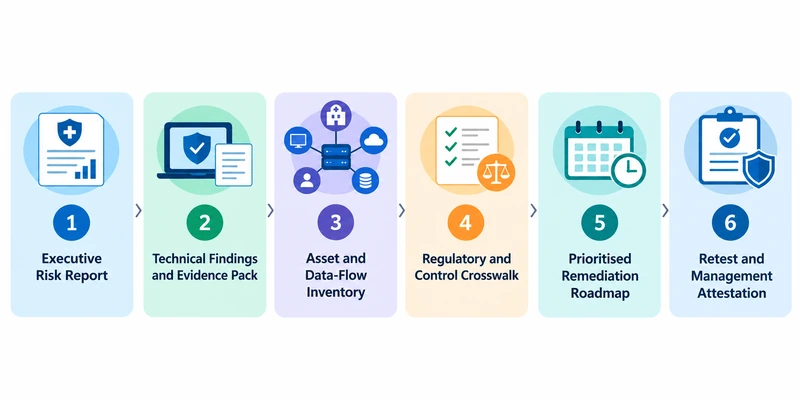
Deliverables are what you’re really paying for. A healthcare cybersecurity assessment that ends in a slide deck and a scanner export leaves your team with homework and no plan. Insist on these six.
1. Executive Risk Report. Top risks, clinical and business impact, priorities and recommended actions on a few pages. Executives need ranked business risk, not a dump of CVEs.
2. Technical Findings and Evidence Pack. Vulnerabilities, configuration observations, penetration-test evidence where authorised, access-control observations, logging gaps, application and API findings, and backup and recovery observations. Your engineers need reproducible detail.
3. Asset and Data-Flow Inventory. A map of patient-data systems, clinical applications, APIs, vendors, cloud services, devices and exchange points. Many organisations get their first complete picture here.
4. Regulatory and Control Crosswalk. Findings mapped to DHA requirements, NABIDH-related controls, UAE privacy obligations, internal policies and contractual duties. A caution: an assessment supports compliance work, but it doesn’t automatically make you “DHA compliant”. Be wary of anyone who says it does.
5. Prioritised Remediation Roadmap. Each finding should list the risk, control owner, priority, estimated effort, dependencies and target date, grouped into a 30/60/90-day plan.
6. Retest and Management Attestation. Remediation validation, an updated risk register and an evidence pack for management, auditors and procurement.
What Factors Determine Healthcare Security Assessment Cost?
There’s no honest one-size price, and any provider quoting one before understanding your environment is guessing. Healthcare security assessment cost depends on six drivers, and knowing them lets you compare quotes for the same healthcare cybersecurity assessment on equal terms.
Organisation size and footprint. A single-site clinic, a laboratory, a telehealth provider and a multi-site hospital network differ in complexity far more than in headcount.
Systems, applications and integrations. Cost rises with every EHR/HIS module, API, mobile app, cloud environment, PACS/LIS/RIS system, device class and third-party link. Organisations running several EMR software solutions in UAE across sites often discover that integration points, not applications, drive the effort.
Depth of testing.
| Level | Typical activities |
|---|---|
| Lower | Documentation review, governance assessment, gap analysis |
| Medium | Vulnerability assessment, cloud configuration review, access review, application assessment |
| Higher | Internal and external penetration testing, API and mobile testing, cloud security assessment, IoMT assessment, ransomware recovery validation |
Clinical operational constraints. Production environments, restricted maintenance windows, biomedical engineering coordination, devices that can’t be scanned and downtime limits all add effort.
Evidence readiness. Current asset inventories, policies, risk registers, vendor registers, access reviews, data-flow diagrams and backup evidence shorten the engagement. If you have to build them from scratch, that time shows up in the quote.
Regulatory and geographic scope. A Dubai-focused review against DHA and NABIDH differs from a multi-emirate or multi-country review, which needs extra mapping, for instance to Abu Dhabi DoH requirements.
Quick Question: “Does a completed assessment make us DHA compliant?”— No. It shows where you meet or miss requirements and gives you evidence and a plan. Compliance is a status granted through the regulator’s own processes, so verify current DHA requirements directly.
How to Compare Healthcare Cybersecurity Assessment Providers
Use four questions when comparing quotes for any healthcare cybersecurity assessment. They separate providers who sell a report from providers who reduce your risk.
What’s actually in scope? Are EHR and clinical applications included? APIs? Medical devices? Cloud? Vendors? Penetration testing? Backup and recovery review? If two quotes differ widely in price, scope is usually why.
What evidence will you receive? Ask for sample reports, a risk register, a control matrix, a remediation roadmap and retest terms.
How is clinical safety protected? Look for rules of engagement, maintenance windows, exclusions, production safeguards, escalation procedures and biomedical coordination.
Do they understand healthcare technology? Experience with EHR/HIS, PACS/LIS/RIS, telehealth, healthcare APIs and IoMT matters. A provider that has built interfaces knows where they break. For example, an HL7 software development company in UAE will spot interface weaknesses a generalist tester can miss. Healthcare cybersecurity consulting should also be strategic, helping you prioritise investment and not just run tools.
How Long Does a Healthcare Cybersecurity Assessment Take?
Ranges vary, so treat these as planning guides, not promises. The timeline of a healthcare cybersecurity assessment depends less on the provider’s speed and more on how quickly your teams can supply access, evidence and testing windows.
Small clinic or focused assessment: several days to a few weeks, depending on testing depth.
Hospital or multi-system assessment: often several weeks, because of asset discovery, interviews, access reviews, technical and application testing, clinical coordination, evidence validation and reporting.
What causes delays: incomplete inventories, vendor dependencies, restricted production testing, multiple locations, complex integrations, slow evidence collection and scheduling constraints. Sending asset lists and diagrams before kickoff is the easiest way to save time.
Common Mistakes When Buying a Healthcare Cybersecurity Assessment
Choosing the cheapest option. Low cost usually means limited scope.
Treating a scan as a full assessment. A scan can’t replace governance review, identity assessment, application testing, vendor review, IoMT analysis or resilience testing.
Focusing only on compliance. Passing an audit doesn’t prove you can withstand an attack.
Ignoring clinical continuity. Tie every finding to patient care, downtime and recovery priorities. This is also the foundation of effective hospital ransomware protection: knowing which systems must come back first.
Accepting a long findings list with no plan. A useful report says what to fix first, who owns it, why it matters and how the fix will be validated.
How to Build a Healthcare Cybersecurity Assessment Roadmap
A healthcare cybersecurity assessment works best as four connected phases rather than one big event. Healthcare cybersecurity consulting support is most valuable in phases 3 and 4, where findings turn into funded decisions.
Phase 1: Scope and discovery. Identify systems, map data flows, list users and vendors, and define testing boundaries.
Phase 2: Assessment and testing. Run governance and identity reviews, vulnerability assessment, application and API testing, infrastructure review, IoMT assessment and third-party assessment.
Phase 3: Risk prioritisation. Rank findings by clinical impact, patient-data exposure, exploitability, regulatory importance and business impact.
Phase 4: Remediation and retesting. Run a 30/60/90-day plan with named owners, retest fixes and report progress to executives.
Why a Healthcare Cybersecurity Assessment Should Be an Ongoing Programme
One healthcare cybersecurity assessment is a snapshot. Your environment changes constantly: new applications, integrations and vendors, cloud migrations, device additions, software updates and new attack techniques. A report from last year describes a system that no longer exists.
Pair periodic assessments with continuous vulnerability management, access reviews, vendor reviews, penetration testing, incident-response exercises and recovery testing. If you commission Custom Healthcare Software Dubai projects or keep extending existing platforms, add security testing to each release cycle so the programme moves at the same pace as development.
The aim isn’t a report. It’s continuous risk reduction and clinical resilience.
Choose Healthcare Cybersecurity Assessment Services Based on Scope, Not Just Price
Healthcare attack surfaces are interconnected. A credible assessment examines technology, people, vendors, data and clinical operations together, and compares providers on scope, testing depth, evidence, deliverables, expertise, timelines and remediation support. Done well, healthcare security risk assessment services give decision-makers a clear view of their highest-priority risks and a funded path to fix them.
When you scope your next healthcare cybersecurity assessment, weigh coverage and healthcare context ahead of the lowest number on the quote. That’s the difference between a provider who knows healthcare software from the inside and one selling generic cybersecurity services Dubai packages. The first can test your EHR integrations, APIs and clinical workflows with the context to understand what a finding means for patient care.
Final Takeaways
- Buy scope, not a report. Confirm EHR/HIS, APIs, cloud, IoMT, vendors and recovery are all included.
- Combine vulnerability assessment, penetration testing, application testing and governance review.
- Require six deliverables, ending with a 30/60/90-day roadmap and a retest.
- Expect cost to follow complexity and clinical constraints, and prepare your evidence early to save time.
- Protect patients first: agree testing rules, maintenance windows and escalation paths in writing.
- Repeat the cycle. Ongoing assessment keeps you resilient, audit-ready and competitive.
Frequently Asked Questions
What is a healthcare cybersecurity assessment?
It’s an evidence-based review of your technical controls, identities, applications, devices, vendors, data flows, governance and recovery capability, with findings ranked by their risk to patient data and clinical operations.
How much does a healthcare security assessment cost?
Cost depends on organisation size, systems and integrations, testing depth, clinical constraints, evidence readiness and regulatory scope. Reputable providers quote after scoping, because a single clinic and a hospital network differ enormously.
How long does a healthcare cybersecurity assessment take?
A focused clinic assessment can take several days to a few weeks. Hospitals and multi-system environments often need several weeks for discovery, testing, clinical coordination and reporting. Incomplete inventories cause most delays.
Is a vulnerability scan the same as a full assessment?
No. A scan lists known weaknesses on assets. A full assessment also reviews governance, identity, applications, vendors, devices and recovery, then ranks risks by clinical impact and gives you a remediation plan.
Does an assessment make us DHA compliant?
No. It identifies gaps, produces evidence and maps findings to DHA and NABIDH-related controls. Compliance is determined through the regulator’s own processes, so confirm current requirements directly with DHA before relying on any report.
Is a HIPAA security risk analysis required in Dubai?
HIPAA is a US law, so it isn’t your primary obligation in Dubai. Its risk-analysis approach is a useful reference, but DHA policies, NABIDH and UAE data-protection law set your local requirements.
Can penetration testing disrupt clinical systems?
It can if poorly managed. Mature providers agree rules of engagement, maintenance windows, device exclusions and escalation contacts beforehand, and coordinate with biomedical engineering, so testing protects patient care rather than risking it.
Should medical devices and IoMT be included?
Usually yes. Connected devices are often unpatched, poorly inventoried and weakly monitored. Assessment should rely on passive discovery, segmentation review and compensating controls, avoiding intrusive scans that could affect device safety.
How often should we repeat the assessment?
Run a full assessment at least annually, plus targeted reviews after major changes such as new applications, cloud migrations, EHR replacements or new vendors. Pair these with continuous vulnerability management between cycles.
What should we ask providers before hiring?
Ask what systems are in scope, what evidence you’ll receive, how clinical safety is protected during testing, and whether the team understands EHR/HIS, APIs, HL7/FHIR interfaces and real clinical workflows.