

Key Takeaways
- Treat security as product design. Remote patient monitoring security belongs in the architecture from day one, not in a pre-launch compliance review.
- Protect the whole chain. Remote patient monitoring security has to cover the wearable, mobile app, cloud, API, EHR and clinician dashboard. One weak link exposes all of it.
- Give every device an identity. Unique credentials and secure onboarding are the first layer of remote patient monitoring security, stopping spoofed or unauthorised devices from feeding readings into patient records.
- Secure the integrations. Remote patient monitoring security must extend to every API, FHIR and HL7 flow, using strong authentication, scoped access and PHI-safe logging.
- Plan for downtime, not just breaches. A monitoring outage is a patient-safety event, so remote patient monitoring security must include tested offline mode, alert delivery and recovery.
- Verify Dubai requirements early. Check DHA telehealth rules, device approvals and data-hosting obligations before you choose an architecture.
- Choose partners on lifecycle security. Faster releases, lower rework and stronger clinician trust come from vendors who document patching, testing and responsibilities.
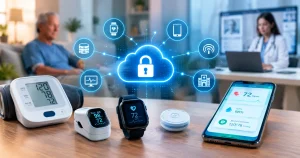
A blood pressure cuff in a patient’s living room is now part of your hospital’s attack surface. So is the smartphone it pairs with, the cloud service that ingests the reading, and the API that pushes it into the EHR.
Remote patient monitoring (RPM) is growing quickly across chronic disease management, post-discharge follow-up, elderly care and hospital-at-home programmes in Dubai. Each of those programmes depends on one platform that connects medical devices, mobile apps, cloud infrastructure, APIs, clinical dashboards and health records.
That’s why remote patient monitoring security has to cover more than encryption. It has to protect patient privacy, the integrity of clinical readings, the availability of the service, and ultimately patient safety. A tampered glucose reading or a silenced alert isn’t just a data incident. It can change a clinical decision.
Good remote patient monitoring security starts from one assumption: every device, network and account outside your walls is untrusted until proven otherwise.
This remote patient monitoring security guide walks through the threats, the controls, the Dubai-specific considerations and the questions to ask any technology partner. It’s written for teams who are building, buying or scaling an RPM platform in the UAE.
What Is Remote Patient Monitoring Security?
Remote patient monitoring security is the practice of protecting connected medical devices, applications, patient data, clinical systems and monitoring workflows across the entire RPM lifecycle, from device onboarding to clinician response.
It rests on the three classic principles of information security:
- Confidentiality: only authorised people and systems see patient data.
- Integrity: readings, alerts and records can’t be altered without detection.
- Availability: monitoring keeps running, and alerts reach clinicians on time.
In RPM, those principles extend into areas conventional IT security rarely touches: device identity, authorisation at the level of individual patients, audit trails for every reading, and clinical continuity when connectivity drops.
How RPM Security Differs From Telehealth Security
A video consultation is a session. Remote patient monitoring is a stream. Devices collect data continuously or on a schedule, outside any facility, on networks you don’t control. Telehealth security focuses on the consultation channel. Remote patient monitoring security has to secure the device, the patient’s home environment, the data pipeline and the clinical workflow that acts on the result.
Why It Matters for Dubai Healthcare Providers
Providers in Dubai operate under licensing, approved-device, patient-consent and data-governance expectations. When readings are compromised, alerts are delayed or monitoring is interrupted, the consequences fall on both patients and the provider’s clinical accountability.
The practical lesson: build remote patient monitoring security into the product design. Retrofitting it after launch is slower, costlier and rarely complete. That’s where Custom Healthcare Software Dubai pays off: a platform built around your clinical pathways, device mix and DHA obligations lets you design security in, instead of adapting a generic product later.
Why RPM Creates a Larger Cybersecurity Attack Surface
Hospitals spend years hardening their own networks. RPM moves part of the care environment into homes, pockets and public Wi-Fi. Remote patient monitoring security has to start from that reality, because it’s one of the core digital health platform security risks that CTOs need to plan for before scaling.
Connected Devices, Mobile Apps and Home Networks
Blood pressure monitors, glucose meters, pulse oximeters and smart wearables generate sensitive health data all day. The exposure points are practical and often mundane:
- Bluetooth pairing that accepts any nearby device
- Insecure home Wi-Fi with default router passwords
- Shared smartphones where a family member can open the patient’s app
- Outdated firmware that never receives a patch
- Lost or stolen devices still linked to a patient record
Strong IoMT security has to assume these conditions exist. Devices operate beyond the controlled hospital network, so trust can’t come from the network. It has to come from the device’s identity, the app’s integrity and the platform’s verification of every message. That’s the foundation of remote patient monitoring security.
A compromised home router doesn’t automatically compromise your healthcare system, and that’s the point of good design. If each endpoint is authenticated and isolated, one weak home network stays a local problem.
Cloud Platforms, APIs and Clinical Integrations
Behind the device sits the rest of the stack: cloud storage, ingestion APIs, analytics engines, clinical dashboards and EHR integrations. A misconfigured storage bucket or an over-permissioned integration can expose thousands of patient records at once, or quietly stop data flowing to clinicians.
Connected medical device security is therefore an end-to-end responsibility. It spans hardware, firmware, mobile software, networks, cloud services and the clinical workflow that consumes the data.
Key Security Threats Facing RPM Platforms
Medical Device Vulnerabilities and Outdated Firmware
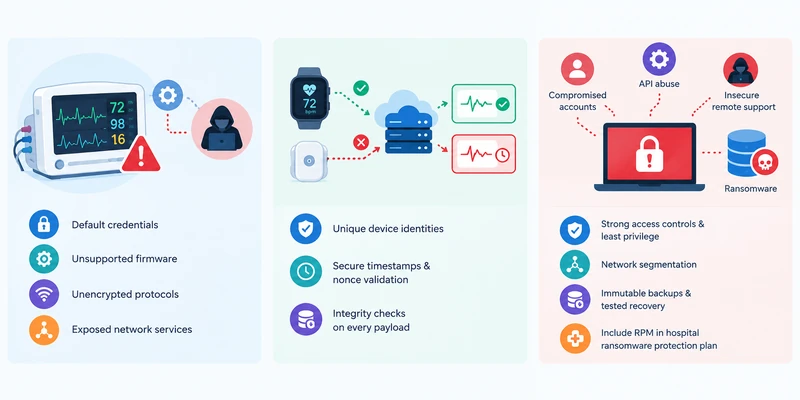
Default credentials, unsupported firmware, unencrypted protocols and exposed network services are the usual culprits. Vulnerabilities in a connected monitor affect both cybersecurity and clinical reliability, because a device that can be manipulated can’t be trusted to report accurately.
A well-documented example: in early 2025 the U.S. FDA warned about vulnerabilities in certain Contec CMS8000 patient monitors and the related Epsimed MN-120 devices, including a concern that the software could send patient data to an external address and allow remote manipulation of the device. The details are worth reading in the FDA’s safety communication. The broader lesson for RPM buyers is simple: ask where a device’s software comes from and what it talks to.
Effective medical device cybersecurity is ongoing work. It needs vulnerability monitoring, patch planning, defined end-of-support policies and secure lifecycle management for every device you deploy.
Device Spoofing, Data Manipulation and Replay Attacks
An attacker who can impersonate a device can submit false readings. One who can capture traffic can resend an old, normal-looking reading to mask a real deterioration. Both attacks target integrity, and both can mislead a clinician. Remote patient monitoring security controls must therefore prove where every reading came from.
The defences are well understood:
- Unique device identities so each reading maps to a verified device
- Secure timestamps and nonce validation to reject replayed messages
- Integrity checks on every payload
Account Compromise, API Abuse and Ransomware
Stolen credentials, excessive permissions, exposed APIs and insecure remote-support tools give attackers a way in. From there, weak RPM software security lets them read patient records, alter configuration or disrupt monitoring. A compromised administrator account in a poorly isolated integration can reach far more than it should.
Ransomware deserves its own place in any remote patient monitoring security plan. When clinical dashboards go offline, clinicians lose visibility of patients who are at home and can’t be checked on by walking the ward. Strong hospital ransomware protection means segmented networks, immutable backups, tested recovery and clear clinical fallback procedures, and RPM platforms should be included in that plan explicitly.
Quick Question: “What is the biggest security risk in remote patient monitoring?”— The biggest risk is untrusted data reaching clinicians. If a device can be spoofed, a reading replayed or an account hijacked, a clinician may act on false information. Verified device identity, encrypted transport and integrity checks are the first remote patient monitoring security controls to put in place.
How to Protect Connected Medical Devices and Wearable Health Data
Device-level remote patient monitoring security is where most programmes should start, because everything downstream trusts what the device reports.
Establish Unique Device Identity and Secure Onboarding
Every device should be registered, bound to one patient and authenticated with its own credentials, ideally certificate-based. Secure pairing prevents unknown devices from submitting readings. Just as important is the boring part: patient-to-device matching, and a clear process for replacing or revoking a lost or compromised device. Identity is the anchor of remote patient monitoring security.
Secure Firmware, Updates and Software Dependencies
Look for signed firmware, secure boot, authenticated updates and the removal of unused services. Ask suppliers for a software bill of materials (SBOM) so you can see which components a device runs, and confirm they operate a vulnerability disclosure process.
Then write the policy down: patch timelines, end-of-support rules and how updates are verified after installation. Medical device cybersecurity fails most often at the maintenance stage, not the design stage.
Protect Wearable Health Data Across Devices and Mobile Apps
Wearable health data security, a core part of remote patient monitoring security, depends on the whole path from sensor to server:
- Encrypt data in transit and at rest, including on the phone
- Use secure mobile storage and short, well-managed sessions
- Harden the app against tampering and reverse engineering
- Bind the app to the device and support remote revocation
- Use secure Bluetooth pairing and communication settings
Don’t skip offline behaviour. Patients lose connectivity, so the app should buffer readings safely and synchronise them in order when the connection returns, without duplicating or corrupting data.
Building Secure RPM Software and Cloud Infrastructure
Secure the Application and Data Processing Layer
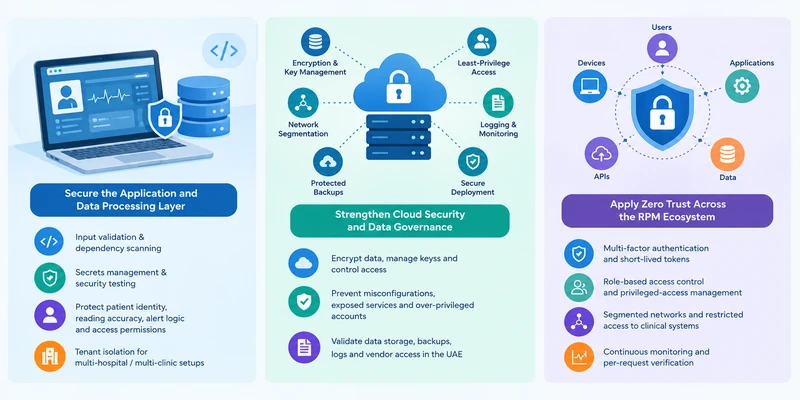
Good RPM software security starts in the codebase: input validation, dependency scanning, secrets management and continuous application security testing. It should protect four things specifically: patient identity, reading accuracy, alert logic and access permissions.
If your platform serves multiple hospitals or clinics, tenant isolation is non-negotiable. One provider must never see another’s patients. This is where secure healthcare software development practices, such as threat modelling in the design phase and security gates in the delivery pipeline, pay for themselves.
Strengthen Cloud Security and Data Governance
RPM platform cloud security covers encryption and key management, least-privilege access, network segmentation, logging and protected backups. The common failures are misconfigured storage, over-privileged accounts, exposed services and insecure deployment pipelines. Because the cloud holds every reading, cloud controls carry much of your remote patient monitoring security.
For UAE deployments, governance questions matter as much to remote patient monitoring security as technical ones. Where are data, backups and logs stored and processed? Who at the vendor can access them for support? How visible is data processing to your compliance team? Getting an independent view through Cloud Security Services Dubai can help validate hosting choices before they’re locked in.
Apply Zero Trust Across the RPM Ecosystem
In an ecosystem of home devices and remote clinicians, there’s no trustworthy “inside” to defend. The answer is zero trust healthcare: continuously verify every device, application, API and user before granting access, and grant only the minimum needed.
In practice that means multi-factor authentication, short-lived tokens, role-based access control, privileged-access management and continuous monitoring. Segmented networks and restricted access to clinical systems keep IoMT security failures from spreading into core hospital systems. Zero Trust turns remote patient monitoring security from a perimeter idea into a per-request decision.
Securing RPM APIs and EHR Integration in Dubai
Integrations are where clinical value is created, and where subtle security failures hide. An RPM platform that leaks data through its EHR connection has failed, no matter how well the device is protected. Remote patient monitoring security must extend to every integration point.
Protect the APIs That Transfer Patient Data
Every API that moves clinical information needs the same discipline, because remote patient monitoring security is only as strong as its weakest endpoint:
- OAuth 2.0 and OpenID Connect for authentication and authorisation
- Mutual TLS between services
- Short-lived tokens and fine-grained scopes
- Rate limiting and replay protection
- Schema validation behind a secure API gateway
- PHI-safe logging, so patient data never ends up in plain-text logs
Strengthen FHIR, HL7 and NABIDH-Related Workflows
RPM platforms often exchange data with EMRs, EHRs, FHIR servers, HL7 interfaces and health information exchange environments. Good FHIR security relies on resource-level authorisation, consent enforcement and reliable patient identity matching, so a reading can’t attach itself to the wrong chart.
For teams working with older hospital systems, an experienced HL7 software development company in UAE can translate between legacy HL7 messages and modern FHIR APIs without weakening access controls along the way.
RPM EHR integration security should prevent three things in particular: unauthorised data access, incorrect patient matching and incomplete audit trails. And plan for messy reality. Late-arriving readings and corrected values are normal in RPM, so your workflow needs rules for accepting them, flagging them and preserving the original record.
DHA Requirements and RPM Compliance Considerations in Dubai
Regulations change. Treat this section as a starting checklist and confirm current requirements with the DHA, your legal counsel and your compliance team.
Align RPM Platforms With DHA Telehealth Requirements
DHA telehealth standards recognise remote patient monitoring as a regulated telehealth service. Providers should verify applicable licensing, use approved telehealth platforms and confirm that devices are approved by the UAE Ministry of Health and Prevention (MOHAP).
Operationally, expect to address device testing with patients, intended-use limitations, maintenance routines and fault reporting. From a security standpoint, remote patient monitoring security controls should deliver strong authentication, confidentiality, encryption and full auditability.
Address Health Data Hosting and Clinical Governance
Before choosing a hosting architecture, validate current UAE data-protection, DHA, cloud and sector-specific requirements. Health-data laws in the UAE include rules that can affect where health information is stored and processed, so cover data residency, backup locations and third-party support access explicitly.
Governance completes the picture for remote patient monitoring security: documented patient consent, clinical accountability, access governance and audit trails. Obligations depend on the specific service, the provider and the regulations in force, so build flexibility into the design instead of assuming one fixed answer.
Quick Question: “Do RPM platforms in Dubai have to follow DHA rules?”— If you provide RPM as a healthcare service in Dubai, DHA telehealth standards are relevant to you. They cover licensing, approved platforms and devices, and remote patient monitoring security expectations such as authentication and encryption. Always confirm the current requirements for your specific service with the DHA.
Remote Patient Monitoring Security Testing and Risk Assessment Checklist
A remote patient monitoring security review should test both technical controls and clinical continuity. Here’s a working checklist.
Technical Testing Before Deployment
- Threat modelling across devices, apps, cloud and clinical integrations
- Firmware and device-identity testing
- Mobile application security testing
- API penetration testing and access-control validation
- Cloud configuration and tenant-isolation reviews
- Wireless and Bluetooth security testing
- Data-integrity, replay-attack and patient-device matching tests
Independent testing matters here, because internal teams tend to test what they built to work. Specialist Cyber Security Services Dubai teams approach the platform the way an attacker would.
Operational Resilience and Incident Response
Remote patient monitoring security that ignores clinical operations is incomplete. Test what happens when things go wrong:
- Offline mode, device failure and delayed readings
- Alert delivery under load and during partial outages
- Backup recovery, incident-response procedures and patch deployment
- Clinical escalation when readings go missing or values turn dangerous
The last item is the one teams forget. If a patient’s readings stop arriving, who notices, how quickly, and what do they do? Remote patient monitoring security only works when that answer is written down and rehearsed.
How to Evaluate an RPM Software Development and Security Vendor
Feature lists and price quotes won’t tell you whether a vendor can deliver lasting remote patient monitoring security for five years. Use these questions.
Questions to Ask Before Choosing a Technology Partner
- Can you provide architecture and data-flow diagrams?
- Do you maintain an SBOM and a documented vulnerability-management process?
- What are your firmware and application patch timelines?
- How is patient data protected in transit, at rest and during integrations?
- Can you show penetration-test results and access-control reviews?
- Where are health data, backups and logs stored and processed?
- How do you handle device replacement, end-of-support and incident notification?
- Can you demonstrate DHA-readiness and healthcare integration experience?
Look Beyond Features and Development Cost
The cheapest build often becomes the most expensive to secure later. Remote patient monitoring security is far cheaper to design in than to bolt on. Weigh lifecycle security, interoperability, clinical workflow fit and ongoing maintenance. Insist on documented security responsibilities and measurable service-level commitments, so it’s clear who patches what and how fast.
If you’re planning a new platform, custom remote patient monitoring software development lets you design device onboarding, data models, alert logic and integrations around your clinical pathways and your security requirements, instead of adapting a generic product afterwards.
Conclusion
Remote patient monitoring security has to protect the complete connected-care ecosystem, from the medical device on a patient’s wrist to the clinician’s dashboard. That means unique device identity, secure firmware, protected mobile apps, hardened cloud infrastructure, controlled APIs and tested clinical continuity, all working together.
Plan for DHA-related requirements and interoperability at the architecture stage, not after go-live. Remote patient monitoring security is a combined effort across software engineering, cybersecurity, integration and governance, and the teams that treat it that way earn clinician and patient trust faster.
FAQs
What is remote patient monitoring security?
Remote patient monitoring security protects connected medical devices, mobile apps, cloud platforms, APIs and patient data across the whole RPM workflow. It safeguards confidentiality, data integrity and availability so clinicians can trust every reading.
How is RPM security different from telehealth security?
Telehealth secures a consultation session, while RPM secures a continuous stream of data from devices in patients’ homes. That adds device identity, home-network risk, firmware management and clinical alert continuity to the security scope.
What are the biggest cybersecurity threats to RPM platforms?
The main threats are outdated device firmware, device spoofing, replay attacks, stolen credentials, exposed APIs, misconfigured cloud storage and ransomware. Each can expose patient data, corrupt readings or interrupt monitoring.
How can healthcare providers secure connected medical devices?
Register every device with a unique identity, use certificate-based authentication, require signed firmware and authenticated updates, and bind each device to one patient. Support remote revocation for lost or compromised devices.
How do you protect wearable health data?
Encrypt data in transit and at rest, harden the mobile app, use secure Bluetooth pairing and short sessions, and bind the app to the device. Buffer readings safely offline and synchronise them once connectivity returns.
What does Zero Trust mean for RPM?
Zero Trust means no device, app, API or user is trusted by default. Each request is verified using MFA, short-lived tokens, role-based access and continuous monitoring, limiting damage if any single component is compromised.
How should RPM platforms secure EHR integrations?
Use OAuth 2.0, mutual TLS and fine-grained scopes for every API. Enforce consent, resource-level authorisation and accurate patient matching over FHIR and HL7 interfaces, and keep complete audit trails without logging patient data.
Do RPM services in Dubai need to follow DHA requirements?
DHA telehealth standards treat remote patient monitoring as a regulated service, covering licensing, approved platforms, MOHAP-approved devices and security expectations. Providers should confirm current requirements with DHA before launching or changing their service.
Where should RPM patient data be hosted in the UAE?
There’s no single answer. Validate current UAE data-protection, DHA and health-data rules first, then document where data, backups, logs and vendor support access sit. Choose hosting that satisfies those requirements for your specific service.
How do you choose a secure RPM development partner?
Ask for architecture diagrams, an SBOM, penetration-test results, patch timelines, data-hosting details and incident-notification terms. Prefer partners with proven healthcare integration experience and documented security responsibilities across the platform lifecycle.