


Key Takeaways
- Airlines using AI predictive maintenance report up to a 30–40% reduction in unplanned AOG (Aircraft on Ground) events, directly protecting revenue and schedule integrity.
- The global aviation predictive maintenance market is projected to reach $4.2 billion by 2028, growing at a 17.1% CAGR—making 2026 the inflection year for widespread adoption.
- UAE carriers and MRO operators face simultaneous regulatory pressure from GCAA and competitive pressure from global hub rivals to upgrade digital maintenance infrastructure.
- AI predictive maintenance reduces per-aircraft maintenance costs by 15–25% on average compared to traditional scheduled maintenance models.
- Implementation costs range from $95,000 to $1.7 million+ depending on fleet size and complexity, with full ROI typically achieved within 12–24 months.
- The critical distinction between AI-powered and legacy maintenance systems is not sophistication — it is timing. AI tells you what is about to fail. Everything else tells you what already has.
The Maintenance Crisis Quietly Draining UAE Aviation Profits
There is a problem hiding in plain sight across the UAE’s aviation sector—in maintenance hangars, in line stations, and in the scheduling systems of every MRO provider operating out of Dubai, Abu Dhabi, and Sharjah.
It is not a shortage of engineers. It is not a lack of investment. It is a maintenance model built for a different era, running on inertia inside one of the world’s most demanding aviation environments.
In 2025, unplanned maintenance events cost the global airline industry an estimated $8.9 billion in operational disruptions, according to IATA data. Every AOG (Aircraft on Ground) event costs an operator between $10,000 and $150,000 per day—depending on aircraft type, recovery logistics, and network position. In a hub-of-hubs market like Dubai, where turnaround precision is a competitive advantage and slot utilization directly impacts revenue, a grounded aircraft is never just a maintenance cost. It is a commercial event with cascading consequences across your entire network.
That is the operational reality driving the rapid shift toward aviation predictive maintenance powered by artificial intelligence. In 2026, this is no longer a technology experiment for early adopters. It is a strategic infrastructure decision for any aviation business in the UAE that intends to remain competitive through the rest of this decade.
This is not a general overview. It is a decision-making resource for aviation business leaders — operators, MRO managers, fleet directors, and technical executives — who need the full picture: the technology, the data, the costs, the regulatory obligations, and the commercial case. Everything you need to make a well-informed decision about the most consequential maintenance technology upgrade your organization will make this decade.
What Is AI Predictive Maintenance in Aviation?
Before understanding why the industry is moving so decisively in this direction, it is important to be precise about what predictive maintenance in aviation actually means—because it is not what most maintenance departments assume.
Aviation maintenance has historically operated on two models.
The first is reactive maintenance: find it broken, fix it. This model accepts failure as an operational constant and responds to it. The cost is unpredictable, the AOG risk is permanent, and in any safety-critical environment, it is increasingly unacceptable.
The second is scheduled maintenance: follow OEM-defined calendar or cycle intervals regardless of actual component condition. This model prevents many failures but at a significant efficiency cost. Components are removed and replaced when the schedule says so — not when the data says so. The result is underutilized serviceability on some components and missed degradation on others that happen to deteriorate faster than the OEM average.
Predictive maintenance in aviation is a third model. It uses continuous data from aircraft systems—engines, landing gear, hydraulics, avionics, and airframe structural monitoring points—and processes that data through machine learning models trained on historical failure signatures. The system identifies deviation patterns before they reach threshold limits, giving maintenance teams advance warning of impending failures with enough lead time to plan, schedule, and execute intervention under controlled conditions.
AI predictive maintenance extends this capability further. Where rule-based condition monitoring flags alerts when a single parameter crosses a predefined threshold, AI systems analyze multivariate relationships across hundreds of sensor inputs simultaneously. They learn the unique performance envelope of individual aircraft tail numbers. They improve their predictive accuracy over time as operational data accumulates. And they can surface failure precursors that are too subtle or too complex for any human engineer — or any rule-based system — to detect.
This is the distinction that separates modern AI predictive maintenance platforms from the legacy HUMS (Health and Usage Monitoring Systems) that many regional operators are still running. HUMS is a recording system. It tells you what happened. AI predictive maintenance is a forecasting system. It tells you what is about to happen—with enough specificity to act on it.
Why the UAE Aviation Sector Is Accelerating This Transition
The UAE is not a typical aviation market, and the maintenance challenges it faces are not typical either.
Dubai International remains the world’s busiest international airport by passenger volume. Etihad and Abu Dhabi’s aviation cluster anchor a second major hub. Emirates operates one of the world’s largest wide-body fleets from a single point. Flydubai and Air Arabia operate high-frequency, high-utilization narrowbody networks where aircraft availability directly determines profitability per route. The total UAE commercial aviation fleet across these operators exceeds 600 aircraft — with further expansion planned through 2026 and 2027 despite ongoing supply chain delays on new aircraft deliveries from both Boeing and Airbus.
This fleet scale creates a compounding maintenance challenge that is unique in its intensity. High utilization rates mean shorter maintenance windows. A competitive hub environment means delays ripple faster and wider than in point-to-point markets. Higher passenger expectations mean that operational reliability is a brand metric, not just a safety metric. In this environment, the cost of maintenance inefficiency is structurally higher than almost anywhere else in the world.
There is also a regulatory dimension that is accelerating timelines. The UAE General Civil Aviation Authority (GCAA) has been progressively tightening its digital airworthiness requirements, aligning its technical regulations with EASA Part-M and Part-CAMO standards. The UAE Aviation Strategy 2030 specifically identifies digital transformation in technical operations as a core investment priority. And the UAE aerospace industry — valued at $2.6 billion in 2024 and projected to reach $3.2 billion by 2027 — is attracting significant investment in digital infrastructure across the MRO sector.
For aviation business leaders in the UAE, the adoption of aviation predictive maintenance systems is not a future consideration being pulled forward by enthusiasm. It is a competitive and regulatory necessity arriving simultaneously from two directions.
Navigating this transition successfully requires more than a software vendor. It requires an aviation software development company with a deep understanding of both the technical architecture of AI maintenance systems and the specific regulatory context that UAE-based operators must operate within.
Why Traditional Maintenance Is Failing in 2026: The Hard Data
The urgency of this transition becomes clear when you look at what the data actually says about traditional maintenance performance.
A 2025 Oliver Wyman MRO Industry Outlook report found that approximately 42% of unscheduled maintenance events could have been predicted and prevented with AI technology that the affected airlines were not yet using. That is not a technology availability gap. That is an adoption gap — one that is costing the industry billions annually in entirely avoidable costs.
The same report confirmed that the average airline spends between 10% and 15% of its total operating cost on maintenance. For a mid-size carrier operating 50 aircraft, that typically represents $80–150 million per year. Within that spend, unplanned events—AOG recovery costs, parts expediting, crew disruptions, passenger reaccommodation, and regulatory reporting—account for 25–35% of total maintenance expenditures.
That means for a $100 million annual maintenance budget, $25–35 million is attributable to events that AI predictive maintenance systems are demonstrably capable of preventing.
The comparison becomes starker when you look at operators who have already made the transition. Airlines and MRO businesses in the predictive maintenance aviation industry that deployed AI-powered health monitoring are reporting the following:
- 25–40% reduction in AOG events
- 15–25% reduction in total maintenance cost per flight hour
- 12–22% improvement in aircraft availability
- 30–50% reduction in unscheduled component removals
These outcomes are consistently reported across IATA’s 2024 Digital Maintenance Transformation report, Boeing’s 2025 Current Market Outlook supplementary data on MRO technology adoption, and independent operator case disclosures at the Dubai Airshow 2025.
The gap between operators running traditional scheduled maintenance and those running AI predictive systems is widening with every passing month. For UAE aviation businesses evaluating this transition, that widening gap represents both a risk and an opportunity — but the window to capture the competitive upside without playing catch-up is narrowing.
How AI Predicts Maintenance Software Works: The Operational Architecture
Understanding the technology at a functional level is essential for making sound procurement decisions. Here is how a modern AI aircraft predictive maintenance system operates across the full maintenance lifecycle.
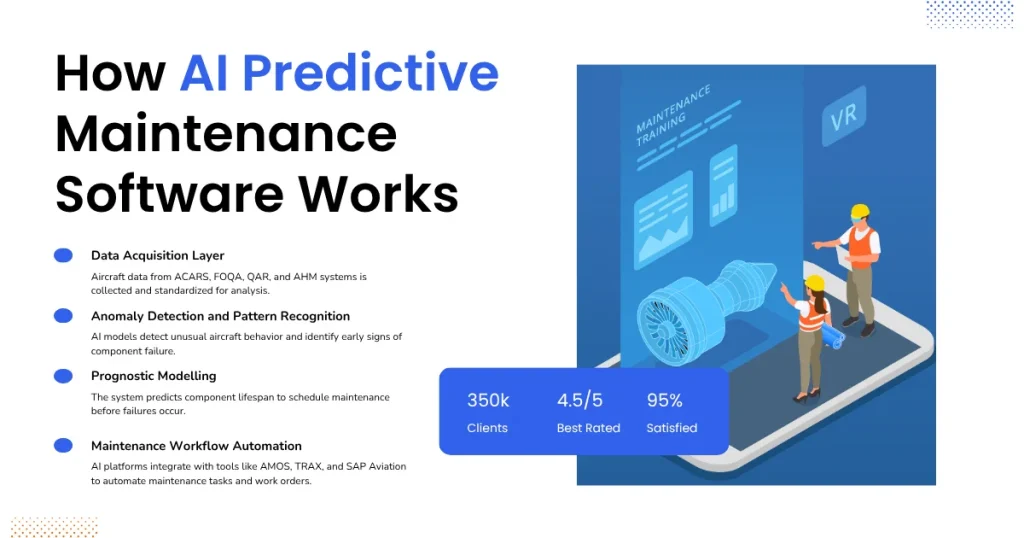
Data Acquisition Layer
Aircraft generate massive volumes of operational data continuously. ACARS transmissions, FOQA (Flight Operational Quality Assurance) data, QAR (Quick Access Recorder) outputs, and AHM (Aircraft Health Monitoring) sensor streams from onboard systems deliver gigabytes of structured operational data per flight. The first function of a predictive maintenance platform is ingesting and normalizing this data across aircraft types, tail numbers, ages, and data transmission formats—a non-trivial technical challenge that separates capable platforms from superficially similar ones.
Anomaly Detection and Pattern Recognition
This is where AI does its core work. Machine learning models—typically combining supervised learning trained on historical fault signatures with unsupervised learning for novel anomaly detection—analyze sensor streams in real time or near-real time. The system identifies deviations from individual aircraft performance baselines and multivariate patterns that correlate with known failure precursors across engine, structural, mechanical, and avionics systems.
Mature platforms also incorporate robust AI detection software capabilities that flag data quality issues—sensor drift, transmission errors, and calibration gaps—that can corrupt predictive models if not identified and corrected before they influence maintenance decisions.
Prognostic Modelling
Once an anomaly is detected, the system moves to prognostics: estimating the Remaining Useful Life (RUL) of the affected component under current and projected operating conditions. This feeds directly into maintenance planning, enabling your technical operations team to schedule the optimal intervention point — before failure, but late enough that the component delivers its full serviceable value.
Maintenance Workflow Automation
In mature implementations, the output is not simply an alert on a dashboard. AI predictive maintenance platforms integrate directly with MRO management systems—AMOS, TRAX, and SAP Aviation—and automatically generate work orders, trigger inventory checks, and pre-position parts based on the prognostic model’s timeline. The human engineering team receives a structured maintenance recommendation with supporting data, not a raw alert requiring manual interpretation and coordination.
This end-to-end automation is where the compounding ROI originates. The avoided AOG event is valuable. The elimination of the entire human coordination chain that an AOG event triggers—the expedited parts procurement, the emergency engineering resource allocation, the airline operations control scramble, and the passenger management—is what makes the financial case extraordinary at scale.
Organizations evaluating the full capability of intelligent workflow automation in their technical operations are increasingly looking at software AI agents for enterprise that can handle complex, multi-step maintenance workflows without requiring manual intervention at each decision point.
Real-World Case Studies: What Airlines Are Actually Achieving
Case Study 1: Middle Eastern Wide-Body Carrier — Engine Health Monitoring
A Middle Eastern full-service carrier operating 80+ wide-body aircraft deployed an AI-based engine health monitoring system across its fleet in 2023. The results within the first 12 months of operation were operationally significant.
The system identified a developing low-pressure turbine blade erosion pattern on three aircraft 47 days before OEM-defined inspection thresholds would have triggered a flag. Early intervention avoided two potential in-service engine removals—situations where the EGT margin approach would have forced unscheduled grounding—saving an estimated $4.2 million in expedited maintenance, AOG costs, and ferry flight expenses. Across the fleet, engine shop visit intervals were extended by an average of 6.3% based on actual condition data rather than conservative OEM scheduling assumptions — a direct bottom-line saving on one of the highest-cost line items in aviation maintenance.
Case Study 2: Low-Cost Carrier — Landing Gear and Hydraulic Systems
A Southeast Asian low-cost carrier operating 120 aircraft implemented airline predictive maintenance across its landing gear and hydraulic systems in late 2023 as part of a broader digital transformation program. After 18 months of operation, the carrier reported a 28% reduction in hydraulic system-related delays and cancellations. Integration of AHM data with their MRO management software reduced average work order generation time from 4.2 hours to under 20 minutes. The carrier estimated total annual savings of $11 million across the fleet—against a platform and implementation investment of approximately $1.6 million, representing a first-year ROI of nearly 590%.
Case Study 3: European MRO Provider — Third-Party Predictive Analytics
A major European MRO provider integrated AI predictive analytics as a value-added service offering for 12 airline customers in 2022–2023. The results transformed both their operational performance and their commercial model. On-time delivery of aircraft back to service improved by 19%. Customer retention improved from 78% to 94% over 24 months. And AI-powered analytics services created a new revenue stream representing 11% of total MRO revenue — a commercial model innovation that traditional scheduled maintenance workflows cannot generate.
These outcomes are consistent with the performance envelope reported across IATA, Boeing, and independent airline disclosures. They are not exceptional results. They are what well-implemented AI predictive maintenance delivers when your data infrastructure is sound and your implementation partner understands both the technology and the aviation operational context.
What AI Predictive Maintenance Actually Costs in the UAE in 2026
Cost uncertainty is one of the most common barriers to procurement decisions. The following framework is designed to give UAE aviation decision-makers a realistic, structured view of what implementation actually costs — and what return it generates.
Small Operator: 5–20 Aircraft
- Software platform licensing: $40,000–$90,000/year
- System integration and implementation (one-time): $30,000–$80,000
- Hardware/sensor retrofitting where required: $10,000–$50,000
- Training, change management, and documentation: $15,000–$30,000
- Total Year 1 investment: $95,000–$250,000
- Typical full ROI timeline: 12–18 months
Mid-Size Operator: 20–80 Aircraft
- Software platform licensing: $90,000–$280,000/year
- Integration and implementation (one-time): $80,000–$200,000
- Hardware and sensor infrastructure: $50,000–$150,000
- Training, programme management, CAME documentation support: $30,000–$70,000
- Total Year 1 investment: $250,000–$700,000
- Typical full ROI timeline: 14–24 months
Large Operator or MRO: 80+ Aircraft
- Enterprise platform licensing: $280,000–$800,000+/year
- Multi-system, multi-aircraft type integration: $200,000–$600,000
- Data engineering infrastructure: $100,000–$300,000
- Total Year 1 investment: $580,000–$1,700,000+
- Typical full ROI timeline: 18–30 months
The Five ROI Value Streams
Understanding ROI from aviation predictive maintenance requires accounting for all five value streams that a well-implemented system generates — not just the most visible one.
First, avoided AOG events represent the highest single value stream, with each avoided event worth $10,000–$150,000 depending on aircraft type and network position. Second, extended component life reduces premature replacement costs across high-value components, including engines, APUs, and landing gear actuators. Third, optimized parts inventory—sized against predictive demand rather than conservative stock buffers—reduces capital tied up in inventory by 15–30% in mature implementations. Fourth, labor efficiency improves as engineering resources shift from a reactive scramble to planned, structured work. Fifth, improved aircraft availability generates additional revenue-generating flight hours per aircraft per year — the top-line benefit that the previous four value streams collectively enable.
A 50-aircraft mid-size operator spending $400,000 per year on a predictive maintenance platform, if it avoids just 8 AOG events per year at an average cost of $35,000 each, recovers $280,000 in direct savings from that single value stream. Add component life extension savings, inventory optimization, and labor efficiency gains, and the full-year benefit typically exceeds $1.2–2 million against a $400,000 platform investment.
This is why selecting the right software development company with deep aviation domain expertise—rather than a generic IT services vendor—is critical to realizing these savings within realistic timelines. Poor implementation quality delays ROI achievement and creates integration debt that compounds over the program lifetime.
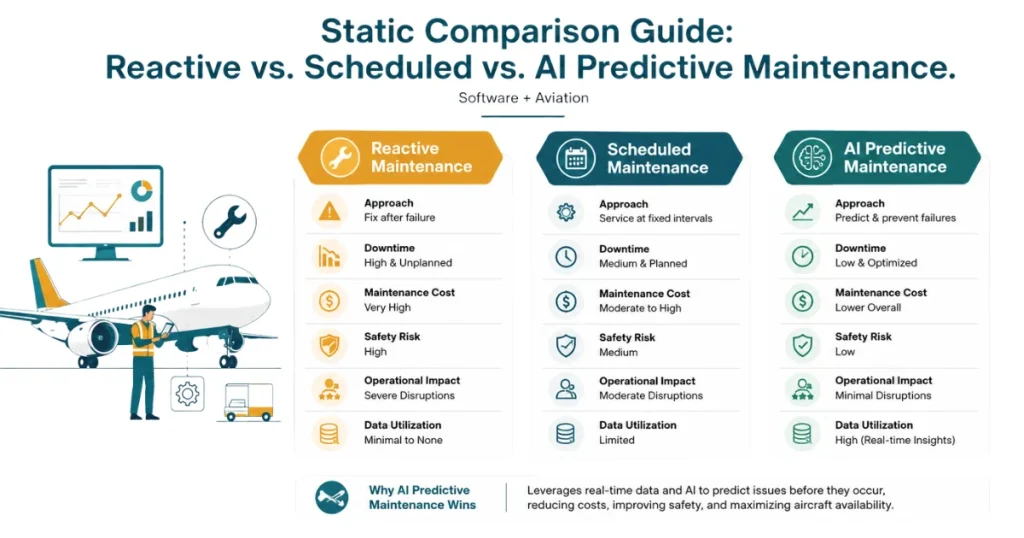
Static Comparison Guide: Reactive vs. Scheduled vs. AI Predictive Maintenance
| Factor | Reactive Maintenance | Scheduled Maintenance | AI Predictive Maintenance |
| Maintenance trigger | Component failure | Fixed calendar or cycle interval | Real-time sensor data + ML prediction |
| Failure prevention capability | None — responds after failure | Partial — based on OEM averages | High — detects anomalies before failure |
| Component utilisation | Full life but high failure risk | Underutilized due to conservative scheduling | Optimised actual useful life |
| AOG risk level | Very high | Medium | Low |
| Maintenance cost profile | Unpredictable with high cost peaks | Predictable but structurally inefficient | Optimised and predictable |
| Data requirements | Minimal | Moderate | High (IoT, ACARS, QAR, AHM) |
| Integration complexity | Low | Low | Medium to high |
| Engineer workload type | Reactive under pressure | Planned but rigid | Proactive and data-driven |
| GCAA/EASA regulatory alignment | Minimum compliance | Standard compliance | Advanced — exceeds standard requirements |
| First-year ROI profile | Negative — failure costs dominate | Moderate | Strong — 12–24 month payback typical |
| Scalability with fleet growth | Poor | Moderate | High |
| Best suited for | Legacy low-volume operations | General baseline compliance | Growth-oriented UAE operators targeting competitive advantage |
The dynamics shown in this comparison make the direction of the predictive maintenance aviation industry unmistakable. The advantages of AI predictive maintenance over both alternatives compound with fleet size—the larger the operation, the wider the financial differential between scheduled and AI predictive approaches becomes, and the faster the platform investment pays for itself.
Legal, Regulatory and Cybersecurity Compliance: What UAE Operators Must Know
Any implementation of AI predictive maintenance for UAE aviation operators carries compliance obligations that must be addressed from the earliest stages of procurement planning — not retrofitted after deployment. Regulatory missteps in this area carry consequences that extend well beyond the maintenance operation.
GCAA Compliance Requirements
The UAE GCAA’s Technical Airworthiness Regulations align closely with EASA Part-M and Part-CAMO, which govern continuing airworthiness management across commercial aviation operations. Under these regulations, any data system used to inform or influence maintenance decisions must meet several mandatory conditions: it must be validated for accuracy and reliability before operational deployment; it must be documented within the operator’s Continuing Airworthiness Management Exposition (CAME); and it must be available for inspection and audit by GCAA oversight teams.
This means that operators who deploy AI predictive maintenance solutions without updating their CAME documentation, without establishing a validation and acceptance protocol for the AI system, and without defining escalation procedures for AI-generated alerts are creating regulatory exposure—regardless of how technically capable the platform itself may be.
EASA and FAA Alignment for International Operations
UAE carriers operating international routes—particularly to European and North American destinations—must ensure that their predictive maintenance systems are consistent with EASA’s Acceptable Means of Compliance AMC 20-22 on airworthiness data monitoring programs and with FAA Advisory Circular AC 120-17A on maintenance program standards. Most enterprise-grade AI predictive maintenance platforms are designed with multi-regulator compliance architecture, but this must be specifically verified during vendor due diligence—it should not be assumed.
Cybersecurity and Data Integrity Standards
AI predictive maintenance systems handle safety-critical operational data. The cybersecurity posture of every platform on your shortlist is not a secondary evaluation criterion. It is a primary qualification gate.
Key questions every UAE aviation operator should put to every vendor under consideration:
Is the platform fully compliant with UAE National Cybersecurity Authority (NCA) Essential Cybersecurity Controls? Where is operational data stored — on-premise, within a UAE-region cloud infrastructure, or offshore? What encryption standards are applied to data in transit and at rest? What is the vendor’s documented incident response protocol? Is the AI model explainable—can your engineers and GCAA auditors trace and understand why a specific maintenance recommendation was generated?
This last requirement — AI explainability — is increasingly significant from both a regulatory and an operational safety perspective. A system that generates maintenance recommendations without a traceable logic chain is a liability in a regulated, safety-critical environment. Platforms built on architectures with genuine explainability, audit trail capabilities, and compliance-grade data governance are the only appropriate standard for aviation applications.
Ensuring your AI implementation incorporates robust AI detection software capabilities — with full data integrity monitoring, explainable outputs, and compliance-grade audit trails — should be a non-negotiable specification requirement during vendor evaluation.
How to Choose the Right AI Predictive Maintenance Solution for Your Operation
Given the range of platforms available, the complexity of aviation data environments, and the weight of the compliance obligations involved, vendor selection is the stage at which most operators lose value before the project begins. The following six-step framework is designed to structure that process effectively.
Step 1: Define Your Failure Mode Priority List
Before approaching any vendor, your technical leadership team should define which aircraft systems and components represent your highest AOG risk and maintenance cost concentration. Engine health? Landing gear actuators? Hydraulic system integrity? APU performance? Your priority list directly shapes the data requirements, sensor coverage needs, and AI model selection criteria — and it prevents vendors from positioning generic platform capabilities against your specific operational challenges.
Step 2: Audit Your Current Data Infrastructure
AI predictive maintenance performance is directly proportional to data quality and coverage. Before evaluating platforms, conduct an honest audit of your current ACARS connectivity, QAR data retrieval and storage processes, and sensor coverage across each aircraft type in your fleet. Identify gaps in sensor coverage that would need to be addressed through hardware investment, and build those costs into your implementation budget from the outset.
Step 3: Evaluate Platform Architecture Against Your MRO Ecosystem
The platform must integrate cleanly with your existing maintenance management systems. If your operation runs AMOS, TRAX, or a custom MRO platform, your AI predictive maintenance solution requires either certified native integration or a well-engineered API layer. Request reference integrations from every vendor—specifically with your MRO software—and speak directly with the reference customers about integration quality and ongoing support experience.
Step 4: Validate Regulatory Compliance Support
Shortlist only vendors who provide documented CAME integration support, GCAA/EASA compliance documentation for their platform, and experience with UAE operator implementations. The vendor’s regulatory team should be able to walk you through the specific documentation updates required for your CAME and the validation protocol for the AI system under your current GCAA oversight framework. Vendors who cannot do this clearly are not ready for the UAE market.
Step 5: Require a Proof of Concept Before Contract Execution
Every credible AI predictive maintenance vendor should be willing to run a time-limited, scope-limited proof of concept on a subset of your fleet using your own operational data in your own environment. A well-structured POC demonstrates predictive accuracy against known historical events, data integration performance, and system usability for your engineering teams. Vendors who resist or significantly restrict POC proposals should not advance to final selection.
Step 6: Evaluate Total Cost of Ownership, Not Licensing Cost
The most dangerous procurement mistake in this category is optimizing for the lowest licensing cost. The full cost profile of an AI predictive maintenance implementation includes licensing, integration engineering, data infrastructure, training, change management, regulatory documentation, ongoing support, and model retraining as your fleet data accumulates. The vendor with the lowest licensing figure frequently presents the highest total 36-month cost once integration complexity and support quality are factored in.
Engaging a specialist aviation software development company or an experienced Dubai IT consultancy as your independent technical implementation partner gives your operation independent quality oversight throughout deployment and significantly accelerates resolution when integration challenges arise. — rather than relying exclusively on the platform vendor’s own professional services team — gives your operation independent quality oversight throughout deployment and significantly accelerates resolution when integration challenges arise.
Final Thoughts:
The commercial argument for AI predictive maintenance in aviation is no longer theoretical, and it is no longer early-stage. The airlines and MRO operators who made this transition in 2022 and 2023 have already compounded 24–36 months of cost savings, AOG avoidance, and competitive reliability advantage that late movers will take years to close.
In the UAE, the case is sharper than in any other market. Regulatory expectations are rising. Competitive intensity in the hub market is intensifying. Operational cost pressures are structural. The aviation predictive maintenance technology is mature, proven, and deployable at every fleet size. The ROI case is validated across dozens of operator deployments.
The cost of delay is not neutral. Every month of reactive or calendar-based maintenance is a month of AOG exposure accumulating on your balance sheet—avoidable costs, inflated per-flight-hour spend, and competitive disadvantage compounding quietly while your network competitors invest in systems that are making their operations more reliable, more efficient, and more profitable at the same time.
For aviation business leaders in the UAE who are ready to move from evaluation to action — to understand what a well-structured AI predictive maintenance implementation looks like for your specific fleet size, data environment, MRO ecosystem, and regulatory context — the right first step is a direct conversation with specialists who have built these systems for aviation operators in this region.

Connect with our aviation software team today for a no-obligation technical readiness assessment—a structured evaluation of your current maintenance data infrastructure, your highest-value use cases, and a realistic implementation roadmap tailored to your operation.
The organizations that move in 2026 will be the ones setting the cost and reliability benchmark in UAE aviation for the rest of this decade. The ones that wait will be catching up to it.
FAQ’s
What is the difference between predictive maintenance and preventive maintenance in aviation?
Preventive maintenance operates on fixed time or cycle intervals defined by the OEM, regardless of actual component condition. Predictive maintenance in aviation uses real-time sensor data, historical performance analytics, and machine learning models to determine maintenance needs based on the actual health state of each component.
Is AI predictive maintenance approved by GCAA for UAE operators?
AI predictive maintenance platforms do not require standalone GCAA approval in the same regulatory framework as airworthiness directives.
How long does AI predictive maintenance implementation take for a UAE operator?
Multi-fleet operations with complex MRO system integrations, legacy data normalization requirements, and multi-aircraft type coverage: a 9–18 month timeline is realistic for full operational deployment.
Do smaller UAE operators with 5–15 aircraft get meaningful ROI from these systems?
Yes — and often more proportionally than larger operators. For a small charter carrier or regional operator, a single avoided AOG event can represent 3–6 months of platform licensing cost.
Can AI systems predict all types of aircraft failures?
No predictive system achieves 100% accuracy across all failure modes, and reputable vendors will not claim otherwise. Its effectiveness for lower-data systems depends on the volume and quality of available training data for that specific failure mode.
What data does an AI predictive maintenance system need from my fleet?
Core data inputs include ACARS transmission data, FOQA and QAR parameters, AHM sensor streams, component life tracking and work order history, and historical maintenance log data.
What are the biggest implementation risks to watch for?
The three most common failure points in aviation predictive maintenance implementations are poor data quality undermining model accuracy, inadequate MRO system integration creating workflow silos, and insufficient CAME documentation creating regulatory exposure.