


Key Takeaways
- A modern Zakat calculator needs more than math — it needs transparency, live data, and trust
- Support cash, gold, silver, stocks, crypto, business assets, and receivables — not just basic categories
- Use gold or silver nisab, and let users choose their methodology openly
- Show line-by-line calculation breakdowns so users understand exactly how the result was reached
- Arabic RTL support and AED currency are essential for UAE users
- Calculation history, PDF/CSV exports, and audit trails build long-term user confidence
- Data encryption and client-side calculation options protect sensitive financial information
- Live gold/silver price APIs and currency exchange APIs are core technical requirements
- Development cost ranges from $10,000 (basic) to $100,000+ (enterprise Islamic fintech solution)
- AI-powered guidance and embedded payment/donation flows are the next big growth areas
- Scholar-reviewed methodology and Shariah compliance matter as much as technical accuracy
Search “zakat calculator” today and you’ll find dozens of tools that do the same thing: ask for a number, multiply by 2.5%, and spit out a result. That used to be enough. It isn’t anymore.
UAE residents managing gold holdings, crypto portfolios, business inventory, and multi-currency bank accounts don’t just want a number — they want to know how that number was reached, whether it follows a recognised methodology, and whether their financial data is safe while they enter it. The demand for digital Islamic financial tools has grown alongside the UAE’s broader fintech boom, and users are bringing the same expectations they have for banking apps — speed, transparency, security — into religious obligations too.
Traditional calculators fall short in four consistent ways:
- Limited asset support — most only handle cash and gold, ignoring stocks, crypto, or business assets.
- No methodology explanation — users are given a total with zero insight into which nisab standard or fiqh approach was used.
- No calculation history — there’s nowhere to review last year’s zakat or compare it to this year’s.
- Poor handling of modern assets — a calculator built in 2015 has no idea what to do with a crypto wallet or a SIP investment.
This is exactly why companies — from Islamic banks to charities to independent fintech startups — are choosing to build a Zakat calculator rather than license a generic template. Done right, it becomes more than a utility; it becomes a trust product. And in the UAE’s Islamic fintech market, trust is the actual currency.
If you’re scoping this build, it’s worth partnering early with an established application development company in UAE that understands both the technical architecture and the religious sensitivity the product demands — because a zakat calculator isn’t just software, it’s a tool people use to fulfil a financial and spiritual obligation.
What Is a Zakat Calculator and Why Is It Important Today?
A Zakat calculator is a digital tool that helps Muslims determine the mandatory annual charitable contribution owed on their qualifying wealth, once that wealth crosses the nisab threshold. Instead of manually tracking gold prices, converting currencies, and applying formulas by hand, users input their assets and the tool does the arithmetic — instantly and, ideally, transparently.
Technology has made a once tedious, error-prone process considerably easier. A well-built calculator handles:
- Automated calculations across multiple asset types in one session
- Real-time gold and silver price updates, so the nisab threshold reflects the actual market rather than a static, outdated figure
- Asset categorization, separating cash, metals, investments, and business holdings so each is treated correctly
- Personalized results, adjusted to the user’s chosen methodology, currency, and asset mix
For individuals, this removes guesswork. For businesses — banks, charities, fintech platforms — offering a reliable calculator is also a trust-building and engagement tool, since it puts the organisation in front of users during a moment that matters to them religiously, not just financially.
How to Calculate Zakat Using a Digital Zakat Calculator?
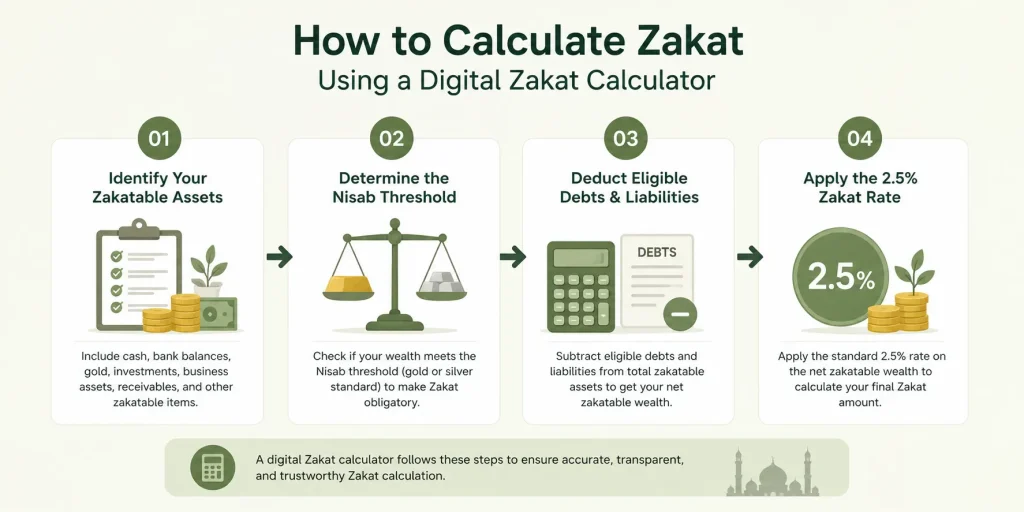
Before exploring the features or technical architecture of a Zakat calculator, it is important to understand the calculation process happening behind the scenes. A reliable digital Zakat calculator does not simply ask for a total amount and generate a result. Instead, it guides users through different categories of wealth, applies the correct rules, and helps them understand how the final Zakat amount is calculated.
Here are the four key steps a well-designed Zakat calculator should follow:
Step 1: Identify Your Zakatable Assets
The first step is identifying all assets that are eligible for Zakat. Since not every possession is subject to Zakat, the calculator should help users separate Zakatable wealth from personal belongings and non-eligible assets.
Common Zakatable assets include:
- Cash and bank balances: Savings accounts, current accounts, foreign currencies, and available cash holdings.
- Gold and silver: Jewellery, gold bars, and coins may be included depending on different scholarly opinions, especially regarding personal-use jewellery.
- Investments: Stocks, mutual funds, ETFs, and other investment holdings may require calculation based on their Zakatable portion.
- Business assets: Trade inventory, goods held for sale, and collectible business receivables are generally considered while calculating business Zakat.
- Receivables: Money owed to the user that is expected to be recovered can also be included.
Each asset category follows different calculation rules. A properly built digital calculator should avoid a single “total wealth” input and instead provide separate sections for each asset type, helping users achieve a more accurate calculation.
Step 2: Determine the Nisab Threshold
After identifying assets, the next step is determining whether the user’s wealth has reached the Nisab threshold. Nisab represents the minimum level of wealth at which Zakat becomes obligatory.
Traditionally, Nisab is calculated based on either:
- Gold-based Nisab: Equivalent to approximately 87.48 grams of gold.
- Silver-based Nisab: Equivalent to approximately 612.36 grams of silver.
Since silver generally has a lower market value compared to gold, using the silver standard means more people may become eligible to pay Zakat. Different scholars and institutions may follow different approaches, so a trustworthy Zakat calculator should clearly explain which Nisab method is being used and allow users to select their preferred standard.
Step 3: Deduct Eligible Debts and Liabilities
Zakat is calculated on net wealth rather than total wealth. This means eligible debts and financial obligations may need to be deducted before calculating the final amount.
The basic calculation can be represented as:
Total Zakatable Assets – Eligible Debts = Net Zakatable Wealth
Short-term financial obligations, such as immediate bills or upcoming payments, are commonly considered for deduction. However, long-term liabilities such as mortgages or extended loans may vary depending on different interpretations and schools of thought.
A digital Zakat calculator should make these options clear instead of applying hidden assumptions, allowing users to understand how their liabilities affect their final calculation.
Step 4: Apply the 2.5% Zakat Rate
Once the net zakatable wealth is calculated and it exceeds the Nisab threshold, the standard annual Zakat rate of 2.5% is applied.
The final calculation is:
Net Zakatable Wealth × 2.5% = Zakat Amount
Although the final step appears simple, the accuracy of the result depends on every calculation made before it. Correct asset valuation, proper Nisab selection, and accurate debt deductions all play an important role in ensuring that the calculated Zakat amount is reliable.
A well-designed digital Zakat calculator combines these steps into a simple user experience while maintaining transparency, accuracy, and trust.
What Makes the Best Zakat Calculator Different From Basic Tools?
If you’re aiming to build the best zakat calculator rather than a basic one, the differentiation happens in a handful of specific, deliberate features.
Live Gold and Silver Price Integration
Static, hardcoded prices are one of the fastest ways to lose user trust. The best zakat calculator pulls:
- Real-time market data for gold and silver
- AED conversion for local UAE users
- A visible price timestamp, so users know exactly when the rate was last updated
- Manual price adjustment options, for users who prefer to input a rate from a specific source
This combination signals that the tool is actively maintained, not a set-and-forget script from years ago.
Transparent Calculation Breakdown
Users shouldn’t have to trust a black box. A line-by-line breakdown answers the unspoken question every user has: “why this amount?”
For example:
Gold: 10g × AED value = Total amount Cash: Bank balance included Debt: Deducted before final calculation
Showing the formula, not just the outcome, is one of the simplest ways to build credibility — and it costs nothing extra in development complexity once the calculation engine exists.
Support for Modern Financial Assets
A calculator built for 2026 needs to go beyond cash and gold. Advanced tools support:
- Stocks
- ETFs
- Crypto assets
- Mutual funds
- Business inventory
- International holdings
Crypto in particular is where most basic calculators fail entirely, simply because valuation and fiqh treatment for digital assets are still evolving — which is precisely why flexibility matters more than a rigid formula.
Arabic and English User Experience
For a UAE-facing product, bilingual support isn’t a nice-to-have — it’s a baseline requirement. That means:
- A proper Arabic RTL interface, not a mirrored English layout with translated labels
- Native AED currency support throughout
- Local examples that reflect UAE financial habits
- Simple Islamic terminology that doesn’t require a glossary to understand
This is one of the areas where working with a mobile application development company in Dubai pays off — local teams already understand RTL design conventions and UAE user expectations in a way that’s hard to replicate from a generic international template.
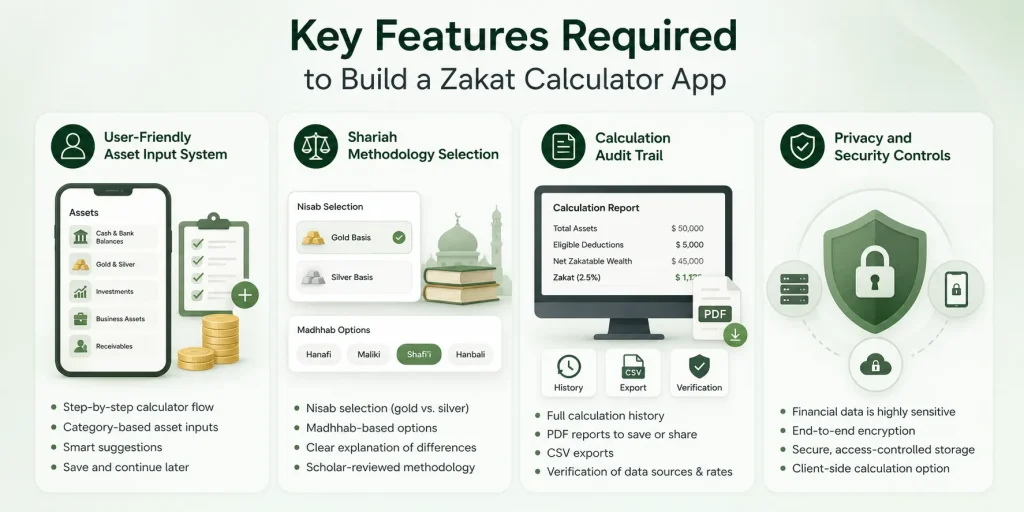
Key Features Required to Build a Zakat Calculator App
User-Friendly Asset Input System
The input experience determines whether users finish the calculation or abandon halfway. Strong implementations include:
- A step-by-step calculator flow instead of one long form
- Category-based inputs that group similar assets together
- Smart suggestions based on previously entered data
- The ability to save previous calculations and return to them later
Shariah Methodology Selection
Because scholars differ on certain points, the app should let users choose rather than impose a single view silently:
- Nisab selection (gold vs. silver basis)
- Madhhab-based options, where relevant
- Clear explanation of how each approach differs
- Scholar-reviewed methodology, ideally with named religious advisors credited in the app
Calculation Audit Trail
Financial and religious record-keeping both benefit from a paper trail. Users need:
- Full calculation history across years
- PDF reports they can save or share
- CSV exports for their own record-keeping
- Verification records showing which data sources and rates were used
Privacy and Security Controls
Zakat calculations expose exactly the kind of information people are most protective of — their full financial picture. This makes security non-negotiable:
- Recognition that financial data is uniquely sensitive, even more so when tied to religious practice
- End-to-end encryption for stored data
- Secure, access-controlled storage
- Client-side calculation options, so sensitive numbers never need to leave the user’s device if they don’t want them to
If you’re mapping out the fuller feature set — donation tracking, recurring giving, transparency dashboards — it’s worth reviewing a broader Islamic charity app development guide, since a zakat calculator often becomes one module inside a larger giving platform rather than a standalone product.
Zakat Calculator Development: Technology Architecture Behind a Reliable Solution
Frontend Development
The frontend has to handle responsive design across devices, full Arabic/English support, and a genuinely mobile-first interface, since most UAE users will interact with this tool on a phone, not a desktop. Common technology choices include:
- React or Next.js for web interfaces
- Flutter for cross-platform mobile apps, useful when targeting both iOS and Android from a single codebase
Backend Development
The backend is where the actual trust gets built or broken. It’s responsible for:
- The core calculation engine, handling all four steps described earlier
- Asset processing logic across multiple categories and currencies
- User accounts and secure data storage
- Report generation for PDF/CSV exports
Typical backend stacks lean on Node.js or Python, paired with cloud infrastructure that can scale as user numbers grow — particularly important during Ramadan, when zakat calculator traffic spikes sharply across almost every Islamic finance platform.
API Integrations
No zakat calculator functions well in isolation. The essential integrations are:
Gold & Silver Price APIs — used for live market rates and accurate nisab calculations, updated regularly rather than cached indefinitely.
Currency Exchange APIs — necessary for foreign assets and international users holding wealth across more than one currency.
Payment APIs — increasingly important as calculators evolve into full giving platforms, enabling users to pay their zakat or donate to charity directly from the results screen rather than calculating in one app and paying in another.
This last point connects to a bigger shift happening across the region: the rise of embedded finance apps in UAE, where calculation, payment, and giving all live inside a single connected experience instead of three disconnected tools.
Challenges Companies Face During Zakat Calculator Development
Handling Different Islamic Opinions
Genuine scholarly differences exist around gold vs. silver nisab, how long-term debt should be treated, and how certain modern assets should be classified. A calculator that picks one answer and hides the alternative risks alienating users who follow a different school of thought.
Solution: Provide methodology options rather than a single hardcoded path, and add scholarly guidance alongside each choice so users understand what they’re selecting and why.
Managing Complex Assets
Crypto valuation swings constantly, international investments involve currency and jurisdiction complications, and business assets require inventory-style accounting that a simple form can’t capture well.
Solution: Build a flexible asset engine from day one, with custom valuation options rather than trying to force every asset type into the same input pattern.
Building User Trust
Financial data concerns and calculation doubts are the two biggest reasons users abandon a zakat calculator mid-session or never return to it the following year.
Solution: Transparent formulas, clearly cited data sources, and downloadable audit reports address both concerns directly — trust here isn’t earned through marketing copy, it’s earned through visible, checkable detail.
Future Trends in Zakat App Development
The future of Zakat app development is shifting from basic calculation tools to intelligent financial assistants. AI-powered features are enabling users to get clearer explanations, automate asset categorisation, and receive personalised Zakat guidance based on their financial details. Meanwhile, Zakat services are becoming part of larger Islamic fintech ecosystems, including banking apps and charity platforms, where users can manage their religious financial responsibilities more conveniently.
Another important trend is automated Zakat reminders based on the Hijri calendar. These systems help users track annual obligations, receive timely notifications before their Zakat due date, and maintain records of previous calculations for easier yearly planning.
How Much Does Zakat Calculator Development Cost?
Cost depends heavily on scope. The main variables are platform choice (web-only vs. native mobile vs. both), the depth of asset support, the number of API integrations, the strength of security requirements, whether AI features are included, and whether an admin dashboard is needed for the business side.
Rough estimated ranges:
- Basic calculator: $10,000–$25,000
- Advanced Zakat app: $30,000–$80,000+
- Enterprise Islamic fintech solution: $100,000+
These figures broadly track what similar religious-giving products cost to build. If you’re benchmarking against a full donation platform rather than a calculator alone, it’s worth reviewing typical Islamic charity app development cost ranges too, since features like recurring donations, campaign management, and donor dashboards add meaningfully to the base estimate.
Why Businesses Should Invest in Zakat App Development?
The Islamic fintech market in the UAE and wider GCC region continues to grow, driven by demand for digital religious tools that match the convenience users already expect from their banking apps. Businesses building in this space — banks, charities, and Islamic organisations — stand to benefit from real partnership opportunities with each other, not just competition.
The upside isn’t only commercial. A well-built zakat calculator drives:
- Better user engagement, since it brings people back annually at a predictable, meaningful time
- Financial transparency, which strengthens the organisation’s own credibility
- Community impact, by making it easier for people to fulfil an obligation they might otherwise delay or miscalculate
For organisations exploring this space for the first time, it’s worth studying which Islamic charity app features perform best with real users — donation tracking, zakat calculation, and campaign transparency tend to be the three most-used, and building around them first reduces the risk of over-investing in features nobody actually opens.

Conclusion
A successful Zakat calculator is not just a percentage calculator — it’s a religious and financial tool that people return to every single year, often to make one of the more meaningful financial decisions in their calendar. Getting the math right is the minimum bar. Getting the trust right — through transparent methodology, real security, and genuine Shariah guidance — is what actually separates a tool people use once from one they rely on annually.
Businesses investing in Zakat calculator development should treat user confidence and Shariah compliance as core product requirements, not afterthoughts bolted on before launch. Get those two things right, and the rest of the product — the UI, the integrations, the reporting — has a real foundation to stand on.
Frequently Asked Questions
How is Zakat calculated online?
A digital calculator totals zakatable assets (cash, gold, investments), checks them against the nisab threshold, deducts eligible debts, then applies 2.5% to the remaining net wealth automatically.
What is the nisab threshold for Zakat?
Nisab equals 87.48 grams of gold or 612.36 grams of silver in current value. Many scholars prefer the silver standard since it qualifies more people for zakat.
Is a Zakat calculator accurate for crypto and stocks?
Only if built for modern assets. Advanced calculators support crypto, ETFs, mutual funds, and business inventory with proper valuation logic — basic tools usually miss these entirely
How much does it cost to build a Zakat calculator app?
Basic calculators cost $10,000–$25,000, advanced apps $30,000–$80,000+, and enterprise Islamic fintech solutions exceed $100,000, depending on features, integrations, and security requirements.