


Key Takeaways
- Islamic charity apps need religion-specific features like Zakat calculators, not a generic donation template
- Ramadan and Zakat al-Fitr create major seasonal giving spikes the app must be built to handle
- Verified charity profiles and campaign approval status build donor trust before the first donation
- Simple, secure checkout (one-tap, multiple payment methods, saved preferences) directly boosts conversion
- Separate categories for Sadaqah, Fitr, Qurbani, and Ramadan campaigns make giving easier to navigate
- Donation tracking and transparency reports are the biggest driver of donor retention
- Recurring donations and smart reminders turn one-time donors into long-term supporters
- Full bilingual Arabic-English (RTL) support is essential for reaching UAE audiences
- AI recommendations and well-timed notifications improve personalization and engagement
- A strong admin dashboard is critical for campaign management, analytics, and compliance
- Budget realistically — a full-featured app is closer to a super app build in cost and complexity
- Avoid common mistakes: payment-only focus, late compliance, poor UX, and underestimating seasonal traffic
Digital giving in the UAE has changed fast. A decade ago, “online donation” meant a bank transfer form and a follow-up email that may or may not have arrived. Today, donors expect something closer to an e-commerce experience — browse a cause, see proof it’s legitimate, pay in two taps, and get a real-time update on where the money went. That shift is exactly why so many NGOs, mosques, and Islamic foundations are now researching Islamic charity app features before building anything at all.
The UAE is one of the most active giving markets in the region. Ramadan alone drives a huge share of annual charitable spending, and a growing number of donors — especially younger, mobile-first ones — won’t give through a platform that feels outdated or unverified. A generic donation page with a single “Donate Now” button doesn’t hold up anymore. Donors want transparency into where funds go, religious accuracy around obligations like Zakat and Sadaqah, and a checkout that feels as smooth as any shopping app.
Get this right, and something measurable happens: recurring donations climb, average gift size increases, and donors recommend the app to others. Get it wrong — a clunky checkout, no verification badges, no proper Zakat calculator — and donors quietly move on. They rarely complain. They just stop opening the app.
This guide breaks down the features that separate a genuinely trustworthy Islamic donation app from a basic payment form, why each one matters to Muslim donors specifically, and what organizations should think through before investing in Islamic charity app development in the UAE.
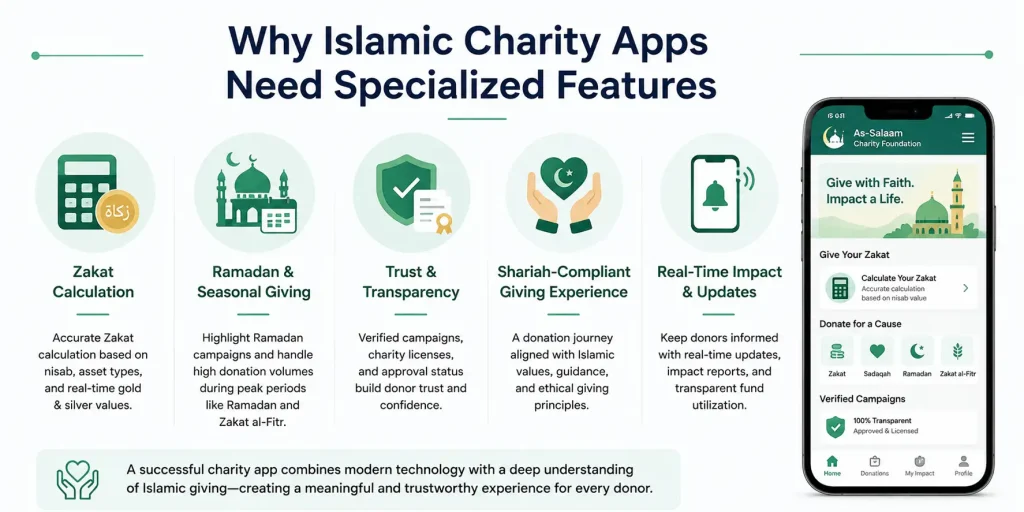
Why Islamic Charity Apps Need Specialized Features
An Islamic charity app isn’t a repainted version of a standard donation platform. The underlying religious framework changes what “good UX” even means here. A feature set copied from a generic fundraising template will always feel slightly off to a Muslim donor, even if they can’t immediately name why.
Start with Zakat. Unlike voluntary giving, Zakat is a calculated, mandatory religious obligation tied to specific thresholds — gold and silver holdings, cash savings, business inventory, investments, and the current nisab value, which fluctuates with market prices. An app that treats Zakat like just another donation category, with a generic amount field, is asking donors to do complex religious math themselves before they even open the app. That’s friction most donors won’t push through.
Sadaqah works differently — voluntary, but culturally significant, and donation behavior around it spikes predictably. Ramadan sees a massive concentration of annual giving inside a single 30-day window, followed by a sharp secondary spike around Zakat al-Fitr just before Eid. An app that can’t handle that traffic surge, or that doesn’t surface Ramadan-specific campaigns prominently, underperforms exactly when it matters most.
Then there’s the trust layer, which UAE donors have become noticeably more careful about. Regulators expect charity platforms operating in the region to show verified campaigns, licensing information, and visible approval status — not just a donation button and a promise. Any organization considering charity app development, or comparing proposals from a mobile app development company Dubai, needs to treat compliance and verification as foundational requirements from day one, not features added after donors start asking questions.
A successful charity application combines solid, modern technology with a genuine understanding of how Islamic giving actually works — not just in theory.
Essential Islamic Charity App Features Every Organization Should Consider
Verified Charity Profiles and Campaign Approval System
Before a donor commits a single dirham, they want confirmation that the organization behind a campaign is real, registered, and accountable. Verified charity profiles — showing registration details, licensing information, approval status, and a visible history of past campaigns — do exactly that.
This matters because:
- It builds donor trust before the first donation, not after
- It reduces fraudulent or unverified fundraising activity
- It gives donors full transparency into who’s running a campaign
- It gives organizations a defensible audit trail if questions come up
Without this layer, even a beautifully designed Islamic charity app looks indistinguishable from a random, unverified crowdfunding page — and skeptical donors treat it exactly that way.
Simple and Secure Donation Checkout
Donors compare your checkout to Careem, Noon, and their own banking app, whether that’s fair or not. If donating takes more than two or three steps, a meaningful chunk of donors abandon before completing it — and most never come back.
A strong checkout needs:
- One-tap donation options for repeat and impulse giving
- Multiple payment methods, including cards, Apple Pay, and popular local wallets
- Bank-grade transaction security with visible trust signals
- Saved payment preferences for repeat donors
- Clear, immediate confirmation once a donation goes through
This is one of the more straightforward Islamic charity app features to design correctly, yet it’s one of the most commonly underbuilt — budgets tend to go toward religious-specific features while checkout is treated as an afterthought, even though it’s where most conversion is won or lost.
Zakat Calculator and Dedicated Zakat Management
This is where Zakat app development stops being a checkbox feature and becomes its own specialty. Building this functionality requires a deeper understanding of Islamic giving requirements along with strong technical execution, similar to the approach followed in specialized mobile app development UAE projects where user trust, accuracy, and compliance are critical.
Zakat calculation isn’t one simple formula — it depends on several asset categories, each with its own rules: gold and silver holdings, cash and savings, business inventory, investments, and the current nisab value. A generic donation slider can’t capture that complexity, and asking donors to calculate it manually elsewhere before returning to donate creates an avoidable drop-off point.
A properly built calculator guides donors through each asset category, applies the correct calculation logic, considers the current nisab threshold, and generates an accurate Zakat amount. It can then allow users to contribute directly without leaving the app. Some advanced platforms also enable donors to distribute their Zakat amount across multiple verified causes through a single donation flow.
When implemented effectively, this feature makes an Islamic charity app far more relevant to Muslim donors compared to platforms without dedicated Zakat functionality. It can become a key differentiator for attracting and retaining users, especially during high-demand periods like Ramadan when Zakat and charitable giving significantly increase.
Sadaqah, Fitr, Qurbani, and Ramadan Donation Options
Islamic giving isn’t a single category, and treating it as one flattens the donor experience. A well-built app clearly separates:
- Sadaqah (voluntary charity, given at any time)
- Zakat al-Fitr (obligatory giving before Eid prayer)
- Qurbani contributions (tied to Eid al-Adha)
- Ramadan-specific campaigns (often time-boxed and heavily promoted)
- Emergency and disaster relief funds
Dedicated categories mean a donor isn’t scrolling through an unsorted list trying to find the one they came for. It also makes financial reporting cleaner, since each fund type carries different rules on how the money can legitimately be used — mixing them together creates real compliance headaches later, not just a messy UI.
Donation Tracking and Transparency Reports
Donors want concrete confirmation that a donation didn’t just disappear into a general account. This is handled through:
- Automatic, itemized donation receipts
- Live campaign progress bars against the target
- Fund utilization updates
- Impact reports tied to measurable outcomes, not vague statements
- Beneficiary stories, shared with proper consent
Transparency is arguably the single biggest driver of long-term donor retention. People give again, and give more, when they can clearly see what their last donation accomplished. Organizations that skip this step often see healthy first-time numbers followed by a steep drop in repeat giving.
Recurring Donations and Giving Reminders
One-time donors matter, especially during Ramadan, but recurring donors are what keep an organization financially stable across the rest of the year. Monthly donation plans, automated reminders, saved donor preferences, and a simple one-tap way to adjust or pause a recurring gift turn a single transaction into an ongoing relationship rather than a one-off interaction.
Arabic and English Language Support
The UAE is bilingual by default, and an app that only functions properly in English quietly narrows its own audience. Full Arabic-English support means genuine right-to-left navigation and layout — not just translated button labels sitting inside a frame that was never designed for it. This extends to number formatting, date conventions, and culturally appropriate imagery. Done properly, it signals the organization actually built the product for its region; done poorly, donors notice broken layouts almost immediately, and it undermines trust in everything else.
Anonymous Donation Option
In Islamic tradition, giving quietly and without recognition is often considered spiritually preferable, and many donors simply don’t want their name publicly attached to a donation. An anonymous giving toggle respects that preference directly, and for a real segment of users, it’s the deciding factor in whether they complete a donation at all.
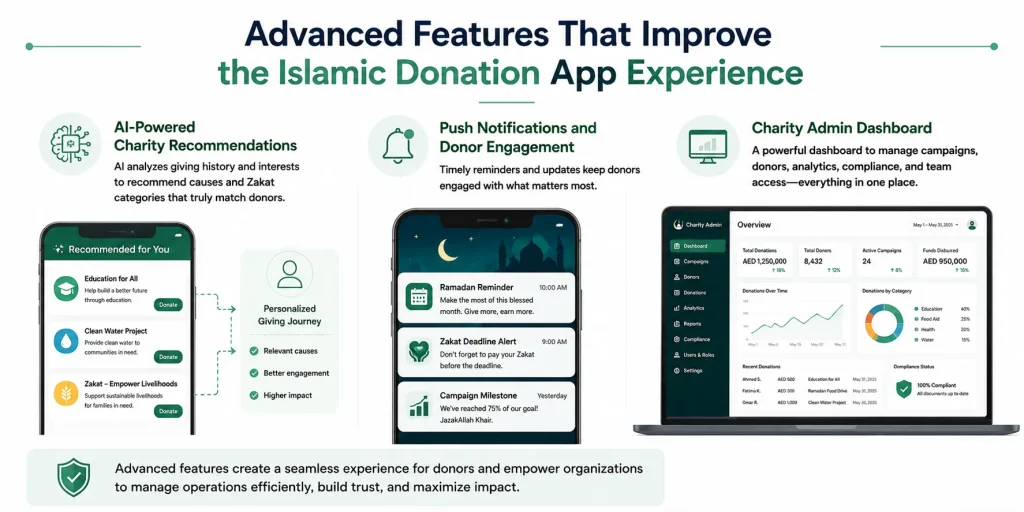
Advanced Features That Improve the Islamic Donation App Experience
AI-Powered Charity Recommendations
AI donation assistants can analyze a donor’s giving history and stated interests to surface causes or Zakat categories that genuinely match them, instead of showing every donor the same generic homepage. This turns a static list of campaigns into something closer to a personalized giving journey — a donor who previously supported education campaigns might be proactively shown a relevant new one rather than having to search for it. While implementing such advanced capabilities can influence the Islamic charity app development cost, the added personalization can significantly improve donor engagement and long-term retention.
Push Notifications and Donor Engagement
Ramadan reminders, Zakat deadline alerts, and campaign milestone updates keep donors engaged without feeling like spam — but only when they’re genuinely timed and relevant. A Zakat reminder sent in the correct week converts far better than a generic push sent at a random interval. Organizations that get this right segment by donor behavior and giving history rather than sending the same message to everyone.
Charity Admin Dashboard
None of the donor-facing features work sustainably without solid backend tooling. Organizations need a dashboard that handles campaign management, donor records, real-time analytics, financial and compliance reporting, and staff access controls, all in one place. This backend layer is often where charity app development projects actually succeed or fail — a beautiful donor-facing app is only half the product; if the team running campaigns is still relying on spreadsheets, that friction eventually shows up as outdated progress bars or delayed receipts.
How These Features Improve Donor Trust and Engagement
Better Transparency → Higher Donor Confidence
Transparency is one of the biggest factors influencing donor decisions. When users can track their donations, view campaign progress, and receive real updates about how funds are being utilized, they develop stronger confidence in the platform. Clear reporting, digital receipts, and impact stories remove uncertainty and help donors feel connected to the cause they are supporting.
Easier Donations → Higher Conversion Rates
A smooth donation experience directly affects how many users complete their contributions. Fewer payment steps, mobile-first design, and support for multiple payment options make the process faster and more convenient. When donors do not face unnecessary friction during checkout, they are more likely to complete their donations and return for future campaigns.
Personalization → Better Donor Retention
Personalized experiences help organizations build stronger relationships with donors beyond a single transaction. Relevant campaign recommendations, timely reminders, donation history, and customized updates make users feel more engaged with causes that match their interests. These features play an important role in converting occasional donors into long-term supporters.
Together, these benefits show why the right Islamic charity app features are not just about improving user experience. They directly influence donor trust, engagement levels, repeat contributions, and the overall success of a charity platform.
Technology Considerations for Islamic Charity App Development
Features are only as strong as the technology behind them. Before starting a build, organizations should think through:
- Secure, scalable cloud infrastructure that can handle Ramadan-level traffic spikes
- Reliable payment gateway integration covering local and international methods
- Strong data security and donor privacy protection
- AI capabilities for personalization and smarter reporting
- Analytics systems that produce usable reporting, not just raw numbers
Budget planning matters here. Many organizations start by researching the cost of super app development UAE agencies quote, since a full-featured charity platform — with a Zakat calculator, admin dashboard, AI recommendations, and multi-payment checkout — sits closer to a “super app” build than a simple donation form. Choosing the right technology partner affects scalability and total cost of ownership for years, not just launch.
Organizations working with a mobile app development UAE partner should also ask about post-launch support, since donation apps need ongoing maintenance around payment gateway updates, seasonal scaling, and evolving compliance requirements — this isn’t a build-once category of software.
Common Mistakes to Avoid When Building an Islamic Charity App
Building Only a Donation Payment Platform
Many organizations focus only on creating a simple payment system and overlook the importance of ongoing donor engagement. Modern donors expect more than just a quick way to transfer money; they want updates, donation tracking, impact reports, and meaningful communication after contributing. Without these engagement features, it becomes difficult to build long-term donor relationships.
Ignoring Compliance Requirements
Charity applications operating in the UAE must consider regulatory requirements from the beginning. Proper approval workflows, charity verification processes, and compliance checks should be integrated into the platform architecture rather than added later. Ignoring these requirements can create operational challenges and reduce donor trust.
Skipping Transparency Features
Transparency plays a major role in building credibility. Donors want clear visibility into campaign progress, fund usage, and the impact created through their contributions. Without tracking features, receipts, and regular updates, even a well-designed application may struggle to retain users.
Poor User Experience
A complicated donation journey can negatively impact conversions. Too many steps, unclear donation categories, slow navigation, or limited payment options can discourage users from completing their contributions. A simple, intuitive, and mobile-friendly experience is essential for improving donation completion rates.
Underestimating Seasonal Traffic and Demand
Islamic charity apps often experience significant traffic increases during periods like Ramadan, Eid, and other major giving seasons. Designing only for average usage can result in performance issues when donation activity suddenly increases. Scalable infrastructure and proper load planning are important to ensure a smooth experience during peak periods.
Most of these challenges happen when organizations treat Islamic charity app development as a simple feature checklist instead of following a structured Islamic charity app development guide based on real donor expectations, compliance needs, and long-term engagement goals. A successful app should connect every feature with a clear purpose: making donations easier, building trust, and creating lasting relationships between donors and charitable organizations.
Future Trends in Islamic Charity App Features
The future of Islamic charity apps is moving toward more connected, intelligent, and transparent giving experiences. Embedded giving will allow donation options to be integrated into everyday digital platforms, making it easier for users to contribute without switching between multiple applications. At the same time, AI-based donation assistance will help users discover relevant causes, receive personalized recommendations, and get better guidance for different types of Islamic giving.
Another major shift will be real-time impact tracking and digital Islamic giving ecosystems that connect donors, verified charities, and beneficiaries through a single platform. Instead of relying only on static reports, donors will expect continuous updates about campaign progress and fund utilization. Organizations that approach Islamic charity app development with scalability and future readiness will be better positioned to adopt these innovations without rebuilding their core systems.

Conclusion
Successful Islamic charity apps are built around three things working together: trust, convenience, and transparency. Features like a proper Zakat calculator, verified campaigns, detailed donation tracking, recurring giving tools, and full bilingual UX aren’t optional extras anymore — they’re becoming the baseline UAE donors expect from any platform asking for their money.
For organizations weighing their options, understanding the realistic Islamic charity app development cost upfront, alongside the feature set that actually drives higher donations, makes it far easier to plan a build that doesn’t need an expensive rework a year later. Working with an experienced mobile app development UAE team — one that understands both the technical requirements and the religious context behind them — makes the real difference between a functional donation app and one donors keep coming back to.
Frequently Asked Questions
What are the most important Islamic charity app features?
Verified charity profiles, a secure one-tap checkout, a proper Zakat calculator, donation tracking with transparency reports, recurring giving options, and full bilingual Arabic-English support are the core features every Islamic donation app should include from launch.
How does an Islamic charity app increase donor trust?
Trust comes from visible verification — approved campaigns and registered organizations — combined with transparent reporting on how funds are used and secure payment processing. Donors give more, and give again, when they can see the full picture rather than taking it on faith.
Why is a Zakat calculator important in charity apps?
Zakat is a religious obligation with specific calculation rules across several asset categories. A dedicated calculator removes the manual guesswork and makes it far easier for donors to give accurately without leaving the app.
What features should be included in an Islamic donation app?
Beyond basic donation functionality, include Sadaqah and Qurbani categories, dedicated Ramadan campaigns, an anonymous giving option, well-timed push notifications, recurring donation tools, and a full admin dashboard for campaign and compliance management.
How much does charity app development cost?
It depends on feature scope — a basic donation app with a simple payment flow costs considerably less than a full platform with AI-powered recommendations, a Zakat calculator, and multi-language support. A detailed quote based on an exact feature list is the most accurate way to budget