
Key Takeaways
- Custom AI vs off-the-shelf AI isn’t a technology question first — it’s a business-strategy question about where you spend, own, and differentiate.
- Off-the-shelf tools win on speed and cost for common use cases. Custom AI wins when a workflow touches proprietary data competitors can’t copy.
- UAE-specific factors — PDPL, sector regulation, data residency — change the calculus more than generic AI comparisons account for.
- Three-year total cost of ownership tells a truer story than the first invoice, in either direction.
- Most Dubai enterprises that get this right run a hybrid stack: buy the foundation, build the differentiation.
- A structured 30-day proof of concept is the fastest way to de-risk the decision before scaling spend.
Nobody in Dubai is asking whether to use AI anymore. Boards stopped debating that around 2023. The question keeping CTOs and CIOs up at night now is narrower and harder: how much of the AI stack should we build ourselves, and how much should we buy?
That’s the real custom AI vs off-the-shelf AI dilemma. Ready-made tools can be live in a sprint. Custom AI can take three to six months but gives you something a competitor can’t buy off a pricing page. Get the call wrong and you end up with a bloated custom build nobody adopts, a subscription stack you’ve outgrown in a year, or a security gap nobody flagged until it was too late.
Dubai adds its own layer to this. The UAE is investing aggressively in sovereign AI infrastructure, enterprise adoption is accelerating across banking, healthcare, logistics, and retail, and the Personal Data Protection Law (PDPL) has turned data governance into a board-level conversation rather than an IT footnote. A generic “buy vs build” framework written for a US or European market doesn’t fully hold up here — and that’s exactly where most comparison articles fall short.
Custom AI vs Off-the-Shelf AI: What Is the Difference?
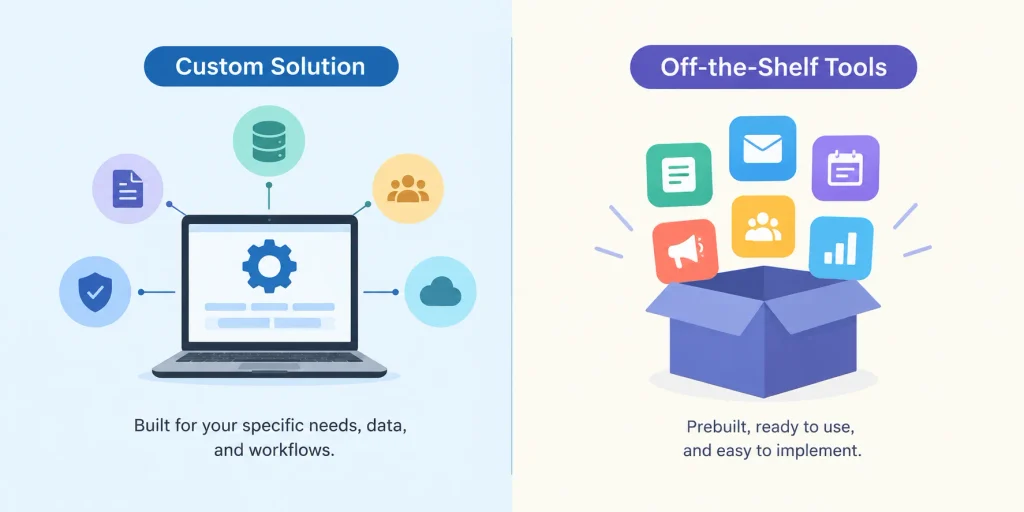
Before the strategy conversation, it helps to be precise about what each term actually means.
What Are Custom AI Solutions?
Custom AI solutions are built around one company’s specific data, workflows, tech stack, and compliance requirements — not a generic template thousands of other businesses also use. Working with a partner offering AI development services dubai companies rely on typically starts with discovery: mapping data sources and existing systems before a single model gets touched.
Examples of custom AI already in production:
- AI-powered decision engines for pricing or risk
- Predictive analytics built on proprietary operational data
- Enterprise RAG (retrieval-augmented generation) applications
- Conversational AI agents — scoped the same way you’d build an AI chatbot like U-Ask, Dubai Government’s citizen-services assistant
- Intelligent document processing for contracts, claims, or compliance filings
- Industry-specific recommendation systems
None of these come out of a box. They’re built to fit the business.
What Are Ready-Made AI Tools?
Off-the-shelf AI tools are prebuilt products you configure and switch on — writing assistants, customer-support bots, marketing automation, meeting-note tools, productivity copilots. You’re not designing anything; you’re subscribing to someone else’s decisions. This is the “off-the-shelf” half of custom AI vs off-the-shelf AI, and for most teams it’s the default starting point.
Ready-made doesn’t mean inferior. It usually means faster deployment, a lower entry price, and a vendor who handles the maintenance you’d otherwise carry internally. For most business functions, that trade-off is the right one.
Quick Question: “Is off-the-shelf AI “worse” than custom AI?”— No. It’s a different tool for a different job. Off-the-shelf AI is often the smarter choice for commodity tasks — the goal is fit, not sophistication.
Custom AI vs Off-the-Shelf AI: The 7 Factors That Should Drive Your Decision
The right answer depends on seven factors, and they rarely all point the same direction:
- Business differentiation
- Data sensitivity
- Integration complexity
- Time to value
- Total cost of ownership
- Internal engineering capacity
- Vendor lock-in and scalability
Walk through each one honestly and the custom AI vs off-the-shelf AI decision usually becomes obvious — even when it felt impossible on page one. Skip a factor, and the custom AI vs off-the-shelf AI call tends to get made on gut feel instead of evidence.
1. Competitive Advantage: Is AI Core to Your Business?
Nowhere does custom AI vs off-the-shelf AI matter more than here. The question that actually matters: is AI simply supporting your operations, or is it becoming part of what makes you win deals?
When Custom AI Makes More Sense
If AI is going to touch revenue, retention, margins, or the actual customer experience, custom AI development starts to earn its cost. A logistics firm using a generic tool to draft emails doesn’t need a bespoke system for that. But a logistics firm predicting delivery delays using its own fleet telemetry, traffic patterns, and customer history? That’s a model nobody else can license, because nobody else has that data.
When Ready-Made AI Is Enough
Commodity capabilities rarely justify a custom build: routine content drafting, meeting transcription, generic customer support, standard marketing workflows. If a competitor can buy the same capability you’re about to spend months building, you’re not creating a moat. That’s the clearest signal in the whole custom AI vs off-the-shelf AI decision — you’re recreating something that already exists elsewhere, slower and at higher cost.
2. Data Sensitivity, Security, and UAE Compliance
This is where the custom AI vs off-the-shelf AI conversation gets genuinely UAE-specific, and where most generic advice runs out. Few write-ups on custom AI vs off-the-shelf AI even mention PDPL, which is exactly why so many businesses get this factor wrong.
Why Data Governance Changes the Build-vs-Buy Equation
The moment personal, financial, healthcare, or government-adjacent data enters the picture, the questions multiply: where is it processed, who can access it, and what happens if the vendor changes its data-handling terms next year? A tool that’s fine for drafting marketing copy is a different animal when it’s touching patient records.
PDPL and Data Residency Considerations
The UAE’s Personal Data Protection Law pushes businesses to evaluate vendor processing arrangements, cross-border transfer practices, retention policies, and audit trails — not just the feature list. Requirements vary by sector; a fintech handling transactions and a retailer handling loyalty-program emails aren’t under identical scrutiny. The point isn’t that every business needs the same controls — it’s that every business needs to actually check, rather than assume the vendor’s default terms are good enough.
Why Custom AI Can Provide Greater Control
Custom AI development lets you design private deployment, controlled data pipelines, role-based access, and region-specific infrastructure from day one. On the custom AI vs off-the-shelf AI spectrum, this is the strongest argument for building rather than buying when data sensitivity is high. That control comes with a trade-off worth saying plainly: you also inherit the governance responsibility that a vendor would otherwise carry for you. Owning the system means owning the audit.
3. Speed to Market: How Quickly Do You Need Results?
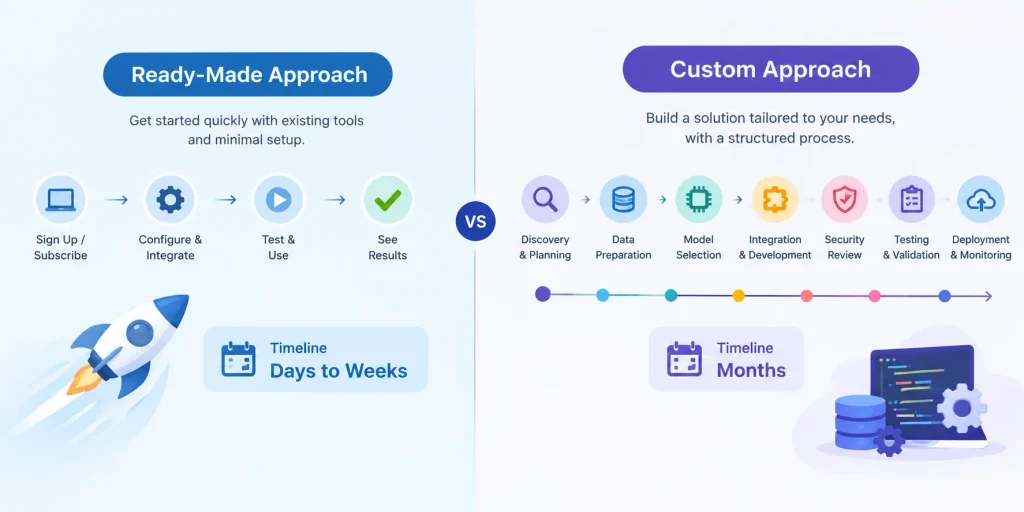
Timeline is often the deciding vote in custom AI vs off-the-shelf AI, even when nobody says so out loud.
Ready-Made Approach
Days to weeks, not months. Existing integrations, prebuilt interfaces, minimal infrastructure work, and a fast read on whether the use case actually delivers value.
Custom Approach
Discovery, data preparation, architecture, model selection, integration, security review, testing, deployment, monitoring. Each stage is necessary for an enterprise-grade result, and together they stretch custom AI development timelines to months rather than weeks. An artificial intelligence development guide covering each stage is worth reading before you scope anything internally.
When Speed Should Win
If you’re still testing whether an AI use case actually works for your business, start with an off-the-shelf tool. Prove the hypothesis cheaply. Fund the custom build once you know it’s worth building — resolving custom AI vs off-the-shelf AI on evidence rather than a hunch.
4. Total Cost of Ownership: Cheap to Start Doesn’t Always Mean Cheap to Scale
Money is where custom AI vs off-the-shelf AI comparisons usually go wrong — everyone compares the sticker price and skips what happens in year two.
| Cost Factor | Custom AI | Ready-Made AI |
|---|---|---|
| Initial investment | Higher | Lower |
| Development | Significant | Minimal |
| Integration | Custom-built | Usually prebuilt |
| Infrastructure | Organization-managed | Vendor-managed |
| Maintenance | Internal or partner-led | Mostly vendor |
| Model monitoring | Organization-managed | Vendor-dependent |
| Subscription costs | Lower/variable after build | Recurring |
| Customization | High | Limited to vendor capability |
| Vendor dependency | Lower | Higher |
What Custom AI Really Costs
Beyond the initial build, factor in data engineering, cloud infrastructure, model or API consumption, security review, MLOps, retraining, and ongoing maintenance. Market ranges for AI software development cost in the UAE vary widely by scope — treat any figure you see, including ours, as an indicative benchmark, not a quote.
The Hidden Costs of Off-the-Shelf AI
Per-seat pricing that scales awkwardly with headcount. Usage-based API costs that spike without warning. Premium tiers gated behind features you assumed were standard. Integration and migration costs that only surface mid-implementation. Vendor price increases you have no leverage against, and switching costs if you ever want out.
The one number that actually matters in any custom AI vs off-the-shelf AI comparison: compare three-year TCO, not the invoice you get on day one.
5. Customization and Integration: How Well Does AI Fit Your Existing Systems?
This is where custom AI vs off-the-shelf AI stops being theoretical and becomes an engineering question. Ready-made tools and enterprise AI platforms often cover a lot of ground well — until your workflows stop looking like everyone else’s. Integration touchpoints worth mapping before you decide: ERP, CRM, HR systems, supply-chain platforms, data warehouses, legacy applications, and internal APIs.
When Off-the-Shelf AI Works
Standardized workflows, common APIs, simple automation, and use cases that don’t need to touch proprietary business logic.
When Custom AI Wins
Anything that has to follow your specific business rules, pull from multiple internal systems simultaneously, or trigger a multi-step workflow unique to your operation. Integration complexity is usually the tiebreaker in custom AI vs off-the-shelf AI once budget and timeline both check out. This is usually where enterprise AI capabilities start to matter more than raw model quality — the intelligence is only as useful as its ability to actually reach your data.
6. Scalability, Control, and Vendor Lock-In
The long-term stakes of custom AI vs off-the-shelf AI show up here, years after the initial decision was made and mostly forgotten.
The Case for Custom Control
Architecture control, model flexibility, data ownership, the freedom to switch underlying models as the market shifts, and long-term product control that doesn’t depend on someone else’s roadmap.
The Trade-Off
All of that control has to be staffed: engineering time, MLOps, security management, and continuous model evaluation don’t run themselves.
The Off-the-Shelf Lock-In Risk
Dependency cuts the other way with ready-made tools — you’re exposed to vendor pricing changes, API availability, product-roadmap decisions you have no say in, usage caps, and whatever the SLA happens to guarantee this year. Lock-in isn’t automatically a bad thing in custom AI vs off-the-shelf AI. It’s a bad thing when it wasn’t a deliberate choice.
7. Enterprise AI Platforms: Where Do They Fit?
Enterprise AI platforms are the answer for businesses that find the custom AI vs off-the-shelf AI framing too binary. They sit in the middle ground between a fully custom build and a simple SaaS subscription, and for a lot of Dubai businesses, that middle ground is exactly right.
What Enterprise AI Platforms Typically Provide
Model access, data connectors, security controls, analytics, workflow tooling, AI agents, governance, and deployment infrastructure — bundled rather than built from scratch.
When an Enterprise AI Platform Is the Better Choice
When you’re running multiple AI use cases across departments and need central governance instead of five disconnected tools with five logins. Teams exploring generative ai solutions in dubai at this scale usually land here first, since one governance layer can serve several use cases at once.
Where Platforms Can Still Fall Short
Architecture limitations, ongoing vendor dependency, pricing that doesn’t flex with usage, and restricted model choice. You get speed and governance, but you give up some of the flexibility a fully custom system would offer.
That gives a useful mental model: Custom AI → Enterprise AI Platform → Off-the-Shelf AI Tool, each trading flexibility for speed as you move right.
Custom AI vs Off-the-Shelf AI: A Practical Decision Matrix
| Business Requirement | Recommended Approach |
|---|---|
| Generic productivity | Off-the-shelf AI |
| Basic content generation | Off-the-shelf AI |
| Standard customer support | Off-the-shelf AI |
| Highly proprietary workflows | Custom AI |
| Sensitive enterprise data | Custom / controlled deployment |
| AI as core product differentiator | Custom AI |
| Multiple enterprise use cases | Enterprise AI platform |
| Rapid experimentation | Off-the-shelf AI |
| Complex legacy integration | Custom AI |
| Long-term differentiation | Custom AI |
Buy for speed. Build for differentiation. Use a platform when you need scale and governance more than either — the shorthand version of every custom AI vs off-the-shelf AI decision on this page.
The Hybrid Strategy: Why You Don’t Have to Choose Just One
The real-world answer to custom AI vs off-the-shelf AI is, more often than not, both. In practice, most Dubai enterprises that get this right don’t pick a single lane. They run a hybrid model.
What a Hybrid AI Architecture Looks Like
Buy: foundation models, cloud infrastructure, generic AI services, standard automation.
Build: proprietary RAG layers, internal knowledge systems, business-specific agents, custom decision logic, and the integrations connecting AI to how your teams actually work.
Why Hybrid Can Reduce Risk
Faster time to market than a fully custom build, lower upfront investment than owning the entire stack, and still enough customization to protect what makes you different — experiment cheaply on the commodity layer while protecting budget for the parts that actually move the business.
Example for a Dubai Enterprise
Picture a financial-services firm in Dubai using a managed foundation model for general language tasks, while keeping customer and transaction data inside controlled infrastructure. On top of that, they build a proprietary RAG layer for internal knowledge, connect AI directly into underwriting workflows, and let employees use an off-the-shelf productivity tool for anything that isn’t sensitive. Nothing about that setup requires an all-or-nothing decision — and increasingly, that’s what modern agentic AI in software engineering teams are building toward: systems of coordinated agents, some bought, some built, working across one governed architecture.
UAE Business Scenarios: Which AI Approach Fits Your Organization?
The custom AI vs off-the-shelf AI answer changes by sector, sometimes sharply. Here’s how it typically plays out across five common industries in Dubai.
Healthcare — sensitive patient data, strict clinical workflows, real regulatory weight. Likely approach: custom or hybrid.
Financial Services — fraud detection, risk scoring, compliance monitoring, customer intelligence competitors would love to copy. Likely approach: custom or hybrid.
Retail — product recommendations, customer service, demand forecasting, marketing automation. Likely approach: hybrid.
Logistics — ETA prediction, fleet optimization, route intelligence, all stronger when built on data a competitor can’t access. Likely approach: custom or hybrid.
Professional Services — document processing, meeting summaries, content generation, day-to-day productivity. Likely approach: off-the-shelf AI tools.
Quick Question: “Do small and mid-size Dubai businesses need custom AI?”— Usually not right away. Most SMEs get more value starting with off-the-shelf or hybrid tools and reserving custom builds for the one workflow that genuinely sets them apart.
30-Day AI Proof-of-Concept Strategy Before You Commit
You don’t need six months to settle custom AI vs off-the-shelf AI for a specific use case. Rather than committing a large budget upfront, run a structured four-week validation.
Week 1 — Identify the Business Problem
Pin down the objective, the AI use case, the data you’ll need, and how you’ll measure success.
Week 2 — Evaluate Build vs Buy
Check existing tools against the gap, assess data sensitivity, and estimate integration complexity and expected ROI.
Week 3 — Build the Proof of Concept
Test accuracy, user experience, integration feasibility, security, and actual business impact — not just whether the demo looks good.
Week 4 — Make the Investment Decision
Decide whether to buy, build, adopt an enterprise AI platform, or move toward a hybrid architecture — settling custom AI vs off-the-shelf AI with four weeks of evidence instead of a vendor pitch deck.
Common Mistakes Businesses Make When Choosing AI Solutions
Most bad custom AI vs off-the-shelf AI decisions trace back to one of five habits.
Choosing based only on price. A low sticker price rarely equals a low three-year total cost.
Building AI because it sounds more advanced. Custom isn’t automatically better; it’s better for specific, proven cases.
Buying without reviewing data policies. Vendor terms matter as much as the feature list.
Ignoring integration costs. The AI product might be cheap. Connecting it to your existing systems rarely is.
Failing to define ROI upfront. Every AI investment needs a measurable outcome before it gets funded, not after.
Final Verdict
Choose Custom AI when: AI directly differentiates your business, proprietary data sits at the center of the use case, workflows are complex, deep integration is required, long-term control matters, or regulatory requirements demand it.
Choose Off-the-Shelf AI when: the use case is standardized, speed is the priority, AI isn’t a core competitive lever, internal capacity is limited, or an existing tool already solves the problem well.
Choose Hybrid when: you need both speed and customization, you want to build on foundation models without owning the entire stack, enterprise governance matters, and some workflows are strategic while others are simply commodity tasks.
However you land on custom AI vs off-the-shelf AI, the smartest AI investment was never automatically the one you build or the one you buy. It’s the one that delivers measurable business value while balancing speed, control, cost, security, and real differentiation.
Ready to Determine the Right AI Strategy for Your Business?
Not sure whether to build, buy, or take a hybrid approach? That’s exactly the custom AI vs off-the-shelf AI conversation worth having before any budget gets committed.
Bring your business objectives, existing systems, data environment, target AI use cases, compliance requirements, and expected ROI to the table. From there, a proper assessment covers build-vs-buy evaluation, AI architecture consultation, proof-of-concept planning, a custom AI development roadmap, and enterprise AI integration — matched to what your business actually needs, not a generic template.
Talk to an AI Solution Expert to map out the right approach for your business, before you spend a single dirham building or buying the wrong one.
Frequently Asked Questions
What’s the main difference between custom AI and off-the-shelf AI?
Custom AI is built around your specific data, workflows, and systems. Off-the-shelf AI is a prebuilt product you configure and subscribe to. One is designed for you; the other is designed for everyone.
Is custom AI more expensive than off-the-shelf AI?
Usually, yes, upfront. Off-the-shelf AI has lower initial costs but recurring subscription fees. Custom AI costs more to build but often has lower long-term costs once development is complete.
How long does it take to build custom AI solutions?
Enterprise-grade custom AI typically takes three to six months, covering discovery, data preparation, development, integration, security review, and deployment — longer for complex, multi-system projects.
Can small businesses in Dubai benefit from custom AI?
Usually not immediately. Most SMEs get more value starting with off-the-shelf or hybrid tools, reserving custom AI for the one workflow that genuinely differentiates their business.
Does PDPL affect my choice between custom and off-the-shelf AI?
Yes. If you handle sensitive personal, financial, or healthcare data, PDPL compliance often favors custom AI or controlled deployments, since you get more say over data processing and storage.
What is a hybrid AI approach?
Hybrid AI combines both: buying foundation models and infrastructure while building proprietary layers like RAG systems, custom agents, and business-specific logic on top for real differentiation.
What are enterprise AI platforms?
Enterprise AI platforms sit between fully custom builds and simple SaaS tools. They bundle model access, security, governance, and workflow tools for businesses running multiple AI use cases at once.
How do I know if I need custom AI or a ready-made tool?
Ask if AI is core to your competitive advantage. If competitors can buy the same capability, use off-the-shelf. If it relies on proprietary data, build custom.
What is a proof of concept, and why does it matter for AI investment?
A proof of concept is a short, structured test — typically 30 days — that validates an AI use case before committing full budget, reducing risk and wasted spend.
What’s the biggest mistake businesses make when choosing an AI solution?
Choosing based on price alone. A low sticker price often hides higher long-term costs; comparing three-year total cost of ownership gives a truer picture than the first invoice.