


Dubai’s push toward becoming a fully AI-native economy under the Dubai Economic Agenda (D33) has put pressure on local businesses to move fast. But speed without direction wastes money. Most companies in the UAE that struggle with AI automation didn’t pick a bad vendor — they picked the wrong process to automate first.
This guide walks through how to find, score, and validate the right process before you spend a single dirham on implementation.
Key Takeaways
- The process you choose matters more than the AI tool you buy — pick wrong, and even the best platform delivers weak ROI.
- Look for high-volume, repetitive, decision-heavy workflows with clean data before automating.
- A simple scoring framework (volume, rule consistency, data availability, error cost, strategic value) removes guesswork from prioritization.
- Human oversight and fallback processes aren’t optional — they’re what makes AI automation trustworthy at scale.
- Starting with one focused pilot, measured against clear metrics, is how Dubai businesses move from experimentation to real efficiency gains and stay competitive as the market shifts.
Why Choosing the Right Process Matters More Than Choosing the AI Technology
Every quarter, more Dubai-based companies — from DIFC fintechs to Jebel Ali logistics operators — announce some kind of AI initiative. Few talk about what happened a year later, because the question most teams start with is backwards.
They ask: “Which AI tool should we buy?” The better question is: “Which business process should we automate first?”
Get that wrong and you get wasted budget, low staff adoption, and an automated version of a process that was inefficient to begin with. Get it right, and AI automation becomes the thing that actually moves your P&L.
This article covers a repeatable framework: mapping workflows, spotting automation signals, scoring opportunities, checking data readiness, calculating ROI, weighing risk, and picking a first pilot — no data science team required.
Why Identifying the Right Processes Is the Biggest AI Automation Challenge
Technology rarely kills an AI project. Poor process selection does.
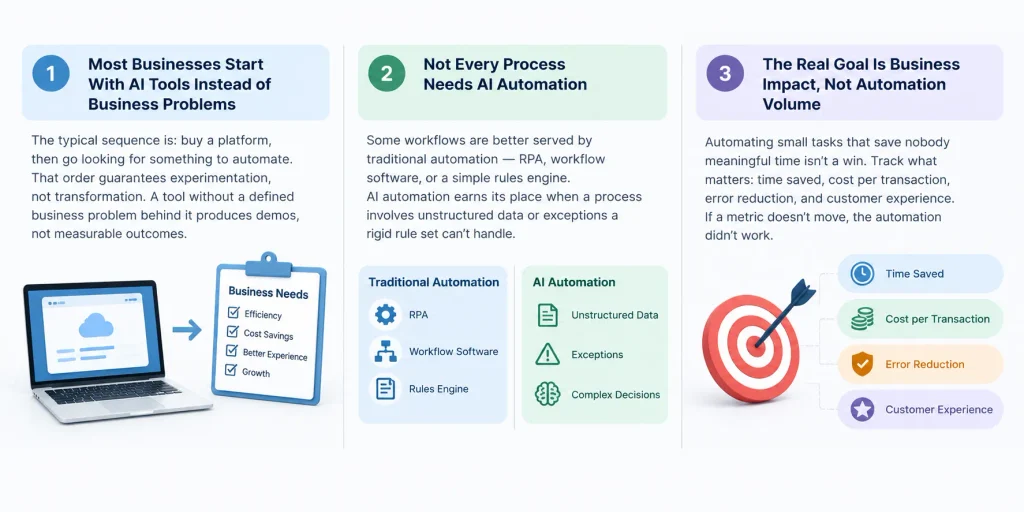
Most Businesses Start With AI Tools Instead of Business Problems
The typical sequence is: buy a platform, then go looking for something to automate. That order guarantees experimentation, not transformation. A tool without a defined business problem behind it produces demos, not measurable outcomes.
Not Every Process Needs AI Automation
Some workflows are better served by traditional automation — RPA, workflow software, or a simple rules engine. AI automation earns its place when a process involves unstructured data or exceptions a rigid rule set can’t handle.
The Real Goal Is Business Impact, Not Automation Volume
Automating small tasks that save nobody meaningful time isn’t a win. Track what matters: time saved, cost per transaction, error reduction, and customer experience. If a metric doesn’t move, the automation didn’t work.
What Makes a Business Process a Good Candidate for AI Automation?
Some workflows are almost tailor-made for automation. Others disappoint no matter how good the technology is.
High Transaction or Process Volume
Repetitive, high-frequency workflows are where AI automation earns its cost fastest — invoice processing, customer requests, document review, record updates, ticket routing, and application processing all fit this pattern.
Repetitive but Not Completely Simple
Simple repetitive automation fires a rule and stops there. AI-powered decision automation interprets a document, an email, or a customer message before deciding what to do — that’s where AI automation adds value a basic script can’t.
Clear Inputs and Expected Outcomes
Strong candidates have defined inputs, decision criteria, expected outputs, and exception paths. If nobody can explain what “correct” looks like for a task, AI can’t learn it either.
High Cost of Manual Errors
Incorrect invoices, compliance slip-ups, delayed shipments, missed approvals — these carry real cost. Understanding enterprise AI capabilities means recognizing that error-prone, high-stakes processes often pay back the fastest, because you’re avoiding losses, not just saving time.
Processes That Create Operational Bottlenecks
Sales, finance, customer service, supply chain, HR, compliance — bottlenecks cluster in the same departments across most mid-sized companies. Unblocking one choke point often speeds up everything downstream.
Step 1: Map How the Process Actually Works Today
You can’t automate a process you don’t fully understand.
Document the Real Workflow, Not the Ideal Workflow
There’s usually a gap between the official SOP and what employees actually do. Shadow the people doing the work and ask what shortcuts they take.
Identify the Process Trigger
What starts the process — an email, a customer request, a document, a system event? Vague triggers produce automation that misses real-world cases.
Track Every Step, Decision and Handoff
Manual activities, approvals, decision points, system changes, handoffs, waiting periods — write it all down. Handoffs are usually where the most time gets wasted.
Identify Systems and Data Sources
ERP, CRM, email, spreadsheets, document management systems, legacy applications — list everything the process touches.
Don’t Ignore Exceptions
How often do exceptions occur, what causes them, who handles them? A process with a 40% exception rate needs a very different automation approach than one with a 2% rate. This is core to planning realistic AI workflow automation, because exceptions are where poorly designed automation breaks.
Quick Question: “Do I need to map every process before automating anything?”— No. Map the 3–5 processes you’re seriously considering, not your entire operation. Full-company mapping is a multi-month project; targeted mapping of shortlisted candidates takes days.
Step 2: Look for the Strongest AI Automation Signals
The more of these five signals a process shows, the stronger the candidate.
Signal #1: Employees Spend Significant Time on the Process
Count hours per week, people involved, and how much is active work versus waiting.
Signal #2: The Process Uses Large Amounts of Data or Documents
PDFs, contracts, invoices, emails, forms, reports — intelligent automation is strongest where there’s a steady, high volume of this material to interpret.
Signal #3: Employees Repeatedly Make Similar Decisions
Approve, reject, route, categorize, extract, validate, prioritize — if the same judgment call comes up dozens of times a day, AI automation can learn to support it.
Signal #4: The Process Requires Multiple Systems
AI can orchestrate a workflow across systems instead of automating one isolated step — that orchestration is often where the biggest gains hide.
Signal #5: The Process Has Measurable Business Outcomes
Processing time, cost per transaction, error rate, SLA compliance — if you can’t measure the process today, you can’t prove the automation worked tomorrow.
Step 3: Score Each Process Before Investing in AI Automation
Once you’ve shortlisted candidates, score them. Gut feeling is a poor way to allocate an automation budget.
The 5 Criteria for Evaluating AI Automation Opportunities
| Evaluation Criteria | Weight | What to Measure |
|---|---|---|
| Process Volume | 25% | Frequency and transaction volume |
| Rule Consistency | 20% | Predictability of decisions |
| Data Availability | 20% | Access to required data |
| Error Cost | 20% | Financial or operational impact |
| Strategic Value | 15% | Business importance |
How to Score Each Process
Use a 1–5 scale: 1 = poor candidate, 2 = limited potential, 3 = moderate opportunity, 4 = strong candidate, 5 = excellent candidate.
Which Processes Should Businesses Prioritize First?
Prioritize strong scores, manageable complexity, available data, clear ownership, and measurable ROI. Pick one to three focused pilots — trying to overhaul the whole operation at once is how AI budgets get burned without a working result to show for it.
Example of an AI Automation Opportunity Score
Invoice processing for a mid-sized Dubai trading company might score: Volume 5, Rule consistency 4, Data availability 4, Error cost 5, Strategic value 4. High volume plus high error cost plus consistent rules is exactly the profile of a strong AI business automation candidate.
Step 4: Check Whether Your Data Is Ready for AI Workflow Automation
A process can score well on paper and still fail in implementation if the data isn’t ready.
Can AI Access the Required Information?
Check access to ERP, CRM, databases, emails, documents, APIs, and knowledge bases. Data that exists but can’t be reached programmatically is still a blocker.
Is the Data Structured or Unstructured?
Structured data — tables, databases, forms — is easier to work with. Unstructured data — emails, PDFs, contracts, images — is where AI automation genuinely shines, but it needs more setup work.
Are Your Data Sources Connected or Fragmented?
Data silos, legacy systems, duplicate records, inconsistent formats — these quietly kill automation projects. A company running five disconnected spreadsheets for one customer record needs to fix that first.
How Much Data Preparation Is Required?
Cleaning, normalization, classification, access control, governance — skipping this is the most common reason AI pilots stall after the demo stage. Many mid-sized companies underestimate this step until they start evaluating custom AI software for mid-sized businesses and realize how much of the budget goes into data preparation rather than the model itself.
Step 5: Calculate the Real Business Case for AI Business Automation
Feasibility isn’t the same as value. This step puts a number on it.
Measure the Current Cost of the Process
Add up employee hours, fully loaded labor costs, existing technology costs, error costs, and rework. Most teams undercount this because they only track the happy path.
Estimate the Potential Value of AI Automation
Look at faster processing, reduced manual work, lower error rates, and fewer delays. Be conservative — a 30% estimate that lands beats a 70% estimate that doesn’t.
Include the Full Implementation Cost
Don’t just price the software. Add integration, data preparation, development, testing, training, and ongoing monitoring. This is also where many businesses start comparing custom AI vs off-the-shelf AI, since a heavily tailored workflow can shift the cost balance compared with a configurable platform.
Use a Simple ROI Model
ROI = (Annual Value Generated – Implementation Cost) ÷ Implementation Cost × 100
Example: AI Automation for Document Processing
A logistics company in Dubai processing 4,000 shipping documents a month at 12 minutes each spends roughly 800 hours monthly on the task. Cutting that to 3 minutes per document frees up around 600 hours. Against a first-year investment in the AED 250,000–350,000 range, labor and error-reduction savings alone can produce payback inside 12 months — before counting faster customer turnaround.
Step 6: Evaluate Risk Before Automating the Entire Process
A strong ROI doesn’t automatically mean you should automate a process end-to-end.
What Happens When the AI Makes a Mistake?
Weigh the financial, customer, compliance, and operational impact of an error. A wrong answer in a marketing chatbot is annoying; a wrong answer in a compliance check is a different problem.
Build in Human Oversight and a Fallback Process
Human-in-the-loop review, confidence thresholds, and exception routing reduce the blast radius of a bad decision without eliminating the efficiency gain. Auditability and decision history matter even more in regulated markets — UAE businesses working under the Dubai Personal Data Protection Law need this by default, along with a backup path for when the AI fails, an integration goes offline, or an output needs manual review.
High-Value AI Automation Opportunities Across Business Functions
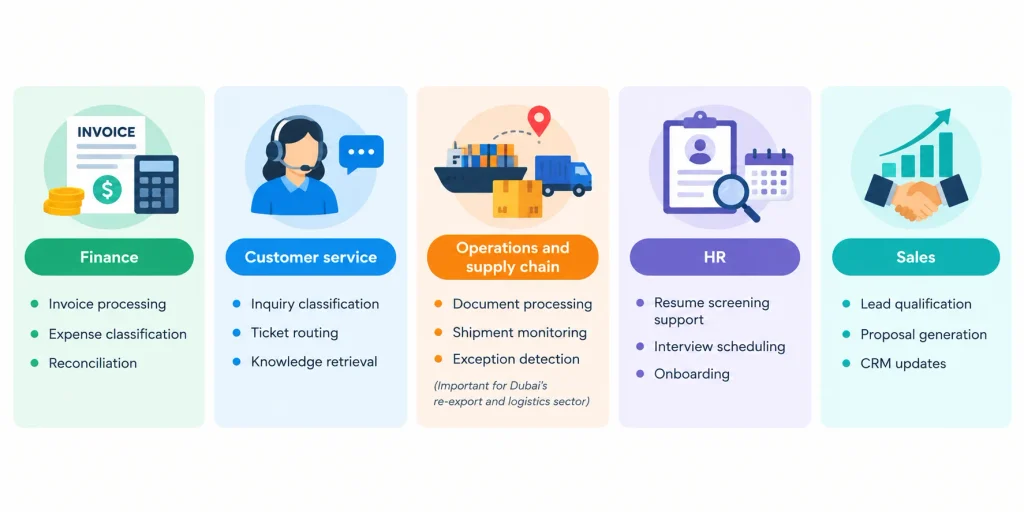
Some departments consistently produce stronger candidates than others.
- Finance: invoice processing, expense classification, reconciliation.
- Customer service: inquiry classification, ticket routing, knowledge retrieval.
- Operations and supply chain: document processing, shipment monitoring, exception detection — a category that matters a great deal to Dubai’s re-export and logistics sector specifically.
- HR: resume screening support, interview scheduling, onboarding.
- Sales: lead qualification, proposal generation, CRM updates.
| Business Function | AI Automation Opportunity | Why It Works |
|---|---|---|
| Finance | Invoice processing | High volume and structured workflows |
| Customer Service | Ticket routing | Repetitive requests and clear categories |
| Supply Chain | Exception detection | Real-time data and operational urgency |
| HR | Document processing | Repetitive administrative tasks |
| Operations | Workflow coordination | Multiple systems and approvals |
For a broader view of where this fits across an entire organization rather than one department at a time, it’s worth reviewing common AI use cases for enterprises before deciding which function to tackle first.
When a Process Is Not Ready for AI Automation
Not every workflow should be automated right now, and saying so is part of doing this properly.
- The process is already broken — automation speeds up inefficiency too.
- There’s no reliable data — AI can’t produce good results from inputs that are missing or inconsistent.
- The process changes too often — it needs to stabilize first.
- There’s no clear process owner — nobody accountable today means nobody accountable after.
- The business can’t measure success — without a baseline, you can’t prove anything improved.
Common Mistakes Businesses Make When Choosing AI Automation Processes
- Starting with the most complex process instead of the most achievable one.
- Automating a broken workflow instead of redesigning it first.
- Ignoring integration requirements with existing ERP, CRM, and legacy applications.
- Focusing only on cost savings and missing speed, accuracy, and customer experience gains.
- Scaling before proving ROI on a small pilot.
Quick Question: “How long should a pilot run before scaling?”— Most businesses need 60–90 days of production use to see a reliable pattern. Anything shorter risks scaling a result that was just a good month.
A Practical 7-Step Framework for Choosing Your First AI Automation Project
- List your most time-consuming processes — start with what actually eats hours weekly, not what sounds impressive.
- Map the current workflow — the real steps, not the documented ones.
- Identify repetitive decisions and bottlenecks — these are your entry points.
- Score each opportunity using the five-criteria model from Step 3.
- Check data and integration readiness before excitement takes over.
- Calculate expected ROI and risk with real numbers, not projections.
- Start with a focused pilot — one process, clear metrics, a defined timeline. Many businesses run this first pilot alongside an established AI development company in dubai, since local implementation experience shortens the path from plan to production.
How to Move From AI Automation Opportunities to a Production-Ready Pilot
Select One High-Impact Process, Define Metrics, Then Build
Choose strong ROI, clear ownership, available data, and manageable risk — the most achievable win, not the biggest one. Define success metrics (processing time reduction, cost per transaction, error rate, automation rate) before a single line of the workflow is built, then handle integration, testing, exception handling, and human oversight in that order — not as an afterthought once something breaks in production.
Measure Results Before Scaling
Successful AI workflow automation moves through pilot, validation, optimization, and scaling — never straight from pilot to company-wide rollout. Along the way, most businesses weigh custom development against existing platforms; for a deeper walkthrough of that decision, an artificial intelligence development guide is a useful next read before committing to either path.
The Future of AI Automation
The shift underway is steady: basic automation gives way to AI-assisted automation, then intelligent automation, then AI agents handling multi-step tasks. Future AI business automation will lean more on cross-system coordination and continuous optimization.
Businesses that understand their own processes today — the actual steps, not the idealized version — will be positioned to scale AI tomorrow without starting from scratch.
Conclusion
Successful AI automation was never about automating everything. It’s about finding processes with high volume, clear business value, reliable data, repetitive decisions, and manageable risk — then proving the model works before expanding it.
Businesses looking to move from AI experimentation to measurable operational results should start with a structured process assessment, a real ROI analysis, and one focused pilot, rather than deploying AI across the organization without clear priorities.
Frequently Asked Questions About AI Automation
How do businesses identify processes suitable for AI automation?
Map the workflow, then check for volume, repetitive decisions, data availability, error cost, and strategic value.
What processes should businesses automate with AI first?
High-volume, repetitive, data-rich, measurable workflows — invoice processing, ticket routing, document review — deliver the fastest, most provable returns.
What is the difference between AI automation and traditional automation?
Traditional automation follows predefined rules exactly. AI automation interprets unstructured information and supports judgment calls a fixed rule set can’t handle.
How do businesses calculate ROI for AI automation?
Weigh labor savings, error reduction, and processing improvements against implementation and ongoing costs, using a straightforward ROI formula.
Do businesses need custom AI for AI business automation?
It depends on workflow complexity, integration requirements, and scalability goals — some processes fit an off-the-shelf platform fine, while others need a custom-built solution.