

Key Takeaways
- Enterprise AI success in 2026 depends on the right enterprise AI capabilities, not just which model you pick.
- Governed data access, security, and human oversight are the three most commonly missing pieces in stalled AI projects.
- Multi-model flexibility and sovereign deployment matter more in the UAE than almost anywhere else, given local data residency expectations.
- Cost visibility (AI FinOps) separates AI programs that scale from ones that quietly get shut down after year one.
- Integration — not the model itself — is usually the deciding factor in whether an AI system actually gets used.
Every enterprise in Dubai seems to be running an AI pilot right now. Fewer of them are running an AI system that’s still standing twelve months later. Many turn to a custom AI development company in dubai to close that gap, and for good reason — off-the-shelf tools rarely map cleanly onto how a specific business actually runs.
That gap isn’t about which large language model a company picked. It’s about whether the surrounding architecture — data governance, security, monitoring, cost control — was built to support AI at scale, or bolted on after the fact. The UAE’s push toward AI adoption across banking, logistics, healthcare, and government services has made this obvious: budgets for AI are climbing, but so is the number of projects that never leave the sandbox.
Buying access to a powerful model doesn’t create business value on its own. Value comes from the enterprise AI capabilities wrapped around that model — the governance, the guardrails, the plumbing nobody puts in a demo. This article breaks down the seven enterprise AI capabilities that separate a working enterprise AI system from an expensive proof of concept, and gives you a practical way to evaluate any AI solution before you commit budget to it.
Why Enterprise AI Projects Fail to Scale Beyond the Pilot Stage
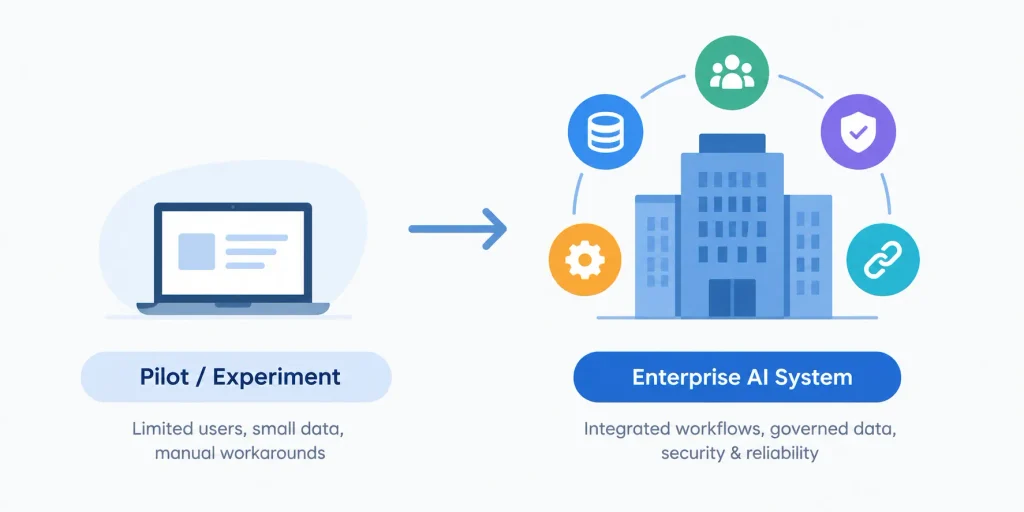
Most organizations can build an AI prototype in a few weeks. Turning that prototype into something departments actually rely on requires enterprise AI capabilities most teams haven’t planned for — and it’s where most projects quietly die.
The Growing Gap Between AI Investment and AI Maturity
Spending on AI keeps rising across UAE enterprises, but a bigger budget doesn’t automatically translate into a working system. AI maturity depends on infrastructure readiness, data governance, integration depth, and whether the operations team actually knows how to run the thing once it’s live. A company can spend heavily on licenses and still be years away from production-grade AI if these fundamentals aren’t in place. This is exactly why leaders need to evaluate enterprise AI capabilities before they shop for platforms or vendors — not after.
The Capability Clarity Problem
Here’s a pattern that shows up again and again: organizations pick a use case and a model first, then try to figure out the supporting capabilities later. It’s backwards, and it shows. The result is a set of disconnected AI tools that don’t talk to each other, budget spent twice on overlapping platforms, security gaps nobody flagged until after launch, and integrations that break the moment a source system updates. None of this is a model problem. It’s a planning problem — one that starts with never having mapped out the enterprise AI capabilities the business actually needed in the first place.
From AI Experiments to Scalable AI Systems
An AI experiment and an enterprise AI system look similar in a demo and behave completely differently in production.
An AI experiment typically runs on a small, curated dataset, serves a handful of test users, relies on manual workarounds, and has almost no governance layer. It works because the conditions are controlled.
An enterprise AI system has to survive contact with the real business: integrated workflows across departments, governed and access-controlled data, active security monitoring, and reliability that doesn’t degrade under real usage. Getting from one to the other is what people mean when they talk about scalable AI systems — and it depends on the seven capabilities below, along with a clear-eyed look at AI use cases for enterprises that actually justify the investment rather than just sounding impressive in a slide deck.
1. Governed Data and Knowledge Access
Governed data access is one of the enterprise AI capabilities businesses underestimate most — an AI system is only as reliable as the data it’s allowed to see, and enterprise data is rarely in one place.
AI Is Only as Reliable as the Data It Can Access
When an AI model pulls from outdated documentation, duplicate records, or content nobody’s touched since 2021, it produces answers that sound confident and are wrong. That’s not a hallucination problem so much as a data hygiene problem. Most enterprises have knowledge scattered across CRMs, ERPs, SharePoint libraries, internal databases, cloud storage, and half-maintained wikis. Without a governance layer connecting all of that, the AI is guessing from whatever it happens to find first.
Essential AI Software Features for Knowledge Governance
A serious enterprise deployment needs permissions-aware retrieval so the AI only surfaces what a given user is actually cleared to see, role-based access control, single sign-on, metadata management, and a way to verify where each piece of information came from. Add document refresh cycles, source tracking, and audit trails, and you’ve got a system where answers can actually be traced back to something real. These aren’t nice-to-haves; they’re the enterprise AI capabilities that decide whether people trust the assistant or quietly stop using it.
Why RAG Needs Enterprise Governance
Retrieval-augmented generation sounds solved once you’ve connected a vector database to a chatbot. It isn’t. Basic RAG retrieves whatever’s semantically similar to the query — it doesn’t care who’s asking, how old the source is, or whether that document was superseded last quarter. Enterprise-grade RAG adds permissions, source quality scoring, and ongoing monitoring on top, which is what actually makes these enterprise AI capabilities usable in a regulated or security-conscious environment, and it’s a prerequisite for any secure AI applications built on top of it.
2. Agentic Workflow Orchestration With Human Oversight
The conversation has shifted from AI that answers questions to AI that takes actions, and that shift demands a new set of enterprise AI capabilities because the risk profile changes completely.
AI Agents Need More Than Automation
A traditional AI assistant responds when prompted and stops there. An agent goes further: it can chain together multiple steps, call APIs, pull from enterprise applications, query databases, and trigger actions in internal tools without someone typing each instruction manually. That capability is powerful, and it’s also why orchestration — the layer that decides what an agent is allowed to do, in what order, under what conditions — has become one of the defining enterprise AI capabilities heading into 2026. Getting this right often means moving away from generic tools and toward custom AI development that’s shaped around how a specific business actually operates, rather than forcing workflows to fit a template.
Human-in-the-Loop Controls Are Still Essential
No enterprise should let an agent operate unsupervised across every process it touches. Approval workflows, human review checkpoints, escalation paths for anything ambiguous, decision thresholds, and a defined list of restricted actions are enterprise AI capabilities that need to exist before an agent goes live — not as an afterthought once something goes wrong.
Workflow Versioning and Rollback
AI workflows aren’t static. Prompts get tuned, data sources change, business rules shift. Without version control, testing environments, rollback options, and a real change-management process, every update becomes a gamble. These controls are what keep secure AI applications stable as they evolve, instead of breaking quietly in production.
3. Enterprise-Grade Security and AI Attack Surface Management
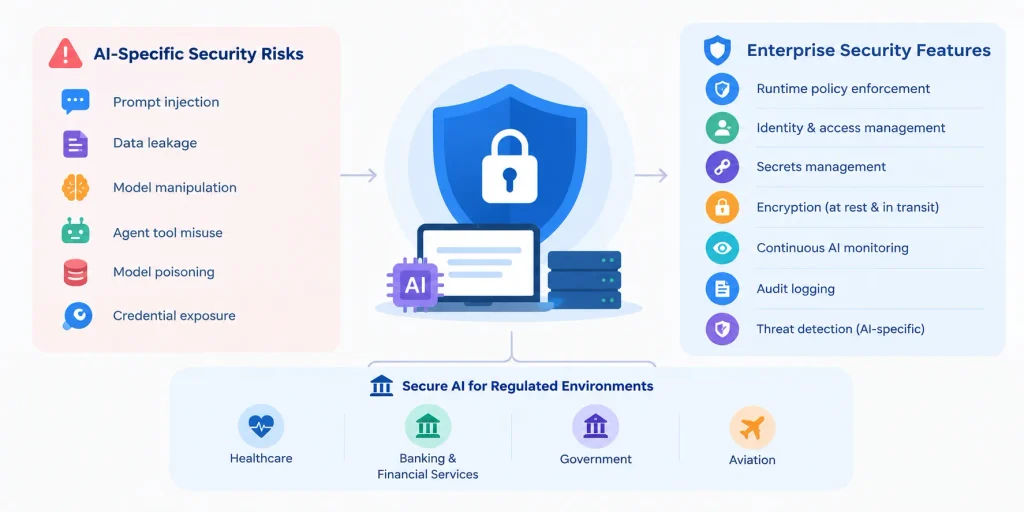
Security for AI isn’t an IT checkbox. It’s one of the non-negotiable enterprise AI capabilities, and it’s a different kind of security than most teams are used to defending against.
Why AI Creates New Enterprise Security Risks
AI systems introduce threats that didn’t exist in traditional software: prompt injection, data leakage through model outputs, model manipulation, agents abusing tool access they were granted, model poisoning through tampered training or retrieval data, and credential exposure when an agent has more system access than it needs. Standard application security practices weren’t built with any of this in mind, which is exactly why they fall short here.
Security Features Every Enterprise AI Solution Should Include
Look for runtime policy enforcement, proper identity management, secrets management that keeps credentials out of prompts and logs, granular access controls, encryption at rest and in transit, continuous AI activity monitoring, audit logging, and active threat detection tuned to AI-specific attack patterns — all enterprise AI capabilities that belong in the architecture from day one.
Building Secure AI Applications for Regulated Environments
In healthcare, banking, financial services, government, and aviation — all sectors with real weight in the UAE market — security can’t be layered on after deployment. It has to be part of the architecture from day one. That’s the difference between secure AI applications that pass an audit and ones that just look secure in a sales deck. These enterprise AI capabilities and the scalable AI systems built on top of them only hold up under scrutiny if security was a design decision, not a patch.
Quick Question: “Is prompt injection really a serious risk for enterprise AI?”— Yes. It’s one of the most common ways attackers manipulate AI outputs or extract data the system wasn’t meant to expose, and it’s specific to how language models process instructions — which is why traditional firewalls don’t catch it.
4. Continuous Evaluation and AI Quality Assurance
AI isn’t a “build it once and walk away” deployment, which is why continuous evaluation is one of the enterprise AI capabilities that gets skipped first and missed most. It drifts, and it drifts quietly.
Why AI Quality Changes After Deployment
Performance shifts because of new data flowing in, model updates from the vendor, prompt changes made by well-meaning team members, evolving user behavior, integration changes elsewhere in the stack, and business requirements that simply moved on. None of that shows up as an obvious error message — it shows up as slowly declining answer quality that nobody notices until a customer complains — exactly the blind spot the right enterprise AI capabilities are built to catch.
Essential AI Software Features for Continuous Evaluation
Pre-deployment testing, quality benchmarks, safety testing, hallucination monitoring, latency monitoring, cost tracking, bias detection, and incident tracking all need to run continuously, not just at launch. Treating continuous evaluation as one of the fundamental enterprise AI capabilities — rather than a one-time QA pass — is what keeps a system reliable a year after it ships.
Moving Beyond Prompt-and-Pray AI Development
Manually testing a handful of prompts and calling it done doesn’t hold up at enterprise scale. What does: automated evaluation pipelines, real test datasets that reflect actual usage, production monitoring that flags anomalies before users do, release validation before anything ships, and regular performance reporting back to the teams accountable for the system.
5. Model Flexibility and Sovereign Deployment Options
Betting an entire AI strategy on one model provider is a decision most enterprises regret within eighteen months — model flexibility is one of the enterprise AI capabilities that’s easy to skip early and expensive to fix later.
Why Multi-Model AI Strategies Are Growing
Different models are good at different things. Some handle complex reasoning better; others are faster and cheaper for high-volume, simple tasks; smaller specialized models often outperform large general-purpose ones on narrow jobs at a fraction of the cost. Locking into a single vendor means inheriting that vendor’s weaknesses along with its strengths — which is exactly the trade-off at the center of the custom AI vs off-the-shelf AI decision every enterprise eventually has to make. Off-the-shelf tools move fast but bend to nobody; a custom-built layer costs more upfront but can route between models, adapt to your workflows, and avoid the ceiling that comes with a single vendor’s roadmap.
What Deployment Flexibility Should Look Like
Deployment options should include public cloud, private cloud, VPC, on-premises, hybrid infrastructure, and sovereign cloud — and for UAE enterprises specifically, data residency and sovereignty requirements make this far more than a technical footnote. Where your data physically sits, and who can access it, is often a compliance question before it’s ever a performance question — and it’s one of the enterprise AI capabilities regulators will ask about directly.
Building Scalable AI Systems Without Vendor Lock-In
Model abstraction layers, flexible API design, portable architecture, adherence to open standards, and intelligent model routing all protect against getting boxed in later. These design choices are what let scalable AI systems evolve as better models come out, instead of forcing a costly rebuild every time the market shifts — which is one more reason secure AI applications built with these enterprise AI capabilities in mind age better than ones stitched together around a single API.
6. AI Cost Management and FinOps
For CTOs and finance leaders, cost visibility is where enterprise AI capabilities either prove their worth or get quietly defunded — this is often where the AI conversation gets real.
Why AI Costs Can Become Difficult to Control
Costs pile up from token usage, model inference, infrastructure, data processing, storage, API calls, vector database operations, and increasingly complex agent workflows that make more calls than anyone budgeted for. Without governance around any of this, AI spend has a way of becoming unpredictable fast — often invisibly, until a monthly invoice makes it very visible indeed.
AI Software Features That Improve Cost Visibility
Cost attribution by team, department-level and application-level reporting, usage monitoring, budget alerts, token optimization, response caching, and smart model routing (sending simple queries to cheaper models and reserving expensive ones for complex tasks) all bring AI spend back under control.
Measuring Business Value, Not Just AI Usage
Usage metrics tell you the system is being used. They don’t tell you whether it’s worth what you’re paying for it. That requires tracking cost savings, actual process efficiency gains, time saved per task, revenue impact, error reduction, customer experience improvements, and employee productivity. Solid FinOps practice is one of the enterprise AI capabilities that turns AI spend from a cost center into something that contributes directly to sustainable, scalable AI systems.
Quick Question: “How do enterprises usually lose control of AI costs?”— Almost always through agent workflows and vector database calls that scale silently in the background — nobody notices because each individual call is cheap, but the volume compounds fast without usage monitoring in place.
7. Integration and Interoperability Across the Enterprise
An AI system that can’t talk to the rest of your tech stack is a very expensive chatbot, no matter how many other enterprise AI capabilities it has underneath.
AI Cannot Deliver Value in Isolation
Real value shows up when AI connects to the systems people already work in — CRM, ERP, HRMS, service management platforms, document systems, databases, and analytics tools. This is where AI integration stops being a technical checkbox and becomes the thing that decides whether employees actually adopt the system or route around it. An AI tool sitting outside the existing workflow gets used once, out of curiosity, and then forgotten.
The Growing Importance of MCP and Standardized Connectivity
The Model Context Protocol and similar standards are making it easier for AI systems to connect to enterprise tools without a custom integration for every single connection. For decision-makers, the practical takeaway isn’t the protocol itself — it’s that standardized connectivity, proper tool access governance, and structured AI-to-system communication mean fewer one-off integrations breaking every time a vendor pushes an update.
Key Integration Features for Scalable AI Systems
API management, pre-built connectors for common enterprise platforms, MCP support, solid authentication, gateway architecture, logging, monitoring, and environment portability all reduce the technical debt that comes from stitching an AI system into an existing stack. Get this layer right and scalable AI systems stop being a slogan and start being something the IT team doesn’t dread maintaining.
How to Evaluate Enterprise AI Capabilities Before Choosing a Solution
Ask These Questions Before Investing
Before signing anything, get straight answers about these enterprise AI capabilities:
- Can it access enterprise data securely, with proper permissions?
- Does it support the systems you already run — CRM, ERP, service platforms?
- Can AI workflows be monitored and controlled after launch, not just at demo time?
- Are human approval workflows built in for higher-risk actions?
- Can it scale across departments without a full rebuild each time?
- How exactly is AI quality measured, and how often?
- Can costs be tracked by application, team, or department?
- Does the architecture support more than one model?
- Are security and compliance controls built into the design, or added later?
- Can it support requirements you don’t have yet but will in two years?
If a vendor can’t answer most of these clearly, that’s the answer.
Avoid Choosing AI Based on Features Alone
A long feature list is easy to produce and easy to fall for. What actually matters is architecture, governance, integration depth, security posture, scalability, cost structure, and operational maturity — not whether the chatbot demo looked slick. Enterprises that compare AI solutions purely on model capability, instead of the enterprise AI capabilities underneath, tend to end up back at this evaluation stage within a year, this time with a migration project on top of the original budget.
Enterprise AI Capabilities Checklist for 2026
An enterprise AI solution worth investing in should include:
- Governed data access with permission controls
- AI workflow orchestration with human oversight
- AI-specific security controls and monitoring
- Continuous evaluation and quality tracking
- Multi-model support and deployment flexibility
- Cost management and usage attribution
- Enterprise-grade integration and interoperability
- Full auditability across every layer
Together, these enterprise AI capabilities, AI software features, scalable AI systems, and secure AI applications form the checklist worth running against any vendor pitch before you sign — a solid framework for AI software development that holds up in production, not just in a demo.
Planning to Scale AI Across Your Enterprise?
Before moving from pilot projects to an enterprise-wide rollout, take an honest look at your current architecture, data readiness, integration requirements, security controls, and scalability. A structured AI assessment — the kind an experienced enterprise AI partner would run before recommending anything — can identify the exact capabilities, technology architecture, and implementation priorities your business needs to turn AI from a pilot into something that delivers measurable results.

Final Thoughts
Enterprise AI success stopped being about who has access to the newest model a while ago. It’s about whether the enterprise AI capabilities — the infrastructure and operational discipline — exist to run that model in production, under real load, with real accountability attached to it.
The right capabilities help a business cut risk, scale without duct tape holding the integrations together, keep costs predictable, protect sensitive data, and actually connect AI to how the business runs day to day — not just how it looks in a pitch deck. None of this is static either. As models change and business needs shift, the AI architecture underneath has to be built to move with them, which is exactly why an honest AI readiness assessment before the next round of investment saves far more than it costs.
FAQs
What are enterprise AI capabilities?
Enterprise AI capabilities are the operational building blocks — governed data access, security, orchestration, evaluation, cost control, and integration — that let an AI system run reliably in production, not just in a demo or pilot.
Why do most enterprise AI projects fail to scale?
Most fail because teams pick a model and use case first, then try to bolt on governance, security, and integration later. Without those enterprise AI capabilities built in early, projects stall at the pilot stage.
What is the difference between an AI experiment and an enterprise AI system?
An AI experiment runs on limited data with minimal governance and a small user group. An enterprise AI system has integrated workflows, access-controlled data, active monitoring, and reliability across departments.
Why does AI need governed data access?
AI models pull answers from whatever data they can reach. Without permissions, source verification, and audit trails, they surface outdated or unauthorized information, producing confident answers that are simply wrong.
What is agentic AI orchestration?
Orchestration is the control layer that decides what an AI agent can do, in what order, and under what conditions — including approval workflows, escalation paths, and rollback options for safety.
What security risks are unique to enterprise AI?
AI introduces threats traditional security wasn’t built for: prompt injection, data leakage, model poisoning, agent tool abuse, and credential exposure. These require AI-specific monitoring and runtime policy enforcement.
Why should enterprises avoid relying on a single AI model provider?
Different models excel at different tasks — reasoning, speed, or cost efficiency. Locking into one vendor inherits its limitations and blocks the flexibility needed for sovereign or hybrid deployment options.
How can enterprises control unpredictable AI costs?
Cost attribution by team, usage monitoring, budget alerts, response caching, and smart model routing keep AI spend visible and predictable instead of scaling silently through hidden token and API usage.
Why is integration the biggest factor in AI adoption?
AI that can’t connect to CRM, ERP, or existing platforms rarely gets used beyond curiosity. Real adoption depends on standardized connectivity, pre-built connectors, and workflows embedded in daily tools.
How should enterprises choose an AI solution in 2026?
Evaluate architecture, governance, security, integration depth, and cost visibility — not just model features. A vendor unable to answer these clearly is unlikely to deliver a production-ready system.