
Key Takeaways
- Off-the-shelf AI tools plateau fast — custom AI development closes the gap between AI adoption and real enterprise AI maturity.
- Connecting fragmented data (ERP, CRM, POS, legacy systems) is usually the real blocker to AI value, not the AI model itself.
- Custom AI solutions improve operational efficiency by turning static dashboards into predictive, automated decision layers.
- Enterprises that move from AI assistants to autonomous AI agents unlock measurable time and cost savings, not just better recommendations.
- Data residency, governance, and security requirements in the UAE make custom-built AI architecture a safer long-term bet than generic SaaS tools.
- A phased, ROI-driven implementation plan — not another isolated pilot — is what separates enterprises that scale AI from those stuck experimenting.
Dubai’s enterprises aren’t short on AI. Most have a chatbot, a copilot license, maybe two or three SaaS tools with “AI-powered” somewhere on the pricing page. What they’re short on is AI that actually moves a P&L line.
UAE AI investment has grown sharply over the past two years, yet enterprise AI maturity has barely kept pace. Plenty of organizations are running pilots — a fraud-detection experiment here, a customer service bot there — without any of it reaching enterprise-wide deployment. Call it pilot purgatory: a growing pile of AI experiments that never graduate into how the business actually runs.
The reason usually isn’t the model. It’s the plumbing. Fragmented data, legacy infrastructure that predates the cloud, compliance requirements specific to the region, and business processes that no generic platform was ever built to handle. Custom AI development exists to solve exactly that gap — designing AI around an organization’s actual workflows, data architecture, security posture, and business goals, instead of asking the business to bend around someone else’s software.
This article breaks down why generic tools stall at scale, what custom AI development actually involves, and where it delivers measurable value for enterprises operating in Dubai and the wider UAE. If your organization has run more than one AI pilot without a clear business outcome, custom AI development is likely the missing piece.
Why Off-the-Shelf AI Tools Hit an Enterprise Ceiling
Buying another AI SaaS subscription feels like progress. For a while, it is. Then the organization hits a ceiling that no amount of prompt engineering fixes.
Generic AI Is Designed for Broad Use Cases
Off-the-shelf tools are built for the widest possible customer base, which means they’re optimized for the average use case — not yours. That shows up as standardized workflows, limited customization options, generic underlying models, fixed integrations, and restricted control over where your data actually lives.
Industry-specific processes — a freight forwarder’s customs documentation flow, a bank’s KYC exception handling, a hospital group’s patient intake — rarely map cleanly onto a one-size-fits-all product. Early research into enterprise AI implementations suggests generic SaaS tools achieve roughly 60% process fit against real business workflows, compared to around 95% for properly designed custom systems. Those figures deserve validation against your own environment before you build a business case on them, but the direction is consistent with what most CTOs already sense: the software fits the workflow, not the other way around, only when custom AI development builds it that way from the start.
Data Silos Make AI Less Useful
Enterprise data rarely lives in one place. It’s split across ERP systems, CRM platforms, POS terminals, legacy databases, third-party APIs, and — more often than anyone wants to admit — spreadsheets sitting on someone’s desktop. An AI tool bolted onto just one of these systems can only ever see a slice of the business.
No amount of model sophistication compensates for incomplete information. A demand forecast built on sales data alone, with no visibility into supplier lead times or warehouse stock, will be confidently wrong. This is where dedicated AI development services earn their keep — not by picking a smarter model, but by building the connective layer that gives that model something worth reasoning over.
Vendor Lock-In Can Become a Strategic Problem
Recurring subscription costs and per-user or per-query pricing add up fast once AI usage scales past a pilot. Add limited model choice, restricted customization, and dependence on someone else’s product roadmap, and enterprises can find themselves paying more each quarter for a tool that still can’t touch their proprietary workflows. Difficulty integrating that tool with existing systems is usually the final straw that pushes a CTO toward building instead of renting.
What Makes Custom AI Development Different for Complex Enterprises?
Custom AI development isn’t just “build a chatbot instead of buying one.” At enterprise scale, custom AI development spans custom machine learning models, generative AI, retrieval-augmented generation (RAG), AI agents, predictive analytics, natural language processing, computer vision, recommendation engines, intelligent automation, and the API work needed to connect all of it to production systems.
AI Is Designed Around the Business Process
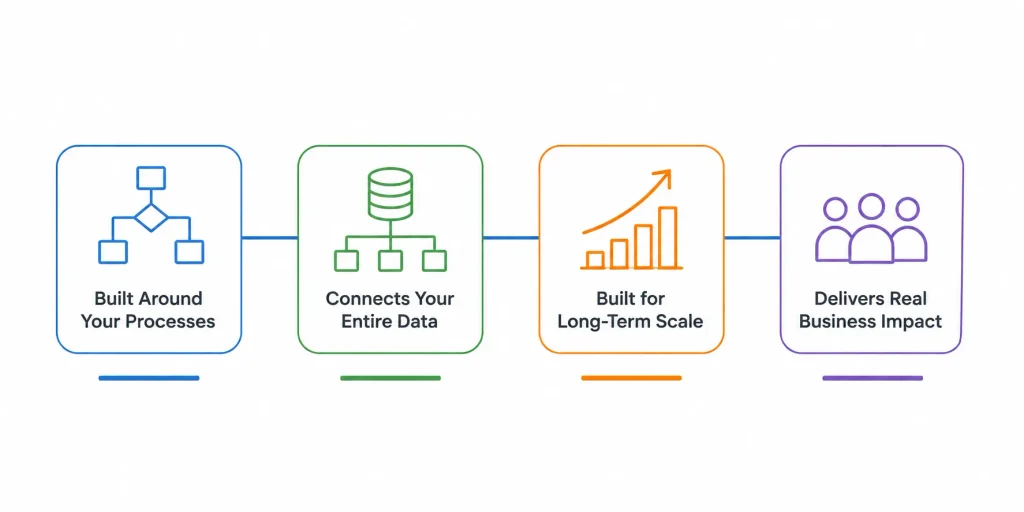
The generic approach asks the business to adapt its workflow to fit the software’s assumptions. The custom approach reverses that: the AI architecture is designed around the existing business process first, then optimized where it genuinely needs to change. That distinction sounds small on paper. In practice, it’s the difference between an AI project employees route around and one they actually use.
Custom AI Solutions Can Connect the Entire Data Environment
A properly architected custom AI solution integrates with ERP, CRM, transport management systems (TMS), POS, HR platforms, finance systems, data warehouses, APIs, IoT devices, and cloud infrastructure — as one connected environment rather than a patchwork of point solutions. That’s what turns “we have a lot of data” into “we have data we can act on.”
Enterprise AI Development Can Be Built for Long-Term Scale
Enterprise AI development that’s built to last relies on modular architecture, flexibility in which models power which task, an API-first design philosophy, cloud scalability, ongoing monitoring, scheduled model retraining, human-in-the-loop controls for high-stakes decisions, and governance frameworks that satisfy auditors as well as engineers. Skip any one of these and the system either breaks under load or drifts out of compliance within a year.
Quick Question: “Is custom AI development only for large enterprises?”— No. Mid-sized organizations with fragmented data or specialized workflows often see faster ROI from custom AI than large enterprises, because the process-fit gap versus generic tools is usually wider for niche operations.
7 Complex Business Challenges Custom AI Development Can Solve
Not every enterprise needs all seven of these. But mapping your own operations against this list is one of the fastest ways to spot realistic AI use cases for enterprises rather than chasing whatever AI trend is loudest this quarter.
1. Fragmented Enterprise Data and Poor Decision-Making
Executives making decisions off three different dashboards, none of which agree with each other, is a familiar problem across the region’s larger enterprises. Custom AI development can create a single intelligence layer that pulls from every relevant source — unified data pipelines, predictive analytics, natural-language querying so a finance lead can ask a question in plain English instead of writing SQL, automated reporting, and anomaly detection that flags a problem before it shows up in next month’s numbers. The business outcome is straightforward: custom AI development turns fragmented reporting into faster decisions made with the full picture instead of a fragment of it.
2. Legacy Systems That Block AI Adoption
Nobody wants to rip out a core system that’s still running the business, and they don’t have to. Custom AI can sit on top of legacy infrastructure as an intelligence and integration layer, connected through APIs, middleware, ETL pipelines, event-driven architecture, and purpose-built data connectors. Reports suggest only around 14% of organizations have actually replaced legacy systems with fully integrated platforms — which means for the other 86%, modernizing capability without a rip-and-replace project is the realistic path. This is where enterprise AI development earns its distinction from generic tooling: it works with what already exists instead of demanding a clean slate.
3. Moving From AI Assistants to Autonomous Workflows
There’s a real gap between an AI assistant and an AI agent. An assistant recommends an action and waits for a human to click “approve.” An agent executes multiple steps toward an objective on its own — detecting an inventory shortage, generating a replenishment request, checking supplier availability, updating the relevant enterprise system, and only escalating to a human when something falls outside the rules.
Roughly 57% of enterprises report some adoption of agentic AI, yet only about 7% are actually using it to run autonomous workflows rather than isolated tasks. That gap exists because autonomous workflows demand deep integration with business systems, permissions, and data — exactly the kind of custom AI development generic tools aren’t built to provide. Agentic AI in software engineering is following the same trajectory: from code suggestions to agents that open pull requests, run tests, and flag regressions without a developer babysitting every step.
4. Predicting Demand, Delays, Fraud, and Operational Risks
Predictive AI is what shifts an enterprise from reacting to problems to seeing them coming. That includes demand forecasting, fraud detection, predictive maintenance on equipment or fleets, shipment ETA prediction, customer churn modeling, risk scoring, and supply chain disruption forecasting. A model trained on your company’s own historical data and operating conditions — your seasonality, your supplier network, your customer base — will consistently outperform a generic prediction tool trained on someone else’s averages. This is a core strength of custom AI development: the model learns your business, not a generic industry average.
5. Personalizing Customer Experiences at Enterprise Scale
Generic personalization tools tend to work off whatever single data source they were built to plug into — usually just browsing behavior or just purchase history, not both. Custom AI development can combine purchase history, browsing behavior, loyalty data, customer service interactions, location, product preferences, and real-time behavior into one profile. In Dubai specifically, that translates into sharper retail recommendations, more relevant hospitality offers, airline loyalty personalization that accounts for actual travel patterns, and banking product recommendations tied to real financial behavior rather than broad demographic guesses.
Quick Question: “How long does a custom AI project typically take to show results?”— A well-scoped proof of value can show measurable results in 8–12 weeks; full enterprise integration and scale-up usually takes 6–12 months depending on legacy system complexity.
6. Meeting Data Privacy, Security, and Governance Requirements
This is where UAE-based enterprises face constraints that global SaaS platforms often aren’t built to handle. Data residency requirements, granular access controls, encryption standards, audit trails, model governance policies, role-based permissions, human oversight on sensitive decisions, and AI impact assessments all need to be built into the architecture from day one, not bolted on after a compliance review flags a gap.
Enterprises operating under the UAE’s Personal Data Protection Law (PDPL), or within DIFC and ADGM frameworks, should treat data governance requirements as a design constraint rather than an afterthought — and confirm current obligations with legal counsel rather than relying on general guidance, since requirements vary by sector and free zone. This is one of the strongest arguments for custom AI development over multi-tenant SaaS in regulated industries. Sensitive sectors — banking, healthcare, government services — often need tighter control over where data is processed and how a model is permitted to interact with it than any multi-tenant SaaS platform can offer.
7. Controlling AI Costs as Usage Scales
SaaS AI pricing looks manageable in a pilot and turns painful at scale. Per-seat pricing, per-query charges, API consumption fees, multiple overlapping tools doing similar jobs, data transfer costs, and vendor dependencies all compound as usage grows. This is where custom AI development pays for itself: a properly designed custom architecture gives an enterprise control over model selection, inference costs, infrastructure choices, caching strategy, workload routing, and the option to use open-source or privately hosted models where that makes financial sense.
Some enterprises report breaking even on custom AI investment within 18–30 months, though that figure should be treated as a benchmark to validate against your own workload and usage patterns, not a guarantee.
Industry-Specific Applications of Custom AI in the UAE
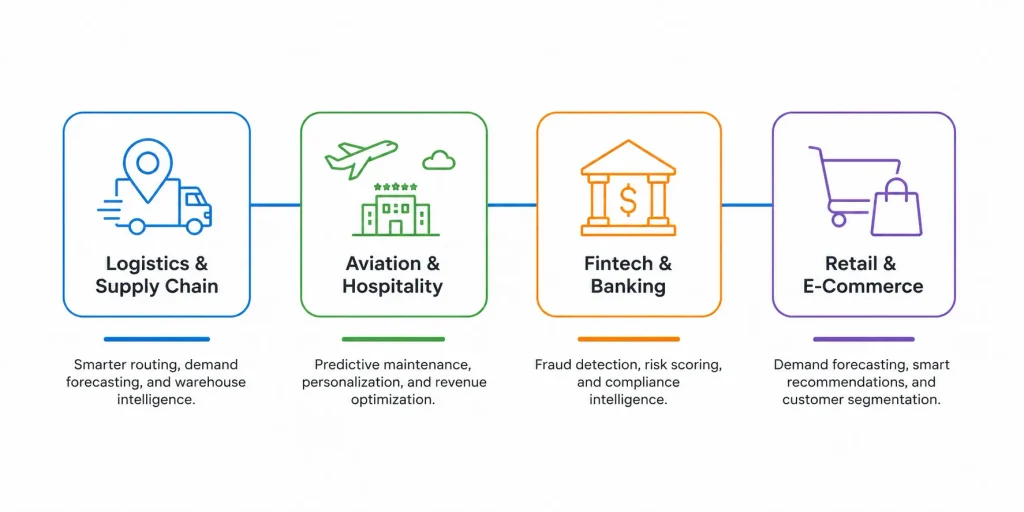
The sectors below show what custom AI looks like once it’s live and running, not just scoped on a slide. Enterprises evaluating AI development services in Dubai usually recognize their own operational gaps in at least two of the four examples that follow.
Logistics and Supply Chain
Between JAFZA-linked logistics operations, port throughput, and last-mile delivery across a dense urban footprint, Dubai’s supply chain enterprises generate more operational data than most teams can use manually. Custom AI development combines traffic, weather, shipment, fleet, and warehouse data into a single forecasting and routing layer — improving fleet optimization, ETA prediction, route optimization, demand forecasting, and warehouse intelligence in ways a generic logistics SaaS tool, built for a global average customer, typically can’t match.
Aviation and Hospitality
Predictive maintenance on aircraft and ground equipment, passenger personalization, revenue optimization, loyalty intelligence, disruption management, and operational forecasting all benefit from AI built around the specific operational data of an airline or hotel group. AI application development in this space works best when it connects customer-facing intelligence — what a guest or passenger actually wants — directly to the operational systems that have to deliver on it.
Fintech and Banking
Fraud detection, transaction monitoring, AML support, credit risk scoring, customer intelligence, and compliance workflows are all areas where financial institutions in the UAE are investing heavily in custom AI. Security, explainability, and governance matter more here than in almost any other sector — a fraud model that can’t explain why it flagged a transaction is a liability, not an asset, when a regulator asks.
Retail and E-Commerce
Demand forecasting, inventory optimization, product recommendations, dynamic promotions, customer segmentation, and omnichannel intelligence are where custom AI solutions can unify online and offline data that generic e-commerce platforms usually keep separate — closing the gap between what a customer does in-store and what they do on an app.
How to Implement Custom AI Development Without Creating Another AI Pilot
Step 1: Identify the Business Problem
Start with a measurable business challenge, not a model. “Reduce delivery delays,” “lower fraud losses,” “improve inventory accuracy,” “automate repetitive workflows,” and “increase customer conversion” are all good starting points. “We should use AI” is not.
Step 2: Audit Data and Legacy Infrastructure
Before writing a line of code, assess data quality, data accessibility, existing APIs, legacy application constraints, current security posture, infrastructure limits, and what integration work is actually required. This step is unglamorous and gets skipped constantly — usually to the project’s detriment six months later.
Step 3: Select the Right AI Architecture
Depending on the problem, the right answer might be machine learning, generative AI, RAG, AI agents, predictive models, computer vision, or some hybrid combination. The architecture should follow the problem, not the other way around.
Step 4: Build a Controlled Proof of Value
Define measurable KPIs before development starts — cost reduction, processing time, forecast accuracy, revenue impact, error reduction, or customer conversion. A proof of value without predefined success metrics is just an expensive demo.
Step 5: Integrate, Govern, and Scale
Custom AI development doesn’t end at model deployment. It requires ongoing monitoring, security maintenance, governance enforcement, periodic model evaluation, continuous optimization, real employee adoption, and AI automation across the production systems people actually use every day.
How to Measure the ROI of Custom AI Development
Measure Operational Efficiency
Track hours saved, automation rate, processing costs, and error reduction against a clear pre-AI baseline.
Measure Revenue Impact
Track conversion rate, customer retention, upselling, cross-selling, and revenue per customer over time.
Measure Risk Reduction
Track fraud losses, compliance incidents, downtime, and operational failures — the costs that don’t show up on a revenue statement but hit the bottom line just as hard.
Measure AI Infrastructure Economics
Compare SaaS subscription costs against API costs, infrastructure spend, maintenance, development, and model inference costs. The business case for custom AI development should be built on total cost of ownership over a multi-year horizon, not just the size of the initial development invoice.
When Should an Enterprise Choose Custom AI Over SaaS?
Custom AI Is Usually More Appropriate When:
- Business workflows are highly specialized
- Enterprise data is fragmented across multiple systems
- AI needs to integrate with legacy infrastructure
- Data sovereignty and residency matter
- The organization needs proprietary models or business logic
- AI usage is expected to scale significantly
- Autonomous workflows are part of the roadmap
- Generic tools consistently fall short on process fit
SaaS May Still Be Better When:
- The use case is genuinely simple
- Requirements are standardized across the industry
- Integration needs are minimal
- Usage volume is relatively low
- Speed to deployment matters more than deep customization
Not every problem needs a custom build. An enterprise that forces a bespoke AI system onto a simple, low-volume use case usually ends up overpaying for flexibility it will never use.
The Future of Enterprise AI in Dubai: From Tools to Intelligent Business Systems
The trajectory is clear enough: standalone AI tools give way to integrated AI, integrated AI gives way to AI agents, and AI agents give way to autonomous workflows woven into how the enterprise actually operates. Abu Dhabi’s AI government vision — one of the most aggressive public-sector AI strategies globally — is pushing the wider UAE private sector toward the same standard: AI that’s embedded in operations, not layered on top of them as a side project.
Dubai enterprises will increasingly compete on their ability to connect data, AI models, business processes, enterprise systems, and governance into one coherent operating environment. Access to the latest model isn’t the advantage anymore — every competitor has access to the same models. Embedding intelligence into the core operating model is.
Ready to Turn Your Enterprise AI Strategy Into Measurable Business Results?
Most enterprises don’t need another AI pilot. They need a clear-eyed assessment of where custom AI can actually move the numbers that matter — and a roadmap for getting there without disrupting the systems already running the business.
If your organization is weighing AI maturity, data readiness, legacy-system constraints, automation opportunities, governance requirements, or the realistic ROI of a custom build, working with the right development partner from the start avoids months of costly trial and error and gets the architecture right the first time instead of retrofitting it later.
Identify where custom AI can deliver measurable value across your enterprise — starting with a straightforward conversation about where your data, systems, and business goals actually stand today.
FAQs
What is custom AI development?
Custom AI development designs AI models, integrations, and workflows around an enterprise’s specific data, infrastructure, and business goals — rather than forcing the business to adapt to generic, off-the-shelf software.
How much does custom AI development cost for an enterprise?
Costs vary by scope, data complexity, and integration depth — from a focused proof of value to a multi-phase rollout. Total cost of ownership should guide the decision, not upfront price.
Is custom AI development better than SaaS AI tools?
Not always. Custom AI suits fragmented data, legacy integration, or data-residency needs. SaaS fits simple, standardized, low-volume use cases where speed to deployment matters more than deep customization.
How does custom AI handle data privacy in the UAE?
Custom architectures can build in data residency, encryption, role-based access, and audit trails aligned to PDPL, DIFC, and ADGM requirements — control that’s harder to guarantee inside shared SaaS platforms.
What industries in Dubai benefit most from custom AI?
Logistics, aviation, hospitality, banking, and retail see the strongest results, since each involves fragmented data, regulatory requirements, or operational scale that generic AI tools rarely accommodate well.
How long does it take to see ROI from custom AI development?
A scoped proof of value can show results within 8–12 weeks. Full enterprise integration typically takes 6–12 months, with break-even often reported between 18 and 30 months.
Can custom AI integrate with our existing legacy systems?
Yes. Custom AI usually connects to legacy infrastructure through APIs, middleware, and ETL pipelines, modernizing capability without requiring a full replacement of core systems the business depends on.