


Key Takeaways
- AI development services cover the full journey from strategy to deployment — not just building a model, but integrating it into real business workflows.
- Dubai’s push toward an AI-first economy, backed by the UAE National Strategy for Artificial Intelligence 2031 and the Dubai Economic Agenda D33, is raising the bar for what “production-ready AI” means locally.
- Data readiness, not model selection, is the single biggest predictor of whether an AI project survives past the pilot stage.
- Choosing between custom AI development, off-the-shelf tools, and a development partner should be based on data sensitivity, workflow complexity, and in-house technical capacity — not trend-following.
- Governance, security, and UAE data protection compliance (including the PDPL) need to be built into an AI system from day one, not bolted on after launch.
- Enterprises that treat AI as an infrastructure investment — not a one-off project — see the strongest gains in efficiency, customer experience, and competitive position over the next 12 to 24 months.
Every enterprise in Dubai has an AI pilot running somewhere. Fewer have one that made it to production.
That gap is the defining challenge of enterprise AI right now. Investment is climbing across every sector — logistics, banking, retail, healthcare, hospitality — but a lot of that spend is still sitting in proof-of-concept purgatory. A chatbot that impressed the board in a demo. A forecasting model that works beautifully on a clean sample dataset and falls apart the moment it touches messy ERP records. An AI agent that looked promising until IT flagged it couldn’t be secured against the company’s access policies.
The reason most of these stall isn’t the technology. It’s what happens after the demo: data that isn’t structured for a model to use, systems that don’t talk to each other, no governance framework to satisfy compliance, and no plan for what happens when the model’s performance drifts six months in.
Dubai’s regulatory environment adds another layer. Between the UAE’s Federal Data Protection Law (PDPL), free-zone frameworks in DIFC and ADGM, and Smart Dubai’s push for responsible AI adoption, local enterprises can’t treat security and governance as an afterthought the way some early AI experiments did elsewhere.
This is where enterprise AI capabilities built through structured AI development services earn their keep. Done properly, artificial intelligence development services take a business from “we ran an interesting pilot” to “this system now handles 40% of our support tickets without a human touching them” — with the data pipelines, security controls, and monitoring to keep it running that way. This guide walks through what that process actually looks like, phase by phase, so you can evaluate it with clear eyes rather than vendor promises.
What Are AI Development Services?
AI development services span the full lifecycle of building an intelligent system for a business — strategy, data preparation, model development, integration into existing software, deployment, and ongoing monitoring. It’s not a single deliverable; it’s a process that continues well after the first version ships.
Understanding the Scope of AI Development Services
A capable AI software development company dubai typically works across several disciplines within one engagement, not just one:
- AI strategy — mapping business problems to feasible AI opportunities.
- Machine learning development — building predictive and classification models.
- Generative AI development — assistants, content generation, and knowledge systems.
- AI agents — systems that can plan, use tools, and complete multi-step tasks.
- Predictive analytics — forecasting demand, risk, or churn.
- Natural language processing (NLP) — extracting meaning from text and speech.
- Computer vision — reading images and video for inspection, security, or diagnostics.
- AI integration — connecting models into ERPs, CRMs, and internal tools.
- AI monitoring — tracking accuracy and drift once a system is live.
Any provider that only offers one of these — say, model-building with no integration or monitoring plan — is handing you half a solution.
AI Development Services vs Traditional Software Development
Traditional software does what it’s told, the same way, every time. AI systems behave differently, and that changes how they need to be built and managed:
- AI performance depends heavily on the quality of the data it’s trained and run on — software doesn’t have this dependency in the same way.
- Models need ongoing evaluation, not a one-time QA pass before launch.
- Outputs are probabilistic. Two identical requests can produce slightly different answers.
- Accuracy can degrade over time as real-world data shifts away from what the model was trained on — a phenomenon called model drift.
- AI requires governance frameworks that traditional software rarely needs: bias checks, explainability, human oversight for high-stakes decisions.
Why Enterprises Need Specialized AI Development Expertise
Most enterprise environments weren’t built with AI in mind. That creates friction a generic developer or a plug-and-play SaaS tool won’t be able to resolve:
- Complex, often decades-old infrastructure that doesn’t expose clean APIs.
- Data siloed across departments, regions, and legacy databases.
- Security requirements specific to finance, healthcare, or government contracts.
- Legacy systems that were never designed to feed real-time data to a model.
- Integration work that touches dozens of internal systems, not just one.
- The need to scale a working prototype to thousands of concurrent users without breaking.
This is why specialized artificial intelligence development services — teams that have solved these exact problems before — tend to outperform generalist software vendors on enterprise AI work.
Why Businesses Are Investing in AI Development Services
AI Is Moving Beyond Basic Automation
For years, “automation” in the enterprise meant rules-based scripts: if X happens, do Y. That’s still useful, but it hits a ceiling fast — it can’t handle exceptions, ambiguity, or judgment calls. What’s changed is that businesses are now layering intelligence on top of automation, so systems can make a call rather than just follow a script.
That shift shows up as predictive forecasting instead of static reports, recommendation engines that adjust in real time, customer service that resolves a query instead of routing it, and workflows that adapt when conditions change instead of breaking.
The Business Benefits of Enterprise AI
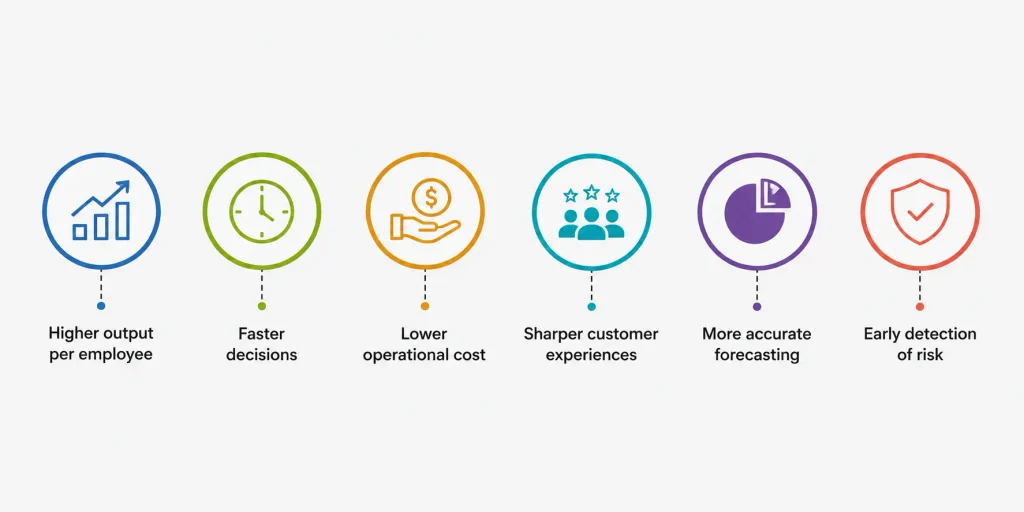
The gains enterprises report tend to cluster around a few consistent areas: higher output per employee, faster decisions because insights don’t wait for a weekly report, lower operational cost through fewer manual touchpoints, sharper customer experiences through personalization, more accurate forecasting, and earlier detection of risk — fraud, compliance issues, equipment failure — before it becomes expensive.
None of these happen automatically just because a model exists. They happen when AI automation is wired into the actual decision points where people currently do manual work — a claims queue, a procurement approval, a maintenance schedule — not bolted on as a separate dashboard nobody checks.
The Enterprise AI Execution Gap
This is the part most vendors gloss over, and it’s worth sitting with. The reason so many AI pilots never scale usually comes down to a short, repeatable list:
- Data that’s inconsistent, incomplete, or scattered across systems that don’t sync.
- Data that exists but isn’t accessible to the team building the model.
- Systems that can’t exchange information without manual export/import work.
- Infrastructure that predates cloud AI tooling and resists integration.
- No governance framework, so legal or compliance blocks deployment at the last mile.
- “Pilot paralysis” — running a fourth proof of concept instead of committing to scale the third one that already worked.
The providers worth hiring are the ones who talk about closing this gap specifically, not just the ones with the most polished model demo. Implementation, not ambition, is what separates a working system from a slide deck.
Quick Question: “Do AI pilots usually fail because of the AI model itself?”— Rarely. Most stalled pilots fail because of data quality, system integration, or missing governance — not because the underlying model was inadequate.
Types of AI Development Services for Modern Businesses
Machine Learning Development
This is the workhorse category: predictive models for demand or pricing, classification systems that sort tickets or documents, forecasting for revenue or inventory, anomaly detection for fraud or equipment failure, and recommendation engines for cross-sell and personalization. Machine learning development services are usually the first stop for enterprises with structured historical data and a clear business question to answer.
Generative AI Development
This category covers enterprise AI assistants that answer employee or customer questions using internal knowledge, document generation for contracts and reports, intelligent search that understands intent rather than just keywords, and content automation for marketing and support. A growing number of Dubai-based firms are now asking specifically about generative AI development services to build internal knowledge assistants — a natural fit given how much institutional knowledge sits in scattered PDFs and email threads inside most enterprises.
AI Agent Development
Agents go a step further than assistants: they’re goal-driven, can call external tools and APIs, automate multi-step workflows, and — in more advanced setups — coordinate with other agents on a shared task. Human oversight remains essential here, particularly for anything touching financial transactions or customer commitments.
Natural Language Processing Solutions
NLP powers conversational AI, document analysis at scale, sentiment analysis on customer feedback, general language processing tasks, and knowledge extraction from unstructured text — think thousands of support tickets or contracts nobody has time to read manually.
Computer Vision Development
Vision models are already doing quiet, high-value work across industries: quality inspection on production lines, object detection for security, healthcare imaging analysis, and retail analytics that track footfall and shelf stock without a human walking the floor.
Predictive Analytics Development
Common applications include demand forecasting, customer churn prediction, fraud detection, and predictive maintenance — flagging equipment likely to fail before it actually does, rather than reacting after the fact.
Intelligent Process Automation
This is where automation and AI converge. Traditional robotic process automation follows fixed rules. Intelligent process automation adds decision-making, context awareness, natural language understanding, and the ability to adapt a workflow when the input doesn’t match the expected pattern.
The Complete Enterprise AI Development Lifecycle
Phase 1: AI Strategy and Business Assessment
Every engagement should start with the business problem, not the technology. That means naming specific challenges, agreeing on strategic objectives, identifying where AI genuinely applies, and defining what a successful outcome looks like in business terms — not just technical ones. This phase usually runs as a set of structured workshops with business stakeholders, not just IT, because the people who own the process being improved are the ones who can say whether a proposed use case is actually worth solving.
Phase 2: AI Use Case Discovery and Prioritization
Not every AI idea deserves a build. A simple scoring framework — weighing business impact, technical feasibility, data availability, implementation complexity, and risk — helps separate the three ideas worth funding from the twenty that sound interesting in a workshop. The output of this phase should be a short, ranked list, not a long wish list nobody has the budget to execute.
Phase 3: Data Readiness Assessment
Before any model gets built, the underlying data needs an honest audit: quality, accessibility, structure, completeness, and security. Skipping this step is the single most common reason projects stall later — see the dedicated section below. A rushed timeline here is usually a false economy; the weeks saved skipping this audit tend to reappear later as months lost debugging a model that was never fed reliable data in the first place.
Phase 4: AI Solution Architecture
This is where the technical backbone gets designed: cloud infrastructure, model selection, APIs, data pipelines, vector databases for retrieval, and the MLOps tooling that will keep everything running once it’s live. Architecture decisions made here — which cloud region to use, how data residency is handled — also need to account for UAE-specific compliance requirements rather than defaulting to whatever the vendor’s standard setup happens to be.
Phase 5: Proof of Concept Development
A proof of concept exists to test assumptions cheaply before committing real budget — validating that the model actually performs on real data, measuring accuracy against a defined benchmark, and gathering feedback from the people who’ll actually use it, not just the sponsors who approved it. A POC that only ever runs on a clean, curated sample dataset hasn’t actually tested anything meaningful; it needs to touch the same messy, real-world data the production system will face.
Phase 6: Production Deployment
Moving from POC to production means solving for things a demo never had to handle: security hardening, scalability under real load, integration with live systems, rigorous testing, and monitoring from day one — not added after the first incident. This is typically the most underestimated phase on both timeline and budget, precisely because it’s invisible in a demo.
Phase 7: Continuous AI Optimization
An AI system isn’t “done” at launch. It needs ongoing model monitoring, periodic performance evaluation, retraining as data patterns shift, feedback loops from users, and regular check-ins on whether it’s still delivering the business result it was built for. A model that scored 92% accuracy at launch can quietly slip to 78% a year later if nobody’s watching — and by the time someone notices from the business side, the damage is already done.
How to Build an Effective AI Strategy Before Development Begins
Start With Business Problems, Not Technology
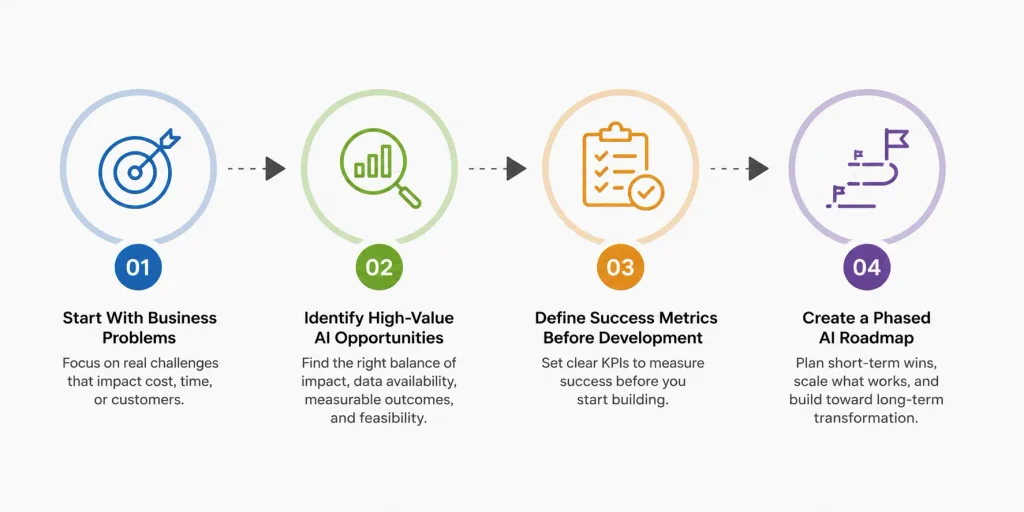
It’s tempting to adopt AI because a competitor announced a chatbot or a board member read about generative AI. That’s a weak foundation. The stronger starting question is: what’s costing us time, money, or customers right now — and could intelligence applied to that specific problem move the needle?
Identify High-Value AI Opportunities
Look for the intersection of high business impact, strong existing data availability, clearly measurable outcomes, and realistic technical feasibility given your current systems. An idea that scores well on impact but has no usable data behind it isn’t ready yet — it’s a data project in disguise.
It helps to work from a working list of proven AI use cases for enterprises rather than starting from a blank page: demand forecasting for supply-heavy businesses, churn prediction for subscription or membership models, document processing for anything drowning in paperwork, and customer service automation for high-volume support functions. Starting from patterns that have already worked elsewhere — and adapting them to your own data — tends to move faster than inventing a novel use case from scratch.
Define Success Metrics Before Development
Agree on what “working” means before writing a line of code: cost savings, processing speed, accuracy thresholds, revenue growth, or customer satisfaction scores. Without this, it’s impossible to know later whether the project succeeded or just shipped.
Create a Phased AI Roadmap
A realistic roadmap sequences short-term wins that build internal confidence, medium-term projects that scale what worked, and a longer-term view of what AI-driven transformation looks like for the business three years out.
Data Readiness: The Foundation of Successful AI Development
Why Data Quality Determines AI Success
Poor data doesn’t just produce mediocre results — it produces confidently wrong ones. A model trained on incomplete or biased data will generate inaccurate outputs, weak predictions, and skewed recommendations that look reasonable on the surface but lead to bad business decisions if nobody catches them.
How to Assess Enterprise Data Readiness
A practical checklist before any development starts:
- Is the data actually accessible to the team building the model, or locked in a system nobody can query?
- Is it accurate, or full of manual-entry errors?
- Is it current, or six months stale by the time it’s used?
- Is it complete enough to train on, or riddled with gaps?
- Is it structured in a way a model can actually use?
- Is access properly controlled, with a clear record of who can see what?
Breaking Down Enterprise Data Silos
Most enterprises have relevant data scattered across ERP systems, CRM platforms, operational databases, and third-party tools that were never designed to talk to each other. Solving this usually takes middleware or an integration layer, not a full system replacement.
Building Data Governance for AI
Governance needs to answer a few concrete questions before AI touches sensitive data: Who owns this data? Who’s allowed to access it, and under what conditions? How long is it retained? Is every access event logged for audit? Are the security controls strong enough to satisfy UAE data protection requirements? This isn’t paperwork for its own sake — it’s what lets legal and compliance sign off on deployment without a last-minute block.
Custom AI Development vs Off-the-Shelf AI Solutions
When Off-the-Shelf AI Solutions Make Sense
Pre-built tools are the right call when requirements are fairly standard, speed matters more than customization, and the use case doesn’t touch proprietary or highly sensitive data.
When Custom AI Development Is the Better Choice
Custom AI development earns its higher cost when workflows are genuinely complex, the value lies in proprietary data a generic tool can’t access, the industry has specific requirements a horizontal product wasn’t built for, or the goal is a capability competitors literally can’t buy off a shelf.
The Limitations of Generic AI Tools
Off-the-shelf tools tend to hit the same walls in enterprise settings: limited customization once you go past the basic use case, data privacy questions about where your information actually goes, weak integration with legacy systems, and vendor lock-in that gets expensive to unwind later.
Build vs Buy vs Partner: Which Approach Is Right?
| Approach | Best For |
|---|---|
| Buy | Standard, well-defined requirements with no need for deep customization |
| Build | Unique workflows or proprietary data that no vendor tool can replicate |
| Partner | Strong business case but limited in-house AI engineering capacity |
Most enterprises land on a mix — buying for commodity use cases, building or partnering for the ones that actually differentiate them.
How to Choose the Right AI Software Development Company
Evaluate Business and Industry Experience
Look past the tech stack for a moment. Does the team understand your industry’s actual constraints — regulatory, operational, seasonal — or are they applying the same generic playbook to every client?
Assess AI Technical Expertise
Confirm real depth in the areas relevant to your project: machine learning, generative AI, retrieval-augmented generation (RAG), AI agents, NLP, computer vision, and MLOps. A team strong in one area but weak in integration and monitoring will leave you with an unfinished system.
Evaluate Their AI Development Process
A mature provider can walk you through a defined process: discovery, strategy, prototyping, development, testing, and deployment — not a vague promise to “figure it out as we go.”
Review Security and Governance Capabilities
Ask directly about data protection practices, access management, AI governance frameworks, and how they handle UAE and regional compliance requirements. If they can’t answer specifically, that’s a signal.
Evaluate Post-Deployment Support
The real work often starts after launch: monitoring, optimization, retraining, and scaling. When evaluating custom AI vs off-the-shelf AI, consider the level of long-term support involved. A provider that disappears once the system ships is offering a one-time build, not a long-term AI solution.

Quick Question: “Should cost be the deciding factor when choosing an AI development partner?”— No. The cheapest bid often skips governance, monitoring, or post-launch support — costs that resurface later, usually at a worse time.
| Evaluation Criteria | Suggested Weight |
|---|---|
| Business outcome alignment | 20% |
| Technical expertise | 20% |
| Security and privacy | 15% |
| Governance capabilities | 15% |
| Total cost of ownership | 10% |
| Industry experience | 10% |
| Post-deployment support | 10% |
Enterprise AI Architecture: Building a Scalable AI Technology Stack
A model is only as reliable as what sits underneath it. Getting enterprise AI infrastructure right — the data pipelines, compute, storage, and operational tooling that support a model in production — is usually a bigger determinant of long-term success than the choice of model itself. Six layers typically make up a mature stack.
The Enterprise Data Layer
This is the foundation: data lakes and warehouses for storage, operational databases for live transactional data, and real-time pipelines that feed models current information instead of last month’s export.
The AI Model Layer
Enterprises typically combine several model types here — foundation models for general reasoning, open-source models where cost or control matters, and fine-tuned or fully custom models trained on proprietary data for specialized tasks.
Knowledge and Retrieval Layer
Vector databases, RAG systems, and semantic search sit here, letting a model pull accurate answers from internal documents instead of relying purely on what it was trained on. This layer is also where multimodal AI in business is starting to show up — systems that can process text, images, and even voice or video together, which matters for use cases like retail visual search or reviewing scanned contracts alongside written notes.
Application and Integration Layer
This is the connective tissue: APIs, ERP integration, CRM integration, and links into whatever third-party platforms the business already runs on.
MLOps and AI Operations
Model versioning, deployment pipelines, monitoring, and performance evaluation live here — the operational discipline that keeps a model reliable months after launch, not just on day one.
Security and Governance Layer
Identity management, access controls, encryption, logging, and auditing wrap around every other layer. In a UAE context, this is also where compliance with the PDPL and relevant free-zone data regulations gets built into the architecture rather than added as a checklist at the end.
AI Governance, Security, and Compliance for Enterprise AI Solutions
Why AI Governance Must Be Built Into Development
Governance isn’t a policy document that sits in a drawer — it’s what makes an AI system accountable, transparent, explainable, and checked for bias before it ever influences a real decision.
Data Privacy and Security
Enterprise AI systems routinely touch sensitive company data and customer information. That means secure infrastructure and tightly controlled data access aren’t optional extras — they’re the baseline.
Human-in-the-Loop AI
Some decisions still need a person in the loop, not just a model’s output. Financial approvals, healthcare recommendations, legal document review, and other high-risk decisions are the clearest cases where full automation is the wrong call, at least for now.
Managing Third-Party AI Vendor Risks
Most enterprise AI systems rely on external APIs and model providers somewhere in the stack. That means understanding exactly how those vendors process your data, and what happens if that dependency changes or fails.
Building Responsible Enterprise AI Solutions
The common thread across responsible AI programs is continuous monitoring, transparency about how a system reaches its outputs, clear accountability when something goes wrong, and ongoing evaluation rather than a one-time compliance check.
Legacy System Modernization for AI Integration
Why Legacy Systems Create AI Implementation Challenges
Older infrastructure tends to create the same recurring problems: data trapped in silos, limited or nonexistent APIs, outdated architecture that wasn’t built for real-time access, and integration work that takes far longer than anyone budgeted for.
Conducting an AI Readiness Assessment
Before committing to a build, it’s worth auditing ERP systems, CRM platforms, databases, available APIs, and cloud readiness across the organization — not just the one department requesting the AI project.
Modernizing Systems Without Complete Replacement
Full system replacement is rarely necessary. API layers, middleware, and cloud integration can bridge legacy systems into an AI-ready state incrementally, without the cost and disruption of ripping everything out at once. This approach tends to suit custom AI software for mid-sized businesses particularly well — enough modernization to make AI viable, without the enterprise-scale budget a full platform replacement would require.
Integrating AI Into Existing Business Workflows
The goal isn’t a standalone AI tool sitting off to the side. It’s AI woven into daily operations, employee workflows, customer experiences, and the actual decision-making processes people rely on every day.
Enterprise AI Solutions Across Major Industries in Dubai and the UAE
AI in Logistics and Supply Chain
Given Dubai’s position as a global logistics hub — DP World, Jebel Ali, and the broader Dubai South corridor — demand forecasting, route optimization, predictive maintenance, and real-time shipment visibility are among the highest-value AI applications in the region. A freight operator moving thousands of containers a week doesn’t need a smarter dashboard; it needs a model that flags a likely customs delay or equipment failure before it disrupts a shipping schedule, and that only works if the model is wired directly into the operational systems tracking those containers in real time.
AI in Healthcare
UAE healthcare providers are applying AI to medical data analysis, patient engagement tools, diagnostic support, and administrative automation — freeing clinical staff from paperwork that AI can handle just as accurately. Given the sensitivity of patient data, healthcare AI projects in the UAE tend to need tighter governance and access controls than almost any other sector, which is exactly where a specialized development partner earns their fee over a generic AI vendor.
AI in Fintech
With DIFC and ADGM positioning Dubai and Abu Dhabi as regional fintech hubs, fraud detection, risk assessment, intelligent customer support, and financial forecasting are core use cases — all of which need to be built with strict compliance in mind from day one. A fraud detection model that flags legitimate transactions too often erodes customer trust just as fast as one that misses real fraud, so accuracy tuning and human review workflows matter as much as the model architecture itself.
AI in Aviation
Home to Emirates, dnata, and one of the world’s busiest airports, the UAE aviation sector is a natural fit for predictive maintenance, flight operations optimization, passenger experience personalization, and operational analytics at scale. Predictive maintenance alone — catching a component likely to fail before it grounds an aircraft — can be worth more than every other AI use case in the sector combined, simply because of what an unplanned delay costs.
AI in Retail
Major UAE retail groups are using AI for product recommendations, demand forecasting, inventory optimization, and increasingly personalized shopping experiences across both physical stores and e-commerce. Retailers running both digital and mall-based storefronts also stand to gain from computer vision applications — automated shelf monitoring, footfall analysis — that connect back to the same demand forecasting models driving their online recommendations.
AI in Hospitality
In a market built around tourism and hospitality, guest personalization, intelligent concierge and customer service, revenue optimization, and operational automation are where AI is having the most visible impact on guest experience. A returning guest whose preferences are remembered and acted on — room temperature, dining preferences, preferred check-in time — experiences that as service quality, even though it’s a recommendation model working quietly in the background.
Given how international Dubai’s guest base is, hotel groups are increasingly commissioning gen ai development services specifically to build multilingual concierge assistants — tools that can handle a guest request in Arabic, English, Mandarin, or Russian without routing everything through a translation layer, and that pull directly from the property’s own service catalogue rather than giving generic answers.
How Much Do AI Development Services Cost?
Factors That Influence AI Development Costs
Pricing shifts based on project complexity, how much data preparation is required, model requirements, the number and depth of integrations needed, infrastructure choices, and security requirements specific to the industry.
Cost by AI Solution Complexity
Costs generally scale across four rough tiers: basic AI applications with narrow scope, moderate solutions involving custom models and a handful of integrations, advanced systems with multiple models and heavy integration work, and enterprise-wide AI platforms spanning several business units.
Hidden Costs Businesses Should Consider
Budgets that only account for development miss the recurring costs: data preparation, ongoing infrastructure, model monitoring, periodic optimization, and maintenance. AI software development cost conversations that skip these usually end in an unpleasant surprise six months post-launch.
How to Calculate AI ROI
A useful ROI framework weighs direct cost reduction, measurable productivity improvements, new revenue opportunities the system unlocks, and the value of risk reduced — fraud caught earlier, downtime avoided, compliance issues flagged before they escalate.
Common AI Development Mistakes Enterprises Should Avoid
Starting with technology instead of business value. Choosing a model or platform before defining the problem it needs to solve almost always leads to a solution looking for a use case.
Ignoring data quality. No amount of model sophistication compensates for messy, incomplete, or inaccessible data.
Running endless AI pilots without scaling. A fourth proof of concept isn’t progress if the third one already proved the point.
Underestimating integration complexity. Connecting a model to legacy ERPs and CRMs is often harder — and slower — than building the model itself.
Ignoring AI governance. Skipping this early means rebuilding it later under pressure, usually after a compliance issue forces the conversation.
Choosing an AI software development company based only on cost. The cheapest bid rarely includes the governance, security, and monitoring work that determines whether a system survives contact with production.
Forgetting about post-deployment optimization. A model that isn’t monitored and retrained will quietly degrade — and nobody notices until the outputs are visibly wrong.
The Future of AI Development Services
The Rise of Agentic AI
Agentic systems that can plan, use tools, and execute multi-step tasks with minimal supervision are moving from experimental to mainstream, particularly in operations-heavy industries like logistics and finance.
Multi-Agent Enterprise Systems
Rather than one model handling everything, enterprises are starting to deploy multiple specialized agents that coordinate across a workflow — one handling data retrieval, another handling analysis, a third executing the action.
Autonomous Business Workflows
The trajectory is clear: AI assistance, where a human still drives every step, is giving way to AI automation, where the system executes routine steps independently, which is in turn giving way to fully AI-driven workflows for well-defined, lower-risk processes.
Industry-Specific AI Platforms
Horizontal, one-size-fits-all AI tools are increasingly being displaced by platforms built specifically for a vertical — logistics, healthcare, fintech — with the domain knowledge baked in rather than added on top.
AI-Native Enterprises
Longer term, the businesses pulling ahead won’t be the ones that bolted AI onto existing processes. They’ll be the ones that redesigned operations around what AI now makes possible from the ground up.
How to Choose the Right Partner for AI Development Services
The right partner understands your business strategy as fluently as they understand the underlying AI technologies and enterprise architecture involved in building it.
Confirm they’ve actually integrated AI with systems like yours before — ERP platforms, CRM software, legacy applications, enterprise databases, and the APIs that connect them.
Data protection, access controls, AI monitoring, and compliance shouldn’t be an afterthought in the conversation — they should come up unprompted.
Ask specifically what happens after launch: who monitors the system, how optimization and retraining work, and what scaling looks like if the pilot succeeds and demand grows.
Conclusion
Successful AI adoption was never just about picking a model or shipping a chatbot. It takes clear business objectives, data that’s actually usable, sound architecture, real integration into existing workflows, security, governance, and the discipline to keep optimizing after launch — not just at it.
For enterprises in Dubai and across the UAE, that discipline matters more than most places. The market is moving fast, the regulatory bar is real, and the businesses treating AI as core infrastructure — not a side project — are the ones pulling ahead. Effective AI development services are what turns isolated experiments into the kind of scalable, measurable transformation that actually shows up on a P&L.
Frequently Asked Questions
What are AI development services?
Services covering the strategy, development, integration, and ongoing management of AI systems for a business — not just building a model, but making it work reliably inside real operations.
What types of businesses need artificial intelligence development services?
Any enterprise with repetitive decision-making, large volumes of data, or customer-facing processes that could benefit from prediction, automation, or personalization — logistics, finance, healthcare, retail, and hospitality are among the strongest fits in the UAE market today.
How much does building a tailored AI system cost?
It varies widely based on complexity, data readiness, and integration scope — from a narrow single-use-case build to a full enterprise platform spanning multiple systems and departments.
How long does it take to develop an AI solution?
A focused proof of concept can take weeks; a production-ready enterprise system with full integration and governance typically takes several months, depending on data readiness and system complexity.
What is the difference between AI development and traditional software development?
AI systems depend on data quality, require ongoing evaluation, produce probabilistic outputs, and can drift in accuracy over time — traditional software behaves the same way every time it’s run.
When should a company build its own AI system instead of buying one?
When workflows are genuinely complex, the value depends on proprietary data, or the goal is a capability competitors can’t simply buy off the shelf.
How do I choose the right AI development partner?
Evaluate industry experience, technical depth, their development process, security and governance capabilities, and what post-deployment support they actually provide.
What makes an AI system “enterprise-grade”?
It’s built and integrated specifically for large organizations — typically involving multiple systems, significant data volumes, and security and governance requirements well beyond what a small-business tool needs to meet.
What is agentic AI?
AI systems that can plan, use external tools, and complete multi-step tasks toward a goal with limited human supervision, as opposed to simply responding to a single prompt.
How can businesses ensure AI security and compliance?
By building governance, data protection, and access controls into the system from the design phase — including alignment with UAE data protection requirements like the PDPL — rather than adding them after deployment.