
Key Takeaways
- AI software development cost in the UAE typically ranges from AED 8K for a basic chatbot to AED 3M+ for a full enterprise AI platform — the spread is driven by complexity, data readiness, and integration scope, not by vendor markup.
- Treat the initial AI software development cost as one line item, not the whole budget. Infrastructure, model usage, and AI operations often add 20-40% to year-one spend.
- Data readiness — clean, accessible, well-labeled data — is the single biggest lever enterprises control to bring AI development cost down before a vendor conversation even starts.
- A phased rollout (pilot → production → scale) improves efficiency, protects budget, and lets teams enhance user experience with real feedback before committing to full-scale spend.
- Enterprises that estimate total cost of ownership up front, not just build cost, stay competitive as AI shifts from experimental to operational across finance, retail, healthcare, and logistics in the region.
Why AI Budgets Are Harder to Predict Than Traditional Software Costs
Dubai’s enterprise sector isn’t experimenting with AI anymore — it’s budgeting for it. Banks are automating fraud detection, retailers are running predictive demand models, and logistics firms across Jebel Ali are piloting computer vision for warehouse operations. But ask five vendors what the AI software development cost for the same project should be, and you’ll get five different numbers, often with no shared logic behind them.
That’s because AI isn’t priced like a website or a mobile app. A CRM build has a known scope: screens, workflows, integrations. An AI system depends on variables that shift the price by 5-10x depending on the answer — how clean is your data, how complex is the model, what’s already running in your tech stack. AI software development in UAE projects also carry a regional layer: data residency requirements, Arabic-language NLP needs, and integration with systems like local banking rails or government portals that few global benchmarks account for.
This guide breaks down what actually drives AI software development cost, what a realistic budget looks like by solution type and use case, the costs enterprises consistently miss, and a framework to estimate your own number before you ever sit down with a vendor.
How Much Does AI Software Development Cost?
There’s no single figure that answers this honestly. AI software development cost depends on solution complexity, AI model requirements, data availability, custom development scope, integrations, infrastructure, security and governance needs, and deployment scale. A rule-based chatbot and a multi-agent enterprise platform both fall under “AI,” but they sit at opposite ends of the budget spectrum.
Here’s a realistic AI software development cost range by solution type, based on typical enterprise engagements in the region.
Average AI Software Development Cost by Solution Type
| AI Solution Type | Estimated Cost | Typical Timeline |
|---|---|---|
| Basic AI chatbot | AED 8K–150K | 2–8 weeks |
| Predictive analytics platform | AED 80K–500K | 3–5 months |
| Custom AI/ML solution | AED 250K–1.5M+ | 4–12 months |
| NLP or Voice AI | AED 300K–950K | 4–9 months |
| Computer vision platform | AED 350K–1.8M | 4–8 months |
| Enterprise AI platform | AED 500K–3M+ | 6–18 months |
Why AI Software Development Cost Varies So Widely
A chatbot that answers FAQs from a static knowledge base costs a fraction of one that pulls live data from your ERP, holds context across a conversation, and escalates intelligently to a human agent. Same category, entirely different engineering effort. The variables driving that AI software development cost gap — solution complexity, data quality, model choice, integration depth, and ongoing model usage — are worth understanding individually, because each one is a lever you can actually pull before development starts.
The 8 Factors That Influence AI Software Development Cost
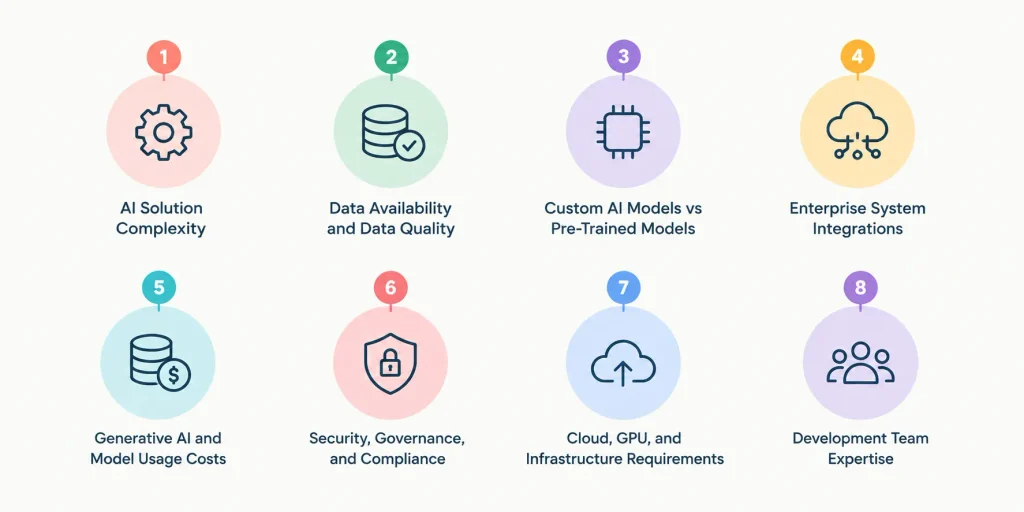
1. AI Solution Complexity
A simple AI assistant answering scripted questions is a few weeks of work. A retrieval-augmented generation (RAG) system pulling from thousands of internal documents is a different project entirely. Predictive models, computer vision pipelines, and multi-agent systems that coordinate several AI tasks each add their own layer of engineering. Complexity isn’t just a technical detail — it’s the single biggest multiplier on the final AI software development cost.
2. Data Availability and Data Quality
AI runs on data, and most enterprises underestimate how much work theirs needs before a model can touch it. Structured data in a clean database is cheap to use. Unstructured data scattered across PDFs, emails, and legacy systems requires cleaning, labeling, and pipeline-building before anything gets modeled. Poor data readiness is the most common reason a project’s actual AI software development cost overshoots its original estimate.
3. Custom AI Models vs Pre-Trained Models
Pre-trained models get you moving fast — lower upfront cost, quicker implementation, but you’re dependent on someone else’s API and its limits. Custom AI development costs more upfront because you’re training a model on your own data, but it gives you better domain accuracy and more control over how it behaves — often the deciding factor for regulated industries like banking or healthcare, where a generic model’s assumptions simply won’t hold. Most enterprises land somewhere in between: a pre-trained base, fine-tuned on proprietary data — a choice that shifts the AI software development cost more than almost any other decision on this list.
4. Enterprise System Integrations
AI rarely lives in isolation. It needs to talk to your ERP, CRM, HRMS, legacy databases, or IoT sensors on a factory floor. Each connection point adds engineering time, especially with older systems that weren’t built with modern APIs in mind. This is one of the most consistently underestimated line items in any AI software development cost estimate — teams price the model, then discover the integration work costs nearly as much.
5. Generative AI and Model Usage Costs
If your solution uses large language models, you’re not just paying for development — you’re paying for every API call, every token processed, every embedding stored in a vector database. This is a cost that continues after launch, separate from the one-time build. Enterprises that don’t separate these two numbers when they budget their AI software development cost are the ones surprised by their first month’s infrastructure invoice.
6. Security, Governance, and Compliance
Enterprise AI needs access controls, encryption, audit logging, and — increasingly — human-in-the-loop checkpoints for high-stakes decisions. In the UAE, this often means aligning with local data protection regulations and sector-specific compliance requirements, which raises the AI software development cost with engineering and legal review time that a consumer-grade AI tool would never need.
7. Cloud, GPU, and Infrastructure Requirements
Training and running AI models, especially computer vision or large language models, needs real compute power. Cloud GPU costs, storage for large datasets, and decisions between cloud, on-premise, or hybrid deployment all shape the infrastructure line of your budget. A model that needs to run in real time on the factory floor has a very different AI software development cost profile than one generating monthly reports.
8. Development Team Expertise
An AI project pulls in AI engineers, ML engineers, data engineers, MLOps specialists, and often a governance lead — a broader bench than a typical software build. Teams with deep, specific experience cost more per hour, but they also avoid the rework that inexperienced teams generate. Team composition is often where a “cheap” AI software development cost quote and a realistic one diverge the most.
Quick Question: “Does a chatbot count as AI software development?”— Yes, if it uses natural language processing or machine learning to understand intent rather than matching keywords. A scripted FAQ bot doesn’t need the same investment as one built on genuine AI software development.
AI Development Cost by Enterprise Use Case
AI Chatbots and Customer Support Automation
From a basic FAQ bot to a fully multilingual, CRM-integrated support assistant with retrieval-augmented responses, this category has the widest range — because the ceiling depends entirely on how much context and integration the bot needs. Multilingual support (especially Arabic-English) and CRM data access push AI development cost up quickly, but they’re also what turns a chatbot from a novelty into a real support-deflection tool worth its AI software development cost.
Predictive Analytics and Machine Learning
Demand forecasting, fraud detection, predictive maintenance, and churn prediction all fall here. These projects lean heavily on proprietary data — a retailer’s five years of sales history, a bank’s transaction patterns — which is exactly why Machine Learning Services Dubai providers spend so much of the early project phase on data engineering before a model gets built at all. The model is often the easy part; the data pipeline behind it is where the real work happens.
Computer Vision Systems
Quality inspection on a production line, retail shelf analytics, security monitoring, healthcare imaging — computer vision projects carry heavier GPU and labeling costs than most other AI categories. Edge deployment, where the model runs directly on a camera or local device rather than in the cloud, adds further engineering to the AI software development cost but cuts long-term latency and bandwidth costs.
Enterprise Generative AI Platforms
Internal copilots, document automation, enterprise search, and multi-agent workflows sit at the top of the pricing range because they combine several of the cost drivers above at once: multiple integrations, ongoing model usage, and governance requirements across departments. These are rarely single projects — they’re programs where the AI software development cost expands over 12-18 months as more teams adopt them.
AI Software Development Cost vs Total Cost of Ownership
The number a vendor quotes for development is only one part of what you’ll actually spend in year one. Enterprises that budget only for the AI software development cost of the build are the ones who run out of runway six months post-launch.
Initial Development Costs
Discovery, strategy, architecture, UI/UX, the AI development itself, integration work, and testing — this is the number most quotes cover, and it’s the one enterprises focus on almost exclusively.
Infrastructure and AI Model Costs
API consumption, token usage, cloud hosting, GPU time, vector databases, and monitoring tools all run continuously after launch. For generative AI projects especially, this can rival the initial build cost within the first year of heavy usage.
AI Operations and Maintenance Costs
Models drift. Data changes. Security needs patching. Ongoing model monitoring, retraining, and infrastructure maintenance are recurring costs, not one-time ones — budget for them as a monthly or quarterly line item, not an afterthought.
Understanding Year-One AI Investment
A simple way to frame it for internal budget conversations:
Year-One AI Investment = Development + Infrastructure + Model/API Usage + Governance + AI Operations
Vendors who only quote the first term of that equation aren’t being dishonest — they’re just quoting scope, not total ownership. Ask for all five.
Hidden Costs Enterprises Often Miss When Budgeting for AI
Even a carefully scoped AI software development cost estimate can miss real money hiding in the phases nobody quotes upfront.
Data Preparation and Engineering
Cleaning, transforming, labeling, and migrating data rarely gets its own line item in early quotes, yet it can consume 20-30% of a project’s total effort on data-heavy builds.
AI Integration and Legacy Systems
Connecting AI to existing enterprise systems is where AI integration work quietly balloons. Legacy platforms without modern APIs sometimes need custom middleware just to exchange data with a new AI layer — a cost that’s nearly invisible until the integration phase actually starts.
AI Testing and Evaluation
Beyond standard QA, AI systems need testing for accuracy, hallucination rates, bias, and edge cases that wouldn’t break traditional software but can seriously undermine an AI system’s reliability.
Change Management and Employee Adoption
The best AI system fails if nobody uses it. Training, workflow redesign, and internal governance policies take real time and budget — and they’re almost never included in a vendor’s technical quote.
Long-Term Monitoring and Optimization
Model drift, prompt optimization, and cost monitoring for token usage are ongoing tasks. Enterprises that skip this step often see their infrastructure bill creep upward for months before anyone investigates why.
How to Estimate Your AI Software Development Cost Before Talking to Vendors
Before any vendor conversation, walk through this five-step framework internally. It won’t give you an exact figure, but it will tell you which end of the range you’re likely to land in — and stop a vendor from anchoring your budget for you.
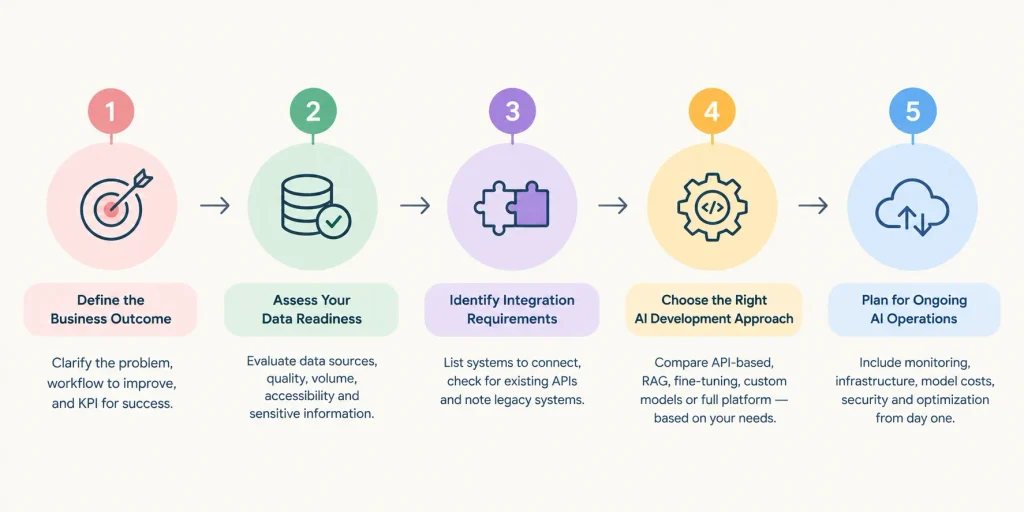
Step 1: Define the Business Outcome
What problem are you solving, which workflow will improve, and what KPI will tell you it worked? Vague goals produce vague — and inflated — estimates.
Step 2: Assess Your Data Readiness
Look honestly at your data sources, quality, volume, accessibility, and any sensitive information involved. This single assessment does more to predict your final AI development cost than any other step in this framework.
Step 3: Identify Integration Requirements
List which systems need to connect, whether APIs already exist for them, and how many legacy systems are involved. Each “yes, but it’s an old system” answer should raise your estimate.
Step 4: Choose the Right AI Development Approach
API-based implementation, a RAG application, fine-tuning an existing model, a fully custom ML model, or a full enterprise platform — each sits at a different price point, and the right choice depends on your answers to Steps 1-3, not on what sounds most impressive.
Step 5: Plan for Ongoing AI Operations
Monitoring, infrastructure, model costs, security, and optimization all need a place in the budget from day one, not as a surprise line item added after launch.
Run through this internally and you’ll walk into vendor conversations with a realistic AI software development cost range already in hand, instead of accepting whatever number lands first.
Typical AI Project Pricing Scenarios for Enterprises
Scenario 1: Enterprise AI Customer Support Assistant
Scope: Generative AI, knowledge base integration, CRM integration, multilingual support, analytics dashboard. Estimated AI project pricing: AED 150K–350K Timeline: 3–4 months
The CRM integration and multilingual requirement (particularly Arabic-English support) are usually what push the AI software development cost toward the higher end of this range.
Scenario 2: Predictive Analytics Platform
Scope: Data pipelines, custom ML model, dashboard, API integration, monitoring. Estimated custom AI development cost: AED 400K–900K Timeline: 6–9 months
Quick Question: “Why do predictive analytics platforms take longer than chatbots?”— Most of the timeline goes into building and validating the data pipeline, not the model itself — dirty or incomplete data can add months before training even starts.
Scenario 3: Enterprise AI Platform
Scope: Multiple AI use cases, generative AI, internal copilots, workflow automation, enterprise integrations, governance, monitoring. Estimated AI software development cost: AED 850K–2M+ Timeline: 9–18 months
These platforms are rarely delivered as one release — they typically launch with one or two use cases and expand as adoption proves out.
How to Reduce AI Development Cost Without Compromising Quality
Bringing the AI software development cost down doesn’t mean cutting corners — it means sequencing spend around what actually needs to be built first.
Start with a high-value use case. Validate business value on one workflow before building a platform around a use case nobody’s confirmed is worth solving.
Use existing models where appropriate. Not every project needs a model trained from scratch — pre-trained models fine-tuned on your data often deliver 80% of the value at a fraction of the cost.
Improve data readiness before development starts. Every week spent cleaning data before the build begins is a week you’re not paying an AI engineering team to do it mid-project, at a higher rate and on a tighter deadline.
Build in phases. Discovery and strategy, then a pilot, then production deployment, then scale across departments — each phase gives you an exit ramp if the numbers stop making sense.
Monitor AI infrastructure and model usage from day one. Token monitoring and model routing (sending simpler queries to cheaper models) can cut ongoing API costs significantly without touching the user experience.
Choosing the Right AI Development Partner
Look Beyond the Initial AI Software Development Cost
The cheapest quote is rarely the cheapest project. A vendor without integration or data engineering depth often looks affordable upfront and expensive by month four, once rework and scope gaps surface. Evaluate technical expertise, industry experience, data engineering capability, and integration track record — not just the number on the proposal.
Review Their AI Development Process
A serious partner can walk you through discovery, architecture, prototyping, testing, deployment, and monitoring as distinct phases, not a single vague “build and launch” line.
Evaluate Security and Governance Capabilities
Ask directly about data protection, access control, AI monitoring, audit logs, and incident response. If the answers are vague, that vagueness will show up in your compliance posture later, not just your budget.
Ask for Transparent AI Project Pricing
Push for clarity on what’s included, what’s excluded, and who owns infrastructure, API, and support costs after launch. The most reliable AI development services dubai providers will walk you through year-one total cost of ownership unprompted — not just the build quote — because they’d rather set expectations now than manage a difficult conversation in month six.
Final Takeaway
There’s no single fixed number for what AI should cost your business. The right budget depends on your business objectives, your data, and how complex the solution genuinely needs to be — not on matching whatever a competitor spent. Enterprises that calculate total cost of ownership, not just development cost, and that factor in data readiness, integration, infrastructure, and governance from the outset, are the ones who avoid the mid-project budget surprises that derail AI initiatives elsewhere.
Starting with one focused, high-value use case and scaling in phases isn’t a compromise — it’s how enterprises across Dubai and the wider UAE are building genuine AI capability instead of one-off AI features. Define the use case, assess your data readiness, map the full cost structure, and build a realistic roadmap before you commit to full-scale development.
Frequently Asked Questions
How much does AI software development cost?
Enterprise AI projects in the UAE typically range from AED 8K for a basic chatbot to AED 3M+ for a full enterprise platform. The number depends on solution complexity, data readiness, integration scope, and whether the solution uses pre-trained or custom-trained models.
What factors affect AI development cost?
The main drivers are solution complexity, data availability and quality, integration requirements, choice of AI model, infrastructure needs, and security or governance requirements specific to your industry.
How much does custom AI development cost?
Custom models trained on proprietary data cost more upfront than API-based implementations — typically starting around AED 250K for a custom AI/ML solution — but they offer better domain accuracy and long-term control, which often justifies the higher initial investment for regulated or data-sensitive industries.
What is included in AI project pricing?
A standard quote covers discovery, development, integration, and testing through to deployment. Ongoing infrastructure, API usage, and maintenance are typically priced separately and should be requested explicitly.
How can enterprises reduce AI software development cost?
Phased development, using existing pre-trained models where appropriate, improving data readiness before the build starts, and validating a single high-value use case before scaling are the most effective ways to control cost without cutting quality.