


Key Takeaways
- Most logistics software implementation mistakes trace back to planning gaps, not the software itself — integration, data quality, and user adoption decide success far more than feature lists.
- Dubai’s logistics ecosystem (Dubai Customs, Dubai Trade, free-zone vs. mainland rules) adds a compliance layer that generic implementation playbooks miss.
- Poor-quality data and rushed AI rollouts are two of the fastest ways to turn a promising platform into an expensive dashboard nobody trusts.
- Field-user adoption — drivers, warehouse staff, dispatchers — makes or breaks ROI, regardless of how advanced the backend is.
- Security, offline capability, and exception-driven dashboards need to be designed in from day one, not patched on after go-live.
- A phased roadmap — operations analysis, integration strategy, data prep, phased rollout, then automation — consistently outperforms a single “big bang” launch.
Dubai’s logistics sector isn’t waiting around for the rest of the world to catch up. Digital trade platforms, automated warehouses, AI-driven route planning, and connected fleet operations are becoming the baseline, not the exception. Yet a striking number of logistics companies in the city pour money into new software and never see the return they expected.
Here’s the uncomfortable truth: logistics software implementation mistakes rarely come down to picking the “wrong” platform. They come from underestimating how tangled the implementation actually is — the integration between systems, the state of the underlying data, the operational workflows on the ground, the compliance requirements specific to the UAE, and whether the people actually using the software day to day were ever consulted.
A modern logistics platform has to talk to warehouses, transportation networks, freight forwarding partners, customs systems, finance software, customer-facing portals, and fleet operations — all at once, all in near real time. Miss one connection and the whole chain of visibility breaks down somewhere.
This guide walks through the twelve mistakes we see most often in logistics software implementation Dubai projects, why each one derails ROI, and what a more strategic approach looks like. If you’re evaluating a platform or midway through a rollout, treat this as a checklist against your own project.
Why Logistics Software Implementation Is Challenging for Dubai Companies in 2026
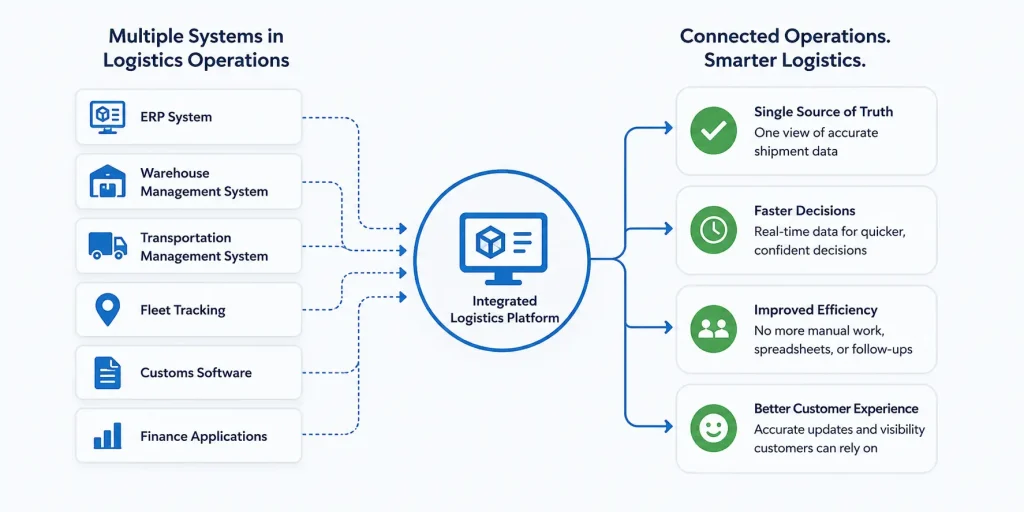
Logistics Operations Are Connected Across Multiple Systems
No logistics company runs on a single piece of software anymore. A typical stack includes an ERP, a Warehouse Management System, a Transportation Management System, fleet-tracking tools, customer portals, customs software, and finance applications — often from five or six different vendors.
When these systems don’t talk to each other properly, the symptoms show up fast: the same shipment data gets entered twice, teams fall back on spreadsheets and phone calls to confirm what should be automatic, decisions get delayed while someone chases down the “real” status, and customers ask where their shipment is because nobody in the company can answer with confidence.
One of the most common logistics software implementation mistakes is treating the new software as a standalone application rather than one node in a connected operational ecosystem. Buy the best WMS in the world and it still won’t fix a business that never planned how that WMS talks to the ERP next to it.
Dubai Logistics Requires Local Operational Understanding
There’s also a regional layer that generic implementation advice skips entirely. Dubai logistics operations have to account for Dubai Customs workflows, Dubai Trade integration, the different rules that apply to free-zone versus mainland operations, GCC cross-border movement, and the reality that staff and customers need the system to work in both Arabic and English. Add in the coordination between air, sea, and road freight — Jebel Ali port, DXB cargo, and inland trucking routes all feeding the same order — and it’s clear why a platform built for a European or US supply chain doesn’t just drop into Dubai unchanged.
Getting logistics software implementation Dubai right means understanding both the technology stack and the regional trade mechanics it has to plug into. Companies that skip this step usually find out the hard way, months after go-live, when a customs workflow doesn’t match how the software was configured.
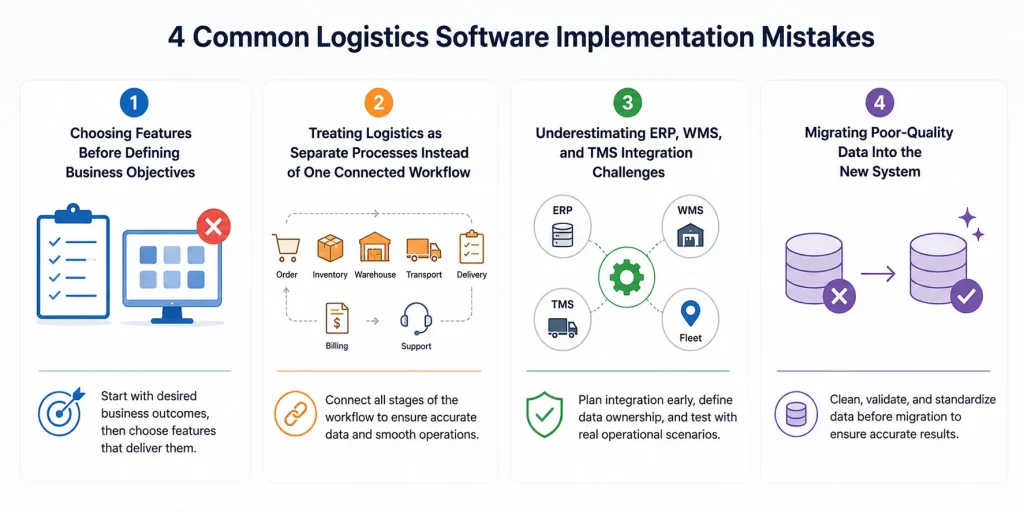
Mistake 1: Choosing Software Features Before Defining Business Objectives
It’s easy to get pulled into a features conversation — driver apps, AI dashboards, live tracking portals, route optimisation engines, warehouse automation. Vendors are good at making all of it look essential. But starting there, before anyone has agreed on what “success” actually means, is one of the most common logistics software errors we see.
The better starting point is a short list of business outcomes: fewer delivery delays, better shipment visibility, less manual data entry, more accurate inventory counts, higher customer satisfaction scores. Once those are defined, the feature conversation gets a lot shorter — you’re now asking which capabilities actually move those numbers, not which ones look impressive in a demo.
Technology should solve a specific operational problem. When it’s chosen first and the problem gets reverse-engineered to fit it, that’s usually where logistics software implementation mistakes start compounding.
Mistake 2: Treating Logistics as Separate Processes Instead of One Connected Workflow
Order processing, inventory management, warehousing, transportation, customs clearance, delivery, billing, customer support — these aren’t separate problems to solve one at a time. They’re stages in a single workflow, and a company that automates one stage while ignoring the rest ends up with a system that looks modern but behaves like the old one.
Here’s a scenario we see constantly: a delivery app marks a shipment as “completed” the moment the driver confirms drop-off. Meanwhile, the inventory system still shows the stock as reserved, the invoice hasn’t been generated, and the customer portal still says “in transit.” Nobody lied — the systems just never talked to each other.
That gap between what one system shows and what actually happened on the ground is where operational inefficiency quietly builds up, invoice by invoice, shipment by shipment, until finance is spending hours a week reconciling numbers that should have matched automatically. This is exactly the kind of disconnect that a well-planned logistics software roadmap is meant to prevent — mapping the full workflow before a single line of code gets written.
Mistake 3: Underestimating ERP, WMS, and TMS Integration Challenges
Integration is where most logistics software projects quietly fail, even when the individual platforms are excellent on their own. The common logistics software integration problems include mismatched data formats between systems, shipment statuses that contradict each other across platforms, duplicate customer or order records, missing or poorly documented APIs, weak real-time communication between systems, error handling that silently drops failed transactions, and staff who end up reconciling data by hand because nobody trusts the automated feed.
Systems commonly involved in these integrations include SAP, Oracle, and Microsoft Dynamics on the ERP side, plus separate warehouse, transportation, and fleet platforms — often from three or four different vendors, none of whom are responsible for making sure the whole picture works together.
How Companies Can Reduce Integration Risks
Run a full integration assessment before any development starts, rather than discovering gaps mid-build. Decide upfront which system “owns” each type of data — customer records, inventory counts, shipment status — so two platforms never both claim to be the source of truth. Favor API-first architecture over rigid point-to-point connections, plan for middleware where legacy systems can’t connect directly, and test against real operational scenarios, not just clean demo data.
Integration planning has to happen before development begins, not after something breaks in production. A clear logistics software integration architecture — one that defines data ownership, connection methods, and failure handling up front — is what separates a smooth rollout from a six-month firefighting exercise, and it’s one of the most overlooked pieces in logistics software implementation mistakes across the industry.
Mistake 4: Migrating Poor-Quality Data Into the New System
New software cannot fix bad data. It can only make bad data move faster and reach more people. Companies routinely migrate duplicate customer records, outdated warehouse location details, incomplete product information, wrong delivery addresses, and shipment statuses that mean different things in different systems — then wonder why the new platform “isn’t working.”
The downstream effects are predictable: reports that don’t add up, automation rules that trigger on the wrong conditions, analytics dashboards nobody trusts, and AI initiatives that stall out because the model was trained on inconsistent inputs. This is one of the more damaging common logistics software errors because it’s invisible at launch and only shows up weeks later, once it’s already contaminated every report built on top of it.
Building a Strong Data Foundation Before Implementation
Before migration, run a data cleansing pass to catch duplicates and obvious errors. Set up master data management so there’s one authoritative record per customer, product, and location. Define validation rules that catch bad entries before they enter the system, not after. Assign clear data ownership so someone is accountable when records drift out of sync, and standardise formats — date formats, address formats, unit measurements — across every system that will feed the new platform. Skipping this step is one of the most avoidable logistics software implementation mistakes on this list, precisely because the fix is boring, unglamorous, and easy to postpone.
Mistake 5: Introducing AI Before Fixing Core Logistics Processes
AI adoption in logistics has picked up fast — predictive ETAs, demand forecasting, route optimisation, automated document processing, predictive maintenance for fleet vehicles, and AI-driven customer service. All genuinely useful, when the groundwork is in place.
Most AI initiatives in logistics fail for the same handful of reasons: the underlying data is too inconsistent to train on, the systems feeding the model aren’t integrated, nobody defined the KPIs the AI is supposed to improve, or the process the AI is meant to automate was never structured in the first place. You can’t optimise a workflow that doesn’t exist yet in a repeatable form.
The Right Sequence for AI Adoption
Digitise the manual processes first. Improve data quality so the inputs are trustworthy. Connect the systems that need to share information. Automate the workflows that are now running on clean, connected data. Only then introduce AI capabilities on top. Rushing this order is a recurring source of logistics software adoption problems — teams end up with an AI feature they don’t trust, sitting on top of a process they never fixed, which is a worse outcome than not having AI at all. AI should support operational decisions, not replace a process that was never under control to begin with — that’s still one of the more persistent logistics software implementation mistakes companies make when chasing the newest capability first.
Mistake 6: Ignoring Dubai Customs and Trade Platform Requirements
Compliance has to be part of the architecture conversation, not a checklist item added after the software is already built. That means factoring in digital documentation standards, customs declaration workflows, electronic approval processes, trade-specific workflows for free-zone and mainland movement, and audit trails that regulators and auditors can actually follow.
Get this wrong and the risks are concrete: clearance delays that ripple through delivery schedules, documentation that doesn’t match what customs expects, manual reconciliation work that undoes the whole point of automating in the first place, and compliance issues that are far more expensive to fix after the fact than to design around upfront.
Logistics software implementation Dubai projects that treat trade compliance as an afterthought tend to discover the gap during their first real customs audit — not the ideal time to find out the workflow was misconfigured. Getting this right from the start is usually a job for a partner offering genuine Custom Logistics Software Development in Dubai, one that understands Dubai Trade and Dubai Customs workflows well enough to build them into the architecture rather than bolt them on later.
Mistake 7: Designing Software Without Considering Field Users
The people who actually touch this software every day — drivers, warehouse staff, dispatch teams, operations managers, and the customers checking their delivery status — rarely get consulted during design. Then the company is surprised when adoption is low.
The usual complaints are predictable: interfaces too complex for a warehouse floor, mobile experiences that weren’t actually tested on the devices field staff carry, excessive manual data entry that eats into productive time, and no meaningful support for Arabic-speaking staff or customers.
Improving Logistics Software Adoption
Involve actual field users during the design phase, not just management. Run pilot testing with a small group before a full rollout. Build role-based training instead of one generic session for everyone. Keep a feedback loop open after launch so small usability issues get fixed before they turn into workarounds. Most logistics software adoption problems trace back to designing for the org chart instead of the people doing the work.
Mistake 8: Selecting Software Based Only on Product Demonstrations
A polished demo is not a stress test. Vendor demonstrations run on clean sample data, in ideal conditions, showing the platform’s best-case scenario. Real logistics operations look nothing like that — failed deliveries, customs delays, partial shipments, returns, invoice disputes, and stretches of offline operation in warehouses or remote delivery zones are the norm, not the exception.
What Companies Should Evaluate Before Selection
Look past the feature list and test for scalability as order volume grows, integration capability with your existing systems, security architecture, how the mobile experience actually performs for field staff, the depth of reporting available, and — most importantly — how the platform handles the messy, real-world workflows a demo never shows. Buying on demo appeal alone is one of the common logistics software errors that only becomes obvious three months into live operations, when the software has to handle a genuinely difficult shipment for the first time.
Mistake 9: Creating Dashboards Without Exception Management
A dashboard full of green checkmarks and pie charts looks reassuring, but it doesn’t help anyone act. Operations teams don’t need a status overview — they need direct answers: which shipment is delayed, which order needs immediate attention, which vehicle requires intervention, which document is missing before customs clearance can proceed.
A dashboard that’s actually useful is built around an exception workflow: event happens, alert fires, an owner is assigned, an action gets taken, and the issue is marked resolved. Anything less just adds another screen someone has to check manually. This kind of exception-first design is central to how you build real-time shipment visibility platform capabilities that operations teams actually rely on, rather than a reporting layer that gets checked once a week and then ignored.
Mistake 10: Ignoring Security, Compliance, and Data Governance
Logistics platforms hold a lot of sensitive information — customer details, delivery addresses, vehicle and driver data, commercial documents, and billing records. Treating security as a post-launch add-on is a decision companies tend to regret.
The baseline practices worth building in from the start: role-based access control so people only see what their job requires, encryption for data at rest and in transit, multi-factor authentication for system access, secured APIs between connected systems, audit logs that track who changed what, and backup systems that actually get tested. Getting Data Security and Compliance in Logistics right from day one is far cheaper than retrofitting it after a breach or a failed audit — and it’s a recurring gap in logistics software implementation mistakes we see across the industry, security treated as someone else’s problem until it becomes everyone’s problem.
Mistake 11: Forgetting Offline Capabilities for Field Operations
Real-world conditions don’t guarantee a stable connection. Weak connectivity in remote delivery areas, warehouse environments that interfere with signal, and device limitations on older hardware are all normal parts of daily logistics operations in the UAE, not edge cases.
Software that assumes constant connectivity breaks down exactly when it’s needed most. The fix is offline data capture that queues actions locally, automatic synchronisation once connectivity returns, retry mechanisms for failed transmissions, and secure local storage so data isn’t lost or exposed in the gap. Ignoring these field conditions during design is a quiet but consistent source of logistics software implementation mistakes — the kind that don’t show up in a boardroom demo but show up constantly on a delivery route.
Mistake 12: Measuring Success Only After Software Goes Live
Go-live is a milestone, not a finish line. Too many companies treat the launch date as the end of the project and only start thinking about success metrics once the system is already running — by which point it’s too late to design the right measurements in.
The metrics worth tracking from the start include delivery accuracy, ETA performance against actual arrival times, fleet utilisation, warehouse efficiency, user adoption rates, customer satisfaction scores, and system reliability under real load. Companies that define these targets before implementation begins can course-correct early. Companies that wait until after launch are often trying to explain, months later, why the numbers don’t look the way anyone expected — a late-stage version of the same logistics software implementation mistakes that could have been caught during planning.
A Practical Roadmap to Avoid Logistics Software Implementation Mistakes in Dubai
Phase 1: Analyse Current Operations
Map existing processes end to end, review what current systems actually do (versus what they’re supposed to do), and get clear, written agreement on business goals before evaluating any vendor.
Phase 2: Build Integration Strategy
Decide how the ERP will connect to WMS and TMS platforms, and map every external connection — customs systems, banking, third-party logistics partners — before development starts.
Phase 3: Prepare Data
Run the data cleansing and standardisation work early, and assign clear ownership rules so the platform launches on data people can trust from day one.
Phase 4: Implement in Phases
Start with the highest-impact workflows rather than trying to launch everything simultaneously, test each phase with real users, and expand gradually as confidence builds.
Phase 5: Optimise With Automation and AI
Once the foundation is solid, layer in analytics, predictive capabilities, and intelligent workflow automation — in that order.
This phased approach is the backbone of a workable logistics software implementation Dubai roadmap, and it’s the single biggest lever for avoiding the logistics software implementation mistakes covered above. Companies that skip straight to Phase 5 are usually the ones that end up circling back to Phase 1 a year later, at a much higher cost.

How Dubai Companies Can Successfully Implement Logistics Software in 2026
Success comes down to a short list of disciplines, applied consistently: align the technology with clearly defined business goals, choose an architecture that can scale as volume grows, prioritise integration over feature count, invest in data quality before automation, involve operational teams in design decisions, plan security from the very beginning, and keep improving after deployment instead of treating go-live as the finish line.
When evaluating an implementation partner, look past the sales pitch and check for genuine logistics industry experience, real integration expertise (not just a claim of “we integrate with everything”), a working understanding of UAE trade and customs workflows, a scalable technical approach, and support capabilities that extend well past launch day. An enterprise logistics software dubai guide worth following treats the partner selection process with the same rigor as the platform selection itself — because the two decisions are more connected than most companies assume. Successful implementation isn’t a technology project alone; it’s technology, process redesign, and change management moving together.
Final Thoughts
Logistics software success was never about buying the most advanced platform on the market. The biggest failures come from overlooking integration, letting bad data through the door, underestimating compliance requirements, and rolling out software that field teams never actually wanted to use.
Dubai’s logistics companies operate in one of the most demanding, fast-moving trade corridors in the world. That makes a structured implementation strategy less of a nice-to-have and more of a competitive necessity — the difference between a connected, scalable operation and one still reconciling spreadsheets six months after go-live.
Before starting a logistics software project, take an honest look at your current processes, your integration requirements, how ready your data actually is, and what business outcomes you’re trying to hit. That audit, done properly before any contract is signed, is what separates a smooth rollout from another entry on this list of logistics software implementation mistakes.
Frequently Asked Questions
How long does a logistics software implementation actually take?
It depends heavily on integration complexity, not just the software itself. Simple, single-system rollouts can take 8–12 weeks, while multi-system ERP/WMS/TMS integrations with customs connectivity often run 6–12 months when done properly, phased rather than rushed.
Why did our logistics software fail even though the vendor demo looked great?
Demos run on clean sample data in ideal conditions. Real operations involve failed deliveries, partial shipments, and offline periods the demo never showed. Evaluate scalability, integration depth, and real-world workflow handling before signing, not just the sales presentation.
Is it worth integrating WMS and TMS with our existing ERP, or keeping them separate?
Most enterprises run ERP, WMS, and TMS from different vendors, so integration is usually unavoidable at scale. The real question isn’t whether to integrate — it’s who owns which data, and whether the connection is real-time or batch-based.
Why does our new software show different shipment statuses than what customers see?
This usually means systems aren’t properly synced — one platform marks a shipment complete before inventory, billing, and customer-facing systems update. It’s a common integration gap, not a software defect, and it’s fixed by defining clear data ownership across systems.
Should we roll out AI features before our core systems are properly connected?
No. AI trained on inconsistent or disconnected data tends to produce unreliable results, which erodes trust in the whole platform. Digitise, integrate, and clean up data first — AI adoption works best as the last step, not the first.
What’s the biggest reason logistics software projects fail in the UAE specifically?
Underestimating the compliance layer — Dubai Customs, Dubai Trade, and free-zone versus mainland rules — is a recurring cause. Software built for a generic Western supply chain often needs real rework to handle UAE-specific trade documentation and approval workflows.
How do we get warehouse staff and drivers to actually use the new system?
Involve them during design, not after launch. Pilot the software with a small group first, build training around actual job roles instead of one generic session, and keep a feedback channel open — most adoption failures come from ignoring real field workflows.