


Key Takeaways
- UAE’s fast-growing eCommerce market is putting significant pressure on logistics companies to automate delivery, warehousing, inventory, and fulfillment operations.
- Rising customer expectations for same-day delivery and real-time shipment visibility are increasing demand for logistics software in UAE.
- Businesses are investing in route optimization, warehouse management, fleet tracking, and supply chain automation software to improve scalability and efficiency.
- Custom logistics software helps UAE businesses reduce operational costs, improve delivery speed, and gain real-time visibility across logistics operations.
- As eCommerce expands across the UAE, logistics technology is becoming a strategic investment rather than an operational option.
The UAE’s eCommerce sector is expanding rapidly, but behind every successful online order lies a highly complex logistics operation. Customers today expect fast deliveries, real-time tracking, smooth returns, and a seamless shopping experience. For logistics companies, warehouse operators, and supply chain businesses in the UAE, this shift has created a new operational reality.
As order volumes rise across Dubai, Abu Dhabi, Sharjah, and other emirates, logistics businesses are under pressure to manage deliveries faster, optimize routes, improve warehouse efficiency, and maintain inventory visibility. Traditional manual systems can no longer keep up with this scale and complexity.
This is why logistics software is becoming a critical investment for UAE businesses. From fleet tracking and warehouse automation to AI-driven supply chain visibility, technology is helping logistics companies scale operations efficiently while reducing costs and improving customer satisfaction.
UAE’s eCommerce Boom Is Reshaping the Logistics Industry
Over the last few years, the UAE has emerged as one of the fastest-growing digital commerce markets in the Middle East. High smartphone penetration, widespread digital payment adoption, improved internet accessibility, and a tech-savvy consumer base have accelerated online shopping across the country. Consumers are now buying everything online, from groceries and electronics to fashion, healthcare products, and household essentials.
This rapid growth in digital commerce is not only transforming retail businesses but also creating significant pressure on logistics and fulfillment operations. Every online order triggers a chain of backend logistics activities, including inventory checks, warehouse processing, route allocation, shipment dispatch, delivery coordination, and customer communication. As order volumes increase, this logistics ecosystem becomes far more complex.
One of the biggest changes in the UAE market is the growing expectation for faster delivery. Customers no longer consider next-day delivery a premium service. In many urban markets, same-day delivery and even express delivery options are becoming expected standards. This creates pressure on logistics companies to operate with speed, precision, and real-time coordination.
At the same time, businesses are managing larger inventories, multiple warehouses, omnichannel retail operations, and rising return requests. These challenges make manual logistics operations inefficient and difficult to scale.
This is where Logistics application development becomes increasingly important. Businesses are investing in software solutions that automate logistics operations, improve warehouse coordination, optimize delivery planning, and provide real-time visibility across the supply chain.
As eCommerce continues to grow in UAE, logistics businesses must manage more orders, faster fulfillment, inventory complexity, and higher customer expectations. This growing operational pressure is one of the biggest reasons demand for logistics software is rising across the region.
Why eCommerce Growth in UAE Is Creating New Logistics Challenges
Order Volumes Are Increasing Faster Than Operational Capacity
The growth of eCommerce in UAE has led to a sharp increase in daily order volumes, but logistics infrastructure in many businesses has not scaled at the same pace. More online orders mean more SKUs to manage, more warehouse movement, more delivery routes, and greater pressure on logistics teams.
A logistics operation that once handled a few hundred daily deliveries may now need to process thousands of orders across different delivery windows and locations. This creates bottlenecks in order processing, picking, packing, dispatching, and route coordination.
Warehouse teams face higher pressure to maintain stock accuracy while ensuring fast fulfillment. Delivery fleets must cover more routes within tighter delivery timelines. Customer service teams must handle increased shipment-related inquiries.
Without logistics software, scaling these operations becomes difficult. Businesses often experience delivery delays, inventory errors, operational inefficiencies, and rising fulfillment costs.
Customers Now Expect Faster and More Transparent Deliveries
Customer expectations in UAE have changed dramatically. Online shoppers now expect more than product delivery — they expect delivery transparency and speed.
Same-day delivery is becoming a competitive differentiator for many eCommerce brands. Customers want live tracking links, ETA notifications, delivery status updates, and better communication throughout the fulfillment process.
This creates operational pressure on logistics providers because every delayed shipment or failed delivery directly impacts customer satisfaction and brand trust.
Businesses that cannot provide real-time delivery visibility often struggle with:
- Increased customer complaints
- Higher support ticket volumes
- Failed delivery attempts
- Lower customer retention
In today’s eCommerce environment, delivery experience has become a competitive advantage, and logistics companies need technology to meet these expectations efficiently.
Manual Logistics Operations Are No Longer Sustainable
Many logistics businesses still rely on spreadsheets, disconnected inventory systems, manual route planning, and human-dependent coordination processes. While these methods may work at a smaller scale, they become inefficient as order volumes grow.
Manual logistics operations often create problems such as:
- Inventory mismatches
- Delivery coordination delays
- Route inefficiencies
- Poor warehouse visibility
- Lack of real-time reporting
- Increased operational dependency on staff
Siloed systems make it difficult for businesses to get a complete view of their logistics operations. A warehouse team may not have updated inventory visibility, while delivery teams may operate without optimized routing data.
As UAE eCommerce expands, manual logistics operations are becoming a major barrier to growth, forcing businesses to adopt logistics software that enables automation and centralized control.
Key Reasons UAE Businesses Are Investing in Logistics Software
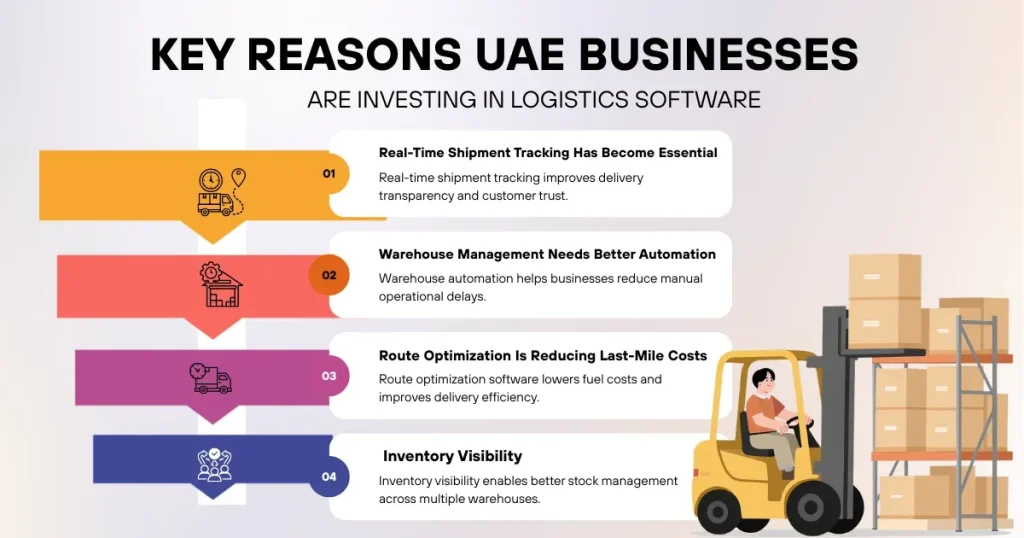
Real-Time Shipment Tracking Has Become Essential
Shipment visibility has become one of the most important requirements in modern logistics operations. Customers want to know exactly where their order is, when it will arrive, and whether there are any delays.
Businesses are investing in logistics software that provides:
- GPS-based shipment tracking
- Customer tracking links
- Live fleet visibility
- Delivery status updates
- Real-time ETA notifications
Real-time tracking improves customer confidence while reducing the burden on customer support teams. It also helps logistics managers monitor fleet movement, identify delays, and improve operational decision-making.
For UAE businesses handling large delivery volumes, shipment visibility is no longer optional — it is becoming a standard expectation.
Warehouse Management Needs Better Automation
Warehouse operations are becoming increasingly complex as businesses manage larger inventories, multiple stock locations, and faster fulfillment cycles.
Manual warehouse processes often create delays in stock movement, picking, packing, and order dispatch.
This is why businesses are investing in warehouse automation capabilities such as:
- Real-time stock synchronization
- Barcode and RFID scanning
- Warehouse movement tracking
- Picking optimization
- Automated stock updates
- Inventory accuracy management
Businesses evaluating warehouse digitization often compare software implementation costs with operational savings. Many decision-makers researching logistics technology also review Supply Chain Management Software Development Cost to understand long-term investment value before implementing automation solutions.
Warehouse software is becoming a core part of logistics modernization in UAE because it improves fulfillment speed, inventory accuracy, and operational efficiency.
Route Optimization Is Reducing Last-Mile Costs
Last-mile delivery remains one of the most expensive parts of logistics operations.
Poor route planning can lead to:
- Higher fuel consumption
- More delivery delays
- Reduced driver productivity
- Increased failed delivery attempts
- Rising logistics costs
Route optimization software helps businesses solve these issues by analyzing delivery schedules, traffic conditions, delivery clusters, and route efficiency.
This helps logistics businesses:
- Reduce fuel costs
- Improve fleet utilization
- Deliver faster
- Reduce failed deliveries
- Improve driver productivity
For UAE businesses operating in dense urban delivery environments, route optimization software has become a key investment for cost control and service efficiency.
Inventory Visibility Is Becoming a Competitive Requirement
As businesses scale across multiple warehouses and omnichannel retail systems, inventory visibility becomes critical.
Without real-time stock visibility, businesses often face:
- Stockouts
- Overstocking
- Fulfillment delays
- Inventory mismatches
- Customer order issues
Modern logistics software helps businesses gain visibility through:
- Real-time stock forecasting
- Warehouse synchronization
- Omnichannel inventory tracking
- Demand planning analytics
- Inventory movement monitoring
This improves operational planning while reducing costly inventory-related disruptions.
Returns Management Is Becoming More Complex
As online shopping grows, reverse logistics is becoming a major challenge for logistics businesses in UAE.
Returns create operational complexity because businesses must manage:
- Return pickup coordination
- Product verification
- Return tracking
- Refund workflows
- Inventory reintegration
Without software support, returns can become expensive and inefficient.
Modern logistics software helps businesses streamline reverse logistics by creating structured return workflows and improving visibility across the returns process.
UAE eCommerce Growth vs Logistics Complexity
| eCommerce Growth Factor | Logistics Impact | Software Needed |
| Higher daily orders | Delivery bottlenecks | Delivery management software |
| More warehouses | Inventory complexity | Warehouse management software |
| Same-day delivery demand | Route inefficiency | Route optimization software |
| Omnichannel retail | Stock visibility issues | Inventory software |
| Customer tracking expectations | Communication pressure | Tracking systems |
The relationship between eCommerce growth and logistics complexity is becoming increasingly clear in UAE. As digital commerce scales, logistics operations become more demanding, interconnected, and data-driven.
Businesses that continue operating with manual logistics systems often struggle with rising delivery costs, slower fulfillment, poor inventory visibility, and lower customer satisfaction.
This is why logistics software is no longer just a technology upgrade. For many UAE businesses, it is becoming a business-critical investment that supports scalability, operational efficiency, and long-term competitiveness.
How Logistics Software Helps UAE Businesses Scale Efficiently
As eCommerce operations expand across the UAE, logistics businesses are under pressure to handle higher delivery volumes, tighter fulfillment timelines, and more complex warehouse operations. Logistics software helps solve these challenges by automating critical processes, improving operational visibility, and reducing inefficiencies across the supply chain.
Instead of relying on disconnected manual systems, businesses can use software to create a more streamlined, scalable, and data-driven logistics ecosystem.
Faster Fulfillment Operations
Speed is one of the biggest competitive advantages in modern logistics. As customer expectations continue to rise, businesses cannot afford delays in order processing, warehouse movement, or shipment dispatch.
Logistics software improves fulfillment speed by automating order processing and coordinating warehouse workflows more efficiently. When an order is placed, the system can automatically assign it for picking, update stock levels, generate dispatch instructions, and prepare delivery workflows in real time.
This automation reduces manual intervention and eliminates unnecessary delays in backend logistics processes.
Warehouse coordination also improves because logistics software connects inventory systems, warehouse teams, and dispatch operations within a centralized platform. Staff can track order progress, identify bottlenecks, and manage stock movement more efficiently.
Businesses benefit through:
- Faster order processing
- Reduced fulfillment delays
- Better warehouse coordination
- Improved dispatch speed
- Higher operational throughput
For UAE businesses managing high-volume eCommerce deliveries, faster fulfillment directly improves delivery timelines and customer satisfaction.
Lower Logistics Costs
One of the biggest reasons businesses invest in logistics software is cost optimization.
Manual logistics operations often lead to unnecessary expenses due to inefficient route planning, poor resource allocation, underutilized fleets, and labor-heavy workflows.
Logistics software helps reduce these costs by improving route optimization, resource utilization, and labor efficiency.
Route optimization tools can calculate the fastest and most efficient delivery paths based on traffic conditions, delivery clusters, route priority, and location intelligence. This reduces fuel consumption, minimizes travel time, and improves fleet productivity.
Resource utilization also improves because businesses can better allocate vehicles, warehouse resources, inventory, and manpower based on operational demand.
Automation reduces repetitive manual tasks, allowing businesses to improve labor productivity without increasing operational overhead.
Cost-saving benefits often include:
- Lower fuel expenses
- Better fleet utilization
- Reduced delivery delays
- Improved labor efficiency
- Lower operational waste
- Better logistics profitability
In a highly competitive UAE logistics market, reducing operating costs while maintaining delivery performance can significantly improve business margins.
Better Customer Experience
Customer experience is now closely tied to logistics performance. Fast delivery, accurate updates, and shipment transparency have become essential parts of the eCommerce experience.
Logistics software helps businesses improve customer satisfaction by creating a more reliable and transparent delivery process.
Customers can receive:
- Real-time tracking links
- Delivery notifications
- ETA updates
- Shipment status alerts
- Return process updates
This reduces uncertainty and improves customer trust.
Software-driven logistics also improves delivery execution by reducing failed deliveries, optimizing route schedules, and improving dispatch coordination. Faster deliveries and accurate communication create a better customer experience from order placement to final delivery.
Businesses that invest in logistics software often see improvements in:
- Customer satisfaction
- Delivery reliability
- Repeat purchase rates
- Customer trust
- Brand experience
In UAE’s competitive eCommerce market, logistics performance is increasingly becoming a customer retention factor.
Real-Time Business Visibility
One of the biggest limitations of manual logistics operations is lack of visibility.
Business leaders often struggle to answer critical operational questions such as:
- Where are delayed shipments?
- Which routes are underperforming?
- Which warehouse is facing inventory pressure?
- What is the real fulfillment performance today?
- How can operations be optimized during peak demand?
Logistics software solves this by creating real-time dashboards and analytics systems that provide operational visibility across the supply chain.
Managers can monitor:
- Delivery performance
- Fleet movement
- Warehouse efficiency
- Inventory trends
- Operational KPIs
- Cost performance
Analytics tools also help businesses forecast demand, identify inefficiencies, and make smarter operational decisions based on live business data.
Real-time visibility supports:
- Better forecasting
- Faster issue resolution
- Performance monitoring
- Operational planning
- Strategic decision-making
For growing logistics businesses in UAE, data-driven visibility is essential for long-term scalability.
Struggling to Scale Logistics Operations in UAE?
As eCommerce demand continues to rise, logistics businesses need technology that can automate operations, improve delivery efficiency, reduce fulfillment costs, and create better customer experiences.
Working with experienced software developers in UAE can help businesses build custom logistics software tailored to warehouse management, fleet tracking, route optimization, and end-to-end supply chain automation.
Types of Logistics Software UAE Businesses Are Investing In
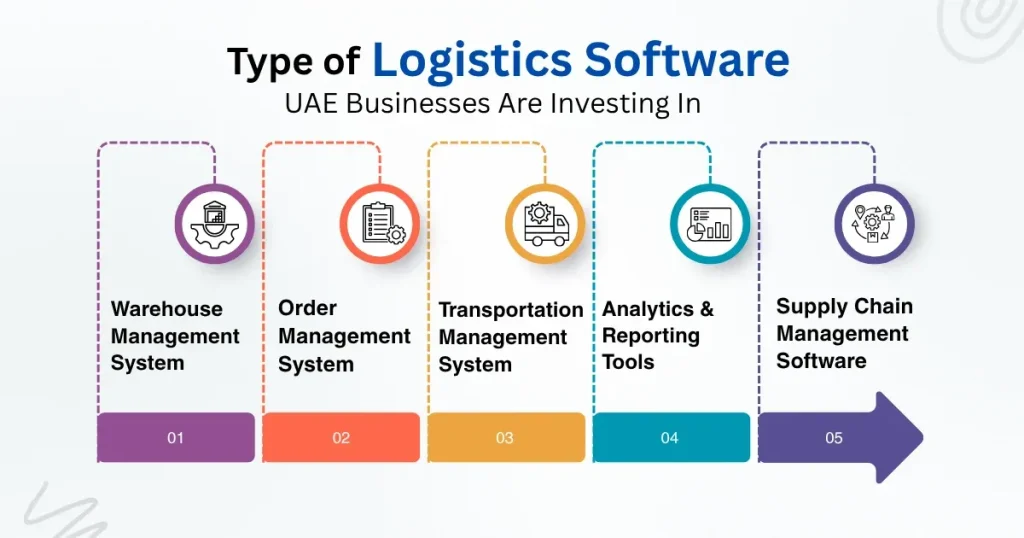
Different logistics businesses face different operational challenges, which is why software investment often depends on specific business needs. From warehouse automation to delivery tracking, UAE businesses are adopting multiple logistics technologies to improve performance and scalability.
Transportation Management Software (TMS)
Transportation Management Software helps businesses plan, execute, and optimize the movement of goods across delivery networks.
A TMS typically helps with:
- Shipment planning
- Carrier management
- Route scheduling
- Delivery coordination
- Freight tracking
- Transportation cost optimization
This software is especially useful for logistics providers managing complex transportation networks across multiple regions.
Warehouse Management Software (WMS)
Warehouse Management Software helps businesses improve inventory control, warehouse movement, stock visibility, and fulfillment operations.
A WMS typically supports:
- Inventory tracking
- Picking and packing workflows
- Barcode scanning
- Warehouse movement management
- Stock synchronization
- Fulfillment optimization
For UAE businesses managing high-volume warehousing operations, WMS platforms improve efficiency and order accuracy.
Fleet Management Software
Fleet Management Software helps businesses monitor and optimize vehicle operations.
Key features often include:
- Vehicle tracking
- Driver monitoring
- Fuel usage reporting
- Maintenance scheduling
- Route monitoring
- Fleet performance analytics
This helps logistics companies improve vehicle productivity while reducing operating costs.
Delivery Tracking Software
Delivery tracking software provides shipment visibility for both businesses and customers.
Core capabilities include:
- Live shipment tracking
- Customer delivery updates
- ETA notifications
- Delivery status alerts
- Proof of delivery records
This software improves delivery transparency and customer communication.
Route Optimization Software
Route optimization tools help businesses reduce delivery time and fuel consumption by creating efficient route plans.
These systems often analyze:
- Traffic conditions
- Delivery priority
- Route clusters
- Driver schedules
- Delivery windows
This helps improve last-mile efficiency while reducing delivery costs.
Inventory Management Platforms
Inventory management systems provide real-time visibility across stock movement and warehouse operations.
Key functions include:
- Stock forecasting
- Inventory synchronization
- SKU management
- Multi-location inventory tracking
- Demand planning
This helps businesses reduce stock-related disruptions.
AI-Powered Logistics Analytics
AI-based logistics software is becoming increasingly important for predictive operations and smarter decision-making.
AI-powered systems can help with:
- Demand forecasting
- Route prediction
- Delivery risk analysis
- Inventory optimization
- Operational trend analysis
- Resource planning
For UAE logistics businesses preparing for future scalability, AI-driven logistics analytics can create a competitive advantage.
When Should a UAE Logistics Business Invest in Custom Logistics Software?
Many businesses delay software investment until operational problems become severe. However, waiting too long often leads to higher costs, customer dissatisfaction, and reduced scalability.
A UAE logistics business should consider investing in custom logistics software when certain warning signs start affecting performance.
Common triggers include:
- Delivery delays are increasing regularly
- Warehouse inefficiencies are slowing fulfillment
- Customer complaints about shipments are rising
- Manual systems are causing operational losses
- Inventory visibility is poor
- Delivery teams operate with disconnected tools
- Business leaders lack real-time operational data
- Scaling logistics operations is becoming difficult
Custom logistics software becomes especially valuable when off-the-shelf tools cannot support unique operational requirements, integrations, or business workflows.
For growing logistics businesses in UAE, software investment is often not about replacing systems — it is about creating infrastructure for long-term growth.
Is Logistics Software Worth the Investment for UAE Businesses?
For many logistics businesses, software investment may initially appear as an operational cost. However, the bigger financial question is often about the cost of continuing with inefficient manual systems.
Cost of Doing Nothing
Businesses that delay logistics automation often face hidden operational costs that continue to grow over time.
These costs may include:
- Delivery inefficiencies
- Poor route planning
- Inventory mismatches
- Warehouse delays
- Operational wastage
- Customer churn due to delivery issues
- Higher labor dependency
- Limited scalability
Manual logistics systems may appear manageable in the short term, but as eCommerce volume increases, inefficiencies become more expensive and difficult to control.
Businesses may lose revenue not only through higher operating costs but also through customer dissatisfaction and reduced delivery reliability.
ROI of Logistics Automation
Logistics software creates measurable operational and financial returns by reducing inefficiencies and improving performance across logistics operations.
Businesses often see ROI through:
- Lower fuel costs through route optimization
- Reduced manual work through automation
- Better order accuracy
- Improved warehouse productivity
- Lower delivery delays
- Better resource utilization
- Improved customer retention
- Increased scalability
Over time, these efficiency gains can offset software investment while creating long-term operational advantages.
Manual Logistics vs Software-Driven Logistics
| Manual Logistics Operations | Software-Driven Logistics |
| High operational dependency | Automation |
| Limited visibility | Real-time dashboards |
| Delivery delays | Optimized routing |
| Inventory errors | Stock synchronization |
| Higher operating cost | Better efficiency |
The ROI of logistics software is not limited to cost savings alone. It also improves operational control, customer satisfaction, scalability, and long-term business resilience.
For UAE businesses operating in a rapidly growing eCommerce ecosystem, logistics software is increasingly becoming an investment in growth rather than just an IT expense.
Future Trends Driving Logistics Software Demand in UAE
The UAE logistics sector is evolving rapidly as businesses adopt advanced technologies to keep pace with rising eCommerce demand, customer expectations, and operational complexity. While logistics software is already helping businesses automate delivery and warehouse operations, the next phase of growth will be driven by smarter, predictive, and connected technologies.
These emerging trends are shaping the future of logistics in UAE and increasing demand for advanced logistics software platforms.
AI in Logistics Planning
Artificial intelligence is becoming one of the most influential technologies in modern logistics planning. Traditional logistics planning often depends on manual forecasting, static routing, and reactive decision-making. AI changes this by helping businesses make faster and more accurate operational decisions based on real-time data.
AI-powered logistics software can analyze large volumes of operational information, including delivery trends, traffic patterns, warehouse activity, demand fluctuations, and route performance.
This allows businesses to improve:
- Delivery planning
- Resource allocation
- Route efficiency
- Operational forecasting
- Risk management
- Demand response
For UAE logistics companies managing fast-moving eCommerce operations, AI-driven logistics planning helps create smarter and more adaptive supply chain systems.
Predictive Demand Forecasting
Demand forecasting has become critical for businesses dealing with fluctuating order volumes, seasonal shopping spikes, and changing customer buying behavior.
Traditional forecasting models often rely on historical assumptions, but predictive demand forecasting software uses AI and analytics to generate more accurate predictions.
These systems can analyze:
- Historical order patterns
- Seasonal demand shifts
- Regional buying behavior
- Inventory movement trends
- Market demand signals
This helps businesses plan inventory, allocate warehouse resources, optimize transportation capacity, and prepare for peak order periods more effectively.
In the UAE’s fast-growing eCommerce ecosystem, predictive demand forecasting helps logistics businesses reduce stock shortages, avoid overstocking, and improve supply chain efficiency.
Smart Warehousing
Warehousing is moving beyond manual storage and stock handling into a more connected and intelligent operating model.
Smart warehousing combines logistics software with automation technologies to improve warehouse performance and operational efficiency.
This can include:
- Real-time inventory tracking
- Barcode and RFID systems
- Automated stock updates
- Warehouse robotics integration
- Picking optimization
- Intelligent warehouse analytics
Smart warehouse systems reduce fulfillment errors while improving speed, inventory visibility, and warehouse productivity.
As UAE businesses scale eCommerce operations, smart warehousing is becoming a key part of logistics modernization.
IoT-Based Fleet Monitoring
Fleet operations generate large amounts of real-time data, and Internet of Things (IoT) technology helps businesses capture and use that information more effectively.
IoT-enabled fleet management systems connect vehicles, sensors, GPS devices, and logistics software to provide live operational monitoring.
Businesses can monitor:
- Vehicle location
- Fuel consumption
- Driver behavior
- Engine health
- Route performance
- Delivery conditions
This improves fleet visibility while helping businesses reduce maintenance issues, fuel waste, and delivery delays.
For logistics companies in UAE managing large delivery networks, IoT-based fleet monitoring creates stronger operational control and better fleet efficiency.
Autonomous Logistics Operations
Automation is moving beyond basic software workflows into more autonomous logistics operations.
Advanced logistics platforms are increasingly using AI, robotics, machine learning, and workflow automation to reduce human dependency in operational decision-making.
Examples include:
- Automated route recommendations
- AI-driven dispatch planning
- Smart warehouse movement systems
- Automated inventory alerts
- Predictive maintenance triggers
- Workflow automation in fulfillment operations
Autonomous logistics systems help businesses improve speed, consistency, and scalability while reducing operational friction.
As logistics complexity grows in UAE, automation will play a major role in future logistics infrastructure.
Cross-Border Digital Supply Chain Systems
The UAE plays a strategic role in regional and international trade, making cross-border logistics a major part of supply chain operations.
Cross-border logistics often involves multiple stakeholders, customs workflows, documentation requirements, transportation coordination, and inventory visibility across geographies.
Digital supply chain systems help businesses manage this complexity by creating connected logistics workflows across international operations.
These platforms support:
- Shipment documentation management
- Customs process coordination
- Cross-border inventory visibility
- International transportation tracking
- Multi-country logistics analytics
- Supply chain communication automation
As regional trade and eCommerce expand, UAE businesses will increasingly need digital logistics platforms that support cross-border supply chain efficiency.
Why UAE Businesses Need the Right Technology Partner for Logistics Software
Building logistics software is not simply about creating an application. It requires deep logistics domain understanding, scalable architecture, technology expertise, and the ability to solve operational challenges specific to supply chain businesses.
This is why choosing the right technology partner becomes critical for UAE businesses investing in logistics software.
Logistics Domain Expertise Matters
Logistics operations are highly specialized. Delivery management, warehouse coordination, fleet optimization, inventory tracking, and supply chain visibility all require software built around operational realities.
A technology partner with logistics domain expertise understands:
- Fulfillment workflows
- Last-mile delivery challenges
- Inventory complexities
- Fleet management requirements
- Warehouse operations
- Supply chain coordination
This reduces development risk and ensures software is built for real business outcomes.
Scalability Architecture for Business Growth
A logistics software platform must support future growth, not just current operations.
As businesses scale, software should handle:
- Higher order volumes
- More warehouse locations
- Growing delivery networks
- More operational data
- New business models
- Multi-region logistics operations
Scalable software architecture ensures businesses can grow without rebuilding technology systems every few years.
Integration Capabilities Are Essential
Modern logistics businesses often use multiple operational tools, including ERP systems, warehouse software, customer platforms, payment systems, tracking tools, and analytics dashboards.
A strong logistics software partner should be able to build integrations that connect these systems into one operational ecosystem.
This improves:
- Data flow
- Operational coordination
- Reporting accuracy
- Customer experience
- Business visibility
Disconnected systems create inefficiencies, while integrated logistics software creates operational control.
UAE Compliance and Regional Requirements
Businesses operating in UAE need software that aligns with regional business, data, and operational requirements.
A technology partner familiar with UAE market expectations can help businesses build software that supports:
- Regional operational workflows
- Security best practices
- compliance requirements
- localization needs
- multi-market logistics support
Regional understanding becomes especially important for enterprise logistics businesses operating across multiple jurisdictions.
Cloud Infrastructure and Performance Readiness
Modern logistics software requires cloud-based scalability, high uptime, secure data access, and strong performance under operational pressure.
A reliable technology partner should design logistics platforms that support:
- Real-time performance
- cloud scalability
- data security
- disaster recovery
- high system availability
- performance monitoring
Cloud-ready logistics software creates stronger operational resilience for growing businesses.
AI Readiness for Future Logistics Innovation
As logistics technology evolves, businesses will increasingly need AI-powered capabilities such as predictive analytics, route intelligence, demand forecasting, and operational automation.
A future-ready technology partner should build software that supports:
- AI integrations
- analytics readiness
- predictive decision-making
- automation capabilities
- operational intelligence
Businesses that prepare for AI today will be better positioned for long-term logistics competitiveness.
Companies evaluating Technology Consulting Firms in the Middle East often prioritize logistics expertise, enterprise scalability, and regional understanding before choosing a development partner. Likewise, many businesses researching Top IT Companies in Dubai look for technology partners that can deliver custom logistics solutions with strong architecture, integrations, and future-ready capabilities.
Build Custom Logistics Software for Your UAE Business
As UAE eCommerce continues to grow, logistics businesses need technology that can scale operations, improve efficiency, reduce fulfillment costs, and create better delivery experiences.
Manual systems and disconnected tools may work for smaller operations, but they often become barriers to growth as order volumes increase and logistics complexity expands.
Custom logistics software helps businesses create a stronger operational foundation through:
- Warehouse automation
- Fleet software solutions
- Route optimization systems
- Real-time tracking platforms
- AI-powered logistics intelligence
- End-to-end supply chain visibility
- Logistics workflow automation
Whether your business needs delivery management software, warehouse optimization, fleet monitoring, or AI-driven logistics systems, investing in the right technology can create measurable operational and financial advantages.
With custom Logistics application development, UAE businesses can build solutions tailored to their operational workflows, growth goals, and long-term digital transformation needs.
As logistics continues to become a competitive differentiator in the UAE eCommerce market, businesses that invest in technology today will be better prepared to scale, compete, and deliver exceptional customer experiences in the future.

Frequently Asked Questions
What is logistics software used for in eCommerce?
Logistics software helps eCommerce businesses manage inventory, process orders, track shipments, optimize delivery routes, automate warehouse operations, reduce costs, improve customer satisfaction, and ensure faster, more accurate order fulfillment across supply chains.
Why is UAE eCommerce growth increasing demand for logistics software?
The rapid growth of UAE eCommerce increases demand for logistics software by enabling faster deliveries, real-time tracking, warehouse automation, inventory management, and seamless order fulfillment to meet rising customer expectations efficiently.
What types of logistics software do UAE businesses need?
UAE businesses need logistics software such as transportation management systems, warehouse management systems, fleet management, order management, inventory management, last-mile delivery solutions, and supply chain visibility platforms for efficient operations.
How much does logistics software development cost in UAE?
Logistics software development costs in the UAE typically range from AED 80,000 to AED 800,000+, depending on features, platform, integrations, customization, AI capabilities, and overall project complexity.
Can logistics software improve last-mile delivery efficiency?
Yes, logistics software improves last-mile delivery efficiency through route optimization, real-time GPS tracking, automated dispatching, delivery scheduling, driver management, and proof of delivery, reducing delays and operational costs.
Is custom logistics software better than off-the-shelf solutions?
Yes, custom logistics software offers greater flexibility, scalability, seamless integrations, enhanced security, and tailored features that align with specific business workflows, making it more suitable for long-term operational growth.
How does logistics software reduce operational costs?
Logistics software reduces operational costs by automating workflows, optimizing delivery routes, minimizing fuel consumption, improving inventory accuracy, reducing manual errors, enhancing resource utilization, and increasing overall supply chain efficiency.
What features should a logistics software platform have?
A logistics software platform should include order management, inventory tracking, warehouse management, fleet tracking, route optimization, real-time shipment visibility, analytics, automation, API integrations, and secure user access controls.