
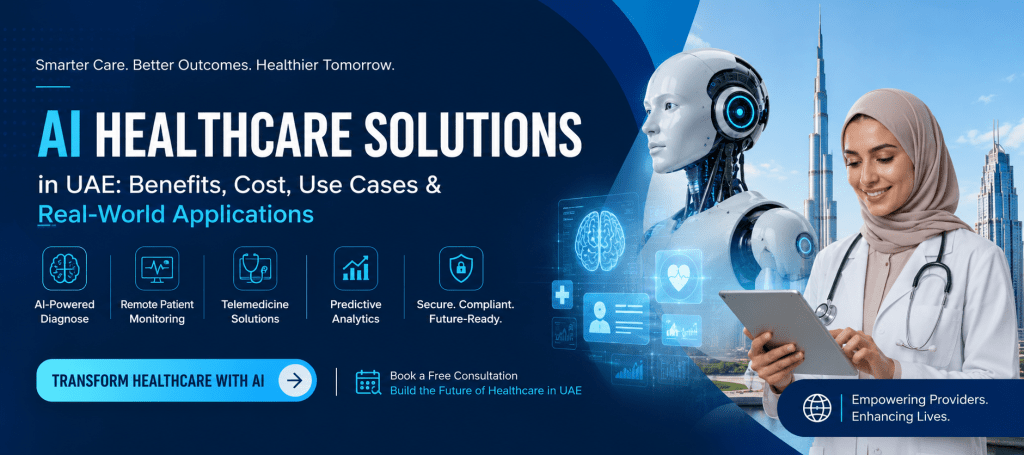
The UAE healthcare sector stands at a pivotal moment of transformation, where AI Healthcare Solutions are reshaping patient care, clinical efficiency, and digital healthcare innovation across the region.
The Hook: A Perfect Storm of Opportunity and Pressure
The UAE is aggressively modernizing its healthcare system — building smart hospitals, integrating unified health records, and positioning itself as a regional hub for medical innovation and tourism. At the same time, artificial intelligence adoption is accelerating at an impressive pace. Patient expectations have evolved dramatically: today’s individuals seek seamless, personalized, convenient, and tech-enabled experiences that match the quality of service they receive in other parts of their lives. Yet providers face mounting operational pressures — rising costs, clinician shortages, growing chronic disease burdens, and the need to serve a diverse, increasingly demanding population.
This combination creates both challenge and opportunity. Healthcare leaders who successfully harness AI and digital tools can deliver better clinical outcomes, dramatically improve efficiency, and exceed modern patient expectations — all while building more resilient, future-ready organizations.
Supporting Stats
- AI in Healthcare Market Growth: The UAE AI healthcare market was valued at approximately USD 39 million in 2024 and is projected to reach USD 337.9 million by 2033, expanding at a compound annual growth rate (CAGR) of 24.1%. Other analyses project even higher growth trajectories, with CAGRs ranging from 21% to over 36% depending on the scope and timeframe, reflecting strong momentum.
- Broader Digital Health Investment: The UAE digital health market is experiencing robust expansion, with estimates showing CAGRs around 23% in the coming decade. This reflects significant government and private-sector investment in infrastructure, electronic health records, telemedicine, and AI-enabled solutions.
- Adoption Trends: AI is already moving from pilot projects to real-world deployment across diagnostics, predictive analytics, patient monitoring, administrative workflows, and personalized care. Government initiatives under the UAE Artificial Intelligence Strategy 2031, combined with emirate-level programs, are accelerating adoption. Hospitals and clinics are increasingly turning to AI for everything from radiology support to operational optimization. Many forward-thinking providers are partnering with a specialized custom ai software application development company to accelerate development while ensuring full compliance with DHA, DoH, and national interoperability standards. Patient-facing tools like AI-powered telemedicine continue to gain strong traction.
ALSO READ- 20 Most Impactful AI Trends Reshaping Global Industries
In short, the foundation is in place. The technology is maturing. The will to innovate is strong. What remains is execution — turning these powerful tailwinds into tangible improvements in care quality, operational performance, and patient experience.
Why UAE Healthcare Sector Is Rapidly Investing in AI
The UAE isn’t just adopting AI in healthcare — it’s strategically embedding it as a core enabler of its long-term ambitions. Several powerful forces are converging, creating strong momentum for investment and implementation.
1. National Vision Driving the Agenda
At the heart of this push is the UAE Strategy for Artificial Intelligence 2031, which positions AI as a key pillar for economic diversification, service excellence, and societal well-being. Healthcare features prominently in the strategy, with goals to reduce chronic diseases, enhance preventive care, and deliver more personalized, efficient services. This aligns closely with the We the UAE 2031 vision, which aims to place the country among the world’s top 10 or 15 healthcare systems globally.
Government leadership at both federal and emirate levels is turning this vision into reality through coordinated digital health initiatives.
2. Foundational Digital Infrastructure
A standout strength is the UAE’s advanced health information exchange ecosystem:
- Malaffi (Department of Health – Abu Dhabi / DoH) — the region’s first major Health Information Exchange (HIE), giving authorized providers seamless access to patient records.
- NABIDH (Dubai Health Authority / DHA) — Dubai’s unified platform connecting hundreds of facilities and millions of records.
- Riayati — the federal bridge under the Ministry of Health and Prevention (MOHAP) that integrates Malaffi, NABIDH, and other systems into a national unified medical record framework.
These platforms create a rich, interoperable data foundation that makes AI not just possible, but highly effective. With billions of clinical records now accessible (with proper consent and governance), AI systems can deliver meaningful insights for diagnostics, predictive analytics, and population health management.
3. Smart Hospitals and Operational Excellence
The UAE is actively building and upgrading “smart hospitals” that leverage AI for everything from patient flow optimization and predictive maintenance to clinical decision support. In an environment of rising demand and operational costs, AI helps maximize resources, reduce waiting times, and ease administrative burdens on clinicians — giving them more time for patient care.
4. Addressing Workforce Shortages
Like many advanced economies, the UAE faces pressures around clinician availability and growing chronic disease burdens. AI is being deployed to optimize staffing, automate routine tasks, support recruitment and credentialing, and improve workforce planning. The goal is clear: stretch existing talent further while maintaining — or improving — quality of care.
5. Boosting Medical Tourism
Medical tourism remains a major economic driver. With hundreds of thousands of international patients visiting annually, the UAE is differentiating itself through cutting-edge technology. AI-powered diagnostics, personalized treatment pathways, robotic precision, and seamless patient experiences make the country even more attractive to global health travelers seeking high-quality, efficient care.
6. Serving a Multilingual, Multicultural Population
The UAE’s highly diverse resident and visitor population brings unique needs. AI excels here — powering multilingual chatbots, patient engagement tools, appointment reminders, and clinical support in Arabic (including Emirati dialect), English, and many other languages. This capability improves access, understanding, and satisfaction across the patient ecosystem.
In essence, the UAE’s rapid AI investment isn’t driven by hype — it’s a calculated response to national goals, operational realities, and patient-centered opportunities. By combining visionary policy, robust digital infrastructure (DHA, DoH, NABIDH, Malaffi, Riayati), and a forward-leaning ecosystem, the country is positioning itself to deliver smarter, more efficient, and more accessible healthcare.

What Are AI-Powered Healthcare Solutions?
AI-powered healthcare solutions represent the practical application of advanced technologies to real clinical, operational, and patient-facing challenges. Far from science fiction, these tools are already delivering measurable improvements in diagnostics, efficiency, personalization, and outcomes — especially in forward-looking markets like the UAE. Leading healthcare app development company providers are playing a key role in turning these technologies into user-friendly, compliant mobile and web platforms that integrate seamlessly with local healthcare systems.
Here’s a clear breakdown of the core technologies and how they come together to create intelligent healthcare systems.
1. Artificial Intelligence (AI) & Machine Learning (ML)
AI is the broad capability of machines to perform tasks that typically require human intelligence — reasoning, learning, and decision-making. Machine Learning (ML) is the primary way AI learns: by identifying patterns in large volumes of data and improving over time without being explicitly programmed for every scenario
In healthcare, many organizations partner with specialized machine learning development services providers to build custom models trained on local UAE patient data, enabling more accurate predictions and clinically relevant insights.
In healthcare, ML models analyze patient records, lab results, and population data to spot trends humans might miss. In the UAE, platforms like Malaffi already use AI and ML for predictive risk modeling to forecast future disease risks at a population level.
2. Predictive Analytics
This uses historical and real-time data to forecast future events. Examples include predicting patient deterioration, hospital readmissions, disease outbreaks, or even no-show appointments.
Predictive tools help shift healthcare from reactive to proactive — enabling earlier interventions and better resource planning. UAE initiatives are leveraging unified records from NABIDH, Malaffi, and Riayati to power these capabilities at scale.
3. Natural Language Processing (NLP)
NLP allows computers to understand, interpret, and generate human language. In healthcare, it extracts insights from unstructured clinical notes, physician dictations, discharge summaries, and patient messages.
Applications include automated clinical documentation, medical coding, and literature review. NLP powers AI scribes that reduce administrative burden and helps build richer, more usable datasets for clinical decision support systems.
4. Computer Vision
This technology enables machines to “see” and interpret medical images — X-rays, MRIs, CT scans, retinal photos, and pathology slides — often with accuracy rivaling or exceeding specialists in specific tasks.
In the UAE, tools like M42’s AIRIS-TB system process thousands of chest X-rays daily, significantly reducing radiologist workload while maintaining high detection standards. Similar solutions are deployed for cancer screening, diabetic retinopathy, and cardiovascular risk assessment.
5. Automation & Healthcare Automation
Automation handles repetitive, rule-based tasks such as appointment scheduling, claims processing, inventory management, and billing. When combined with AI, it becomes “intelligent automation” that adapts to exceptions and learns from outcomes.
By leveraging advanced automation and intelligent workflows through AI agent development services, healthcare providers can streamline patient coordination, automate repetitive operational tasks, improve clinical response times, and reduce the burden on frontline medical staff while maintaining high-quality patient care standards.
6. Agentic AI — The Next Evolution
While traditional AI responds to specific queries or performs narrow tasks, agentic AI consists of autonomous agents that can reason, plan multi-step processes, take actions, and adapt to achieve complex goals with minimal human supervision.
In healthcare, agentic systems might handle end-to-end care coordination, proactively adjust treatment plans based on incoming data, or manage administrative workflows across multiple systems. This emerging capability is gaining traction globally and aligns perfectly with the UAE’s ambition for truly intelligent healthcare systems.
7. Bringing It All Together: Intelligent Healthcare Systems & Clinical Decision Support
These technologies rarely work in isolation. They combine into comprehensive platforms that deliver clinical decision support — real-time, evidence-based recommendations at the point of care — while powering healthcare automation across the enterprise.
The result? Faster and more accurate diagnoses, reduced administrative burden on clinicians, personalized treatment pathways, and more efficient operations. In the UAE context, the rich, interconnected data foundation provided by DHA’s NABIDH, DoH’s Malaffi, and the national Riayati platform makes these solutions particularly powerful.
The technology exists today. The infrastructure is maturing rapidly. The real differentiator in the coming years will be how thoughtfully organizations select, integrate, and govern these solutions to deliver genuine value for patients and providers alike.

ALSO READ – MACHINE LEARNING IN HEALTHCARE WHAT ENTERPRISES MUST KNOW
7 Real AI Applications in UAE Healthcare
The UAE is moving beyond pilots to deploy AI solutions that deliver tangible improvements in care quality, speed, efficiency, and patient experience. Here are seven high-impact applications already transforming healthcare across the country.
1. AI Diagnostics & Medical Imaging
Computer vision powers some of the most mature AI use cases in the UAE today. AI systems analyze medical images with remarkable speed and consistency, supporting radiologists and enabling faster, earlier diagnoses.
- Airdoc, deployed at Medcare Hospital Al Safa in Dubai, uses AI-powered retinal imaging to detect over 35 eye conditions and assess risks for 9 systemic chronic diseases (including cardiovascular risks, diabetes, and hypertension) in minutes through a simple fundus scan.
- M42’s AIRIS-TB processes thousands of chest X-rays daily, significantly reducing radiologist workload while maintaining high accuracy in tuberculosis screening.
- GE HealthCare partners with UAE providers (including collaborations with M42) to deliver AI-enhanced imaging platforms that improve workflow, detection accuracy, and clinical decision-making.
These tools accelerate diagnosis, reduce reporting backlogs, and support earlier intervention — critical advantages in both urban hospitals and population screening programs.
2. AI-Powered Telemedicine Platforms
Telemedicine app development company has become a cornerstone of accessible care in the UAE, and AI is elevating it from basic video calls to intelligent, scalable platforms.
Leading telemedicine app development companies in the UAE now integrate AI for smarter patient journeys. Key capabilities include:
- AI triage that assesses symptoms upfront and directs patients to the right care level.
- Virtual consultations with real-time clinical decision support for physicians.
- Multilingual healthcare support (Arabic, English, and others) for the UAE’s diverse population.
- Expanded rural and remote healthcare access, reducing the need for travel to major cities.
These platforms improve convenience, reduce unnecessary hospital visits, and help manage demand across DHA and DoH networks.
3. Remote Patient Monitoring (RPM)
Wearables and connected devices, powered by AI, are transforming chronic care management. Solutions continuously track vital signs (heart rate, blood pressure, glucose, oxygen levels) and use predictive analytics to detect deterioration early.
- Predictive alerts notify clinicians before conditions worsen.
- Personalized insights support better chronic care management for diabetes, hypertension, heart failure, and post-discharge patients.
- Integration with national platforms like Malaffi and NABIDH enables seamless data flow into unified records.
RPM reduces hospital readmissions, empowers patients to manage their health, and eases pressure on inpatient resources.
4. AI Chatbots & Virtual Healthcare Assistants
AI chatbot development services and AI agent development services are in high demand as providers seek to automate routine interactions while maintaining a human touch.
Modern healthcare chatbots and virtual assistants handle:
- Appointment automation — scheduling, rescheduling, and reminders.
- Answering patient FAQs on medications, procedures, and insurance.
- Preliminary symptom checking with appropriate escalation to clinicians.
- Care coordination — follow-up reminders, lab result explanations, and post-treatment guidance.
Multilingual capabilities make these tools especially effective across the UAE’s multicultural population, improving engagement and reducing administrative workload for front-line staff.
5. Predictive Analytics in Hospitals
Predictive models analyze historical and real-time data to forecast events and optimize operations. Common applications include:
- Patient readmission reduction through risk scoring and targeted interventions.
- ICU monitoring with early warning systems for patient deterioration.
- Operational forecasting — predicting admission surges, bed occupancy, staffing needs, and emergency department flow.
Hospitals leveraging unified data from NABIDH, Malaffi, and Riayati gain a significant edge in proactive resource management and improved patient outcomes.
6. AI in Electronic Health Records (EHR)
AI transforms static records into intelligent records that actively support care. Key benefits include:
- Automatic summarization of patient history.
- NLP-driven clinical documentation that reduces typing burden.
- Smart alerts for drug interactions, care gaps, or guideline deviations.
- Enhanced interoperability and seamless integration with NABIDH (DHA), Malaffi (DoH Abu Dhabi), and the national Riayati platform.
This creates a more complete, actionable view of the patient, supporting better clinical decisions across fragmented care settings.
7. AI Agents in Healthcare Operations
This is one of the most exciting and future-focused areas. Agentic AI goes beyond narrow tools to autonomous, goal-oriented agents that manage complex workflows.
Applications include:
- Autonomous workflows that coordinate between departments and systems.
- AI scheduling optimized for clinician availability, patient urgency, and resource utilization.
- Care automation — from pre-authorizations to discharge planning.
- Broad administrative optimization — claims processing, inventory management, billing, and compliance.
By reducing manual overhead, AI agents free clinicians to focus on patients and help organizations operate more efficiently at scale.
These seven applications demonstrate that AI in the UAE healthcare sector is not experimental — it is operational and delivering results. Organizations that strategically combine these technologies with strong governance, change management, and integration to national platforms (DHA, DoH, NABIDH, Malaffi, Riayati) will lead the next wave of healthcare excellence in the region.
Cost of AI Healthcare Development in UAE
Investing in AI healthcare solutions in the UAE requires careful budgeting. While costs vary significantly based on scope and complexity, the long-term returns — through efficiency gains, better outcomes, and competitive advantage — often justify the investment, especially with strong government support and growing digital infrastructure.
Typical Development Cost Ranges (2026)
Here are realistic cost estimates for common AI healthcare solutions in the UAE market:
| Solution | Estimated Cost (USD) | Timeline | Key Features Included |
| AI Chatbot / Virtual Assistant | $20,000 – $50,000 | 2–4 months | Basic NLP, appointment booking, FAQs, multilingual |
| AI-Powered Telemedicine Platform | $60,000 – $150,000 | 4–8 months | Video consults, AI triage, EHR integration, payments |
| Remote Patient Monitoring (RPM) System | $80,000 – $250,000 | 5–9 months | Wearable integration, predictive alerts, dashboards |
| Enterprise AI Healthcare Platform | $200,000+ | 8–18+ months | Full integration, predictive analytics, agentic workflows, compliance |
Note: Prices are for custom development and can be 20-40% lower for white-label or heavily configured off-the-shelf solutions. Enterprise projects often include ongoing maintenance (15-25% annually).
Key Cost Factors in the UAE Market
Several variables influence the final investment required:
- Regulatory Compliance — Adhering to DHA, DoH, MOHAP, and federal data protection standards (including HIPAA-equivalent and local privacy rules) adds significant cost for security, audit trails, consent management, and clinical validation.
- Integrations — Connecting with NABIDH (DHA), Malaffi (DoH), Riayati, existing EHR/EMR systems, insurance portals, and lab/pharmacy networks is one of the biggest cost drivers. Deep, secure interoperability increases complexity and testing requirements.
- AI Models & Customization — Using pre-trained models keeps costs lower. Custom training on UAE-specific data (multilingual, local disease patterns, cultural nuances) or fine-tuning large language models raises expenses but delivers superior performance.
- Cloud Infrastructure & Security — Hosting on secure, scalable clouds (with local data residency requirements) plus robust cybersecurity, encryption, and redundancy adds to both initial and recurring costs.
- Scalability — Solutions designed for thousands of users, high concurrency (e.g., during peak seasons or medical tourism surges), and future expansion cost more upfront but reduce long-term expenses.
- Multilingual & Multicultural Systems — Supporting Arabic (including Emirati dialect), English, Hindi, and other languages with high accuracy requires advanced NLP, additional testing, and localization — an important investment for the UAE’s diverse population and medical tourism goals.
Other factors include project management, change management/training for clinical staff, ongoing model monitoring, and post-launch support.
Pro Tip: Many UAE providers start with a focused MVP (Minimum Viable Product) — such as an AI chatbot or RPM module — then scale into a full intelligent platform. This phased approach controls initial investment while proving ROI quickly.
Ready to build a cost-effective, compliant AI healthcare solution tailored for the USA?
Connect with SISGAIN’s healthcare AI specialists for a detailed project assessment and transparent pricing.
We deliver solutions optimized for NABIDH, Malaffi, and Riayati integration, multilingual excellence, and full regulatory compliance.
Regulatory & Compliance Challenges
Navigating the regulatory landscape is one of the most critical aspects of deploying AI in USA healthcare. The good news is that the UAE has created a clear, mature, and supportive framework that encourages innovation while protecting patients. However, non-compliance carries serious risks — including fines, license suspension, or operational restrictions.
Here’s what healthcare organizations and technology partners must address:
1. Emirate-Level Regulators
- Dubai Health Authority (DHA): Requires all AI solutions used in licensed facilities to comply with its Artificial Intelligence Policy. This includes clinical validation, transparency, ethical use, and mandatory integration with NABIDH. DHA emphasizes patient safety, explainability of AI decisions, and rigorous testing before deployment.
- Department of Health – Abu Dhabi (DoH): Enforces strict standards through the Responsible Artificial Intelligence Standard (2025) and oversees all AI development, procurement, and deployment in Abu Dhabi.
2. Cybersecurity & Information Security
- ADHICS (Abu Dhabi Healthcare Information and Cyber Security Standard): The mandatory cybersecurity framework for all healthcare entities in Abu Dhabi. It covers data protection, access controls, incident response, and risk management. ADHICS v2.0 sets high benchmarks for protecting sensitive health information.
- Cybersecurity Overall: Both DHA and DoH mandate robust measures including encryption, audit trails, breach notification (often within 24–48 hours), and regular penetration testing. Local data residency requirements often apply to sensitive patient data.
3. Data Privacy — PDPL
The Federal Personal Data Protection Law (PDPL) is the cornerstone of data privacy in the UAE. Key points relevant to AI:
- Health and biometric data are classified as sensitive personal data, requiring stronger protections and explicit consent mechanisms.
- Strict rules on processing, storage, sharing, and cross-border transfers.
- Data subject rights (access, correction, deletion, etc.) must be supported.
- Organizations must conduct Data Protection Impact Assessments (DPIAs) for high-risk AI processing.
4. Interoperability & Data Governance
AI systems must integrate securely with national platforms:
- NABIDH (DHA – Dubai)
- Malaffi (DoH – Abu Dhabi)
- Riayati (Federal connector)
Seamless, secure interoperability is mandatory. This demands standardized data formats, consent management, and strong governance to ensure data quality and patient privacy.
5. AI Governance & Ethics
UAE regulators expect organizations to implement:
- Clear accountability frameworks (including senior management oversight)
- Transparency and explainability of AI decisions, especially in clinical contexts
- Bias mitigation and fairness testing
- Continuous monitoring and auditing of AI model performance
- Ethical review processes aligned with national AI Strategy 2031
Common Challenges & How to Overcome Them
- High cost and complexity of compliance
- Managing multilingual data securely
- Ensuring AI models trained on diverse UAE population data
- Balancing innovation speed with regulatory approval timelines
Success Formula: Treat compliance as a foundational design requirement — not an afterthought. Leading organizations build solutions with privacy-by-design, security-by-default, and full auditability from day one.
Future of AI in UAE Healthcare
The UAE is not just adopting AI — it is positioning itself to lead the next wave of healthcare innovation globally. Backed by the UAE AI Strategy 2031 and strong national infrastructure (NABIDH, Malaffi, and Riayati), the coming years will see a shift from supportive AI tools to truly intelligent, proactive, and autonomous healthcare systems.
Here are the transformative technologies set to redefine care delivery in the UAE:
Generative AI
Generative AI will move beyond documentation to create personalized treatment plans, synthetic medical data for training, multilingual patient education materials, and even simulated clinical scenarios for doctor training. In the UAE’s diverse population, it will excel at generating culturally sensitive discharge instructions, consent forms, and preventive health guidance in Arabic, English, and other languages.
AI Agents & Autonomous Workflows
Agentic AI represents the biggest leap forward. These autonomous agents will handle complex, multi-step processes with minimal supervision — from end-to-end care coordination and insurance pre-authorizations to discharge planning and follow-up scheduling. Dubai’s initiatives to incubate Agentic AI in healthcare signal strong momentum, enabling hospitals to operate with greater efficiency and scalability.
Ambient AI
Imagine walking into a consultation room where AI quietly listens, understands context, documents the entire encounter, and suggests relevant insights in real time — without interrupting the doctor-patient relationship. Ambient AI (including ambient scribes) will dramatically reduce administrative burden, allowing clinicians to focus fully on patients.
Voice AI & Conversational Intelligence
Advanced voice AI will power natural, multilingual interactions for appointment booking, symptom reporting, medication reminders, and virtual health coaching. In a multilingual society like the UAE, voice-enabled systems will make healthcare more accessible and inclusive for all residents and medical tourists.
Edge AI
Processing data directly on devices (wearables, bedside monitors, portable scanners) will enable real-time insights with lower latency and enhanced privacy. Edge AI is particularly valuable for remote monitoring in remote areas or during high-volume periods such as medical tourism peaks.
Predictive & Preventive Healthcare
AI will shift the entire system from reactive treatment to truly predictive care. By combining genomics, wearable data, unified records from Malaffi and NABIDH, and population-level insights, models will forecast disease risks years in advance, enabling personalized prevention programs and dramatically reducing chronic disease burden.
The Intelligent Healthcare Ecosystem
These technologies will converge into fully autonomous workflows that optimize everything from hospital operations and supply chains to population health management. Smart hospitals of the near future will anticipate needs, self-optimize resources, and deliver hyper-personalized care at scale.
The UAE’s unique advantages — visionary leadership, robust digital infrastructure, diverse population data, and strong government-private partnerships (such as those led by M42) — position it exceptionally well to become one of the world’s most advanced AI-native healthcare systems
Why Healthcare Providers Choose SISGAIN
When UAE healthcare organizations decide to invest in AI and digital transformation, they choose a partner who understands both the technology and the local healthcare landscape. Here’s why leading providers across Dubai, Abu Dhabi, and the wider UAE trust SISGAIN.
Deep Healthcare Expertise Meets Cutting-Edge AI
SISGAIN brings specialized healthcare expertise combined with advanced AI integration capabilities. Our team has successfully delivered complex projects that align with DHA, DoH, and MOHAP requirements while leveraging the full potential of national platforms like NABIDH, Malaffi, and Riayati.
Comprehensive Technology Capabilities
- AI Integration & Intelligent Systems: From predictive analytics and computer vision to agentic AI and generative AI solutions, we build systems that deliver measurable clinical and operational impact.
- Telemedicine Capabilities: We develop robust, AI-powered telemedicine platforms with smart triage, seamless video consultations, and secure integrations.
- Healthcare App Development Services: Our end-to-end healthcare app development services create intuitive patient apps, clinician portals, and admin dashboards tailored to the UAE’s multilingual and multicultural environment.
- Scalable & Future-Ready Architecture: Solutions designed to grow with your organization — supporting increasing patient volumes, medical tourism, and expanding smart hospital initiatives.
UAE-Focused Solutions with Global Standards
We don’t offer generic solutions. Every project is customized for the UAE ecosystem:
- Full compliance with DHA, DoH, ADHICS, and PDPL requirements
- Deep interoperability with national health information exchanges
- Multilingual support (Arabic, English, and beyond)
- Culturally attuned user experiences for residents and international patients
Enterprise Healthcare Development Strength
As a trusted enterprise healthcare development partner, we handle complex, large-scale implementations — from pilot projects to full-scale intelligent healthcare platforms. Our solutions emphasize security, performance, and long-term maintainability.
Proven Results
- Faster time-to-market with compliant, regulation-ready solutions
- Reduced operational costs through intelligent automation
- Higher patient satisfaction and engagement
- Strong ROI through efficient workflows and better resource utilization
Healthcare leaders choose SISGAIN because we combine technical excellence with practical understanding of UAE healthcare challenges and opportunities.
1. How long does it take to implement an AI healthcare solution in the UAE?
Implementation timelines vary by project scope. Simple AI chatbots can be deployed in 2–4 months, while full AI-powered telemedicine platforms or enterprise solutions typically take 6–12 months, including integration with NABIDH, Malaffi, or Riayati, and full regulatory approvals.
2. Is AI in healthcare compliant with DHA, DoH, and PDPL regulations?
Yes — when built correctly. A reputable partner will design solutions with privacy-by-design, full ADHICS compliance, explainable AI, and complete audit trails. SISGAIN specializes in delivering regulation-ready solutions that meet all current DHA, DoH, and federal requirements.
3. What is the ROI timeline for AI investments in UAE healthcare?
Most organizations see measurable returns within 6–12 months. Common benefits include reduced administrative workload (20-40% time savings), lower readmission rates, decreased unnecessary visits through AI triage, and improved operational efficiency.
4. Can AI solutions integrate with our existing hospital systems and national platforms?
Absolutely. SISGAIN builds solutions with strong interoperability, enabling seamless integration with NABIDH, Malaffi, Riayati, existing EHR/EMR systems, insurance portals, and laboratory systems.
5. How does AI support multilingual patients in the UAE?
Advanced Natural Language Processing (NLP) allows AI systems to communicate fluently in Arabic (including Emirati dialect), English, Hindi, Urdu, and other languages. This improves patient engagement, understanding, and satisfaction across diverse populations and medical tourists.
6. Is patient data secure when using AI healthcare solutions?
Security is non-negotiable. Compliant solutions use encryption, role-based access, local data residency (where required), continuous monitoring, and ADHICS-compliant cybersecurity frameworks to protect sensitive health data.
7. Do we need to replace our current systems to adopt AI?
No. Most AI solutions are designed to enhance and integrate with your existing infrastructure. You can start with targeted solutions (chatbots, RPM, or imaging AI) and gradually scale into a full intelligent healthcare platform.
8. What makes SISGAIN different from other AI development companies?
SISGAIN combines deep healthcare expertise, proven UAE regulatory knowledge, and specialized healthcare app development services with advanced AI capabilities. We focus exclusively on building compliant, scalable, and culturally relevant solutions tailored for the UAE market — not generic global templates.