


Key Takeaways
- AI-driven ecommerce personalization increases conversion rates by up to 23%—retailers who aren’t using it are actively surrendering revenue to competitors who are.
- Retail chatbots powered by AI in e-commerce and retail lift sales by up to 67% while cutting customer support costs by 30%, making them one of the strongest ROI investments in the entire e-commerce tech stack.
- The global AI-enabled e-commerce market is projected to reach $8.65 billion by 2025—early adopters are already pulling ahead while slower competitors scramble to catch up.
- Shoppers assisted by AI convert at a 12.3% purchase rate versus just 3.1% for non-AI-assisted sessions—a 4x gap that compounds aggressively at scale.
- Implementing ecommerce AI solutions costs between $15,000 and $500,000+, depending on scope, but mid-market retailers consistently achieve full ROI within 6–14 months.
The rules of online retail have been rewritten. Consumers no longer compare you only against your direct competitors—they compare every shopping experience against Amazon, Nike, and Sephora. They expect personalized storefronts, instant answers, predictive recommendations, and delivery timelines that feel impossibly fast. When any brand in their feed delivers that level of experience, the bar is raised for everyone.
AI in ecommerce is the core infrastructure retailers are using to meet that bar. It is not a pilot program, a future roadmap item, or a luxury reserved for enterprise budgets. It is the operational backbone of every high-growth online retailer in 2025—and the gap between businesses that have deployed it and those that haven’t is widening every quarter.
The numbers are stark. The global AI-enabled e-commerce market is on track to hit $8.65 billion by 2025, expanding at a CAGR of 14.6% through 2030 (MarketsandMarkets, 2024). Retailers deploying AI for e-commerce websites report an average 25% increase in lead conversions. AI-assisted shoppers convert at a 12.3% purchase rate compared to 3.1% for non-AI sessions. That is not a marginal edge—it is a structural advantage.
Every use case in this guide is live, deployed, and generating measurable commercial returns right now. We have structured the content around revenue impact—the highest-return applications come first. You will also find real cost benchmarks, compliance considerations, and industry case studies so you can make a business decision, not just read another industry overview.
AI-Powered Personalization: The Engine Behind 23% Higher Conversions
If you want to understand where AI in online shopping delivers its most immediate commercial impact, personalization is the answer. When a shopper arrives on your site and every element—the product grid, the promotional banners, the email follow-up sequence—feels like it was assembled specifically for them, they buy. This is not a hypothesis. The data is definitive.
The Numbers:
- AI-powered personalization lifts conversion rates by up to 23% (Epsilon, 2024)
- Personalized product recommendation engines account for 35% of Amazon’s total revenue
- Shoppers who engage with personalized recommendations convert at 5.5x the rate of those who don’t (Barilliance, 2024)
- Personalized email campaigns generate 6x higher transaction rates than batch-and-blast sends (Experian, 2024)
How it works in practice: AI personalization engines ingest behavioral data streams—click patterns, scroll depth, session duration, cart abandonment signals, purchase history, device type, time of day—and construct individual customer profiles that update in real time. Each subsequent visit to your site dynamically renders a different product grid, promotional offer, and recommended content path based on that customer’s specific behavioral fingerprint.
The enterprise standard is collaborative filtering combined with deep learning models. Retailers like ASOS, Zalando, and H&M use these systems to serve individualized homepage experiences to tens of millions of users simultaneously. But mid-market platforms—Nosto, LimeSpot, and Barilliance—have brought the same underlying functionality within reach of businesses in the $500K–$50M annual revenue range.
The business case for personalization extends well beyond the conversion rate headline. Customer lifetime value rises dramatically when every touchpoint is contextually relevant to that individual. Retention rates improve 15–20% in the first year of AI personalization deployment, compounding over time in ways that make the initial investment look conservative in retrospect.
Building this capability from the ground up starts with a robust AI software development solution that integrates with your existing ecommerce stack without requiring a full platform migration.
AI Chatbots and Conversational Commerce: 67% More Sales, 30% Lower Support Costs
Retail chatbots represent the highest-volume AI deployment in ecommerce—and the ROI profile is one of the most compelling in the technology sector. A well-deployed conversational AI system does something almost no other investment achieves: it simultaneously increases revenue and reduces operational costs.
Industry Data:
- Retail chatbots increase sales by 67% (Salesforce, 2024)
- Businesses deploying AI chatbots for customer service reduce support costs by 30% on average (IBM, 2024)
- 80% of routine customer questions are now handled without human intervention by modern AI chatbots
- Lead conversion rates improve by 25% for ecommerce stores that deploy chatbots on landing and product pages
The commercial mechanism is straightforward. AI chatbots eliminate friction at every stage of the buyer journey. A shopper confused about sizing gets an accurate answer in seconds instead of abandoning to find a competitor. A customer who left their cart at checkout receives a personalized, timely re-engagement. A post-purchase customer with a return question gets resolution in under two minutes instead of waiting 48 hours for email support.
The more sophisticated deployments use AI and machine learning in ecommerce conversational systems not just for reactive support but for active selling. These platforms identify high-intent browsing signals and proactively initiate product conversations—asking qualifying questions, surfacing the right SKUs, and guiding shoppers toward their optimal selection. This is especially powerful in considered-purchase categories: electronics, furniture, and fashion, where customers have specific requirements but need help translating those requirements into the right product.
Case Study—Fashion Retailer, $18M Revenue: A fashion eCommerce brand implemented a conversational AI chatbot across their product pages and cart flow in Q1 2024. Results within 90 days:
- Cart abandonment dropped from 74% to 51%
- Average order value increased by $22
- Support ticket volume fell 41%
- Annualized revenue impact: $2.1M
- Total deployment cost: $47,000, including integration and first-year licensing
Predictive Inventory Management: Cut Costs by 25% While Eliminating Stockouts
Inventory mismanagement is one of the largest preventable costs in retail. Overstocking ties up working capital and triggers margin-destroying clearance events. Understocking produces stockouts that push customers directly to competitors, often permanently. Traditional inventory systems react to what already happened. AI-driven ecommerce inventory systems predict what is about to happen and act before the problem materializes.
Financial Impact:
- Retailers using AI-powered inventory management reduce inventory costs by 25–30% (McKinsey, 2024)
- Stockout rates drop by 50% in the first year of AI deployment (Gartner, 2024)
- Excess inventory decreases by 30–40% within 18 months
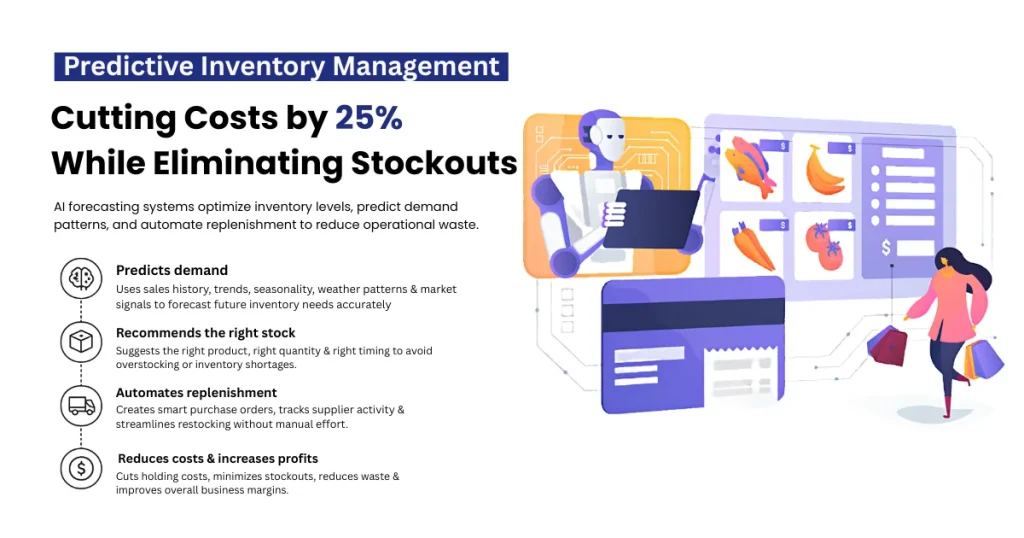
AI and machine learning models for inventory analyze thousands of simultaneous variables: historical sales velocity at the SKU level, seasonal demand curves, promotional lift coefficients, supplier lead time variability, competitor pricing signals, and increasingly, external signals like weather patterns and social media trend data. The output is a dynamic replenishment model that continuously calculates the optimal order quantity, supplier selection, and timing for every product in your catalog.
This growing reliance on AI-driven inventory optimization also reflects the rising UAE eCommerce logistics software demand, as retailers invest in smarter warehouse management, order fulfillment, and end-to-end supply chain visibility.
The commercial impact extends beyond cost reduction. When the right product is consistently in stock, customer satisfaction improves, repeat purchase rates increase, and review scores trend upward. For categories like FMCG, health and beauty, and consumer electronics, availability is frequently the primary driver of brand loyalty—making AI inventory management both a cost and a retention play simultaneously.
Real-World Result: A major global fashion retailer deployed AI-driven inventory management across thousands of store locations worldwide. The system reduced overall inventory levels by 20% while simultaneously improving product availability by 15%. Working capital was freed as a result: approximately $2.8 billion annually. For businesses looking to build demand forecasting models tailored to specific product categories and supplier networks, partnering with a specialist machine learning development company ensures the architecture accounts for the unique complexity of your supply chain.
Dynamic Pricing Intelligence: Capturing Margin in Real Time
Pricing is one of the highest-leverage variables in ecommerce—yet most retailers are managing it with tools built for a slower era. Static price lists updated weekly or monthly cannot compete against AI and e-commerce pricing systems that adjust dozens of times per day in response to real-time market signals. The gap in pricing sophistication is a direct gap in margin capture.
The Revenue Case:
- Retailers using AI dynamic pricing see average revenue increases of 8–12% with no change in traffic or conversion rate (Pros Holdings, 2024)
- Airlines—the earliest aggressive adopters—generate 15–20% more revenue per seat with AI pricing versus fixed pricing models
AI pricing models process competitor prices continuously, assess inventory levels and days-to-sell targets, incorporate demand elasticity models by product category, and layer in customer segment data to build a price that maximizes margin at each moment for each customer type. The result is not necessarily lower prices—sophisticated AI pricing systems frequently raise prices when demand signals are strong, inventory is constrained, or the purchasing audience shows lower price sensitivity. This dynamic margin capture is largely invisible to customers but highly visible to your P&L.
Legal note: Dynamic pricing must comply with consumer protection regulations in your operating markets. Algorithmic price discrimination based on protected characteristics creates significant legal exposure. Any dynamic pricing deployment should be reviewed for compliance before going live.
AI-Driven Visual Search: Capturing High-Intent Shoppers Your Competitors Miss
Visual search is among the most commercially underutilized AI capabilities in ecommerce today—which is precisely what makes it such a significant competitive opportunity. A shopper who cannot find the words to describe what they want but can photograph it represents a high-intent buyer that traditional search completely fails to serve. AI in retail and ecommerce visual search captures them at the exact moment of intent.
Commercial Data:
- Visual search is projected to generate $40 billion in e-commerce revenue by 2025 (Gartner)
- Shoppers who use visual search are 3x more likely to purchase than those who use text search
- Pinterest reports 600 million visual searches monthly, the vast majority with direct commercial intent
The technology works by training deep learning models on your product image database. When a customer uploads a photo—a jacket worn by someone they follow on Instagram, a piece of furniture from a design magazine, shoes spotted on the street—the AI identifies visual attributes (color, pattern, material, silhouette, style aesthetic) and returns the closest matches from your catalog in under 500 milliseconds.
For fashion, home decor, furniture, and lifestyle verticals, visual search transforms discovery by removing the vocabulary barrier that causes high-intent customers to leave without converting.
Case Study—Home Decor Retailer: Wayfair deployed visual search across their mobile app in 2023. Within six months, sessions using visual search converted at 2.3x the rate of standard text search sessions. Mobile revenue attributable to visual search grew to represent 11% of total app revenue by Q4 2023.
Retailers like iHerb also demonstrate the growing importance of intelligent product discovery, personalized recommendations, and seamless online shopping experiences. Our detailed iHerb Review 2026 explores how these features, along with pricing, shipping, and product selection, contribute to a better customer experience and higher customer retention.
AI-Powered Fraud Detection: Stop Losing Revenue You’ve Already Earned
Ecommerce fraud is a direct, ongoing tax on your revenue. Global e-commerce fraud losses reached $48 billion in 2024 (Juniper Research)—and the figure grows alongside transaction volumes every year. Traditional rule-based fraud systems have two structural weaknesses: they generate excessive false positives that block legitimate customers, and they are easily circumvented by sophisticated fraud actors who learn your rules and route around them.
The Business Case:
- AI fraud detection systems reduce chargebacks by up to 40% (Kount, 2024)
- False positive rates drop by 70% compared to rule-based systems
- Revenue recovered from reduced false positives alone averages $150,000–$400,000 annually for mid-market ecommerce businesses
Machine learning fraud models evaluate hundreds of behavioral signals simultaneously: device fingerprinting, IP reputation, typing cadence, session behavior patterns, order velocity, shipping address anomalies, and deviations from historical purchasing patterns. Each transaction receives a real-time fraud probability score, allowing legitimate orders to be approved instantly while anomalies are routed for review.
Critically, AI fraud models continuously improve. Every confirmed fraud case and every confirmed false positive feeds back into the model, progressively sharpening its accuracy. Rule-based systems don’t learn—they require your team to manually update rules every time fraud patterns evolve, which sophisticated fraud actors exploit systematically.
Legal & Compliance Context: Fraud detection AI must comply with GDPR, CCPA, and PCI DSS standards. Any fraud model processing personal behavioral data must include data minimization principles, customer consent mechanisms, and right-to-explanation provisions. Automated rejection of legitimate customers based on protected demographic characteristics creates significant legal exposure—require bias audit reports from any fraud AI vendor before procurement.
Hyper-Personalization and CRM: From Segments to Individual-Level Marketing
Traditional CRM divides customers into segments: high-value, lapsed, and first-time buyers. AI in ecommerce hyper-personalization eliminates segments entirely. Every customer becomes a segment of one. The marketing experience delivered to each individual is dynamically assembled from their behavioral history, purchase patterns, communication preferences, predicted purchase timing, and lifetime value score.
Revenue Impact:
- Hyper-personalized email campaigns achieve 6x higher transaction rates than standard campaigns (Experian)
- Personalized push notifications show 3x higher open rates and 4x higher conversion rates than generic messages
- CLV increases by an average of 18–25% in the first year of hyper-personalization deployment
Effective hyper-personalization architecture requires three connected layers: a unified customer data platform (CDP) that aggregates all touchpoint data in real time; a predictive modeling layer that scores each customer for churn risk, purchase propensity, optimal offer timing, and preferred communication channel; and a dynamic content delivery system that assembles personalized communications automatically without manual creative input for each individual.
This goes significantly beyond what standard email marketing platforms provide. It requires purpose-built AI infrastructure—and the commercial returns justify the investment for any e-commerce business with more than 10,000 active customers. For detailed implementation guidance and technology comparisons, the AI-powered hyper-personalization CRM deep-dive covers everything you need to build this capability.
AI Search and Merchandising: Fix the Search Box That’s Costing You Sales
On-site search is one of the most neglected high-return revenue channels in ecommerce. Visitors who use site search convert at 2–3x the rate of non-searchers—yet most ecommerce stores are running decade-old keyword-matching systems that return irrelevant results, miss synonyms, fail entirely on natural language queries, and offer no understanding of shopping intent.
The Cost of Poor Search:
- 68% of shoppers who receive poor search results abandon the site immediately (Baymard Institute, 2024)
- Ecommerce businesses with effective AI search see average revenue increases of 8–15% from search-driven sessions
- AOV for AI search users is consistently 12–18% higher than for keyword search users
AI-powered search understands intent, not just character strings. A shopper who types “something for a beach vacation under $100” receives results the algorithm interprets as lightweight, casual, seasonal, and price-filtered—without requiring the customer to use retail-specific vocabulary. Natural language processing, vector search architecture, and multimodal search capabilities are what separate modern AI search from legacy systems still powering most ecommerce sites today.
Beyond the search bar, AI merchandising tools automatically optimize product ranking on category pages using real-time performance signals. Products with high conversion history, strong margin, low return rates, and sufficient inventory rank higher. Items trending on social or gaining momentum in competitor searches receive boosted visibility. This automated merchandising intelligence replaces weeks of manual work by your merchandising team every month.
AI-Powered CLV Prediction: Know Exactly Which Customers Are Worth Fighting For
Not all customers are equal—and ecommerce AI solutions can tell you precisely which customers justify aggressive acquisition investment, which ones to nurture for retention, and which ones are consuming marketing budget without commercial return. CLV prediction models are among the highest-ROI AI applications in ecommerce because they directly inform your most expensive business decisions: acquisition budgets, retention campaign spend, and discount strategy.
Commercial Case:
- Ecommerce businesses using AI CLV models reduce customer acquisition costs by 20% on average by concentrating spend on high-propensity lookalike audiences (McKinsey, 2024)
- Retention campaigns targeted using AI CLV scores achieve 35% higher response rates
- Marketing budget efficiency improves by 15–25% in the first year of CLV model deployment
AI CLV models synthesize purchase frequency, average order value, category breadth, return rate, seasonal purchase cadence, brand engagement signals, and cohort performance data into a single ranked, scored customer list updated daily. The output enables surgical resource allocation rather than equal-weight distribution across your entire customer base.
Practical applications: identifying high-CLV customers for VIP program enrollment before they reach that threshold; flagging at-risk high-value customers for proactive retention outreach; excluding low-CLV customers from expensive promotional campaigns; and building lookalike audience models for paid acquisition targeting the behavioral profile of your top 20% of customers.
AI-Enabled Supply Chain and Logistics: Last-Mile as a Competitive Weapon
Delivery speed and reliability have crossed the threshold from differentiator to baseline expectation. Consumers treat 2-day delivery as standard, and same-day delivery is becoming the norm in urban markets across virtually every product category. AI-driven ecommerce logistics infrastructure enables retailers to meet these expectations while containing the cost of fulfillment—a combination that is almost impossible to achieve with traditional logistics technology.
The Numbers:
- AI-optimized routing reduces last-mile delivery costs by 10–15% (DHL, 2024)
- Delivery ETA accuracy improves from 72% to 94% with AI logistics models, directly reducing failed delivery attempts and support contacts
- Returns processing time drops by 30% when AI handles routing and restocking decisions automatically
AI logistics systems optimize in real time across multiple variables simultaneously: warehouse location selection for each individual order, carrier scoring based on cost, speed, and reliability, route optimization incorporating live traffic and weather, and proactive customer communication that notifies shoppers of any delay before they ever need to contact support.
For e-commerce businesses building custom fulfillment infrastructure, this capability is best developed as part of a comprehensive e-commerce app development service that integrates AI logistics modules directly with your warehouse management system, order management platform, and customer-facing tracking experience.
Complete AI in Ecommerce Cost Guide for 2025
Uncertainty about cost is one of the most common blockers to AI adoption in retail. The investment range is genuinely wide, but the right investment tier for your business size and objectives is more predictable than it appears.
Implementation Cost by Business Size
| Business Size | Annual Investment | ROI Timeline | Best Starting Point |
| Small ($500K–$5M revenue) | $2,000–$15,000/yr | 3–6 months | AI Chatbot + Basic Recommendations |
| Mid-Market ($5M–$50M) | $15,000–$120,000/yr | 6–12 months | Personalization + Inventory AI |
| Large Enterprise ($50M–$500M) | $120,000–$500,000/yr | 12–18 months | Full-Stack AI Platform |
| Global Retailer ($500M+) | $500,000–$5M+/yr | 18–36 months | Custom AI + Proprietary Models |
Monthly Cost Breakdown by AI Application
| Application | Entry | Mid-Market | Enterprise | Key Cost Driver |
| AI Personalization Engine | $200–$800 | $2,000–$8,000 | $20,000+ | Catalog size + traffic |
| AI Chatbot | $50–$500 | $1,000–$5,000 | $10,000–$50,000 | Conversations + integrations |
| Predictive Inventory AI | $500–$2,000 | $3,000–$12,000 | $30,000+ | SKU count + supplier feeds |
| Dynamic Pricing AI | $300–$1,500 | $2,000–$10,000 | $25,000+ | Catalog depth |
| AI Fraud Detection | $200–$1,000 | $1,500–$6,000 | $15,000+ | Transaction volume |
| Visual Search | $1,000–$3,000 | $5,000–$20,000 | $50,000+ | Image catalog size |
| AI Search & Merchandising | $500–$2,000 | $3,000–$10,000 | $25,000+ | Traffic + catalog size |
| CLV Prediction Models | $1,000–$5,000 (setup) | $10,000–$30,000 (setup) | $50,000+ custom | Customer database size |
Hidden Costs Most Retailers Fail to Budget
The license fee or SaaS subscription is only one component of true AI ownership cost. Retailers who plan only for the tool cost consistently face budget overruns:
Integration and API Development: $5,000–$50,000 depending on existing tech stack complexity. Most AI tools require custom integration work to connect with your OMS, PIM, ERP, and CRM systems.
Data Preparation and Cleansing: AI models require clean, structured, consistent data to function accurately. For retailers with years of inconsistent historical data, preparation can cost $10,000–$100,000.
Training and Change Management: $2,000–$20,000 for staff training, process documentation, and workflow redesign across affected teams.
Ongoing Model Maintenance: AI models degrade over time as consumer behavior evolves. Budget 15–20% of your initial AI investment annually for model retraining and performance monitoring.
Compliance and Legal Review: $5,000–$25,000 for GDPR, CCPA, and consumer protection compliance review—a non-negotiable cost for any system processing customer personal data.
Traditional Ecommerce vs. AI: Performance Comparison
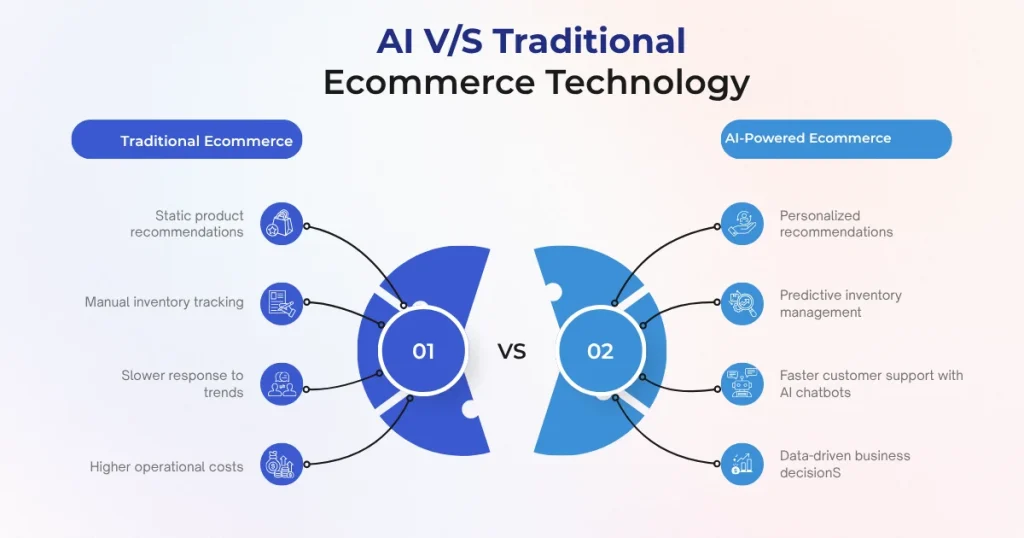
| Function | Traditional Approach | AI-Powered Approach | Measurable Uplift |
| Product Recommendations | Rule-based (top sellers, same category) | Behavioral ML (individual-level, real-time) | +35% revenue per session |
| Customer Service | FAQ pages, 24–48 hr email queue | Instant AI chatbot, 80% auto-resolved | −30% support costs, +25% lead conversions |
| Inventory Management | Historical averages + buyer judgment | Predictive AI (demand, seasonality, supplier risk) | −25% inventory costs, −50% stockouts |
| Pricing | Manual updates, periodic competitor checks | Real-time dynamic AI (100+ signals) | +8–12% revenue, +5% margin |
| Site Search | Exact/phrase keyword matching | NLP + vector search (intent-based) | +15% search conversion, +12% AOV |
| Fraud Detection | Rule-based fixed thresholds | ML anomaly detection (adaptive, real-time) | −40% chargebacks, −70% false positives |
| Email Marketing | Segment-based (5–10 groups) | Hyper-personalized (individual triggers) | 6x higher transaction rate |
| Demand Forecasting | Statistical models (historical only) | AI multi-variable (history + external signals) | 20–30% better accuracy |
Legal, Security, and Compliance Framework
The legal landscape governing AI for ecommerce websites is evolving at a pace that has caught many retailers off guard. Deploying AI without a compliance framework exposes your business to regulatory penalties, reputational damage, and civil liability.
Data Privacy Regulations
GDPR: Any AI system processing personal customer data in regulated markets must meet core requirements: lawful basis for processing, data minimization, right to explanation for automated decisions, and data retention limits. Fines reach up to 4% of global annual revenue or €20 million, whichever is higher.
Consumer Privacy Regulations (US): Requirements cover transparency around data collection, deletion requests within 45 days, and opt-out mechanisms for AI personalization and targeting systems. Similar legislation is now active or pending in 18+ US states as of 2025.
International Privacy Regimes: Global retailers must account for evolving digital privacy laws across markets, particularly those with data localization requirements that directly affect AI systems processing customer data for buyers in those regions.
AI-Specific Regulatory Developments
The EU AI Act classifies certain AI applications as high-risk—including systems that materially influence consumer purchasing decisions. Ecommerce AI that crosses this threshold may require conformity assessments, transparency obligations, and human oversight provisions. Dynamic pricing systems, AI-generated content, and chatbots all face transparency requirements, including the obligation to disclose AI identity when directly asked.
Security Requirements
Model Security: AI models are themselves attack surfaces. Model inversion attacks can extract training data, including customer PII. Require model security audits and adversarial testing results from any AI vendor before contracting.
API Security: Recommendation and personalization APIs must be secured with OAuth 2.0 or API keys, rate-limited, and monitored for anomalous query patterns.
Data Pipeline Security: Behavioral data feeding AI models must be encrypted in transit (TLS 1.3) and at rest (AES-256), with least-privilege access controls throughout.
Third-Party AI Vendor Due Diligence: Before signing any AI vendor contract, require: SOC 2 Type II report, penetration testing results, full subprocessor list, data residency confirmation, and an incident notification SLA (typically 72 hours).
Industry Case Studies: AI Delivering Measurable Revenue
Fashion & Apparel: Stitch Fix — AI as the Entire Business Model
Stitch Fix has built its company architecture around AI personalization at its core. Machine learning models analyze 85 style attributes per garment and 50+ preference signals per customer, generating individualized selections for 4+ million active clients. Revenue per active client is 3.5x higher than comparable styling subscription services using human-only curation. Inventory sell-through efficiency—garments purchased that sell without markdown—runs 22% above the industry average for fashion retail.
Consumer Electronics: Best Buy — AI Reducing Returns by 20%
Best Buy deployed an AI recommendation engine specifically targeting their highest operational cost: product returns. By improving recommendation accuracy so customers receive products genuinely matched to their use case, Best Buy reduced returns on AI-influenced purchase paths by 20% within 12 months. At their scale, a 20% reduction in returns represents approximately $300M in annual cost avoidance. The system achieved full payback in under 60 days.
Grocery & FMCG: Ocado — 99.1% Warehouse Accuracy at Scale
Ocado’s Smart Platform deploys AI and robotics simultaneously across demand forecasting, warehouse operations, and delivery routing. Their AI demand forecasting system reduced food waste by 40% with a three-week demand horizon at SKU level. The warehouse AI processes 3.5 million items daily at 99.1% pick accuracy—a figure manual operations cannot approach. Ocado now licenses this platform to global grocery retailers, generating a technology revenue stream representing 18% of total company revenue.
Health & Beauty: Sephora—2.5x Conversion via AI Virtual Try-On
Sephora’s Virtual Artist feature allows customers to virtually try on makeup using augmented reality and AI color matching technology. Sessions including virtual try-on convert at 2.5x the rate of sessions without it. Average order value for virtual try-on sessions is $35 higher than standard sessions, and returns on AI-influenced beauty purchases are 30% below the category average because customers receive products more accurately matched to their actual skin tone and preferences.
Where AI in Ecommerce Is Heading Through 2027
The applications covered here represent the current standard—not the ceiling. For retailers who want to understand what AI and ecommerce will look like over the next two to three years and position their technology roadmap ahead of the next wave of capability deployment, the latest AI trends analysis covers the emerging developments that will define retail AI through 2027.
The trajectory is clear: AI in ecommerce will move from optimizing existing purchase flows to creating entirely new commerce models—autonomous shopping agents, predictive replenishment that operates without explicit customer initiation, and generative AI storefronts that construct individualized shopping experiences from the ground up for every session.
Final Thoughts:
Every retailer reading this guide is at a different point in their AI journey. Some are evaluating a first chatbot deployment. Others are architecting a full-stack AI platform. What they share is a common commercial reality: the performance gap between AI-driven ecommerce operators and traditional retailers is not static — it compounds every quarter that the decision is delayed.
The businesses that adopt AI in ecommerce now are not just gaining a tool. They are building a data asset—customer behavioral history, model training data, optimization cycles—that becomes increasingly difficult for later entrants to replicate. First-mover advantages in AI compound in ways that almost no other technology investment does.
SISGAIN has delivered AI and ecommerce technology solutions for retail and digital commerce businesses across global markets. Our engineering teams have built personalization engines, inventory AI systems, conversational commerce platforms, and custom machine learning models for clients ranging from $2M Shopify stores to $500M+ multichannel retail operations.
If you are ready to move from evaluation to implementation, our team will deliver a no-obligation technical assessment of your current stack, a prioritized AI roadmap aligned to your specific revenue goals, and a transparent implementation cost breakdown within five business days.

Connect with SISGAIN today and let our AI eCommerce specialists build the technical business case for your specific situation—including projected ROI, implementation timeline, and a stack recommendation tailored to your existing technology.
FAQ’s
How much does it cost to implement AI in an e-commerce business?
The range runs from $2,000 to $500,000+ annually, depending on business size, use case complexity, and whether you use off-the-shelf SaaS tools or custom-built solutions. Full ROI is typically achieved within 6–18 months, with simpler deployments returning investment in as little as 90 days.
What is the ROI of AI in e-commerce—is it actually worth the investment?
For businesses with sufficient scale and clean historical data, the ROI of AI in ecommerce ranks among the strongest in the entire technology investment landscape. AI personalization alone returns $5–$10 for every $1 invested within 12 months, according to industry benchmarks.
Do I need a dedicated data science team to implement AI in my e-commerce store?
No. Modern AI SaaS platforms for ecommerce are specifically engineered for teams without data science expertise. Tools like Klaviyo (AI email), Yotpo (AI loyalty), Nosto (AI personalization), and Gorgias (AI customer support) are configured through visual interfaces with pre-built ecommerce integrations that deploy in weeks, not months.
How long does it take to implement AI solutions in an e-commerce business?
SaaS AI tools typically deploy in 2–8 weeks, including integration and data connection. Custom AI development projects range from 3 months for a single-use-case model to 18+ months for a full-stack proprietary AI platform.
Is AI in eCommerce secure? What are the risks?
Ecommerce AI systems carry both technical and regulatory risk. Technical risks include adversarial attacks on ML models, data pipeline vulnerabilities, and API security exposure. Regulatory risks include GDPR and CCPA non-compliance, FTC enforcement for deceptive AI practices, and EU AI Act requirements for high-risk applications. A proper compliance review before deployment is non-negotiable.
What AI application should an e-commerce business implement first?
For most businesses, AI chatbots and AI personalization deliver the fastest ROI at the lowest implementation complexity. Both directly address the two biggest revenue problems in ecommerce: cart abandonment and insufficient conversion rates.
What data does my business need to use AI effectively in e-commerce?
Requirements vary by application. Personalization requires 6+ months of transaction history and session behavioral data. Demand forecasting requires 12–24 months of sales history at SKU level, plus your promotional calendar and relevant external event data. Your AI vendor or implementation partner should audit your data readiness before scoping the project.