

Choosing a healthcare app development company in Dubai is not only a design or coding decision. It is a business, compliance, security, and patient experience decision.
Healthcare apps handle sensitive patient information, clinical workflows, prescriptions, payments, insurance details, reports, and doctor-patient communication. A small mistake in architecture, access control, or integration can create serious operational and legal risks.
For hospitals, clinics, pharmacies, diagnostic labs, telemedicine startups, and digital health companies in the UAE, the right development partner should understand:
- Healthcare workflows
- Patient data security
- UAE and Dubai compliance expectations
- EHR/EMR integration
- Telemedicine and remote patient monitoring models
- Scalable app architecture
- Long-term maintenance and support
The wrong vendor may lead to:
- Compliance issues
- Budget waste
- Delayed launch
- Poor patient adoption
- Weak security
- Integration failure
- Post-launch maintenance problems
This guide gives you a practical checklist to select the right healthcare app development partner Dubai businesses can trust for secure, scalable, and compliance-ready digital health products.
Key Takeaways
- The best healthcare app development company in Dubai should understand healthcare workflows, compliance, security, EHR/EMR integration, and long-term support.
- Healthcare app development cost in Dubai can range from AED 80,000 to AED 1,000,000+ depending on features, complexity, integrations, and compliance needs.
- Important healthcare app features include appointment booking, video consultation, e-prescriptions, secure payments, admin dashboards, and patient data protection.
- Before hiring a vendor, check their healthcare portfolio, security practices, integration experience, source code ownership terms, and post-launch support.
What Is a Healthcare App Development Company?
A healthcare app development company in Dubai builds secure digital platforms for hospitals, clinics, pharmacies, diagnostic labs, doctors, patients, and healthcare startups. A reliable healthcare software development company UAE offers healthcare app development Dubai, web platforms, admin panels, integrations, and custom healthcare app development based on clinical, operational, and compliance needs.
These companies create apps for appointment booking, telemedicine, EHR/EMR access, pharmacy delivery, lab bookings, remote monitoring, hospital management, and patient engagement.
Why Dubai Healthcare Businesses Need Specialized App Development Partners
Dubai’s healthcare ecosystem is moving fast. Patients now expect digital-first access to care, including online appointments, video consultations, digital prescriptions, lab reports, and secure messaging.
A generic app agency may know mobile development, but healthcare requires more than standard app features. You need a partner that understands healthcare operations and risk.
A specialized healthcare app development partner helps with:
- Dubai’s digital healthcare growth: Hospitals, clinics, pharmacies, and health-tech startups are investing in connected patient platforms.
- Patient expectations: Users expect simple booking, fast access to doctors, secure payments, and real-time updates.
- Sensitive data privacy: Patient records, prescriptions, reports, and medical history need strong data protection.
- Secure integrations: Healthcare apps often connect with EHR/EMR systems, labs, pharmacies, insurance providers, and payment gateways.
- Compliance-ready development: Compliance should guide app design from day one.
- Telemedicine growth: Video consultations, e-prescriptions, and remote care require stable and secure systems.
- Remote patient monitoring: Wearables and connected devices support chronic care, elderly care, and post-treatment monitoring.
- AI in healthcare apps: AI chatbots, symptom checkers, predictive analytics, and automation can improve service delivery when implemented with proper safety and compliance controls. To explore real tools before planning your AI roadmap, read our guide on AI healthcare solutions in 2026 with pricing, features, benefits, and real-world case studies.
- EHR/EMR integration: Clinical data should move safely between systems using structured standards such as HL7 and FHIR.
If your app will manage patient data or clinical services, choose a vendor with healthcare-specific development experience.
Types of Healthcare Apps a Development Company Can Build
| Healthcare App Type | Best For | Key Features |
|---|---|---|
| Telemedicine app | Clinics, hospitals, digital health startups | Video consultation, doctor profiles, appointment booking, e-prescription, chat, payments |
| Doctor appointment app | Clinics, hospitals, specialist centers | Doctor search, slot booking, reminders, payments, cancellation, patient records |
| Remote patient monitoring app | Chronic care, elderly care, home healthcare | Wearable integration, vitals tracking, alerts, dashboards, care plans |
| EHR/EMR app | Hospitals, clinics, doctors | Patient records, medical history, prescriptions, lab reports, clinical notes |
| Pharmacy delivery app | Pharmacies, online medicine platforms | Medicine catalog, prescription upload, order tracking, payments, refills |
| Lab booking app | Diagnostic labs, hospitals | Test booking, home sample collection, report access, payments, notifications |
| Hospital management app | Multi-specialty hospitals, clinics | Patient management, doctor schedules, billing, reports, admin dashboard |
| Fitness/wellness app | Wellness brands, preventive care startups | Activity tracking, diet plans, coaching, wearable sync, reminders |
Must-Have Features in a Healthcare App
A strong healthcare app should support different users with role-based features. Patients, doctors, and admins need separate workflows.
Patient App Features
- Patient registration
- Appointment booking
- Video consultation
- Prescription access
- Medical history
- Lab reports
- Online payment
- Push notifications
- Medicine reminders
- Secure chat
Doctor App Features
- Doctor dashboard
- Appointment management
- Patient history
- Consultation notes
- E-prescription
- Video consultation
- Report review
- Follow-up reminders
Admin Panel Features
- User management
- Doctor management
- Appointment control
- Payment tracking
- Analytics dashboard
- Content management
- Role-based access
- Audit logs
Advanced Features
- AI chatbot
- Symptom checker
- Wearable integration
- Remote patient monitoring
- EHR/EMR integration
- Multilingual support
- Insurance integration
- Analytics and reporting
The best features depend on your use case. A pharmacy app does not need the same workflow as a telemedicine platform. A hospital app may need deeper integration, stronger access controls, and more complex reporting.
Healthcare App Compliance Checklist for Dubai and UAE
Compliance should be planned before development, not added later. If your vendor treats compliance as a final-stage task, that is a serious warning sign.
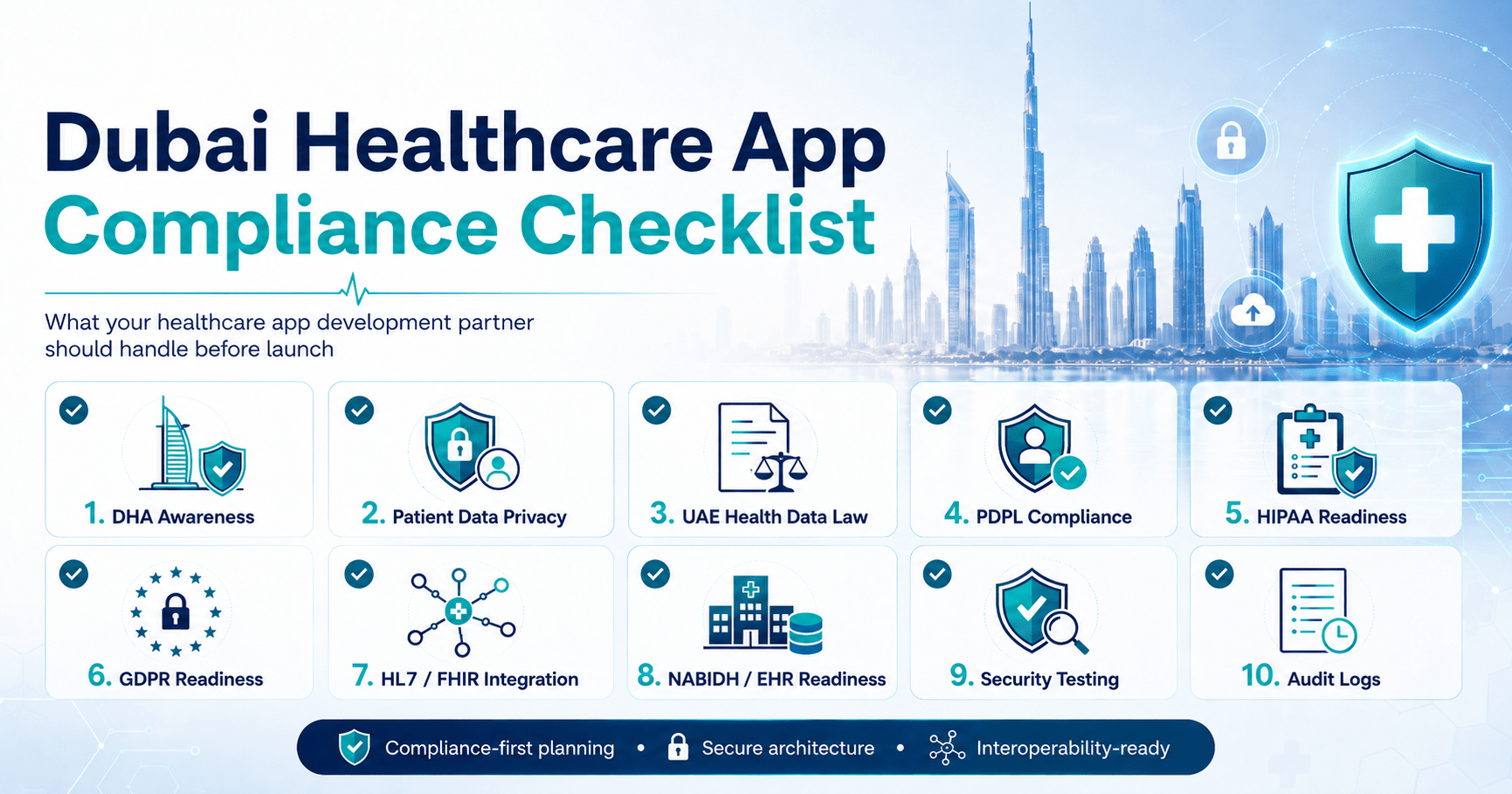
A good DHA compliant healthcare app development approach includes privacy, security, access control, auditability, hosting decisions, and integration standards from the discovery phase.
| Compliance Area | What Your Development Partner Should Handle |
|---|---|
| DHA awareness | Understand Dubai healthcare expectations and design workflows that support regulatory readiness |
| Patient data privacy | Protect personal health information through secure storage, access rules, and consent-based workflows |
| UAE Health Data Law | Plan how health data is collected, stored, transferred, accessed, and managed |
| PDPL | Support personal data protection principles, consent, data minimization, and user rights |
| HIPAA readiness | Apply strong security and privacy practices if serving global or US-related healthcare users |
| GDPR readiness | Support privacy-by-design, consent management, and data handling controls for EU users |
| HL7/FHIR | Use healthcare data standards for structured interoperability |
| NABIDH/EHR readiness | Prepare architecture for future healthcare data exchange and EHR connectivity |
| Security testing | Include vulnerability testing, secure code review, API testing, and penetration testing |
| Audit logs | Track user actions, data access, changes, login attempts, and admin activity |
Your vendor should also help your internal team validate requirements against DHA, UAE health data regulations, PDPL expectations, interoperability standards, and healthcare cybersecurity best practices.
How to Choose the Best Healthcare App Development Company in Dubai
Selecting the right vendor requires a structured review. Use the following areas to compare agencies before signing a contract.
Check Their Healthcare Industry Experience
Healthcare workflows are different from eCommerce, delivery, or social apps. A healthcare app may involve doctors, nurses, pharmacists, lab technicians, insurance teams, admins, and patients.
A vendor with healthcare experience can better understand appointment logic, consultation flow, report handling, prescriptions, medical records, role-based access, and patient privacy.
Question to ask:
Have you built healthcare apps for clinics, hospitals, pharmacies, labs, or telemedicine companies before?
Red flag:
The vendor only shows generic mobile apps and cannot explain healthcare workflows.
Review Their Compliance Knowledge
Compliance affects app architecture, hosting, consent, user roles, data access, audit logs, and documentation. Your development partner does not replace legal counsel, but they should understand how to build compliance-ready systems.
Question to ask:
How do you plan patient data privacy, access control, audit logs, and regulatory readiness during development?
Red flag:
The vendor says, “Compliance can be added after launch.”
Check Their UI/UX Capability
Healthcare apps must be simple, fast, and accessible. Patients may use the app while sick, stressed, elderly, or unfamiliar with digital tools. Doctors need quick access to patient history, reports, and notes. Admins need clean dashboards.
Your UI/UX should consider:
- Patient booking journeys
- Doctor consultation workflow
- Admin approval and reporting
- Lab report access
- Pharmacy order flow
- Multilingual use cases
- Accessibility and readability
Question to ask:
Will you create separate user journeys for patients, doctors, admins, labs, and pharmacy teams?
Red flag:
The vendor uses one generic interface for all users.
Evaluate Their Technical Architecture
A healthcare app should be built for growth. Today you may launch appointment booking. Tomorrow you may add telemedicine, insurance, remote monitoring, AI triage, or EHR/EMR integration.
Review the vendor’s approach to:
- Scalable cloud architecture
- Secure APIs
- Database design
- Performance under high traffic
- Modular features
- Backup and disaster recovery
- Future integrations
- Monitoring and logging
Question to ask:
How will the app architecture support future features and integrations?
Red flag:
The vendor cannot explain scalability, security, APIs, or database structure.
Ask About EHR/EMR and Third-Party Integrations
Modern healthcare apps often need integrations with hospital systems, lab systems, pharmacy software, payment gateways, insurance platforms, video consultation APIs, SMS/WhatsApp providers, and wearable devices.
An experienced vendor should understand EHR EMR integration healthcare app needs and interoperability standards such as HL7 and FHIR.
Question to ask:
Can you integrate the app with EHR/EMR systems, lab systems, payment gateways, insurance platforms, and wearable devices?
Red flag:
The vendor has no clear integration strategy and treats integration as a simple plugin task.
Check Their Security Practices
Security is not optional in healthcare. Your app should protect patient data at every level.
Ask your vendor about:
- Encryption for data at rest and in transit
- Role-based access control
- Multi-factor authentication
- Secure APIs
- Audit logs
- Backup and recovery
- Penetration testing
- Secure coding practices
- Session management
- Admin access controls
The vendor should be able to explain how each security layer protects patient data and reduces risk.
Review Their Post-Launch Support
Healthcare apps need continuous care after launch. New bugs, OS updates, API changes, security patches, compliance improvements, server monitoring, and feature upgrades are common.
Your contract should define:
- Support hours
- Bug-fixing process
- Server monitoring
- Maintenance cost
- Security updates
- App store updates
- Feature enhancement process
- SLA terms
A healthcare app is not a one-time project. It is a long-term digital healthcare product.
Vendor Evaluation Checklist
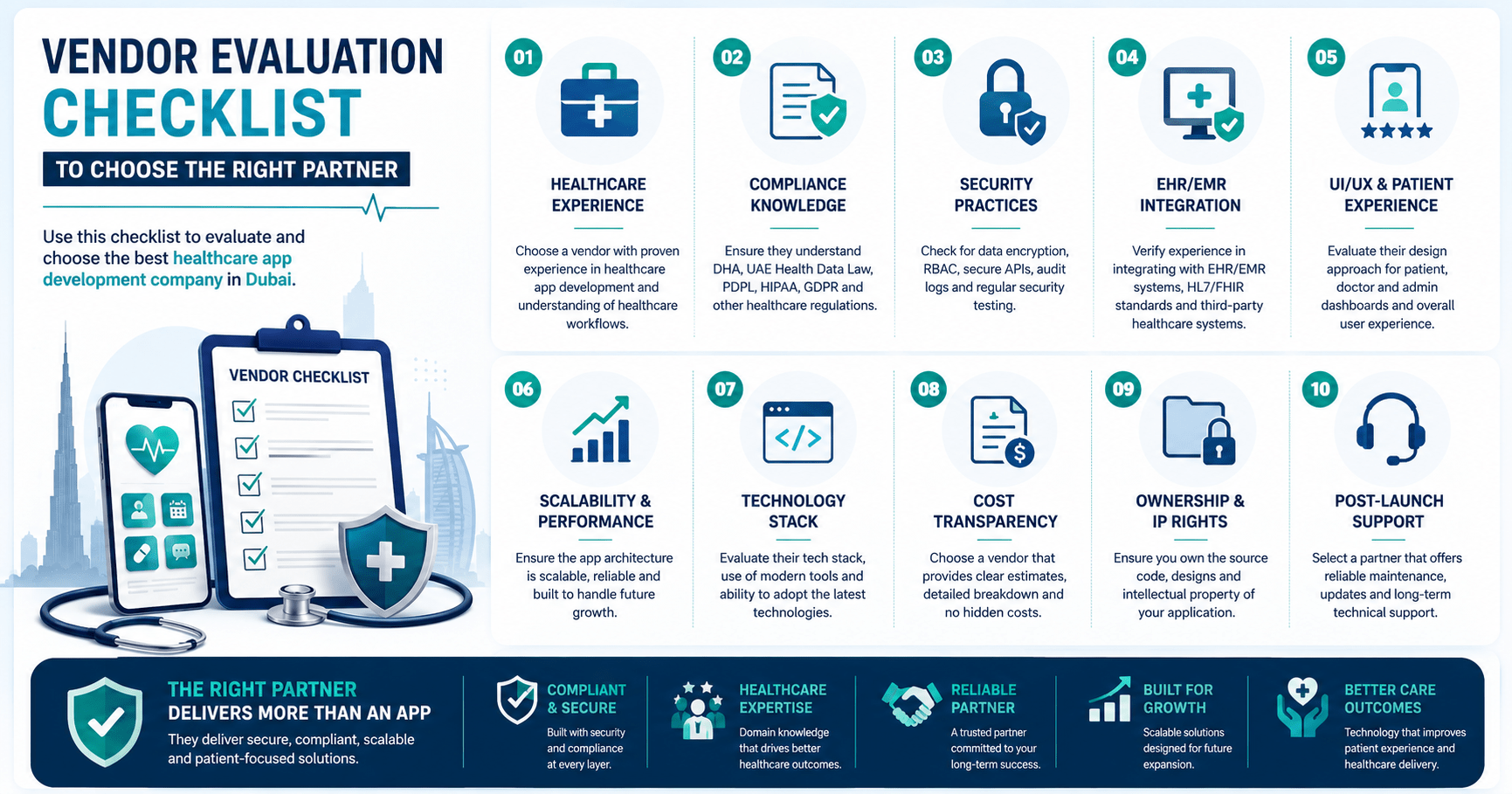
| Evaluation Factor | Questions to Ask | Red Flag |
|---|---|---|
| Healthcare portfolio | Have you built healthcare apps before? | No healthcare case studies or examples |
| Dubai/UAE knowledge | Do you understand Dubai and UAE healthcare expectations? | No local market understanding |
| Security | How do you protect patient data? | No mention of encryption, MFA, RBAC, or testing |
| Integration | Can you support EHR/EMR, lab, pharmacy, insurance, and payment integrations? | No integration roadmap |
| UI/UX | Do you design separate workflows for each user role? | One-size-fits-all design approach |
| Scalability | How will the app handle growth? | No cloud or architecture plan |
| Ownership | Will we own the source code and IP? | Unclear ownership terms |
| Support | What post-launch support do you provide? | No maintenance plan |
| Cost clarity | What is included in the estimate? | Vague pricing or hidden charges |
Healthcare App Development Cost in Dubai
The healthcare app development cost Dubai businesses should expect depends on app complexity, features, integrations, compliance requirements, and development timeline.
| App Complexity | Estimated Cost Range | Best For |
|---|---|---|
| Basic healthcare app | AED 80,000–180,000 | Appointment booking, simple patient profiles, notifications, basic admin panel |
| Mid-level healthcare app | AED 180,000–450,000 | Telemedicine, payments, e-prescriptions, doctor dashboard, reports |
| Advanced healthcare app | AED 450,000–1,000,000+ | EHR/EMR integration, AI chatbot, remote monitoring, insurance, analytics |
| Enterprise healthcare platform | AED 1,000,000+ | Multi-branch hospitals, large telemedicine platforms, complex integrations, high-scale systems |
Factors That Affect Cost
- App complexity
- Number of user roles
- UI/UX design level
- Telemedicine features
- EHR/EMR integration
- AI chatbot or automation
- Wearable device integration
- Compliance and security requirements
- Cloud hosting
- Maintenance and support
A reliable vendor should provide a clear cost breakdown, not just a single final number. Ask what is included in discovery, design, development, testing, deployment, integrations, and support.
Hidden Costs Most Healthcare Businesses Forget
Many healthcare businesses budget for development but forget ongoing and third-party costs.
Common hidden costs include:
- Cloud hosting
- Video consultation API
- SMS/WhatsApp notification cost
- Payment gateway charges
- EHR/EMR integration cost
- Compliance documentation
- Cybersecurity testing
- App store maintenance
- Third-party API subscriptions
- Ongoing support and updates
Ask your vendor for a 12-month cost view, including development, launch, hosting, maintenance, and third-party services.
Best Technology Stack for Healthcare App Development
The best technology stack depends on your app goals, budget, scalability needs, integrations, and compliance expectations.
| Layer | Recommended Technologies |
|---|---|
| Mobile app | Flutter, React Native, Swift, Kotlin |
| Web frontend | React, Next.js, Angular |
| Backend | Node.js, Laravel, Python, .NET |
| Database | PostgreSQL, MySQL, MongoDB |
| Cloud | AWS, Azure, Google Cloud, UAE-compatible hosting |
| APIs | REST, GraphQL, HL7, FHIR |
| Security | MFA, encryption, RBAC, audit logs |
| Analytics | Power BI, Google Analytics, custom dashboards |
For healthcare apps, technology should support security, performance, interoperability, and long-term scalability.
Mistakes to Avoid When Hiring a Healthcare App Development Company
Avoid these common mistakes before choosing a medical app development company Dubai businesses can depend on:
- Choosing the cheapest development company
- Hiring a generic app agency with no healthcare experience
- Ignoring compliance and data privacy
- Not planning EHR/EMR integration early
- Building features without understanding workflows
- Not defining source code ownership
- Skipping security testing
- Not planning post-launch support
- Ignoring patient and doctor UX separately
- Not asking for a scalable architecture plan
The cheapest quote often becomes expensive when the app needs redesign, security fixes, compliance changes, or integration rework.
Questions to Ask Before Signing the Contract
Before hiring a healthcare app development company in Dubai, ask these questions:
- Have you built healthcare apps before?
- Can you show healthcare app case studies?
- Do you understand Dubai healthcare compliance requirements?
- How will you protect patient data?
- Can the app integrate with EHR/EMR systems?
- What technology stack will you use and why?
- How much will the app cost and what is included?
- How long will development take?
- Will we own the source code?
- What post-launch support do you provide?
- How will you handle future scalability?
A professional vendor should answer these clearly and provide documentation where needed.
Why Choose SISGAIN as Your Healthcare App Development Company in Dubai?
SISGAIN works with healthcare businesses that need secure, scalable, and custom digital health solutions. As a healthcare software development partner, SISGAIN supports hospitals, clinics, pharmacies, labs, telemedicine startups, and healthcare entrepreneurs with practical product planning and development.
SISGAIN’s healthcare development capabilities include:
- Healthcare software development experience
- Custom healthcare app development
- Telemedicine app development Dubai solutions
- Remote patient monitoring app development UAE support
- EHR/EMR integration support
- Secure and scalable architecture
- Patient, doctor, and admin-focused UI/UX
- Post-launch support and maintenance
- UAE and global healthcare market understanding
SISGAIN focuses on building healthcare apps that align with real workflows, patient data security needs, and long-term product growth.
Final Checklist: How to Select the Right Healthcare App Development Company
Use this checklist before choosing your vendor:
- Healthcare development experience
- Dubai/UAE market understanding
- Compliance-first development approach
- Strong security practices
- EHR/EMR integration capability
- Clear cost breakdown
- Scalable architecture
- Good UI/UX process
- Source code ownership clarity
- Post-launch support
If a vendor cannot meet these points, continue your search.
Conclusion
Choosing a healthcare app development company in Dubai is a business, compliance, and technology decision. Your development partner should understand healthcare workflows, patient data security, local compliance expectations, app features, cost planning, integrations, and long-term product growth.
The right company will not only build an app. It will help you design a secure, scalable, and user-friendly healthcare platform that supports patients, doctors, admins, and your business goals.
If you are planning healthcare app development Dubai businesses can rely on, SISGAIN can help you evaluate your idea, define the right features, estimate costs, and build a solution designed for long-term success.
FAQs
How do I choose a healthcare app development company in Dubai?
Choose a healthcare app development company in Dubai with proven healthcare experience, UAE market understanding, compliance awareness, strong security practices, EHR/EMR integration capability, and clear post-launch support. Review their portfolio, ask about patient data protection, check source code ownership terms, and request a detailed cost breakdown before signing.
How much does healthcare app development cost in Dubai?
Healthcare app development in Dubai usually costs AED 80,000–180,000 for a basic app, AED 180,000–450,000 for a mid-level app, AED 450,000–1,000,000+ for an advanced app, and AED 1,000,000+ for an enterprise platform. Cost depends on features, integrations, compliance, UI/UX, and support needs.
What features should a healthcare app include?
A healthcare app should include patient registration, appointment booking, video consultation, prescriptions, medical history, lab reports, online payments, reminders, secure chat, doctor dashboard, admin panel, analytics, and role-based access. Advanced apps may include AI chatbot, EHR/EMR integration, insurance integration, wearable integration, and remote patient monitoring.
What compliance is required for healthcare apps in Dubai?
Healthcare apps in Dubai should consider DHA expectations, patient data privacy, UAE Health Data Law, PDPL, audit logs, secure access, encryption, hosting decisions, and data handling rules. Apps with international users may also need HIPAA or GDPR readiness. Compliance planning should begin before design and development.
Is DHA compliance important for healthcare app development?
Yes. DHA compliance awareness is important for healthcare apps serving Dubai patients, clinics, hospitals, or providers. Your app should be designed with patient privacy, secure workflows, access control, audit logs, and healthcare process requirements in mind. Your development partner should support compliance-ready technical planning.
What is NABIDH integration in healthcare apps?
NABIDH supports health information exchange in Dubai by helping healthcare providers access and share patient health information more effectively. For healthcare apps, NABIDH readiness may involve preparing secure architecture, structured data, interoperability standards, and EHR connectivity so future integration becomes easier.
Can healthcare apps integrate with EHR/EMR systems?
Yes. Healthcare apps can integrate with EHR/EMR systems using APIs and interoperability standards such as HL7 and FHIR. Integration allows doctors and healthcare teams to access medical history, prescriptions, lab reports, diagnoses, and consultation notes. Planning this early reduces delays and rework.
How long does it take to develop a healthcare app?
A basic healthcare app may take 3–5 months. A mid-level telemedicine or appointment app may take 5–8 months. Advanced healthcare platforms with EHR/EMR integration, AI, remote monitoring, insurance, or multi-branch workflows may take 8–12+ months, depending on complexity and approvals.
Which technology stack is best for healthcare app development?
Common healthcare app technologies include Flutter, React Native, Swift, Kotlin, React, Next.js, Node.js, Python, .NET, PostgreSQL, MySQL, AWS, Azure, Google Cloud, REST APIs, GraphQL, HL7, and FHIR. The best stack depends on scalability, security, compliance, integration, and budget needs.
What mistakes should I avoid when hiring a healthcare app development company?
Avoid choosing only by price, hiring a generic app agency, ignoring compliance, skipping security testing, delaying EHR/EMR planning, overlooking UX for doctors and patients, accepting vague cost estimates, and failing to define source code ownership. Also confirm post-launch support before contract signing.
Why choose SISGAIN for healthcare app development in Dubai?
SISGAIN offers custom healthcare app development, telemedicine app development, remote patient monitoring solutions, EHR/EMR integration support, secure architecture, and post-launch maintenance. SISGAIN understands healthcare workflows and helps businesses plan practical, scalable digital health products for Dubai, the UAE, and global markets.