


key takeaways
- Predictive analytics in logistics shifts operations from reactive to proactive — flagging risks before they cause delays.
- Four levels: descriptive → diagnostic → predictive analytics in logistics → prescriptive (action-ready).
- Runs on connected data: GPS, ERP, WMS, TMS, IoT — fragmented systems limit results.
- Dubai’s port volume, cross-border trade, and last-mile density make predictive analytics in logistics especially valuable here.
- Key use cases: demand forecasting, ETA prediction, fleet maintenance, route optimization, warehouse planning, risk detection.
- Powers “control towers” — moving from dashboards to AI-recommended actions.
- Benefits: fewer late deliveries, lower costs, stronger resilience, better sustainability.
- Challenges: data fragmentation, integration complexity, trust in AI, data privacy compliance.
- Rollout path: define problem → clean data → pilot → scale.
- Future: generative AI explanations, autonomous agents, digital twins, autonomous vehicles.
- Predictive analytics in logistics is becoming a core competitive advantage, not just a tech upgrade.
A shipment leaves a Dubai warehouse right on schedule. Then traffic backs up on Sheikh Zayed Road, the customer isn’t home for the drop-off, and the delivery van’s brake pads are wearing thinner than anyone realized. None of that shows up on a dashboard until it’s already a problem, and by the time a delay gets flagged, the damage — a missed window, an annoyed customer, a driver rerouting on the fly — is already done.
That’s the gap traditional logistics software has always had. It tells you what happened. It rarely tells you what’s about to happen. Predictive analytics in logistics closes that gap by using historical and real-time data to flag risks before they turn into failed deliveries, empty trucks, or blown budgets.
Dubai’s logistics sector has outgrown simple tracking tools. Between the volume moving through Jebel Ali Port, the pace of e-commerce growth, cross-border trade with the wider GCC, and rising last-mile delivery expectations, operators are managing more moving parts than any dashboard alone can make sense of.
This article walks through what predictive analytics in logistics actually does, why it matters for companies operating in Dubai specifically, and how it’s reshaping day-to-day decisions — from ETA accuracy to fleet maintenance to warehouse planning.
What Is Predictive Analytics in Logistics?
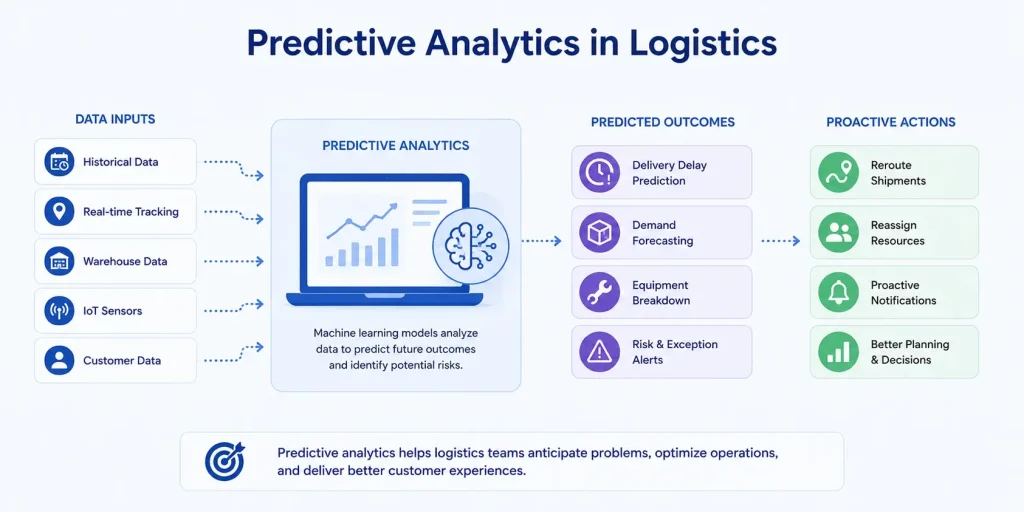
Put simply: predictive analytics in logistics uses historical data, live operational signals, and machine learning models to estimate what’s likely to happen next in a supply chain — a late delivery, a stockout, a breakdown — so teams can act before it happens rather than clean up after.
Traditional Analytics vs. Predictive Analytics
Most logistics teams already use some form of analytics without calling it that. The difference is which question it answers.
Descriptive analytics answers “what happened?” — the monthly report showing 340 late deliveries last quarter. Diagnostic analytics answers “why did it happen?” — maybe 60% of those delays trace back to congestion near a specific interchange. Predictive analytics answers “what’s likely to happen?” — flagging, in real time, that today’s 2:15 PM delivery to Jumeirah Village Circle has a 70% chance of missing its window. Prescriptive analytics goes a step further and answers “what should we do about it?” — reroute the driver, reassign the delivery, or send the customer a proactive delay notice.
Most logistics operators in the UAE are strong on the first two and largely missing the last two — which is exactly the gap predictive analytics in logistics fills.
How It Actually Works
Under the hood, predictive analytics in logistics runs on historical performance data plus live operational feeds. Machine learning models train on past outcomes — delivery times, breakdown patterns, demand spikes — then apply to current conditions to generate a forecast, translated into a recommendation a dispatcher can act on immediately.
The data feeding these models typically comes from GPS and telematics, ERP systems, warehouse management systems (WMS), transport management systems (TMS), IoT sensors on vehicles and storage units, and customer delivery preferences and history.
None of this works well in isolation, though. A model trained only on GPS data misses warehouse dispatch delays. One trained only on ERP history misses live road conditions. Predictive analytics in logistics gets useful precisely when these sources are connected — which is exactly where most implementations stall, and where a proper enterprise logistics software dubai guide becomes useful before committing budget to any single tool.
Why Dubai Logistics Companies Need Predictive Analytics
Managing Complex Regional Supply Chains
Dubai sits at the crossroads of Asia, Europe, Africa, and the wider Middle East — a genuine commercial advantage, but also a complexity multiplier. Jebel Ali Port alone moves millions of containers a year, and between the air cargo hubs, free zones, and GCC distribution routes running through them, a single delay at one node ripples outward fast.
A container held up at customs doesn’t just affect that shipment. It pushes back warehouse receiving schedules, throws off transport bookings already locked in for the week, and can leave a retailer short on inventory during a peak sales period. Predictive analytics in logistics gives planners early warning on these knock-on effects, instead of discovering them after a warehouse manager calls asking where a shipment went.
Handling Dubai’s Last-Mile Delivery Challenges
Last-mile delivery in Dubai comes with a specific set of headaches generic logistics playbooks don’t cover. High-rise residential towers mean drivers often can’t just “arrive” — they need building access, lift time, and sometimes a call to a concierge desk. Gated communities add another layer of friction, and parking near commercial districts during peak hours can eat up more time than the drive itself.
A static route plan built the night before can’t account for any of that. It doesn’t know that a particular tower’s loading bay gets blocked every afternoon, or that a specific customer is rarely home before 7 PM. Predictive analytics in logistics adjusts for these patterns using real delivery history, not a one-size-fits-all route template.
Supporting UAE Sustainability and Smart Logistics Goals
The UAE’s push toward smart mobility and lower emissions isn’t just a policy talking point — it’s shaping procurement decisions at logistics companies right now. Fleet optimization powered by predictive models cuts unnecessary mileage, fuel use, and emissions directly. As EV fleets become more common, predictive analytics in logistics Dubai companies use also helps plan charging schedules and route ranges around battery performance, rather than assuming every vehicle behaves like a diesel truck.
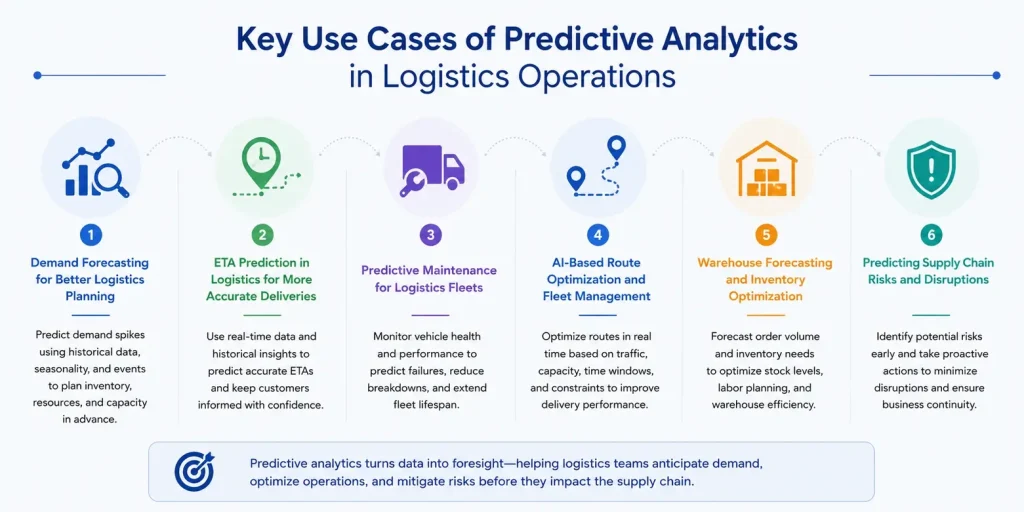
Key Use Cases of Predictive Analytics in Logistics Operations
Demand Forecasting for Better Logistics Planning
Demand in Dubai doesn’t move in a straight line. Ramadan and Eid shift buying patterns sharply. Major exhibitions at venues like Dubai World Trade Centre create short, intense demand spikes in specific zones, and e-commerce campaigns from regional platforms can double order volume for a 48-hour window before dropping right back down.
Predictive models trained on historical demand, seasonal patterns, and campaign calendars help logistics teams prepare for these swings instead of reacting to them mid-surge — warehouses staffed appropriately before a spike hits, not two days into it. This is where supply chain predictive analytics earns its keep: fewer stockouts, less panic-hiring of temporary staff, and inventory positioned where demand is about to appear rather than where it was last month.
ETA Prediction in Logistics for More Accurate Deliveries
Traditional ETAs are usually a static calculation: distance divided by average speed, with a buffer tacked on. They’re wrong constantly, which is exactly why customers stop trusting delivery windows after a few bad experiences.
ETA prediction in logistics done properly pulls from live GPS location, current traffic conditions, individual driver behavior, actual warehouse dispatch timing (not the scheduled one), delivery history at that specific address, and even building-access factors at the destination. The result is a moving estimate that updates as conditions change, not a number set once at 8 AM and left untouched until the driver’s already late.
The business case is straightforward: fewer failed delivery attempts, fewer support calls asking “where is my order,” and a customer who trusts the delivery window enough to plan around it. For companies competing on experience rather than price alone, that trust is worth more than it sounds.
Predictive Maintenance for Logistics Fleets
Dubai’s climate is brutal on vehicles. Sustained high heat, long operating hours, and heavy utilization put more strain on engines, batteries, tires, and brakes than fleets in milder climates ever experience. A breakdown mid-route in July isn’t just an inconvenience — it can delay an entire day’s delivery schedule for one vehicle and everyone depending on it.
Predictive maintenance models track engine performance, battery health, tire pressure, brake wear, temperature readings, and service history to flag which vehicles are approaching failure risk before it happens. Instead of fixed maintenance intervals that either service a healthy vehicle too early or miss a failing one too late, fleets get maintenance scheduled around actual vehicle condition — fewer roadside breakdowns, better fleet availability, lower long-term repair costs.
AI-Based Route Optimization and Fleet Management
Route planning that only calculates shortest distance is solving the wrong problem. Real routing decisions need to weigh live traffic, delivery time windows customers actually committed to, vehicle capacity, driver shift limits, priority versus flexible deliveries, and road restrictions specific to certain vehicle types or times of day.
AI in logistics software handles this by continuously recalculating the best route and sequence throughout the day, not just once each morning. If a driver falls behind by mid-afternoon, the system can re-sequence remaining stops, reassign a delivery to a nearby vehicle with capacity, or flag that a customer notification should go out now rather than after the missed window.
Warehouse Forecasting and Inventory Optimization
Warehouses in Dubai’s logistics corridors deal with workload that swings hard between quiet weeks and peak periods. Predicting order volume, labor requirements, storage needs, and replenishment timing in advance lets a warehouse manager schedule staff and space around what’s actually coming, not what came last time.
This is another area where supply chain predictive analytics moves the needle directly. A warehouse that knows three days out that Thursday’s order volume will spike 40% above normal can bring in extra hands and clear staging space in advance, instead of scrambling on the day itself — a small operational shift with a large downstream effect on delivery accuracy.
Predicting Supply Chain Risks and Disruptions
Supplier delays, port congestion, unexpected weather, carrier capacity issues, and geopolitical disruptions upstream aren’t new risks, but predictive models make them visible earlier. Tracking risk indicators across a supply network lets teams line up alternative suppliers, pre-plan backup routes, or adjust safety stock before a disruption hits inventory availability. Waiting until a shipment is already stuck is the expensive way to find out about a problem that had warning signs a week earlier.
How Predictive Analytics Is Transforming Logistics Operations in Dubai
From Visibility Dashboards to Intelligent Decision Systems
For years, “good” logistics software meant a dashboard showing where every shipment was in real time. That’s still useful, but it’s fundamentally passive — someone still has to notice the problem, figure out why it’s happening, and decide what to do.
Predictive systems shift that model. Instead of showing a dot on a map and leaving interpretation to a human, they flag which shipments are at risk, explain why, and suggest what action closes the gap. That’s the real shift behind how predictive analytics is transforming logistics: moving software from a passive reporting layer to an active decision-support layer, by connecting predictions directly to operational actions rather than leaving them as forecasts nobody acts on.
Creating AI-Powered Logistics Control Towers
The most mature version of this shows up as a control tower — a single system combining real-time visibility, risk alerts, demand and ETA forecasting, recommended actions, and performance monitoring in one place. Rather than a dispatcher checking five separate systems to piece together what’s going wrong, a control tower surfaces the risk and the recommended fix together, and it isn’t reserved for the largest 3PLs with massive IT budgets. Mid-sized operators in Dubai are increasingly adopting scaled-down versions of the same approach, often built by a Logistics Software Development Company in Dubai that can tailor the control tower to existing ERP and TMS systems rather than forcing a rip-and-replace of everything already in place.
Benefits of Predictive Analytics for Dubai Logistics Businesses
Improved Delivery Performance
Fewer late deliveries, more accurate ETAs, and customers who get a delivery window they can actually plan around instead of calling support to ask where their order is. This alone tends to be the single most visible win companies report after adopting predictive analytics in logistics.
Lower Operational Costs
Better route planning cuts fuel consumption and reduces wasted mileage. Predictive maintenance avoids costly emergency repairs and unplanned downtime, and labor planning driven by accurate demand forecasts means warehouses aren’t overstaffed during quiet weeks or scrambling during peak ones.
Stronger Supply Chain Resilience
Early risk detection gives teams days, not hours, to respond to a supplier delay or port congestion issue — the difference between quietly rerouting around a problem and explaining to a customer why their order is three weeks late.
Better Sustainability Performance
Smarter routing and fleet planning reduce fuel use and emissions as a direct byproduct, not a separate initiative bolted on afterward. For companies reporting against UAE sustainability targets, that’s a measurable win predictive analytics in logistics delivers alongside its operational benefits.
Taken together, these four areas are exactly what people mean when they talk about a system that improves supply chain efficiency — not one flashy feature, but a set of compounding gains across delivery, cost, resilience, and sustainability.
Challenges of Implementing Predictive Analytics in Logistics
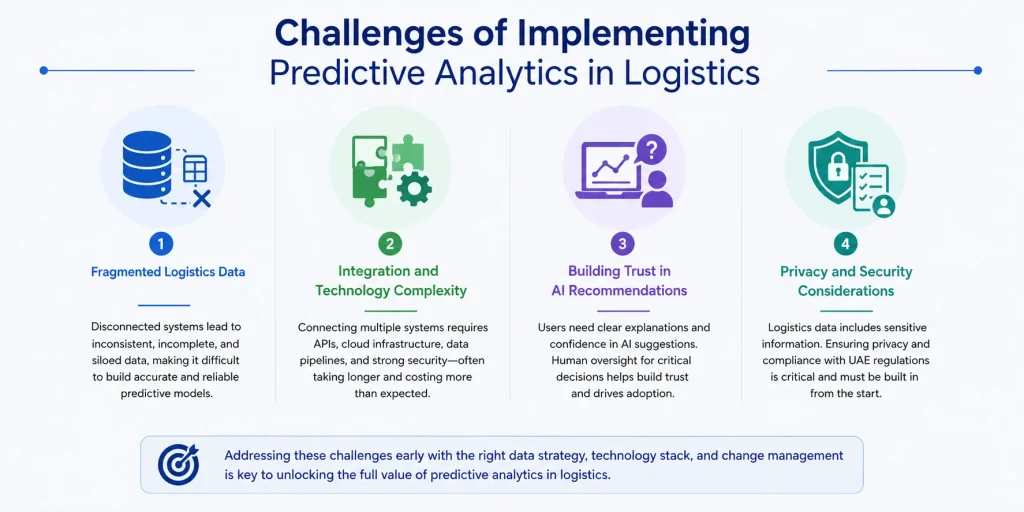
None of this is plug-and-play, and it’s worth being honest about that before budgeting for it.
Fragmented Logistics Data
Most logistics companies run separate ERP, WMS, TMS, GPS, and IoT systems that were never designed to talk to each other. Data quality varies wildly between them, and historical records are often incomplete — gaps that make model training harder than vendors tend to admit upfront.
Integration and Technology Complexity
Connecting these systems means API work, cloud infrastructure, reliable data pipelines, and security controls that hold up under scrutiny. Underestimating this integration timeline is one of the most common reasons predictive analytics initiatives stall midway.
Building Trust in AI Recommendations
A model that recommends rerouting a driver needs to explain why, or dispatchers will simply ignore it. Explainable predictions and a human-approval step for high-impact decisions matter more than raw model accuracy early on — teams need to see the system be right a few times before they’ll trust it without double-checking.
Privacy and Security Considerations
Logistics data includes customer addresses, delivery preferences, and driver location history — sensitive by nature. Getting Data Security and Compliance in Logistics right isn’t optional under UAE data protection requirements, and it needs to be built into the system from day one, not added as an afterthought once the pilot is already running.
How Businesses Can Implement Predictive Analytics in Logistics Successfully
Step 1: Identify a clear business problem
Don’t start with “we want AI.” Start with a specific, measurable pain point — too many late deliveries, unplanned fleet downtime, chronic inventory shortages, or fuel costs that keep climbing. The clearer the problem, the easier it is to measure whether predictive analytics in logistics actually solved it.
Step 2: Prepare and integrate data
Run a data quality check before anything else. Confirm which systems can actually connect, and how much clean historical data exists to train a model on. This step gets skipped more often than it should, and it’s usually why later stages run over budget.
Step 3: Start with a focused pilot
Pick one use case — ETA prediction, fleet maintenance forecasting, or demand forecasting are all reasonable starting points — and prove it works before expanding. A narrow, well-measured pilot builds internal confidence faster than a sprawling rollout trying to do everything at once.
Step 4: Scale across logistics operations
Once the pilot delivers measurable results, expand to more data sources, more automation, and more advanced forecasting. This is also where a platform’s underlying architecture matters most — the modern logistics platform features that supported one pilot use case need to hold up once ten more are running on top of the same system.
Future Trends of Predictive Analytics in Dubai Logistics
Generative AI and predictive logistics. AI assistants are starting to explain predictions in plain language rather than raw dashboard numbers — telling a dispatcher in a sentence why a shipment is at risk, instead of leaving them to interpret a probability score.
AI agents for logistics automation. Autonomous agents are beginning to monitor shipments continuously, detect exceptions the moment they occur, and trigger workflows like rebooking a carrier or notifying a customer, without waiting for a human to spot the issue first.
Digital twins and smart supply chains. Digital twins let planners simulate an entire network before committing resources — testing how a new warehouse location or a change in delivery zones would actually perform.
Autonomous logistics and predictive intelligence. Autonomous vehicles and delivery robots are still early-stage in most markets, but they depend entirely on predictive intelligence to operate safely. As Dubai keeps investing in smart mobility infrastructure, this is one of the clearer long-term directions the technology is heading.
Conclusion
Logistics companies aren’t competing on fleet size or warehouse square footage anymore. They’re competing on speed, visibility, reliability, and how fast they can make a good decision when something goes wrong. Predictive analytics in logistics gives businesses the ability to see a problem coming instead of explaining it after the fact.
Dubai’s operators that build predictive capability around their own routes, fleets, and customer patterns — not a generic template built for a different market — stand to gain the most: better customer experience, lower operational costs, and a supply chain that bends instead of breaks.
If you’re weighing where to start, the right move is usually a focused conversation about your actual data, systems, and bottlenecks, not a platform demo. That’s the groundwork worth getting right before anything else.
FAQs
What is predictive analytics in logistics?
Predictive analytics in logistics uses historical and real-time data with machine learning to forecast risks like delays, breakdowns, or stockouts before they happen, enabling proactive decisions instead of reactive fixes.
How does predictive analytics improve ETA accuracy?
It combines live GPS, traffic, driver behavior, and delivery history to generate constantly updating delivery estimates, replacing static calculations and reducing failed or late delivery attempts significantly.
Why is predictive analytics important for Dubai logistics companies?
Dubai’s complex trade routes, Jebel Ali Port volume, and dense last-mile delivery challenges require predictive analytics in logistics to manage disruptions, traffic, and demand spikes proactively.
What data sources power predictive analytics in logistics?
GPS, ERP, WMS, TMS, IoT sensors, and customer delivery history feed machine learning models, which must be integrated for accurate, actionable predictions across logistics operations.
What are common challenges in implementing predictive analytics?
Fragmented data systems, integration complexity, building trust in AI recommendations, and meeting UAE data privacy requirements are the biggest hurdles companies face during adoption.
How should businesses start implementing predictive analytics in logistics?
Identify a clear problem, prepare and integrate data, run a focused pilot like ETA prediction, then scale gradually across fleet, warehouse, and supply chain operations.