


Key Takeaways
- A structured logistics software development roadmap is what separates enterprises that scale smoothly from ones that keep patching broken systems.
- Fragmented data between ERP, WMS, and carrier platforms is still the #1 blocker to real-time visibility for Dubai logistics operators.
- Last-mile delivery in the UAE has its own quirks — Makani numbers, bilingual addresses, villa-heavy neighborhoods — that off-the-shelf routing tools weren’t built for.
- AI only pays off in logistics when it sits on clean, connected data. Bolted-on AI pilots rarely survive contact with real operations.
- The roadmap has six phases: strategy, data foundation, core platform build, real-time visibility, AI and analytics, and cross-border/customs integration — followed by continuous optimization.
- Build vs. buy isn’t binary. Most enterprises land somewhere in between, buying commodity modules and building where logistics is their actual competitive edge.
- User adoption, not code quality, is the reason most logistics software projects underdeliver.
Dubai didn’t become a logistics hub by accident. Jebel Ali Port moves more containers than almost any port outside East Asia, Dubai South is building out an entire logistics corridor around Al Maktoum Airport, and e-commerce fulfillment volumes in the region have grown fast enough that warehouses built five years ago are already running out of room. If you run operations for a logistics company here, you’ve felt this pressure directly — more shipments, tighter delivery windows, and customers who now expect Amazon-level tracking on a mattress delivered from Ras Al Khor.
Here’s the problem: none of that growth is winnable through fleet size or warehouse square footage anymore. Every competitor can add trucks and racking. What they can’t easily copy is a connected, intelligent operation — one where a dispatcher can see a delayed container the moment customs flags it, not three days later in a spreadsheet. That’s what a logistics software development roadmap is actually for. It’s not a tech project bolted onto the business; it’s the plan that turns scattered systems into one operation that can see itself clearly and react fast.
This guide walks through why Dubai enterprises need this roadmap now, the specific challenges pushing the shift, the capabilities that matter in 2026, and a phase-by-phase plan you can actually hand to a CIO or a delivery partner.
Why Dubai Enterprises Need a Logistics Software Development Roadmap in 2026
Digital Transformation Is Becoming a Logistics Competitive Advantage
Logistics used to be an execution business — move the freight, fill the truck, hit the delivery window. It’s now a technology business that happens to move physical goods. Enterprises across the UAE are shifting budget from standalone tools (a TMS here, a spreadsheet there) toward connected platforms that talk to each other by default.
Customers drove a lot of this. Someone ordering furniture from a Dubai retailer expects a live map, not a “your order is on its way” text. A retail chain expects its 3PL to flag stockouts before they happen, not after a shelf goes empty in Deira. A well-built Dubai logistics software roadmap gives enterprises a direct line to four things that actually move the P&L: operational efficiency, on-time delivery, cost per shipment, and the customer experience that keeps contracts renewing.
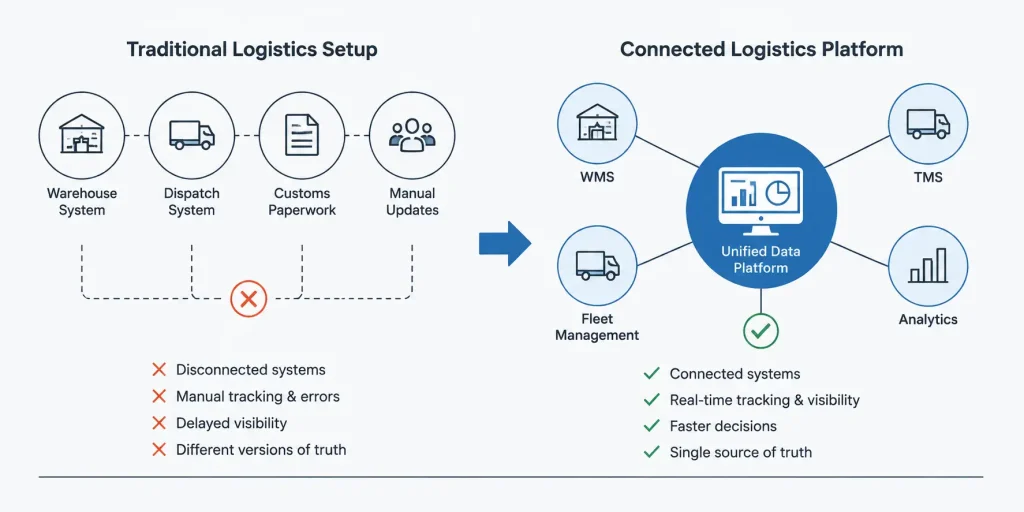
The Shift From Traditional Systems to Connected Logistics Platforms
Most Dubai logistics operations today still run on a patchwork: one system for the warehouse, another for dispatch, a shared inbox for customs paperwork, and a WhatsApp group that somehow became the real-time tracking tool. It works — until volume doubles and nobody can find the one shipment that’s stuck at Hatta.
Traditional setups share the same failure points: warehouse systems that don’t talk to fleet systems, manual tracking that depends on someone remembering to update a sheet, analytics that show what happened last month instead of what’s happening right now, and teams working from different versions of the truth. The fix isn’t another point tool — it’s an integrated platform where TMS, WMS, fleet, and analytics share one data layer. That’s the foundation every later phase of the roadmap builds on.
The Biggest Challenges Driving Logistics Software Transformation in Dubai
Fragmented Data and Integration Problems
Ask any operations head in the UAE what keeps them up at night and “our systems don’t talk to each other” comes up fast. Legacy ERPs, carrier portals, warehouse platforms, EDI feeds from international partners, and a growing pile of IoT sensors on trucks and containers all generate data — separately, in different formats, on different schedules.
Without a real integration plan, that data doesn’t merge into insight. It creates duplicate records, decisions made on stale numbers, and a visibility gap that widens every time the business adds a new system. If you’re evaluating vendors or partners for this work, it’s worth working from a proper logistics software UAE guide that walks through integration architecture before a single line of the platform gets built — retrofitting integration after the fact is far more expensive than planning for it up front.
Last-Mile Delivery Complexity and Address Intelligence Issues
Last-mile delivery in the GCC has problems that generic routing software wasn’t designed to solve. Makani numbers exist precisely because street addresses in much of Dubai don’t follow a predictable grid. Add bilingual address data — a customer typing a location in Arabic while the driver’s app expects English — and failed delivery attempts pile up fast, especially in newer residential communities where Google Maps pins are still catching up to reality.
Intelligent routing that factors in Makani coordinates, villa-community layouts, and real driver feedback (not just theoretical GPS distance) cuts failed-attempt rates in a way that off-the-shelf Western routing tools rarely manage out of the box.
Moving AI From Experimentation to Real Business Impact
Nearly every logistics company in Dubai has run some kind of AI pilot in the last two years — a demand forecasting trial, a chatbot for customer queries, a computer-vision project for warehouse counting. Most of them quietly died. Not because the AI was bad, but because the data feeding it was messy, nobody owned governance for it, and it was never actually wired into the systems dispatchers and planners use every day.
AI belongs inside the logistics software development roadmap as a core stage, not a side experiment run by a data science team in isolation. It needs the data foundation from Phase 1 and the connected platform from Phase 2 before it can do anything reliable.
Cross-Border Trade and Regulatory Complexity
Dubai’s position as a re-export and transshipment hub means a huge share of cargo crosses at least one border — often several, across GCC transportation corridors with their own customs processes, documentation standards, and compliance rules. Paper-based or email-based documentation slows every one of those crossings down and creates a compliance risk that grows with volume. Enterprises need systems flexible enough to handle multiple regulatory regimes without a custom workaround for every corridor.
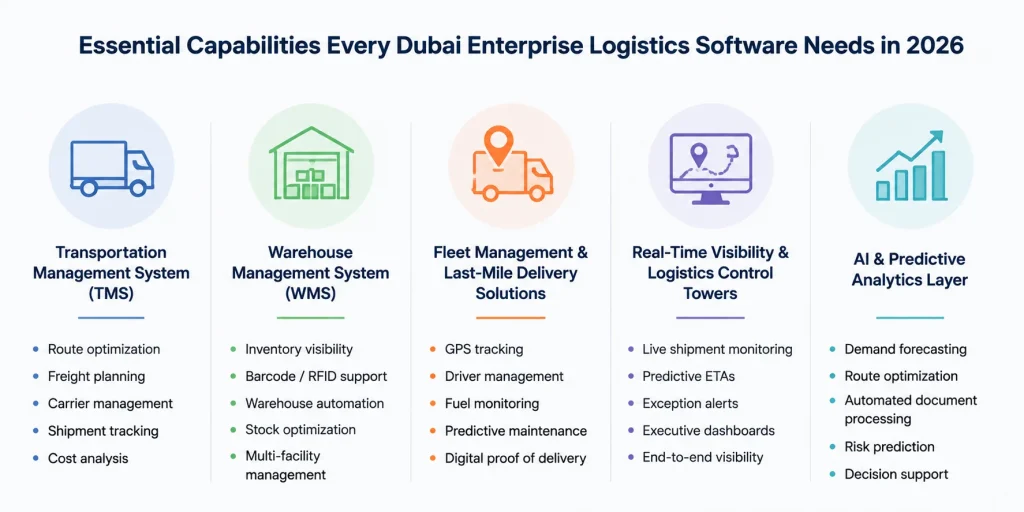
Essential Capabilities Every Dubai Enterprise Logistics Software Needs in 2026
Transportation Management System (TMS)
A modern TMS handles route optimization, freight planning, carrier management, shipment tracking, and cost analysis in one place. The real value isn’t any single feature — it’s that dispatch, finance, and customer service are all looking at the same shipment status instead of reconciling three different answers.
Warehouse Management System (WMS)
Inventory visibility, barcode and RFID support, warehouse automation, and stock optimization all live here. For Dubai enterprise logistics software specifically, the WMS needs to handle multi-facility operations cleanly — a lot of regional 3PLs run warehouses across Dubai, Abu Dhabi, and sometimes Jebel Ali Free Zone as one logical inventory pool, not three separate silos.
Fleet Management and Last-Mile Delivery Solutions
GPS tracking, driver management, fuel monitoring, predictive maintenance, and digital proof of delivery are table stakes now, not differentiators. What matters is how well these connect back to the TMS and WMS, so a maintenance flag on a truck actually triggers a rerouting decision instead of sitting in a separate dashboard nobody checks until the truck breaks down.
Real-Time Visibility and Logistics Control Towers
This is where a lot of enterprises still fall short. A control tower gives you live shipment monitoring, predictive ETAs, exception alerts, and executive dashboards that show the whole network at a glance — not after someone compiles a report. If you’re planning to build real-time shipment visibility platform capabilities in-house, the hardest part usually isn’t the dashboard UI, it’s getting reliable, low-latency data feeds from every carrier and warehouse system into one place first.
AI and Predictive Analytics Layer
Demand forecasting, route optimization, automated document processing, risk prediction, and decision support all sit on this layer. It should sit on top of everything else in the stack, pulling from the same connected data rather than running its own separate pipeline.
The Complete Logistics Software Development Roadmap for Dubai Enterprises
Phase 0: Strategy and Business Assessment (4–6 Weeks)
Every logistics software development roadmap that actually works starts here, not with code. The goal is understanding what’s really happening in the operation today — where the manual workarounds are, where technology gaps are costing money, and what the business is actually trying to achieve in the next 18 months.
This phase includes process mapping across warehouse, dispatch, and customer service, an honest evaluation of current systems (including the ones nobody wants to admit are held together with macros), and agreement on the KPIs that will define success: delivery accuracy, cost per shipment, inventory accuracy, and delivery time.
Phase 1: Data Foundation and Integration Planning (30–60 Days)
This is the least glamorous phase of any logistics software development roadmap and the one most often skipped — which is exactly why so many projects stall later. It covers data cleanup, a full system assessment, API planning, and the integration architecture that everything else depends on: connections to the ERP, carrier APIs, warehouse systems, and telematics feeds.
Skip this phase and you’ll be doing it anyway, mid-project, at three times the cost.
Phase 2: Developing the Core Logistics Platform (3–6 Months)
This is where the TMS, WMS, fleet management, and last-mile applications actually get built, typically on cloud-native infrastructure with a microservices, API-first architecture so each module can evolve independently. For enterprises where logistics operations are the actual differentiator — not just a cost center — this is usually the point where a partner offering custom logistics software development in Dubai earns its keep over an off-the-shelf platform, because the workflows here rarely match a generic template exactly.
Dubai enterprise logistics software needs more flexibility than most out-of-the-box tools offer, particularly around multi-language operations, free zone documentation, and the address complexity covered earlier.
Phase 3: Building Real-Time Visibility and Control Tower Capabilities
With the core platform live, this phase layers on shipment tracking, inventory visibility, fleet monitoring, and exception management into a single control tower view. This is the point where operations genuinely shifts from reactive — finding out about a problem when a customer calls — to proactive, catching the exception before it becomes a complaint.
Phase 4: Adding AI and Advanced Analytics
Predictive ETA, demand forecasting, dynamic routing, predictive maintenance, and automated documentation all belong here. Done well, predictive analytics in logistics operations doesn’t replace the planners and dispatchers already doing this work — it gives them a head start, flagging the shipment likely to miss its window three hours before anyone would have noticed manually. AI should enhance the workflows built in Phase 2 and 3, not exist as a separate project running in parallel with its own dashboard nobody opens.
Phase 5: Digital Customs and Cross-Border Integration
Electronic documentation, compliance automation, and customs data exchange come together here to support cross-border supply chain visibility across GCC corridors. For enterprises with regional ambitions beyond the UAE, this phase is what makes expansion into Saudi Arabia, Oman, or Bahrain a configuration change rather than a rebuild.
Phase 6: Continuous Optimization and Scaling
A logistics software development roadmap doesn’t end at go-live. This phase covers ongoing performance tuning, new logistics channels (think quick-commerce or same-day delivery lines), deeper analytics, and — for enterprises with the volume to justify it — digital twins that let planners test network changes in simulation before touching live operations.
Build vs Buy: Selecting the Right Logistics Software Approach
When Ready-Made Logistics Software Makes Sense
Off-the-shelf platforms work well for standard operations with limited customization needs — a smaller logistics team running fairly conventional freight or warehouse operations doesn’t need a bespoke build, and paying for one is usually a waste of budget better spent elsewhere.
When Enterprises Need Custom Logistics Software
The calculus flips once logistics is the business’s actual edge, not just a support function. Custom software wins on business-specific workflows, tighter integrations, GCC-specific requirements that generic platforms handle poorly, and the scalability to grow without hitting a licensing wall. The build vs buy logistics software for enterprises decision usually comes down to one honest question: does this system need to look like every competitor’s, or does it need to look like yours? A customized logistics roadmap for enterprises earns its cost when the operation itself is the differentiator customers are paying for.
Common Mistakes Enterprises Should Avoid When Building Logistics Software
Starting Development Without Understanding Business Processes
Jumping straight to development without Phase 0’s process mapping is the single most common reason logistics software projects miss their mark. Strategy has to come first, even when it’s tempting to skip straight to building something visible.
Ignoring Integration Requirements
ERP connections, carrier APIs, data flow between systems, and legacy platforms that refuse to die gracefully — all of it needs to be mapped before development starts, not discovered halfway through.
Treating AI as a Standalone Feature
AI needs a data foundation, real governance, and genuine operational integration to deliver anything beyond a demo. Treat it as a bolt-on and it’ll behave like one.
Forgetting User Adoption
This is where most projects actually lose. The software can be technically excellent and still fail if dispatchers quietly go back to their old spreadsheet because nobody trained them properly or the new workflow adds three extra clicks to a task they used to do in one. Logistics software adoption problems are rarely about the technology — they’re about training, workflow redesign, and getting frontline staff involved early enough that the system fits how they actually work, not how a project spec assumed they’d work.

Conclusion
Dubai’s logistics sector isn’t becoming technology-driven — it already is, and the gap between enterprises with a connected platform and enterprises still stitching together spreadsheets is only going to widen. A phased logistics software development roadmap doesn’t just reduce project risk; it turns a scary six-figure technology decision into a series of manageable steps, each one delivering value before the next begins.
The enterprises that build their logistics technology foundation today will be better prepared for the next generation of supply chain competition in Dubai and the wider GCC.
Frequently Asked Questions
How much does it cost to build custom logistics software in Dubai?
It depends heavily on scope, but most mid-sized enterprises building a TMS + WMS + basic visibility layer land somewhere in the six-figure USD range for an initial build, with ongoing costs for hosting, integrations, and iteration. A phased roadmap lets you validate value at each stage instead of committing the full budget up front.
Is it better to build our own logistics platform or use something like SAP TM or Oracle?
If your workflows are close to industry-standard, an established platform can get you live faster and cheaper. If your operations depend on GCC-specific processes — Makani-based routing, bilingual documentation, free zone customs flows — you’ll likely spend more customizing a rigid enterprise platform than building something purpose-fit.
How long does it take to implement a full logistics software roadmap?
A realistic timeline for the full six-phase roadmap, from strategy through AI and cross-border integration, runs 12–18 months for a mid-to-large enterprise. Core platform capabilities (TMS/WMS/fleet) can be live and delivering value within 4–6 months if the data foundation work in Phase 1 is done properly.
Why does our AI forecasting keep failing even though we paid for a “smart” logistics tool?
Almost always a data problem, not an AI problem. If the tool is pulling from inconsistent inventory records, delayed carrier updates, or manually entered data with gaps, the forecast will be unreliable no matter how good the underlying model is. Fix the data foundation before troubleshooting the algorithm.
Can small and mid-sized logistics companies in the UAE afford this kind of transformation, or is it only for large enterprises?
Smaller operators generally don’t need the full custom build — a well-integrated combination of existing SaaS tools (a good TMS, a WMS, and a lightweight visibility layer) can deliver most of the same benefits at a fraction of the cost. The roadmap framework still applies; it’s the build-vs-buy answer that changes.
What’s the biggest reason logistics software projects fail after launch?
Poor user adoption, consistently. Teams underestimate how much frontline staff — dispatchers, warehouse pickers, drivers — need to be involved in workflow design and trained properly. A technically sound system that nobody actually uses correctly delivers none of its projected ROI.
Do we need Makani integration if we already use Google Maps for delivery routing?
Yes, if you’re delivering to residential or newer commercial areas. Google Maps pins in parts of Dubai still lag behind actual development, while Makani numbers are tied directly to the government’s official addressing system and tend to be far more reliable for last-mile accuracy, especially in villa communities and newer free zones.