


Key Takeaways
- A true multi-branch logistics platform unifies inventory, shipments, customers, and finance across every branch and country instead of stitching together country-specific tools.
- Cross-border compliance (VAT, e-invoicing, customs, HS codes) needs to be configurable from day one — hard-coding rules for one country is the single biggest reason GCC logistics platforms need rebuilding within two years.
- API-first, event-driven architecture lets a multi-branch logistics platform add new warehouses, fleets, or countries through configuration rather than custom development.
- Real-time cross-border visibility — order to warehouse to customs to delivery — is now a buyer requirement, not a nice-to-have, for 3PLs and freight forwarders operating across Dubai, Riyadh, and Doha.
- AI only pays off once the underlying data is clean; forecasting, route optimization, and predictive ETAs should come after core operations are digitized, not before.
- Security and data residency decisions (UAE-region hosting, encryption, access control) belong in the architecture phase, not as a bolt-on before go-live.
- Businesses that treat branch expansion as a configuration exercise, not a rebuild, scale faster and spend less on every new location.
Most logistics companies in the GCC didn’t plan to end up here. A warehouse in Dubai got its own system. Then Abu Dhabi needed one. Then a partner in Riyadh joined the network, and someone bolted on a spreadsheet to track cross-border shipments because nothing else talked to anything else.
That’s the reality behind a lot of “digital transformation” conversations happening across the region right now. Companies aren’t struggling because they lack software — they’re struggling because they have too much of it, none of it connected, and no single view of what’s actually moving between branches.
A multi-branch logistics platform solves a specific problem: it gives a logistics business one operational layer across branches, countries, compliance regimes, and existing systems, instead of a patchwork of tools that happen to sit under the same company name. This guide walks through what that actually looks like — architecture, features, compliance, AI, security, and a realistic build roadmap — for logistics companies, 3PLs, freight forwarders, and distributors scaling across Dubai, Abu Dhabi, Riyadh, Jeddah, Doha, Muscat, and Bahrain.
Why Multi-Branch Logistics Operations Are Getting Harder Across the GCC
Regional expansion used to mean opening a warehouse and hiring a manager. Now it means managing five or six moving parts at once: inventory, fleet, customs, tax, currency, and language — often across three or four countries simultaneously. The operational complexity grows faster than most companies expect, and the systems built for a single-country warehouse rarely hold up.
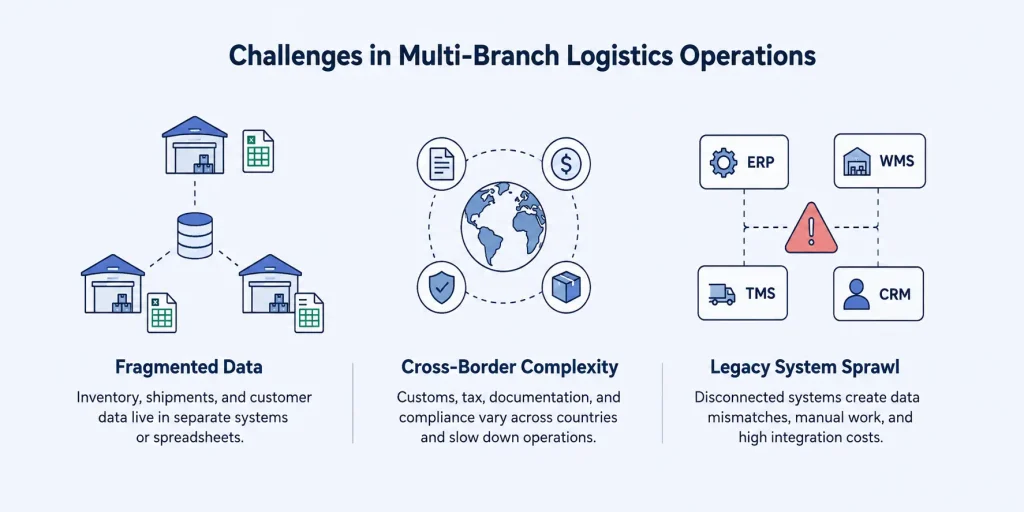
Fragmented Data Across Warehouses and Branches
Ask a regional operations director how much stock sits in the Jeddah warehouse right now, and in a lot of companies, the honest answer is “give me twenty minutes.” Inventory counts, shipment status, customer records, and rate cards often live in separate systems per branch — sometimes separate spreadsheets per branch manager. Inter-branch transfers get tracked over WhatsApp.
None of this is a people problem. It’s what happens when a business grows branch by branch without a shared data layer underneath it. A single-country warehouse management tool was never built to answer “what does our entire network look like today,” so it doesn’t.
Cross-Border Operations Add Another Layer
Move one shipment from Dubai to Riyadh and you’re suddenly dealing with customs documentation, VAT treatment that differs by country, e-invoicing formats, HS codes, country-of-origin declarations, and Incoterms — on top of the actual delivery. Most legacy systems treat this as a reporting afterthought: something to reconcile at month-end rather than something the platform tracks live.
That’s backwards. Cross-border movement isn’t an edge case for a GCC logistics operation — it’s the operation. Any platform serious about regional scale needs to treat customs status, tax treatment, and documentation as first-class, real-time data, not a spreadsheet someone updates on Fridays.
Legacy Systems Make Regional Scaling Expensive
Every disconnected ERP, WMS, TMS, CRM, and GPS system a company adds is another integration someone has to maintain by hand. This is usually where the real cost of scaling shows up — not in opening a new branch, but in the six weeks of manual data reconciliation that follows. Common logistics software integration problems — duplicate customer records, mismatched inventory counts between WMS and ERP, shipment statuses that update in one system but not another — compound with every branch added, until IT teams spend more time firefighting integrations than improving operations.
A properly designed multi-branch logistics platform replaces this patchwork with a single connected core, so adding branch number six doesn’t mean adding six more integration headaches.
What Makes a Logistics Platform “GCC-Ready”?
“GCC-ready” gets thrown around loosely. In practice, it means five specific things: the platform is built multi-branch from the start, handles multi-country compliance through configuration, treats integration as core architecture rather than an add-on, gives real-time operational visibility, and runs on infrastructure that scales without a rebuild.
Multi-Country and Multi-Branch Data Model
The data model matters more than almost any other decision in the build. Country, branch, warehouse, fleet, customer, transaction, and tax configuration should all be separate, linked entities — not fields buried inside a single “location” table. This is what lets a company run centralized master data (one customer record, one product catalog) while still letting each branch operate with its own local rules.
Companies evaluating Custom Logistics Software Development in Dubai should ask vendors directly how the data model handles this separation before any UI conversation happens — because retrofitting a multi-country data model onto a single-country system later is close to a full rebuild.
Localized Rules Without Duplicating the Platform
UAE, Saudi Arabia, Oman, Qatar, Bahrain, and Kuwait each have their own tax treatment, invoicing formats, and customs procedures. That doesn’t mean a company needs six separate applications. Configurable, country-specific rule sets — tax logic, document formats, currency, workflow variations — let one multi-branch logistics platform serve every market from a single codebase. The alternative (a separate build per country) means every future feature gets built six times instead of once.
Arabic-English Support and Regional Usability
Bilingual interfaces aren’t a translation layer bolted on at the end — they need to be part of the base design: Arabic-English documents, notifications, currency formatting, time zones, and workflows that match how teams on the ground actually operate. A platform that treats Arabic support as an afterthought usually shows it in the details — RTL layout bugs, mistranslated shipment statuses, invoice templates that don’t hold up to a Saudi ZATCA audit.
Core Features Every Multi-Branch Logistics Platform Should Include
This is the section that maps most directly to what buyers actually evaluate when comparing a multi-branch logistics platform against the tools they already have. Skip any of these and the platform ends up as a partial solution that still needs three other tools to do the job properly.
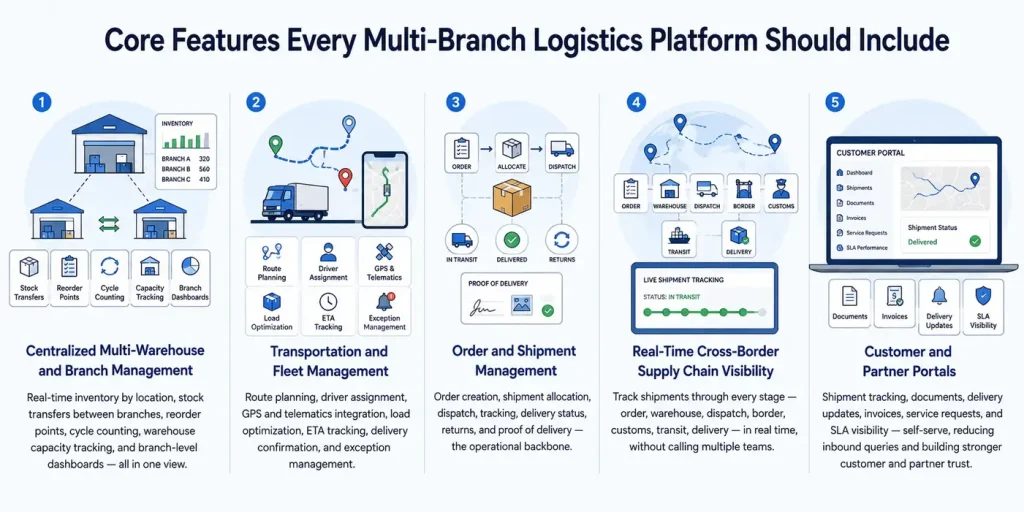
Centralized Multi-Warehouse and Branch Management
Real-time inventory by location, stock transfers between branches, reorder points, cycle counting, warehouse capacity tracking, and branch-level dashboards — all in one view. This is what turns a multi-branch logistics platform into the single source of truth a regional operations team can actually run the business from, instead of chasing branch managers for updates.
Transportation and Fleet Management
Route planning, driver assignment, GPS and telematics integration, load optimization, ETA tracking, delivery confirmation, and exception management need to sit inside the same platform as inventory and orders — not in a separate fleet tool that requires manual reconciliation. This is one of the areas where modern logistics platform features genuinely differ from what a five-year-old TMS can offer: live exception alerts instead of end-of-day reports.
Order and Shipment Management
Order creation, shipment allocation, dispatch, tracking, delivery status, returns, and proof of delivery — the operational backbone. Nothing unusual here, but it has to be tightly connected to inventory and fleet data, or the platform just becomes another silo with a nicer interface.
Real-Time Cross-Border Supply Chain Visibility
This is where most legacy systems fall apart. Executives and customers alike should be able to track a shipment through every stage — order, warehouse, dispatch, border, customs, transit, delivery — without calling three different teams. Companies that decide to build real-time shipment visibility platform capability into their core system, rather than treating it as a customer-facing add-on, tend to see the biggest jump in customer satisfaction scores, because visibility failures are consistently the top complaint in freight and 3PL customer surveys across the region.
Customer and Partner Portals
Shipment tracking, documents, delivery updates, invoices, service requests, and SLA visibility — self-serve, so customers stop emailing “where’s my shipment” and partners stop calling for POD copies. A well-built portal reduces inbound support volume noticeably; most companies report a meaningful drop within the first quarter after launch. Portals are also where a multi-branch logistics platform earns customer trust — a partner who can see exactly where their shipment sits, without a phone call, tends to stay a partner.
Designing the Right Logistics Platform Architecture
This is the part that determines whether the platform holds up in three years or needs replacing.
Recommended Architecture for GCC Logistics
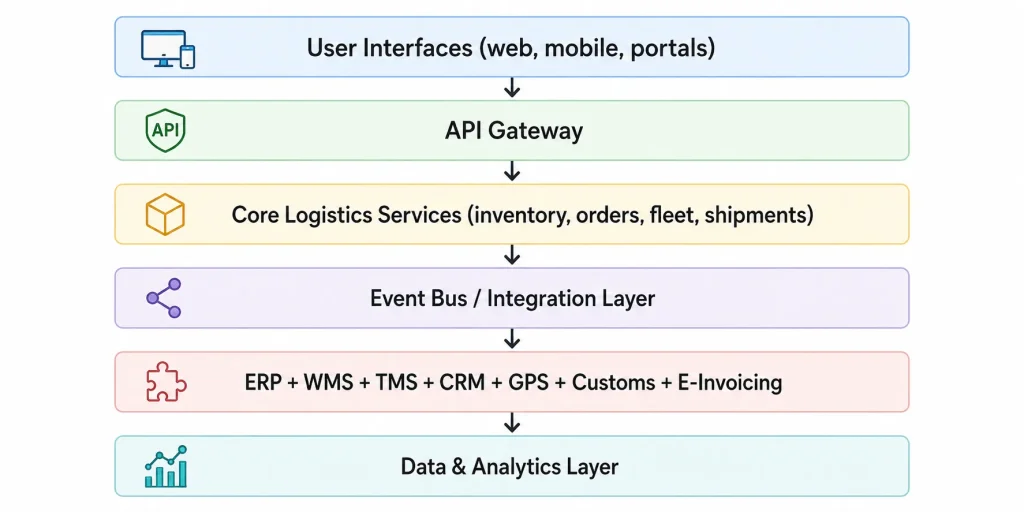
The goal of this logistics platform architecture is modularity. Each layer should be replaceable or extendable on its own — swap the TMS integration without touching order management, add a new country's customs system without rebuilding the event bus.API-First Integration Layer
REST APIs, webhooks, EDI where partners require it, an API gateway to manage traffic and auth, and dedicated connectors for ERP, telematics, and customs systems. Building API-first from the start is what makes future integrations a configuration task instead of a development project.
Event-Driven Architecture for Real-Time Operations
Order created, shipment dispatched, vehicle assigned, customs cleared, delivery completed, inventory transferred — each of these should fire as an event that other services can react to independently. This is what lets branches and services scale without one slow system dragging down the rest of the network.
Multi-Region Cloud and Data Residency
UAE-region deployment, regional cloud infrastructure, backup strategy, encryption, disaster recovery, and data residency all need deciding at the architecture stage — not after the platform is already handling live shipments. Anyone putting together an enterprise logistics software dubai guide for internal stakeholders should flag this early: data residency requirements differ by country in the GCC, and retrofitting compliant hosting after launch is expensive and disruptive.
Building Compliance Into the Platform From Day One
Compliance isn’t a feature to add later. It’s a structural decision, and it’s usually where a multi-branch logistics platform is judged hardest by customers, auditors, and regulators alike.
UAE VAT and E-Invoicing Readiness
VAT treatment, invoice structures, tax codes, digital invoice workflows, and audit trails all need to be configurable, not hard-coded — the UAE’s e-invoicing environment is still evolving, and a platform built around today’s exact rules will need rework the moment those rules shift.
Saudi ZATCA and Country-Specific Requirements
Saudi Arabia’s ZATCA e-invoicing requirements are stricter and more specific than the UAE’s. A multi-branch logistics platform operating in both markets needs to support these differences through configuration — separate rule sets per country, not a separate codebase per country.
Customs and Trade Documentation
HS codes, commercial invoices, country of origin, Incoterms, customs declarations, and import/export documents all need to live inside the platform, tied to the actual shipment record — not generated separately and attached as PDFs after the fact.
Compliance-as-Code
The strongest approach is a rules engine: country, transaction type, branch, customer, tax status, and trade flow feed in, and the applicable compliance rules come out automatically. When Saudi Arabia updates a ZATCA requirement or the UAE adjusts an e-invoicing field, the rules engine gets updated once — not every branch’s local workaround.
Where AI Adds Real Value to GCC Logistics Operations
AI in logistics gets oversold constantly. The genuinely useful applications are narrower and more specific than the marketing suggests.
Demand Forecasting Across Branches
Historical shipment volumes, seasonality, Ramadan demand shifts, promotional periods, and regional patterns feed into forecasting models that tell a branch manager what to stock before a shortage happens, not after.
AI Route Optimization
Traffic conditions, delivery windows, vehicle capacity, fuel efficiency, and border wait times all factor into route planning that a human dispatcher simply can’t recalculate in real time across dozens of active routes.
Predictive ETA and Exception Detection
This is one of the more mature applications of predictive analytics in logistics operations right now: models trained on historical delivery data can flag shipments likely to miss delivery windows or hit customs delays before they actually happen, giving operations teams a window to intervene instead of reacting after a customer complaint.
Intelligent Inventory Rebalancing
AI can recommend moving stock between branches before a shortage occurs, based on sell-through rates and inter-branch transfer patterns — turning inventory management from a reactive task into a planned one.
AI works best as a capability embedded inside the multi-branch logistics platform, pulling from the same live operational data every other feature uses — not as a separate analytics dashboard someone checks once a week.
Security and DevSecOps for GCC Logistics Platforms
A multi-branch logistics platform handles commercially sensitive data — rate cards, customer contracts, shipment values, sometimes personal data tied to deliveries. Security has to be architecture, not an afterthought bolted on before launch.
Core Security Controls
Role-based access control, multi-factor authentication, encryption in transit and at rest, API security, audit logging, network segmentation, and proper secrets management. None of this is optional for a platform handling regional trade data.
Secure CI/CD and DevSecOps
Static application security testing, software composition analysis, container scanning, infrastructure-as-code security checks, dynamic testing, software bills of materials, and artifact signing — built into the deployment pipeline, not run manually before a release.
Data Residency and Disaster Recovery
Where data physically lives, how backups are handled, and what the recovery time objective actually is — these decisions need documenting and testing before go-live, not discovered during an actual outage.
How to Build a Multi-Branch Logistics Platform: Implementation Roadmap
A realistic logistics software development roadmap runs in phases — trying to build everything at once is the most common way these projects stall out. A phased approach helps teams validate the core platform, control scope, and introduce advanced capabilities only when the underlying infrastructure is ready.
Phase 1 — Map the Existing Logistics Ecosystem
Audit every branch, warehouse, system, integration, data flow, compliance requirement, and operational bottleneck before writing a line of code. This gives the team a clear picture of how information currently moves across the organization. Skipping this step is the single biggest predictor of scope creep later.
Phase 2 — Build the Core Platform
Start with branch management, inventory, orders, shipments, users, customers, and basic dashboards. These capabilities form the operational backbone of the platform and should be tested across multiple branches before adding more advanced functionality.
Phase 3 — Connect the Existing Systems
Integrate ERP, WMS, TMS, CRM, GPS, accounting, and customs systems through the API layer established during the architecture phase. This allows existing investments to remain useful while creating a unified flow of operational data.
Phase 4 — Add Compliance and Regionalization
Introduce country-specific tax rules, invoice formats, customs workflows, documents, and local configurations on top of the core platform. A configurable approach makes it easier to adapt the system as GCC markets introduce new regulatory requirements.
Phase 5 — Introduce AI and Advanced Analytics
Add AI and advanced analytics only once enough clean operational data is flowing through the system for models to learn from. This could include demand forecasting, route optimization, predictive ETAs, and inventory recommendations.
Phase 6 — Scale Across New GCC Branches
The real test of whether the build succeeded is how easily a new branch can be added. Ideally, expansion should involve configuration, integrations, user setup, and localized rules — not rebuilding the platform from scratch.
How to Measure the ROI of a Multi-Branch Logistics Platform
Technology investments need a clear business case, and logistics leadership teams evaluating a multi-branch logistics platform should track three key areas. Operational KPIs include on-time delivery rate, order processing time, inventory accuracy, warehouse utilization, vehicle utilization, and route efficiency.
Financial KPIs include transportation cost, cost per shipment, inventory carrying cost, manual processing cost, and compliance-related losses. Visibility and customer KPIs include shipment visibility rate, customer response time, delivery exceptions, complaint rates, and SLA compliance.
The cost to build custom logistics software in UAE varies significantly based on scope. A core platform for three branches is very different from a regional solution across six countries with AI and compliance-as-code. However, ROI should always be measured across the entire network, not branch by branch. A platform that seems expensive for one warehouse can look very different when compared with the manual reconciliation costs it eliminates across ten.
Common Mistakes to Avoid When Building a GCC Logistics Platform
Even well-funded projects can fail when a multi-branch logistics platform repeats common mistakes. Building separate systems for every country creates duplicated development and maintenance work, while hard-coding compliance rules makes updates difficult when regulations change. Rules should remain configurable and version-controlled.
Treating integration as an afterthought can create costly problems, so ERP, WMS, TMS, CRM, GPS, and other systems should be considered from the beginning. Adding AI before fixing data quality is another mistake because AI cannot deliver reliable results from fragmented data.
Finally, designing for one branch and scaling later can lead to an expensive rebuild. A genuine GCC logistics platform should support multiple branches from day one, allowing GCC logistics software to grow around the entire network rather than a single location.
What Does a Future-Ready GCC Logistics Platform Look Like?
One platform. Multiple branches, multiple warehouses, multiple countries, multiple connected systems — one operational view sitting on top of all of it. Unified data, real-time visibility, country-specific compliance handled through configuration, API-first integrations, AI-driven decision support where the data supports it, secure regional cloud infrastructure, and branch onboarding that’s a configuration task rather than a development project.
That’s what separates a genuine multi-branch logistics platform from a collection of software that happens to serve the same company. The second version works fine until branch four opens. The first version is built to keep working.
Conclusion
The right multi-branch logistics platform should make GCC expansion easier, not more technically complicated. Done properly, it lets a logistics business add branches faster, connect existing systems instead of replacing them, improve cross-border visibility, automate compliance, optimize transportation, apply AI where the data actually supports it, and maintain proper security and regional data controls throughout.
If your organization is evaluating a new logistics platform, modernizing an existing TMS or WMS environment, or expanding operations across GCC markets, the first step isn’t picking a vendor — it’s mapping the operating model, the integration landscape, and the country-specific compliance requirements that any new architecture will need to support. Get that mapping right, and the technology decisions that follow get a lot easier to make.
Frequently Asked Questions
How long does it actually take to build a multi-branch logistics platform from scratch?
For core operations across two or three countries, expect six to nine months for a functional first version, followed by ongoing phases for compliance, integrations, and AI. Anyone quoting six weeks is underscoping the work.
Is it better to buy an off-the-shelf logistics platform or build a custom one for GCC operations?
Off-the-shelf works fine for single-country operations. Once you’re managing compliance across UAE, Saudi Arabia, and Oman together, most off-the-shelf tools hit a wall. Custom builds cost more upfront but avoid years of workarounds.
We already have an ERP — do we really need a separate logistics platform on top of it?
Most ERPs handle finance and inventory but weren’t built for live shipment tracking or customs workflows. A logistics platform typically integrates with the ERP rather than replacing it, handling the operational layer the ERP never covered.
How do you handle VAT differences between UAE and Saudi Arabia in one platform without maintaining two separate systems?
Use a configurable tax engine tied to the transaction’s country, customer type, and trade flow, instead of hard-coded tax logic. When a rule changes in one country, you update the configuration, not the underlying software.
What’s the single biggest reason logistics software projects go over budget in this region?
Integration, almost every time. Teams scope the core platform reasonably well, then discover mid-project that connecting the ERP, customs system, and multiple telematics providers is significant work that should’ve been scoped from day one.
Can AI actually replace manual dispatch and route planning, or is that still overhyped?
AI route optimization genuinely cuts fuel costs and improves delivery windows, but it works best as a recommendation layer a dispatcher reviews, not a fully autonomous system, given how much local road and customs conditions vary.
How many branches justify investing in a dedicated multi-branch platform instead of manual processes?
There’s no fixed number, but most teams feel it by branch three or four, when manual reconciliation starts eating a real chunk of someone’s week. Building the multi-branch data model earlier keeps the eventual platform cheaper.