


Here’s a number that should get your attention: a Series A healthcare startup budgeted $80,000 for an AI-powered patient finance app. The final bill? $310,000. Nobody lied. Nobody was careless. They simply never had the right budget conversation before writing a single line of code.
That story is not unusual in fintech software development. It is, in fact, the norm for enterprises that treat budget planning as a line item rather than a strategic decision.
In 2026, the global fintech market is valued at $395.38 billion and growing at a CAGR of 16.3% through 2034, according to Polaris Market Research. Every bank, insurer, hospital network, lender, and wealth manager on the planet is either building, upgrading, or buying fintech infrastructure right now. And most of them are underfunding the project by 30 to 50 percent because they are comparing the wrong numbers.
This blog gives you the real numbers. Cost breakdowns by industry. Legal and security budget lines most enterprises miss entirely. A step-by-step planning framework. A free estimation tool. And a comparison guide so you know exactly where your money should go before you commit to a vendor.
If you want to understand the broader business value before diving into costs, read through the full landscape of fintech benefits and their enterprise impact first. Then come back here for the budget specifics.
Why Most Fintech Budgets Fail Before Development Begins
The single biggest reason fintech software development budgets collapse mid-project is not complexity, scope creep, or bad vendors. It is the absence of a complete cost picture at the planning stage.
Most decision-makers receive a quote for development hours and treat it as the total budget. The real software development budget includes development costs, yes, but it also includes compliance architecture, third-party API licensing, security audits, infrastructure, ongoing maintenance, and the cost of regulatory changes your platform has to absorb after launch.
When you look at it that way, here is what enterprise teams consistently underestimate:
Compliance costs add 20 to 30 percent to total build costs in regulated categories. Security hardening, biometric authentication, and penetration testing add $30,000 to $100,000 per project on their own. Third-party integrations with payment gateways, KYC providers, or EHR systems in healthcare add $20,000 to $40,000 per integration. And annual maintenance runs 15 to 20 percent of your initial build cost every year post-launch.
None of these show up in a feature-by-feature development quote. All of them show up in your actual invoice.
The good news is that none of this is unpredictable. If you know the full structure of a fintech software development budget, you can plan for it, negotiate around it, and protect your organization from costly mid-project surprises.
Key Cost That Drives in Fintech Development in 2026
Before breaking down costs by industry, it helps to understand the seven universal drivers that shape every fintech software development engagement in 2026.
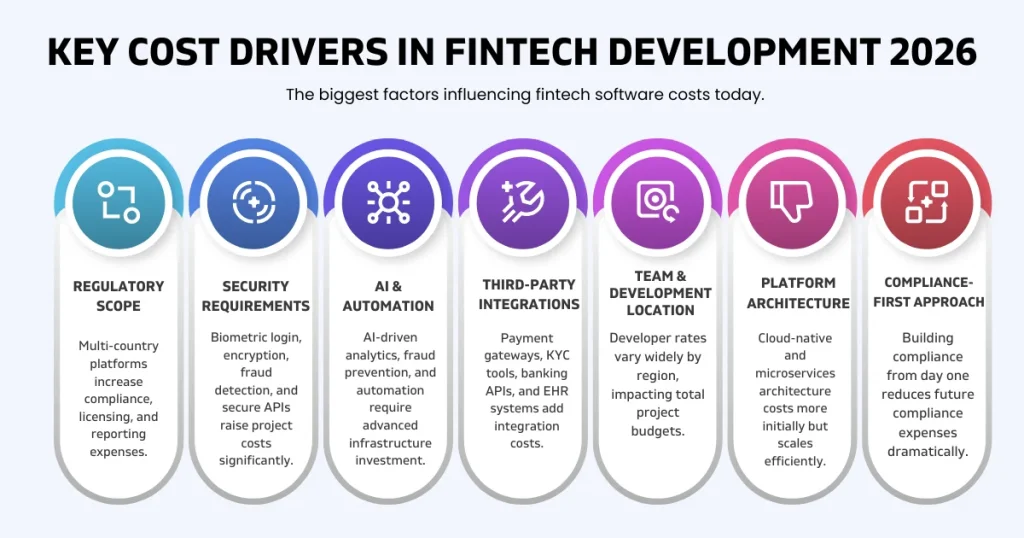
Regulatory Scope. Building for multiple jurisdictions multiplies compliance costs immediately. Every new market adds localization, additional licensing, and regulatory reporting requirements. A single-market platform costs far less than one designed for cross-border operations.
Security Requirements. In 2026, deep biometric authentication, end-to-end encryption, AI-powered fraud detection, and secure API gateways are baseline expectations, not premium additions. These security layers add $30,000 to $100,000 to a typical project, and that is before annual penetration testing.
AI and Automation Integration. AI-powered fraud detection, underwriting automation, predictive analytics, and personalized financial recommendations are now standard features in competitive platforms. AI feature sets add $50,000 to $150,000 to a build depending on model complexity and data infrastructure requirements.
Third-Party Integrations. Payment processors, KYC providers, credit bureaus, open banking APIs, and — in healthcare fintech — EHR systems like Epic or Cerner all carry per-integration costs. Budget $20,000 to $40,000 per major integration connection.
Team Location and Composition. A senior fintech engineering team in North America bills at $150 to $200 per hour. A comparable team in Eastern Europe or South Asia bills at $40 to $80 per hour. The same feature set at different hourly rates creates dramatically different project totals, which is why vendor comparison based only on total quotes is misleading without understanding team composition.
Platform Architecture. The architectural choices made in week one determine scalability costs for years. Custom software development built on microservices with cloud-native infrastructure costs more upfront but scales at a fraction of the cost of a monolithic system.
Compliance-First vs. Compliance-Retrofit. Teams that build compliance into architecture from day one spend 40 to 60 percent less on compliance than teams who retrofit it after launch. This single decision affects your total software development budget more than almost any other choice.
Full Cost Breakdown by Industry — Every Sector Covered
The cost of fintech software development is not a single number. It varies significantly by sector, use case, regulatory environment, and scale. Here is a complete breakdown across every major industry vertical.
Banking and Payment Software
Banking software is among the most complex and expensive fintech builds because of the combination of real-time transaction requirements; PCI-DSS compliance; AML and KYC obligations—where fintech compliance software for banks plays a critical role in automating regulatory checks; and multi-currency infrastructure.
Basic digital banking app (single market, limited features): $80,000 to $150,000 Mid-range banking platform (multi-currency, KYC/AML, real-time payments): $200,000 to $450,000 Enterprise-grade core banking system (multi-region, full compliance stack, legacy migration): $600,000 to $1,500,000+
Cost drivers unique to this sector include real-time payment rails integration (SWIFT, SEPA, and ACH), multi-currency ledger architecture, PCI-DSS Level 1 compliance certification, and fraud detection infrastructure. AI-powered fraud prevention alone adds $30,000 to $50,000 to build costs but typically reduces fraud losses by 40 to 60 percent within 18 months—making it one of the highest-ROI line items in the entire budget.
Digital payment transaction value is projected at $24.07 trillion globally in 2025, with continued multi-year growth ahead. The infrastructure supporting that volume needs to be engineered to match it.
Healthcare Fintech Software
Healthcare fintech sits at the intersection of two of the most heavily regulated industries on earth. You are building platforms with the help of financial software app developers that handle both money and protected health information (PHI), which means you are subject to HIPAA, PCI-DSS, and increasingly, CMS interoperability mandates simultaneously.
This double compliance burden is what makes healthcare fintech software development substantially more expensive than either healthcare apps or standard fintech builds in isolation.
HIPAA-compliant MVP (basic payment processing, patient billing): $35,000 to $80,000 Mid-range health finance platform (EHR integration, claims processing, patient payment portals): $150,000 to $350,000 Enterprise health finance system (AI-driven revenue cycle management, multi-payer integration, full audit infrastructure): $400,000 to $800,000+
HIPAA compliance alone adds 20 to 30 percent to total development costs. Each EHR integration connection with Epic, Cerner, or Allscripts adds $20,000 to $40,000 and requires navigating sandbox environments and vendor certification programs. The mHealth market is projected to grow from $40.65 billion in 2026 to $88.70 billion by 2032, and enterprise health systems are actively investing in financial infrastructure that matches that growth trajectory.
Critical budget items specific to healthcare fintech:
FHIR R4 compliance for data interoperability is now mandated under CMS regulations and must be architected from the start, not added later. AI-driven revenue cycle management systems, which automate claims processing, denial management, and payment posting, run $150,000 to $300,000 for model development and training data infrastructure. Annual maintenance for healthcare fintech platforms should be budgeted at 18 to 22 percent of initial build cost due to the volume of regulatory updates in this sector.
Insurance Technology
InsurTech platforms handle underwriting logic, claims processing, policy management, and increasingly, real-time telematics data. The complexity of actuarial models and state-by-state regulatory variation in markets like the US makes compliance costs particularly significant.
Basic InsurTech MVP (single product line, one market): $60,000 to $120,000 Mid-range InsurTech platform (multi-product, claims automation, customer portal): $180,000 to $380,000. Enterprise InsurTech system (AI underwriting, multi-state compliance, full claims lifecycle): $500,000 to $1,200,000+
The biggest cost driver unique to InsurTech is actuarial model integration. Custom underwriting algorithms require data science teams in addition to engineering teams, which adds 20 to 35 percent to typical development costs.
Investment and Wealth Management Platforms
Investment platforms require real-time data streams, charting infrastructure, AI-driven portfolio analytics, and compliance with securities regulations (SEC in the US, FCA in the UK, SEBI in India, and equivalent authorities in other markets).
Basic investment app (watchlist, basic portfolio tracking, market data): $100,000 to $180,000 Mid-range wealth management platform (robo-advisory, automated rebalancing, tax optimization): $250,000 to $500,000 Enterprise investment management system (institutional-grade, multi-asset, algorithmic trading infrastructure): $600,000 to $1,500,000+
The most significant growth area in this sector right now is AI-driven investment intelligence. If you are exploring what modern AI financial intelligence looks like before building your own, reviewing a live example—such as an AI stock market prediction platform—gives you a concrete reference point for what your financial software development scope actually needs to include.
Lending and Credit Software
Lending platforms combine loan origination, credit scoring, underwriting, servicing, and collections into a single workflow, all of which must operate within consumer protection regulations and anti-discrimination law.
Basic lending MVP (single loan product, manual underwriting): $70,000 to $130,000 Mid-range lending platform (automated underwriting, credit bureau integration, borrower portal): $200,000 to $400,000 Enterprise lending system (AI underwriting, multi-product, multi-market, full servicing lifecycle): $500,000 to $1,000,000+
AI-powered credit scoring using alternative data (utility payments, rent history, and cash flow analysis) is now a competitive differentiator in lending, particularly for enterprises targeting underserved markets. This capability adds $80,000 to $150,000 to build costs but dramatically expands the addressable borrower pool.
Regulatory Technology
RegTech platforms help financial institutions manage compliance, reporting, and risk monitoring at scale. They are typically B2B products sold to banks, insurers, and investment firms, which means the buyer’s own compliance requirements become part of your product’s compliance requirements.
Basic RegTech tool (single compliance workflow, one market): $50,000 to $120,000 Mid-range RegTech platform (multi-regulation, automated reporting, audit trail infrastructure): $180,000 to $400,000 Enterprise RegTech system (real-time monitoring, AI anomaly detection, multi-jurisdiction): $500,000 to $1,200,000+
RegTech is one of the fastest-growing segments in the fintech market precisely because regulatory complexity continues to increase globally. The enterprises building in this space are, in effect, building compliance infrastructure for the entire financial industry.
Need an Accurate Fintech Software Cost Estimate for Your Industry?
Whether you are building a banking platform, healthcare fintech solution, InsurTech product, lending system, or AI-powered investment app, the real challenge is not just development—it is planning the right architecture, compliance scope, and scalability from day one.
Partner with experienced financial software app developers to get:
- Industry-specific cost forecasting
- Compliance-ready architecture planning
- Feature prioritization for faster ROI
- Scalable fintech infrastructure built for growth
- Transparent development timelines and budgeting
Start with a tailored consultation and discover what your fintech product will realistically cost to build in 2026 — before expensive mistakes happen.

Fintech Software Development Cost Comparison Table
| Software Category | MVP | Mid-Market | Enterprise |
| Banking & Payments | $80K–$150K | $200K–$450K | $600K–$1.5M+ |
| Healthcare Fintech | $35K–$80K | $150K–$350K | $400K–$800K+ |
| InsurTech | $60K–$120K | $180K–$380K | $500K–$1.2M+ |
| Investment & Wealth | $100K–$180K | $250K–$500K | $600K–$1.5M+ |
| Lending & Credit | $70K–$130K | $200K–$400K | $500K–$1M+ |
| RegTech | $50K–$120K | $180K–$400K | $500K–$1.2M+ |
| AI-Powered Fintech | $75K–$150K | $300K–$600K | $800K–$2M+ |
Budget Allocation by Phase (any fintech project):
- Engineering (frontend + backend): 40 to 60 percent
- QA and Security Hardening: 15 to 30 percent
- Compliance and Legal Architecture: 15 to 25 percent
- Ongoing Annual Maintenance: 15 to 20 percent of initial build cost, per year
Legal and Security Costs — The Budget Line Most Enterprises Skip
Legal and security costs are the most consistently underbudgeted components in any fintech software development engagement. They are also the ones that cause the most expensive post-launch problems when skipped.
Here is a realistic breakdown of what you should be budgeting for:
PCI-DSS Compliance Architecture: $20,000 to $50,000 for design and implementation. Annual QSA audit: $15,000 to $40,000.
KYC/AML Infrastructure: $30,000 to $80,000 for integration with identity verification providers (Onfido, Jumio, or equivalent). Ongoing per-verification costs of $0.50 to $3.00 per user check.
GDPR/Data Privacy Architecture: $15,000 to $35,000 for privacy-by-design implementation, consent management, and data residency infrastructure.
HIPAA Compliance (healthcare fintech only): 20 to 30 percent of total development budget. A $200,000 project therefore carries $40,000 to $60,000 in HIPAA-specific costs.
Penetration Testing and Security Audits: $15,000 to $40,000 per audit cycle. Enterprise-grade platforms should budget for two audit cycles per year.
Legal Review and Licensing: $10,000 to $30,000 for legal review of data agreements, user agreements, and regulatory filings depending on jurisdiction.
Secrets Management and Infrastructure Security (HashiCorp Vault, AWS Secrets Manager, CI/CD security scanning): $10,000 to $25,000 for initial implementation, plus ongoing tooling costs.
Total additional legal and security budget to add to any fintech development estimate: 25 to 40 percent on top of your core development quote.
This is not optional spending. These are the costs that protect your license to operate. The enterprises that treat compliance as infrastructure—not an afterthought—spend 40 to 60 percent less on compliance over the lifetime of their platform than those who retrofit it after launch.
Real-World Case Study: Healthcare Fintech Platform Budget Breakdown
Company profile: A mid-sized US hospital network (12 hospitals, 60+ clinics) needed to replace a legacy patient billing and payment system with a modern, HIPAA-compliant healthcare fintech platform. Goals included real-time payment processing, EHR integration with Epic, automated insurance eligibility verification, and a patient-facing payment portal accessible across mobile and web.
Initial budget estimate (internal): $180,000
Actual project scope after discovery:
| Budget Line | Amount |
| Core development (frontend + backend) | $145,000 |
| Epic EHR integration | $38,000 |
| HIPAA compliance architecture | $52,000 |
| Patient identity verification (KYC-adjacent) | $18,000 |
| Mobile app development (iOS + Android) | $44,000 |
| QA and security hardening | $36,000 |
| Penetration testing and audit | $22,000 |
| Annual maintenance provision (Year 1) | $47,000 |
| Total | $402,000 |
What changed: The discovery phase revealed that Epic integration required FHIR R4 compliance, HIPAA architecture was not accounted for in the original estimate, the mobile app scope had been assumed but not priced, and the security audit was treated as optional until legal reviewed the project.
Outcome: Platform launched in Month 8. Patient payment completion rate improved from 41 percent to 74 percent in the first 90 days. Billing cycle time reduced from 34 days to 11 days. Annual collections increased by $2.3 million in Year 1 against a platform investment of $402,000.
Budget lesson: The original $180,000 estimate represented less than half of the real project. A complete discovery process and a full budget conversation at the start would have set the right expectation and allowed the organization to make an informed investment decision—rather than being surprised mid-project.
Build vs. Buy vs. Outsource — Which Model Fits Your Budget?
One of the highest-stakes decisions in any fintech software development project is the delivery model. The wrong choice does not just cost money; it costs time, security, and competitive positioning.
| Criteria | Build In-House | Buy Off-the-Shelf | Outsource to a Partner |
| Upfront Cost | Very High | Low | Medium |
| Customization | Unlimited | Very Limited | High |
| Time to Launch | 12–24 months | 2–4 months | 4–12 months |
| Compliance Fit | You control it | Vendor-dependent | Partner-managed |
| Scalability | High (if architected well) | Expensive to scale | High |
| 3-Year Total Cost | Highest | Moderate-High | Lowest for most enterprises |
| Best Suited For | Large enterprises with 100+ engineers | SMBs needing speed over customization | Mid-market to enterprise, any sector |
The build-in-house model gives maximum control but requires recruiting specialized fintech engineering talent in one of the most competitive hiring markets in tech. The average salary for a senior fintech engineer in 2026 is $185,000 to $230,000 in North American markets.
The buy model (Temenos, SAP Financial Services Cloud, and Salesforce Financial Cloud) works for enterprises with standard workflows and limited differentiation requirements. It fails when your competitive advantage depends on product experiences that off-the-shelf platforms cannot deliver.
The outsource model — partnering with experienced custom software development companies — delivers the fastest time to market, the most cost-effective access to specialized compliance and security expertise, and the flexibility to scale the engagement as your product evolves. For most mid-market and enterprise fintech projects in 2026, this is the most financially rational choice.
How to Structure Your Fintech Software Development Budget
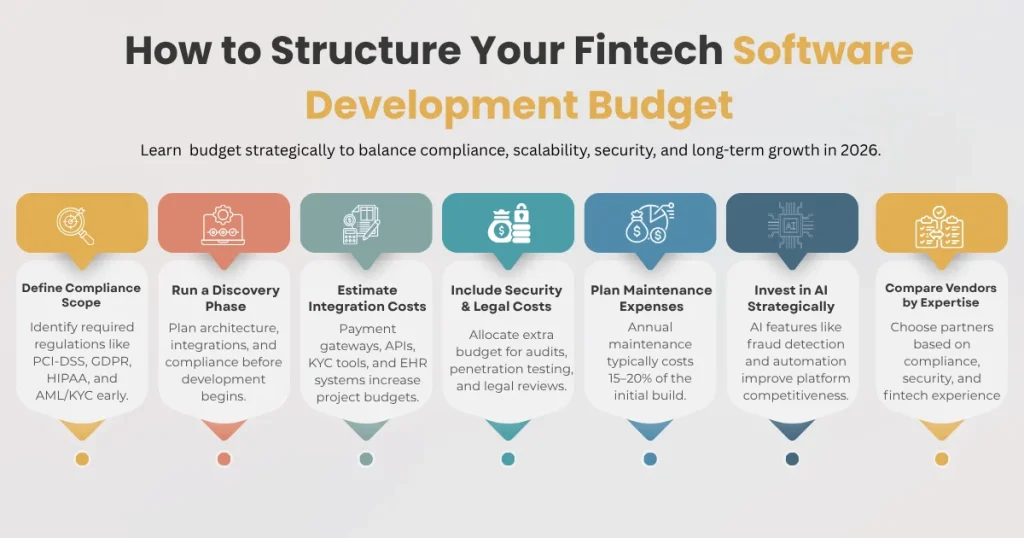
Step 1: Define your compliance scope first, not last. Identify every regulatory framework your platform must comply with before estimating development costs. PCI-DSS, GDPR, HIPAA, AML/KYC, SEC, FCA — each adds a specific, quantifiable cost. Build these into your initial budget.
Step 2: Run a discovery phase before committing to a project budget. A structured discovery phase (4 to 6 weeks, $15,000 to $30,000) produces a technical architecture document, a compliance requirements map, an integration dependency list, and a realistic project estimate. Every dollar spent on discovery saves $5 to $10 in development and rework. Do not skip this.
Step 3: Budget your integration costs explicitly. List every third-party system your platform must connect to. Payment gateways, KYC providers, credit bureaus, banking APIs, EHR systems for healthcare. Each connection costs $20,000 to $40,000. Add them up before presenting the budget to stakeholders.
Step 4: Add 25 to 40 percent for legal and security costs. Take your core development estimate and add 25 to 40 percent specifically for compliance architecture, penetration testing, security audits, and legal review. This is not a contingency buffer. This is a required, predictable expense.
Step 5: Build a Year 1 maintenance provision into the initial budget. Annual maintenance runs 15 to 20 percent of your initial build cost. For a $400,000 platform, that is $60,000 to $80,000 per year. Include Year 1 maintenance in your initial budget presentation so stakeholders see the true cost of ownership from day one.
Step 6: Align AI investment with your competitive roadmap. AI in fintech software development is no longer optional for competitive platforms. Fraud detection, underwriting automation, personalized recommendations, and predictive risk models are now expected capabilities. Understanding the current landscape of AI trends affecting financial software will help you make informed decisions about where AI investment adds the most value for your specific use case. Budget $50,000 to $150,000 for meaningful AI capability depending on your use case, and plan this as an investment in differentiation, not a cost to minimize.
Step 7: Get three structured vendor quotes — not hourly rate comparisons. Compare vendors on full-scope quotes that include compliance architecture, security, testing, and integration costs — not just hourly development rates. A $60/hour offshore team that requires significant rework, fails compliance audits, or delivers insecure code costs far more than a $150/hour team with fintech domain expertise. This is also why selecting proven custom AI development solutions partners—especially for AI-powered fintech features—matters as much as the development cost itself.
Ready to Plan a Fintech Software Development Budget That Actually Works?
The difference between a fintech project that delivers ROI and one that burns through budget mid-project is almost always this: the planning conversation that either happened or did not happen before development began.
Now you have the complete picture. Cost ranges by industry. Legal and security budget lines. A build vs. buy vs. outsource framework. A step-by-step budgeting process. And a real case study showing exactly what surprise costs look like and what the outcome can be when you build the right way.
The next step is to get an estimate that reflects your actual project—your compliance scope, your integrations, your market, your timeline—with guidance from SISGAIN
Here is what happens when you reach out to our team:
- Free 30-minute budget discovery call — we review your scope, compliance requirements, and integration needs with no commitment and no sales pressure.
- Customized budget estimate delivered within 3 to 5 business days — full breakdown by phase, including legal, security, and maintenance.
- Transparent vendor recommendation — we tell you exactly what kind of engagement model fits your budget and goals, whether that is a dedicated team, a fixed-scope project, or a phased MVP-to-enterprise roadmap.
Conclusion
Planning a fintech software development budget is not a guessing exercise — it is a strategic decision with real financial consequences in both directions. Underbudget, and you either kill the project mid-build or launch a platform too fragile to survive its first compliance audit. Overbudget without a framework, and you burn stakeholder confidence before a single user signs up.
The enterprises that get this right share one habit: they treat the budget conversation as a product decision, not a procurement exercise. They define compliance scope before estimating development cost. They account for legal, security, and integration costs as fixed line items, not contingencies. They build maintenance into the original budget so Year 1 operating costs do not come as a surprise. And they choose their delivery model—build, buy, or outsource—based on a 3-year total cost of ownership, not a year 1 quote comparison.
The numbers in this guide are grounded in 2026 market data and real project outcomes across banking, healthcare, fintech, InsurTech, lending, investment, and RegTech sectors. Use them as your baseline. Then use the free calculator, the 7-step framework, and the case study as your planning tools.
The fintech market is growing at 16.3% annually. The window to build competitive financial infrastructure is open now — but it rewards the enterprises that plan well, not just the ones that move fast.

FAQ’s
How much does fintech software development cost in 2026?
Fintech software development costs range from $20,000 for a narrow MVP to $1,500,000 or more for a full enterprise platform. The most common range for a functional, market-ready mid-tier fintech platform is $150,000 to $500,000.
How long does it take to develop a fintech app?
A fintech MVP typically takes 4 to 6 months. A mid-market platform takes 6 to 10 months. An enterprise-grade, multi-market financial software platform typically requires 10 to 18 months.
What is the biggest mistake companies make when budgeting for fintech software?
Not accounting for compliance, legal, and security costs upfront. These consistently add 25 to 40 percent to the base development estimate and are non-negotiable expenses. Companies that treat them as optional discover this after the project is already underway, leading to budget overruns that could have been avoided entirely.
Is it cheaper to build or buy fintech software?
Buying off-the-shelf solutions is cheaper in Year 1 but more expensive over a 3-year horizon for enterprises with customization or scaling requirements. Custom software development built to your specific requirements delivers better ROI for mid-market and enterprise buyers over a 3- to 5-year time horizon.
How do AI features affect fintech software development cost?
AI features add $50,000 to $150,000 to a fintech build depending on scope. Fraud detection models sit at the lower end of this range. Full AI-powered underwriting or personalized financial planning engines sit at the higher end.
Does healthcare fintech cost more than standard fintech?
Yes, typically 20 to 35 percent more per comparable scope due to the dual compliance burden of HIPAA plus financial regulations. HIPAA architecture alone adds 20 to 30 percent to development costs. EHR integrations add $20,000 to $40,000 per connection. Any enterprise entering healthcare fintech should budget for this premium from the start.
What should be included in an annual fintech maintenance budget?
Annual maintenance should cover OS and framework updates, regulatory compliance updates, security patch management, infrastructure costs, annual penetration testing, and feature enhancements. Budget 15 to 20 percent of your initial build cost annually. For a $400,000 platform, that means $60,000 to $80,000 per year.