

Key Takeaways
- Hospital ransomware protection is a patient-safety problem first and an IT problem second.
- Backups alone don’t restore clinical capability. Identity, dependencies and data integrity decide how fast care returns.
- Effective hospital ransomware protection classifies applications by patient-care impact, not by department.
- Build a controlled degraded mode so clinicians can keep working while systems are rebuilt.
- Combine immutable backups, network segmentation and a dependency-aware recovery sequence.
- Test recovery with clinical scenarios and measure actual recovery times against approved targets.
- Align your hospital ransomware protection programme with NABIDH and DHA expectations, and document every risk decision.
It’s 3:40 a.m. in Dubai. The emergency department is filling up, and the EMR won’t load. Pharmacy can’t see active orders. The lab interface has stopped returning results, and nobody can log in because the identity system is down.
No screen shows a ransom note yet, but the hospital is already operating blind.
This is why hospital ransomware protection can’t stop at antivirus, firewalls and a nightly backup job. Modern healthcare ransomware attacks threaten two things at once: the confidentiality of patient data and the availability of the clinical services that depend on it. A hospital that restores its files but can’t trust the restored records hasn’t recovered.
The central argument of this article is simple. Hospital ransomware protection means a hospital can do four things during an attack: keep minimum safe clinical operations running, contain the compromise, restore trusted applications in a clinically sensible order, and reconcile the data before normal work resumes.
We’ll cover application architecture, recovery engineering, hospital downtime procedures, and the Dubai compliance context that shapes each decision. It’s written for CIOs, CISOs and clinical operations leaders who need a practical view of hospital ransomware protection, not a product pitch.
Why Hospital Ransomware Protection Matters for Dubai Hospitals
The Connected Healthcare Environment in Dubai
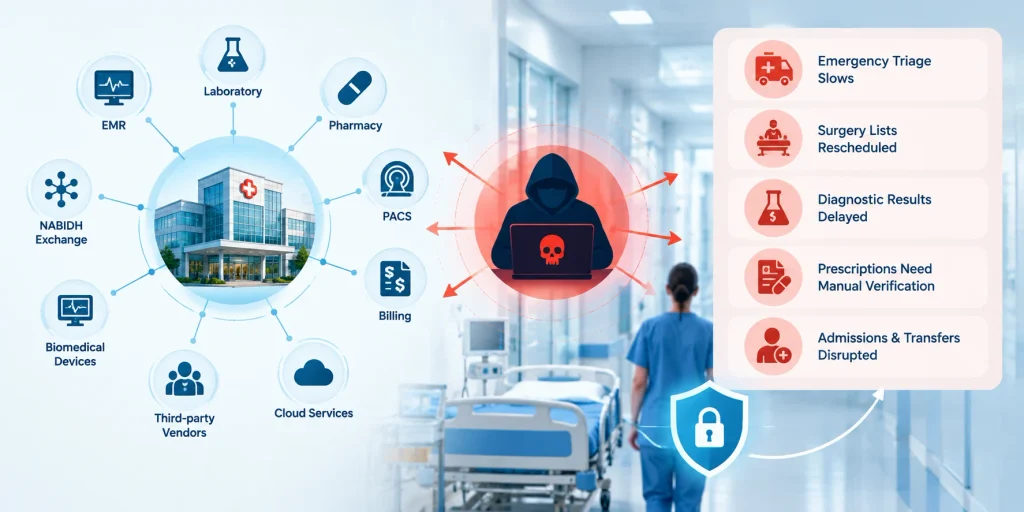
A Dubai hospital rarely runs on one system. The EMR talks to the laboratory system, the pharmacy application, PACS, billing, and NABIDH-connected exchange platforms. Biomedical devices feed monitoring data into that same web. Cloud services and third-party vendors sit on the edges, often with remote access.
That interdependence is what makes an attack spread. A compromised vendor account or a single infected server can disrupt several clinical workflows at once. It’s also why hospital ransomware protection has to account for third-party applications, cloud services and vendor connections, and not just the hospital’s own perimeter.
Many of these exposures fall under broader digital health platform security risks, which is a useful companion read when you’re mapping your wider attack surface.
The Clinical and Business Impact of Healthcare Ransomware
Think about what stops when core systems go down. Emergency triage slows. Surgical lists get rescheduled. Diagnostic results arrive on paper, late, or not at all. Prescriptions need manual verification. Admissions and patient transfers turn into phone calls.
Prolonged downtime also builds a hidden cost: manual workloads, delayed procedures and administrative backlogs that take weeks to clear after systems return. Strong ransomware resilience healthcare programmes treat this as one continuous problem covering patient safety, service continuity and business continuity. Hospital ransomware protection is the discipline that ties those three together.
The Changing Threat Landscape: From Encryption to Clinical Disruption
Why Modern Ransomware Attacks Go Beyond File Encryption
The threat is shifting, and it’s worth being precise about how. In its 2025 healthcare survey, Sophos reported that exploited vulnerabilities were the most common technical root cause of attack, used in 33% of incidents, overtaking credential-based attacks. The same report found that only 34% of attacks resulted in encrypted data, compared with 74% reported in 2024. Extortion-only attacks, where data is stolen but not encrypted, tripled to 12% of attacks from 4% in 2022/23.
Read those numbers carefully. Defences are stopping more attacks before encryption. But attackers are adapting toward data theft and extortion, which means a hospital can face a serious incident without a single locked file.
That shift matters for EHR security. If your hospital ransomware protection strategy only asks “can we restore encrypted data?”, it misses the case where patient records are stolen and the systems still run.
Why Backups Alone Cannot Guarantee Hospital Ransomware Protection
Having backup copies and restoring trusted clinical capability are two different things.
Attackers who reach privileged accounts can delete or corrupt backups, or poison the recovery infrastructure itself. Even a clean backup is only useful if the identity system, DNS, databases and integration engines it depends on can be rebuilt in the right order.
Sound healthcare disaster recovery plans therefore account for application dependencies, data integrity and identity recovery. A backup that restores a database no one can log in to solves nothing, and it doesn’t deliver hospital ransomware protection either.
What Does Hospital Ransomware Resilience Actually Mean?
Four Outcomes of a Resilient Clinical Environment
Resilience isn’t a product. It’s four outcomes you can test:
- Continue minimum safe clinical operations during the disruption.
- Contain the attack to stop lateral movement across clinical and administrative systems.
- Restore trusted applications and dependencies in a clinically prioritised sequence.
- Reconcile downtime records and validate restored data before normal operations resume.
If a hospital can demonstrate all four, it has real hospital ransomware protection. If it can only demonstrate the first line of defence, it has a security tool set.
Prevention Versus Resilience
Good hospital ransomware protection needs both prevention and recovery. Prevention lowers the odds of an incident. Recovery capability decides how bad it gets when prevention fails, and eventually it will.
There’s a distinction many plans miss: system availability is not the same as clinically safe availability. A restored EMR isn’t ready for use until its data, access controls and integrations have been validated. Putting an unverified system back in front of clinicians can be more dangerous than leaving it offline.
Quick Question: “What is a ransomware recovery time objective for a hospital?”— It’s the maximum time a specific clinical service can stay unavailable before patient safety is put at risk. A ransomware recovery time objective hospital teams can defend is set with clinical leaders, per service, then proven through testing rather than assumed.
Hospital Ransomware Protection Risk Assessment Framework
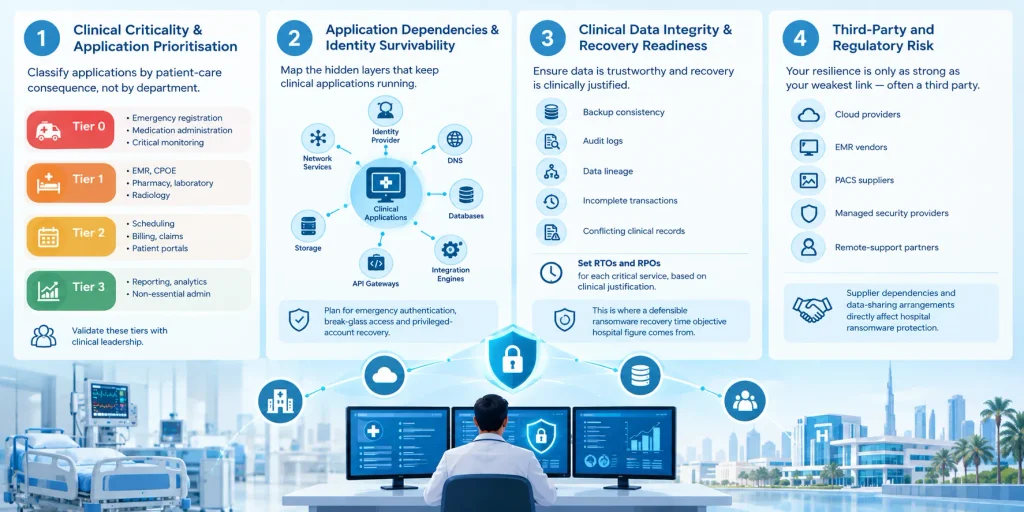
A structured healthcare cybersecurity assessment gives you evidence instead of assumptions. Use these four lenses to shape your hospital ransomware protection roadmap.
1. Clinical Criticality and Application Prioritisation
Classify applications by patient-care consequence, not by which department owns them. Four illustrative recovery tiers work well:
- Tier 0: Emergency registration, medication administration, critical monitoring.
- Tier 1: EMR, CPOE, pharmacy, laboratory, radiology.
- Tier 2: Scheduling, billing, claims, patient portals.
- Tier 3: Reporting, analytics, non-essential administration.
Validate these tiers with clinical leadership. IT alone shouldn’t decide what’s critical, and hospital ransomware protection built on the wrong priorities will restore the wrong things first.
2. Application Dependencies and Identity Survivability
Map the hidden layers: identity providers, DNS, databases, API gateways, integration engines, storage and network services.
A clinical application can be technically running yet unusable because authentication or one interface has failed. Plan for emergency authentication, break-glass access and privileged-account recovery before you need them.
3. Clinical Data Integrity and Recovery Readiness
Assess backup consistency, audit logs, data lineage, incomplete transactions and conflicting clinical records. Then set recovery time objectives (RTOs) and recovery point objectives (RPOs) for each critical service, based on clinical justification. This is where a defensible ransomware recovery time objective hospital figure comes from: a number the clinical team agreed to, not one the IT team guessed.
4. Third-Party and Regulatory Risk
List your cloud providers, EMR vendors, PACS suppliers, managed security providers and remote-support partners. Supplier dependencies and data-sharing arrangements directly affect hospital ransomware protection, because your recovery timeline is often only as fast as your slowest vendor.
Design Patterns for Ransomware-Resilient Clinical Applications
This is where hospital ransomware protection moves from strategy to architecture. Each pattern below solves a specific failure that shows up in real incidents.
1. Build a Minimum Viable Hospital Operating Model
Define the smallest set of capabilities required to deliver safe, prioritised care: patient identification, allergy information, medication details, urgent orders and results, emergency communication and downtime documentation.
Then design hospital ransomware protection so these capabilities can run independently of full application restoration. If the EMR is down for a day, clinicians should still know who the patient is and what they’re allergic to.
2. Design Clinical Applications With a Controlled Degraded Mode
Give applications a planned fallback state: read-only patient summaries, locally cached emergency information, offline forms and temporary order queues.
Two rules matter here. First, show visible warnings whenever information may be stale or incomplete. Second, validate and reconcile queued data before it synchronises back into the live record. A degraded mode without those rules adds risk instead of hospital ransomware protection.
3. Use Cell-Based Network Segmentation
Separate clinical applications, biomedical devices, administrative systems, vendor access and backup infrastructure into controlled zones. Segmentation limits lateral movement while keeping essential clinical communication alive.
Base access rules on workflows, not just network boundaries. A pharmacy interface needs to reach specific services, not the whole clinical network. Segmentation is one of the most cost-effective layers of hospital ransomware protection because it shrinks the blast radius of every other failure.
4. Implement Immutable Backups and Isolated Recovery
Immutable backups healthcare teams rely on protect recovery copies from unauthorised change or deletion. Done properly, the design includes isolated backup credentials, offline or logically separated copies, application-consistent snapshots and routine restoration testing.
One point deserves emphasis: recovery infrastructure shouldn’t depend entirely on production administrator credentials. If an attacker owns those credentials, they own your recovery too, and your hospital ransomware protection collapses with them.
5. Restore Applications Through a Dependency-Aware Recovery Sequence
Map how identity, DNS, databases, integration engines, EMR, pharmacy, laboratory and PACS relate to each other. Restore in that dependency order, using clean-room restoration and controlled reconnection.
This is where healthcare disaster recovery earns its value. Teams that restore whatever is easiest first often find they have to rebuild it again once a missing dependency surfaces. Hospital ransomware protection means restoring in clinical priority, not in convenience order.
6. Apply Zero-Trust Access and Clinical Break-Glass Controls
A zero trust healthcare model means least-privilege access, MFA, separate administrative accounts, time-limited vendor access and service-to-service authorisation.
Emergency access still has to exist, because clinicians can’t wait for a ticket during a resuscitation. The answer is to restrict break-glass access, audit it, and review every use afterward. That balance is central to hospital ransomware protection and to identity resilience.
7. Quarantine Interfaces and Reconcile Clinical Data
HL7, FHIR and DICOM interfaces may need to be selectively suspended during an incident so corrupted or malicious messages don’t spread. Build in suspicious-message quarantine, validated replay, duplicate detection and audit-log preservation.
When systems return, manual-to-digital reconciliation protects data integrity. Paper records from the downtime period must be entered, checked against queued transactions, and signed off. Skipping this step undermines the hospital ransomware protection you built everywhere else.
Dubai Compliance Considerations for Hospital Ransomware Protection
Aligning Resilience Architecture With NABIDH Requirements
The NABIDH Information Security Standards touch nearly every part of resilience: risk assessment, business continuity, backup, access control, incident management, supplier relationships and biomedical-device security. The standards also call for information security continuity planning that covers both business continuity and disaster recovery, including mechanisms to maintain security controls in highly adverse operating conditions.
That connects clinical application resilience directly to the confidentiality, integrity and availability of health information. For Dubai hospitals, hospital ransomware protection is therefore both a clinical safeguard and a compliance obligation. Document your risk treatment, control effectiveness and management approval of residual risks. Regulators and auditors want evidence of decisions, not just policies.
Incident Reporting, PHI Protection and Third-Party Governance
Prepare your healthcare incident response plan to cover incident communication, evidence preservation and regulatory coordination. The research supplied for this brief references a 48-hour reporting requirement for applicable NABIDH-related incidents. Reporting obligations depend on the specific incident and the rules that apply, so confirm current requirements with the Dubai Health Authority before finalising your playbook.
Vendor governance and cloud controls also support hospital ransomware protection. Contracts should define who notifies whom, how quickly, and what access the vendor keeps during an incident.
For hospitals that want outside validation, working with a Cybersecurity Services Company Dubai that understands DHA and NABIDH expectations can shorten the path from gap analysis to audit-ready evidence.
Quick Question: “Are immutable backups enough to protect a hospital from ransomware?”— No. Immutable backups protect your recovery copies, but you still need clean identity, restored dependencies, validated data and tested clinical workflows. They’re one layer of hospital ransomware protection, not the whole strategy.
How to Test Hospital Ransomware Protection and Recovery Readiness
Run Scenario-Based Clinical Resilience Exercises
A plan that’s never been tested is an opinion. Run practical exercises built around scenarios like these:
- EMR unavailable for four hours.
- Identity provider compromised.
- PACS unavailable during urgent diagnostics.
- Pharmacy interface disrupted.
- Backup administrator credentials stolen.
- Vendor remote-access account compromised.
- NABIDH-related data exchange interrupted.
- Restored database contains inconsistent clinical records.
Involve nurses, pharmacists and emergency physicians, not just IT. The clinical friction points only show up when clinicians are in the room, and testing hospital ransomware protection without them gives a false sense of security.
Measure Actual Recovery Performance
Compare tested recovery times with your approved recovery time objectives. Check that clinicians can access trusted records and complete essential workflows. Test dependency restoration, emergency authentication, interface replay and clinical reconciliation.
Interface replay is a common weak spot. If your integration layer was built by a team without deep messaging expertise, replaying HL7 traffic safely can be harder than expected. Bringing in an HL7 software development company in UAE to review your interface engine and replay logic often surfaces duplicate-message and sequencing risks early.
Hospital ransomware protection should be measured through evidence from exercises, not documented policies. Hospital downtime procedures that clinicians have actually practised beat a binder on a shelf every time.
Hospital Ransomware Protection CIO/CISO Readiness Scorecard
Use this table in your next leadership review of hospital ransomware protection. For each question, mark Yes, No or Evidence Required, and ask for the listed proof.
| Assessment question | Evidence to request |
|---|---|
| Are critical clinical services ranked by maximum tolerable downtime? | Approved clinical criticality matrix |
| Can emergency care operate without the primary identity provider? | Tested emergency access procedure |
| Are backups immutable and isolated from production credentials? | Backup configuration and restoration evidence |
| Is the full application dependency graph documented? | Validated dependency map |
| Can interfaces be quarantined and replayed safely? | Interface recovery test |
| Has clean-room recovery been tested? | Recovery exercise report |
| Can clinicians validate restored data? | Clinical acceptance and reconciliation records |
| Are vendor connections reviewed and tested? | Third-party access review |
| Is the applicable incident-reporting workflow understood? | Incident response and reporting playbook |
| Has actual recovery time been measured? | Tested RTO results |
Dependency mapping is usually where hospitals stall, especially when the core hospital management system software has grown through years of add-ons and integrations. Any “No” or “Evidence Required” answer is a gap worth prioritising in your healthcare incident response plan and your wider hospital ransomware protection roadmap.
Conclusion
Hospital ransomware protection is about keeping care safe, containing the compromise, and restoring services clinicians can trust. Degraded-mode applications, immutable backups, dependency-aware recovery and validated data reconciliation all serve that single goal.
In Dubai’s connected healthcare environment, where NABIDH links providers and a failure in one system ripples across many, hospital ransomware protection isn’t optional. Build it into your architecture now, while you can test it calmly.
Choosing the right Healthcare Software Solutions Dubai partner means finding a team that designs for failure as carefully as it designs for daily use.
Strengthen Your Hospital’s Ransomware Resilience Before the Next Attack
Assess your clinical applications, recovery dependencies, backup architecture and downtime workflows with a hospital ransomware resilience assessment. Identify critical recovery gaps, evaluate degraded-mode capabilities, and build a prioritised improvement roadmap aligned with your clinical continuity objectives and Dubai healthcare requirements.
Request a Resilience Assessment—
FAQs
What is hospital ransomware protection?
Hospital ransomware protection is a combined strategy of prevention, detection, containment and recovery that keeps clinical services running safely during an attack and restores trusted systems and patient data afterward.
Why aren’t backups alone enough to protect a hospital?
Attackers can corrupt backups or steal privileged credentials. Even clean copies fail if identity, databases and interfaces can’t be rebuilt in order, so restored data must also be validated clinically.
What are immutable backups in healthcare?
Immutable backups are recovery copies that can’t be altered or deleted for a set period, even by administrators. They keep a clean restore point available if attackers compromise production credentials.
What is a ransomware recovery time objective for a hospital?
It’s the longest a clinical service can stay down before patient safety suffers. Clinical leaders set it for each service, and testing must prove the hospital can genuinely meet it.
What is degraded mode in clinical applications?
Degraded mode is a planned fallback state offering read-only patient summaries, cached emergency data, offline forms and order queues, with stale-data warnings, so clinicians can keep working safely during outages.
How does network segmentation help stop ransomware?
Segmentation splits clinical systems, biomedical devices, administrative networks, vendor access and backups into controlled zones. It limits lateral movement, so one compromised system can’t easily spread across all clinical workflows.
Does NABIDH apply to ransomware resilience in Dubai?
Yes. NABIDH Information Security Standards cover risk assessment, continuity, backup, access control, incident management and supplier security, all of which shape how Dubai hospitals plan for and recover from ransomware.
How often should a hospital test its ransomware recovery plan?
At least annually, plus after major system changes or vendor switches. Run clinical scenarios with nurses, pharmacists and physicians, then compare measured recovery times against your hospital’s approved recovery objectives.
What happens to hospital operations during a ransomware attack?
Emergency triage slows, results and prescriptions move to paper, surgeries get rescheduled and transfers rely on phone calls. Manual workloads and administrative backlogs can continue for weeks after systems return.
What should a hospital do first after detecting ransomware?
Activate the incident response plan, isolate affected systems, and switch to downtime procedures. Preserve evidence, notify leadership and regulators as required, and restore clinical services only from validated clean backups.