

Key Takeaways
- Telemedicine security has to be designed before the first line of code is written — not bolted on before a DHA or NABIDH audit.
- A layered architecture (patient apps → identity → API gateway → video/chat → EHR integration → cloud/data) gives you clear ownership for every control and every piece of evidence.
- Testing is proof, not paperwork — a documented test plan with owners, pass criteria and remediation SLAs is what actually satisfies regulators and enterprise buyers.
- Vendor and AI risk (video SDKs, OTP providers, ambient documentation tools) is now as material to your threat model as your own code.
- Getting this right early shortens go-live timelines, cuts remediation costs, and turns “we’re secure” from a marketing line into something you can prove in a sales cycle.
Why Telemedicine Security Is a Clinical and Business Requirement
Securing a telemedicine platform is not about encrypting video calls and locking down a login page. It’s about protecting everything that flows through that platform once a patient clicks “join consultation”: identity documents, clinical notes, prescriptions, lab images, remote-monitoring data, payment details, and the API traffic connecting all of it to your EHR.
When that protection fails, the damage isn’t abstract. A compromised session can expose a patient’s diagnosis. A misconfigured API can leak prescription history to the wrong account. A ransomware event on your storage layer can take an entire clinic offline mid-shift. Each of these has a knock-on effect on clinical decision-making, provider trust, regulatory standing, and — for a platform still working toward DHA or NABIDH readiness — your launch date. This is the practical, day-to-day case for telemedicine security: it’s risk management for a system where a gap doesn’t just cost money, it can cost patient trust.
What Makes Telemedicine Security Different From Ordinary App Security?
A typical SaaS product worries about accounts and payment data. A telemedicine platform has to secure all of that plus clinician privileges, live video, clinical documentation, connected medical devices, health-information exchange APIs, emergency workflows, and — increasingly — AI-generated consultation notes.
That combination is why telemedicine security can’t sit in a single team’s backlog. It has to be an engineering responsibility that runs across the entire platform lifecycle, from the first architecture diagram to the incident-response runbook you hope you never need. This is also where healthcare attack surface management earns its place in the conversation: every new integration, SDK, or patient-facing feature widens what an attacker can target, so the surface needs to be mapped and monitored continuously, not audited once a year.
Start With the Telehealth Security Requirements Before Writing Code
Telemedicine security architecture should start with requirements discovery, not a penetration test scheduled two weeks before launch. For a Dubai-based deployment, that means understanding the regulatory and technical baseline before your first sprint, not after your fifth.
Map DHA Telehealth Requirements to Platform Architecture
The DHA Telehealth Standard covers patient identification, consent, clinical documentation, referrals, incident reporting, business continuity, emergency management, and how data is transmitted, stored, and accessed. These aren’t checkbox items — each one translates into a real architecture decision. Patient identification, for instance, drives how you design onboarding and identity verification. Consent requirements shape your data model, not just your UI copy.
Regulatory alignment requires documented validation and a risk assessment your team can defend in an audit. A “HIPAA compliant” badge on your homepage doesn’t satisfy a DHA reviewer, and it isn’t a substitute for telemedicine security that’s actually been designed and tested against these requirements.
Include NABIDH Security Requirements in the Architecture
NABIDH integration brings its own list: risk assessment and treatment, asset classification, access control, secure communications, supplier management, cloud security, incident management, business continuity, and security governance. Each of these needs to be visible in your architecture diagrams and your evidence pack, not just your policy documents — this is where telemedicine security stops being a policy statement and becomes something you can actually demonstrate.
If your team is building this in-house for the first time, this is usually where secure healthcare software development practices — secure SDLC, threat modeling at design time, code review gates tied to PHI-handling modules — start to matter more than any single tool you buy.
Where HIPAA Fits Into a UAE Telemedicine Project
HIPAA compliant video conferencing architecture becomes relevant the moment your platform serves US-based covered entities or handles workflows that touch American patients or providers — which happens more often than founders expect, especially with international telehealth partnerships. But HIPAA alignment doesn’t replace DHA or NABIDH requirements. The two frameworks overlap in places (encryption, access control, audit logging) and diverge in others (breach notification timelines, specific consent language, data residency expectations). Treat them as complementary baselines, not interchangeable ones — strong telemedicine security means satisfying whichever frameworks actually apply to your patient base, not the one that’s easiest to market.
Quick Question: “Do we need both DHA and HIPAA compliance if we only serve UAE patients?”— No. If your platform serves patients and providers entirely within the UAE, DHA and NABIDH are your primary frameworks. HIPAA only becomes relevant if you handle US patient data or partner with US-based entities.
Secure Telemedicine Platform Reference Architecture
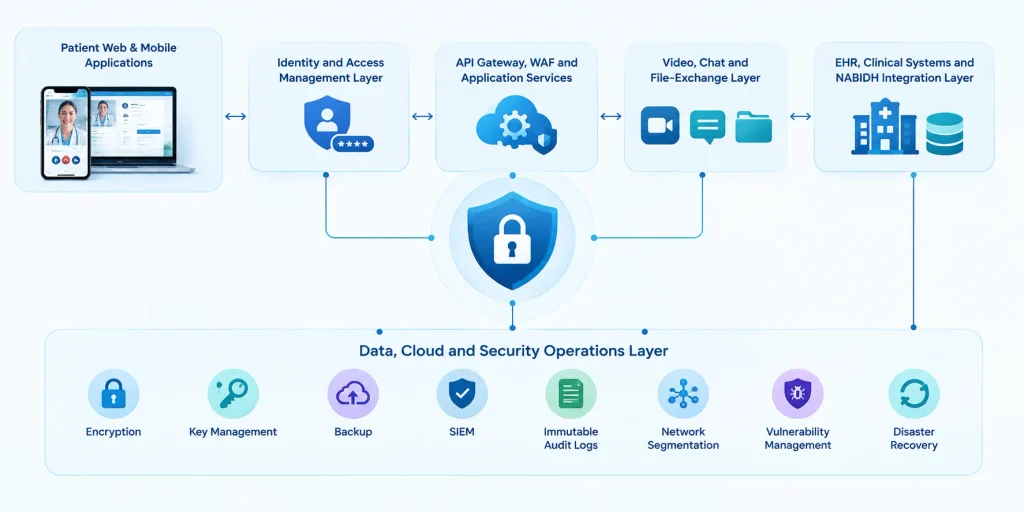
A secure telemedicine platform reference architecture should show clear boundaries between patient-facing applications, identity services, the API layer, clinical systems, infrastructure, and the vendors you depend on. Each boundary is a place where you enforce a control and generate evidence that it worked — and together, these boundaries are what telemedicine security actually looks like on a diagram rather than in a policy document.
Patient Web and Mobile Applications
The app layer needs secure local storage, device and session management, certificate pinning or validation, secure file handling, and notifications that never leak PHI in a preview text. Minimize what’s stored on the device at all — the less PHI sitting in local storage, the smaller the blast radius if a phone is lost or compromised. This is often the layer where telemedicine security gets underweighted, since teams assume the backend carries most of the risk.
Identity and Access Management Layer
This is where telemedicine authentication lives: MFA for staff, role- and attribute-based access control, least-privilege defaults, clinician identity verification, short-lived sessions, and the ability to revoke a device or session instantly. You’ll also need break-glass access for emergencies — a documented, audited path that lets an on-call clinician reach a record outside normal permissions without leaving a gap for abuse.
This layer is also where the shift toward zero trust healthcare shows up in practice — no implicit trust for any device, session, or internal service, even ones sitting inside your own network. Every request gets verified, every time, regardless of where it originates.
API Gateway, WAF and Application Services
Your API layer protects appointments, consultation workflows, patient records, messaging, e-prescriptions, remote patient monitoring, and payments. It needs rate limiting, strong API authentication, schema validation, secrets management, and real-time threat detection sitting in front of it. A single unauthenticated endpoint here is often the fastest path to a full PHI breach, which is why API-layer telemedicine security deserves its own review cycle, separate from general application testing.
Video, Chat and File-Exchange Layer
Video security can’t be treated as its own island — it has to inherit the same identity and access controls as the rest of the platform, or you end up with a telemedicine security posture that’s strong everywhere except the one feature patients use most. That means secure meeting creation, strict meeting authorization (no guessable consultation links), session-token protection, recording controls, scoped chat access, file-upload scanning, and expiring access links for shared files. This is also where HIPAA compliant video conferencing architecture matters again — specifically in how you select and configure your video SDK or infrastructure vendor.
EHR, Clinical Systems and NABIDH Integration Layer
Integration with EHRs and NABIDH means FHIR/HL7 payload validation, mutual TLS, OAuth 2.0/OIDC for service-to-service auth, integration-specific authorization, data minimization, full audit trails, and clear handling for failed transactions. FHIR security deserves its own line item here — a malformed or unvalidated FHIR resource is one of the most common ways clinical data gets exposed or corrupted during an integration, and it’s rarely caught until something goes wrong in production. Integration points like this are exactly where telemedicine security tends to break down first, because they sit outside a single team’s direct control.
Data, Cloud and Security Operations Layer
Encryption at rest and in transit, KMS- or HSM-backed key management, backup infrastructure, SIEM, immutable audit logs, network segmentation, vulnerability management, and disaster recovery all sit here. This is also the layer where telehealth PHI storage decisions get made — and storage isn’t just about picking an encrypted database. It’s about designing access controls, retention schedules, backup cadence, and deletion workflows around what regulators and your own risk assessment actually require — data handled this carelessly undermines telemedicine security no matter how strong the layers above it are.
Essential Telemedicine Security Controls by Architecture Layer
Think of this as a practical telemedicine security control framework mapped to the architecture above, not a generic checklist copied from a template.
Identity and Access Controls
MFA, RBAC/ABAC, least privilege, privileged-access management, session expiration, clinician identity verification, break-glass access, and periodic access reviews. When evaluating a vendor or internal team, ask for evidence — access review logs, MFA enforcement reports, session-revocation test results — not just a statement that “access controls are in place.”
Patient Consent and Privacy Controls
Consent needs to be separated by purpose: teleconsultation, recording, AI or ambient documentation, data sharing, and remote monitoring each need their own consent record. Every consent event should carry a version, a timestamp, an identity link, and a clear withdrawal path. Consent-to-processing enforcement means the system actually blocks processing when consent hasn’t been given — not just that a form was displayed once. Consent is one of the few telemedicine security controls a patient can actually see, which makes it worth getting right.
API and Integration Security
OAuth 2.0/OIDC, mTLS, a maintained API inventory, rate limiting, schema validation, a secrets vault, key rotation, FHIR/HL7 validation, and protection against broken object-level authorization — the vulnerability class behind a large share of healthcare data breaches, where one patient’s API call can be manipulated to return another patient’s record.
Data Protection and Telehealth PHI Storage
Encryption, key management, data minimization, backup, retention schedules, secure deletion, restricted database access, and PHI-safe application logs. It’s worth checking your own logging pipeline specifically — debug logs are a surprisingly common place for PHI to leak unintentionally.
Video, Chat and File Security
Meeting authorization, anti-enumeration protections on meeting IDs, recording permission controls, file scanning, content-access expiration, secure image handling, notification security, and defined chat retention periods.
Monitoring, Audit and Incident Response
Centralized logging, SIEM, synchronized time sources across systems, anomalous-access detection, documented incident runbooks, investigation trails, and immutable audit events. If your logs can be altered after the fact, they won’t hold up as evidence — to a regulator or to your own incident team. Monitoring is the layer that turns telemedicine security from a set of static controls into something you can actually respond with in real time.
Build a Telemedicine Security Test Plan Before Go-Live
Testing is how you generate evidence, not just how you find bugs. A useful framework here is simple: test objective → owner → frequency → pass criterion → evidence → remediation SLA. If you can’t fill in all six columns for a given test, it isn’t ready to run.
Threat Modeling and Data-Flow Testing
Map every actor — patient, clinician, administrator, APIs, EHR, medical devices, AI services, third-party vendors — and test the threats specific to each: account takeover, exposed recordings, IDOR, API-token theft, clinician impersonation, ransomware, and unauthorized PHI access. This mapping exercise alone tends to surface the biggest telemedicine security gaps before a single test is run.
Authentication and Authorization Testing
MFA enforcement, password-reset abuse, session expiration, privilege escalation, patient-to-patient isolation, clinician-role separation, and break-glass auditing all need dedicated test cases, not a single “login works” checkbox.
API Security Testing
Test for broken object-level authorization, injection, mass assignment, excessive data exposure, replay attacks, rate-limit bypass, expired-credential handling, and invalid FHIR/HL7 payloads. This is where working with a team that specializes in API development services Dubai pays off — API security testing needs someone who understands both healthcare data models and modern API attack patterns, not a generic pen-test checklist.
Video, Chat and File Security Testing
Unauthorized meeting access, invitation reuse, recording-access bypass, malicious file uploads, unsafe image processing, and PHI exposure through notifications or logs — each of these needs its own test script, run against the actual video vendor you’re using, not a generic assumption about “the SDK handles that.”
Cloud, Infrastructure and Recovery Testing
Vulnerability scans, configuration reviews, container and image scanning, secret detection, backup restoration drills, network segmentation checks, disaster recovery testing, and — increasingly non-negotiable for healthcare — a ransomware recovery exercise you actually run, not just document.
Quick Question: “How often should a telemedicine platform be penetration tested?”— At minimum annually, plus after any major architecture change, new integration, or significant feature release touching PHI. High-risk platforms often test quarterly.
Clinical Resilience and Safety Testing
This is the section that separates a genuinely mature security program from a checklist exercise. Test what happens when a consultation drops mid-session, when the EHR goes down during an active appointment, when a patient identity is matched incorrectly, when a remote-monitoring alert fails to fire, or when an emergency escalation path breaks. Security controls that create unsafe barriers to urgent clinical care are their own kind of failure — a locked-down system that blocks a clinician from reaching a deteriorating patient hasn’t succeeded at telemedicine security, it’s just moved the harm somewhere else.
Telemedicine App Security Testing for Third-Party and AI Components
Telehealth Vendor Risk
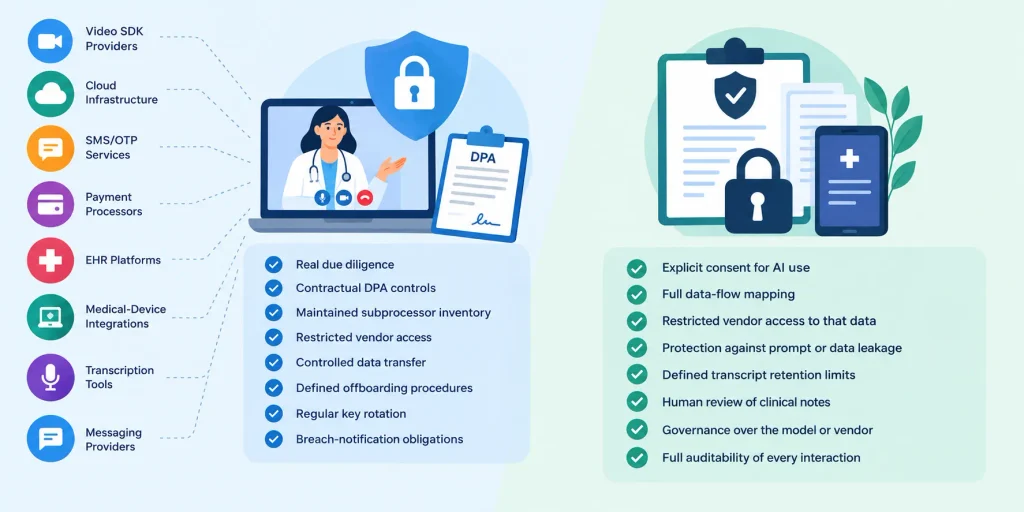
Most telemedicine platforms depend on a chain of vendors: video SDK providers, cloud infrastructure, SMS/OTP services, payment processors, EHR platforms, medical-device integrations, AI transcription tools, and messaging providers. Each one is a piece of telehealth vendor risk you’re inheriting whether you’ve assessed it or not. Manage it with real due diligence, contractual DPA controls, a maintained subprocessor inventory, restricted vendor access, controlled data transfer, defined offboarding procedures, regular key rotation, and clear breach-notification obligations written into the contract — not assumed. Vendor risk is where telemedicine security most often gets outsourced by accident, simply because no one owns it explicitly.
If you’re evaluating build partners for this work, look closely at whether a telehealth app development company UAE actually has healthcare-specific vendor-risk processes, versus a generic software vendor checklist reused from other industries.
Security Testing for AI and Ambient Documentation
AI-powered consultation notes and ambient documentation tools introduce a genuinely different threat model from a typical app feature. You need explicit consent for AI use, full data-flow mapping showing where the transcript goes, restricted vendor access to that data, protections against prompt or data leakage, defined transcript retention limits, human review of AI-generated clinical notes, governance over the model or vendor itself, and full auditability of every AI-assisted interaction. Treat an AI vendor with the same scrutiny you’d apply to an EHR integration — because functionally, it’s handling the same class of data.
90-Day Telemedicine Security Implementation Roadmap
A phased rollout keeps telemedicine security from becoming a single, overwhelming milestone right before launch.
Days 1–30 — Discovery and Architecture Regulatory requirement mapping, asset inventory, data-flow mapping, PHI classification, threat modeling, vendor assessment, and architecture review.
Days 31–60 — Build and Control Implementation IAM, API security, encryption, logging, network segmentation, consent controls, secure video configuration, and backup and recovery setup.
Days 61–90 — Testing and Go-Live Evidence Penetration testing, API testing, configuration review, clinical-resilience testing, vendor testing, remediation, evidence-pack preparation, and a formal go-live security review.
Actual timelines shift based on platform scope, the number of integrations, applicable regulatory requirements, your existing infrastructure, and how much remediation work the testing phase turns up. A platform integrating with three EHR systems and a remote-monitoring device network will move slower than a standalone consultation app — and that’s fine, as long as the roadmap reflects it honestly.
Custom vs White-Label Telemedicine Platform Security
| Factor | Custom Platform | White-Label Platform | Integration-Led Modernization |
|---|---|---|---|
| Architecture control | High | Vendor dependent | Moderate–High |
| Security customization | High | Depends on vendor | High for integration layer |
| Time to market | Longer | Faster | Moderate |
| Third-party dependency | Selective | Usually higher | Existing-system dependent |
| Compliance evidence | Built around requirements | Must validate vendor claims | Requires multi-system evidence |
| AI integration | Flexible | Vendor dependent | Depends on existing stack |
| Long-term control | High | Contract dependent | Depends on architecture |
Secure telemedicine platform cost is usually the first question founders ask when weighing these three routes, but it’s driven far more by integration scope and compliance depth than by build method alone — a lean white-label deployment with heavy EHR integration can end up pricier than a custom build with a narrow scope.
Neither path is automatically “more secure” — a white-label platform from a vendor with real DHA and NABIDH experience can outpace a custom build with a rushed timeline. What matters is whether you can actually validate the vendor’s telemedicine security claims, not just take them on faith.
Questions to Ask a Telemedicine Development Partner
Before signing with any partner, ask who owns the security architecture decisions, whether penetration testing is included and by whom, how API security is handled, how cloud configuration is managed, how PHI is handled end-to-end, how consent architecture works, how video sessions are secured, what NABIDH integration experience they actually have, how AI data is handled, what the incident response process looks like, what security evidence they can hand over, and how they manage their own vendors and subprocessors.
A team offering genuine Healthcare App Development Dubai experience should be able to answer all of these specifically, with examples — not with a generic security-page paragraph copied across every client pitch.
Telemedicine Security Checklist for Dubai Healthcare Platforms
A go-live-ready platform should be able to check off DHA requirements mapped to architecture, NABIDH security requirements assessed, and patient and clinician identity verified, alongside MFA implemented for privileged users and RBAC/ABAC configured across every role. Consent workflows need to be tested, not just built, and PHI should be encrypted at rest and in transit, with telehealth PHI storage reviewed against your actual retention and access requirements. On the technical side, APIs should be penetration-tested, video sessions secured, and file uploads scanned before anything reaches production.
Audit logs need to be centralized, backup restoration tested rather than assumed, and third-party vendors formally assessed for the risk they introduce. Round it out with AI data flows fully documented, clinical-resilience scenarios tested end to end, and remediation evidence documented for anything the process turns up.
Build Security Into the Telemedicine Platform Before Launch
Telemedicine security isn’t a final-stage compliance exercise you run the week before launch. It’s a thread that runs from requirements through architecture, through every control you implement, through development, through testing, and into the evidence pack you hand a regulator or an enterprise buyer. Requirements → Architecture → Controls → Development → Testing → Evidence → Go-Live — skip a link in that chain, and you’ll pay for it later, usually at the worst possible time.
If your organization needs outside expertise to get this right — whether that’s architecture review, application penetration testing, NABIDH integration security assessment, API security assessment, or an AI/ambient documentation security review — working with an established Cybersecurity Services Company Dubai can shortcut months of trial and error.
Assess Your Telemedicine Platform Security Before Go-Live
Request a telemedicine security architecture assessment and get a clear picture of where your platform stands before it reaches patients — and before a regulator, partner, or attacker finds the gap first.
FAQs
What are the key telehealth security requirements for a telemedicine platform?
Identity verification, consent management, access control, encryption, auditability, secure APIs, incident management, business continuity, vendor risk management, and whatever regulatory requirements apply to your market — DHA and NABIDH for UAE deployments, HIPAA where US patients or entities are involved.
How should telehealth PHI storage be secured?
Through encryption, proper key management, strict access controls, centralized logging, defined retention schedules, tested backups, and documented secure-deletion processes. Encryption alone isn’t a storage strategy.
Is a third-party video SDK secure enough for telemedicine?
It depends entirely on how it’s architected, configured, and tested — not on the vendor’s marketing claims. The same SDK can be secure in one deployment and exposed in another, based on authorization logic, data flows, and access management around it.
How does telemedicine authentication protect patient and clinician accounts?
Through MFA, identity verification, tight session management, granular authorization, device controls, and ongoing monitoring of privileged access — layered together, not relied on individually.
What should telemedicine app security testing include?
Application testing, API testing, authentication and authorization testing, infrastructure and cloud testing, video and file security testing, privacy testing, integration testing, and clinical-resilience testing.
How much does telemedicine security implementation cost?
It depends on platform complexity, the number of integrations, your compliance scope, cloud architecture choices, third-party services, testing requirements, and whether you’re building from scratch or securing an existing system. A standalone consultation app with basic DHA alignment costs meaningfully less to secure than a platform integrating EHR, remote monitoring devices, and AI documentation — get a scoped assessment before assuming either extreme.