

Key Takeaways
- Digital health platform security risks now sit outside the hospital walls — in APIs, vendor connections, cloud workloads, and AI tools nobody officially approved.
- Seven breach zones account for almost every healthcare incident in the region: APIs/interoperability, third-party vendors, IoMT devices, cloud infrastructure, identity, AI, and human workflows.
- A single weak link — one over-permissioned API, one forgotten vendor account — is usually enough to chain into a full PHI breach or a ransomware event.
- UAE healthcare organizations sit inside a specific regulatory web (NABIDH, ADHICS, PDPL, and emirate-level rules), and compliance status is not the same thing as being secure.
- Attack surface management works as a continuous discipline, not a once-a-year audit, and that shift is what separates platforms that get breached from ones that get boring headlines instead.
- Treating security as a design decision — not a bolt-on — is what lets Dubai’s digital health platforms scale, keep patient trust, and stay ahead of a threat landscape that changes every time a new API, device, or AI tool joins the network.
Why the Healthcare Attack Surface Has Become a Business-Critical Risk
A decade ago, “hospital security” meant a firewall, an antivirus license, and a locked server room. That model is dead. Today’s digital health platform is a mesh of systems talking to each other constantly — and every connection is a door that adds to your organization’s digital health platform security risks.
Digital healthcare no longer has a single perimeter
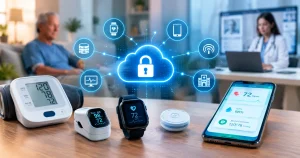
Walk through what a modern UAE hospital or digital health company actually runs on any given day: an EHR/EMR system holding every patient record, a patient portal, a couple of mobile apps, FHIR and HL7 interfaces feeding data in and out, dozens of APIs, cloud infrastructure hosting most of it, a PACS system storing imaging, IoMT devices on every ward, AI applications summarizing notes, third-party vendors managing billing or analytics, payment systems processing insurance claims, and clinical workstations logged in around the clock.
None of these sit behind one wall anymore. Each is its own entry point. That’s the real shift behind rising digital health platform security risks — they’re distributed across the entire ecosystem, not contained inside a hospital network diagram from 2015.
Why traditional vulnerability management is no longer enough
Running a vulnerability scanner and patching what it finds used to pass for “security.” It doesn’t anymore, because it only answers one question: what’s broken? It doesn’t answer the questions that actually matter — what’s exposed to the internet, who has access to what, which APIs are being called by systems nobody remembers approving, and how data actually flows once it leaves the EHR. Left unanswered, those questions are exactly what turn everyday gaps into serious digital health platform security risks.
That gap is exactly what healthcare attack surface management was built to close. Instead of a snapshot, it’s a live, ongoing map of every asset, identity, API, and data flow an attacker could realistically use — refreshed constantly, not once a year before an audit.
What makes healthcare attack surfaces different from other industries (and why digital health platform security risks feel different here)
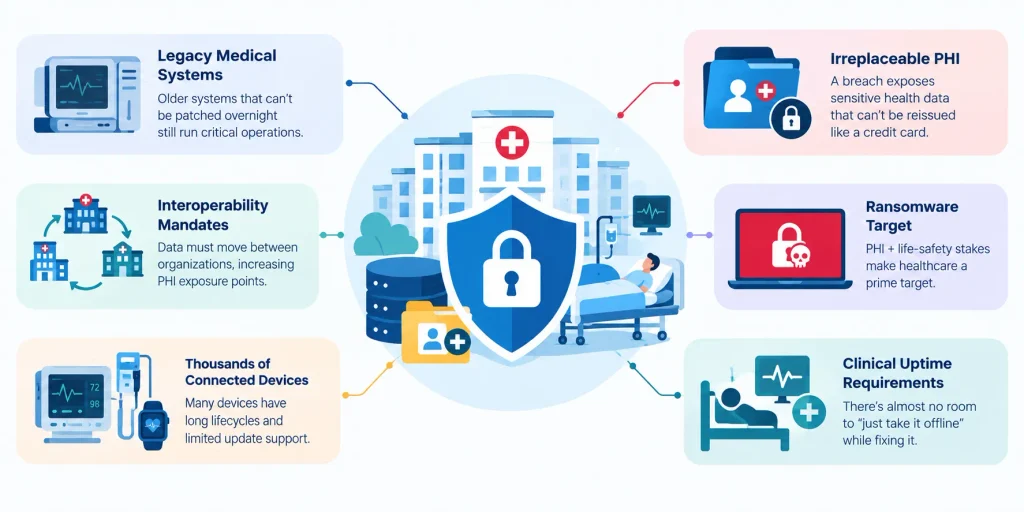
A retailer that gets breached loses card numbers. A hospital that gets breached loses PHI that can’t be reissued like a credit card, and in the worst cases, it loses the ability to safely treat patients. That combination — irreplaceable data plus life-safety stakes — is what makes healthcare a preferred ransomware target. It’s also why digital health platform security risks carry a different weight here than in almost any other sector.
Add to that the realities specific to this sector: legacy medical systems that can’t simply be patched overnight, interoperability mandates that force data to move between organizations, strict regulatory obligations, thousands of connected medical devices with years-long lifecycles, and clinical uptime requirements that leave almost no room for “just take it offline while we fix it.” Every one of these widens PHI exposure points in ways a generic corporate network never has to deal with. Together, they explain why digital health platform security risks in healthcare rarely map cleanly onto generic industry benchmarks.
If your organization is still scoping out its digital infrastructure, this is also the moment to build security in from day one rather than retrofitting it — which is exactly where a partner offering Healthcare Software Development Dubai services earns its keep, by architecting access control, encryption, and audit logging into the platform instead of patching them in after a breach.
The Healthcare Attack Surface Map at a Glance
Before drilling into individual weaknesses, it helps to see the whole board. Picture an attacker standing outside your network, looking for the shortest path to patient data — whether that path runs through the EHR, a connected device, or a telemedicine app development UAE teams shipped last quarter without a security review.
The seven major breach zones
Nearly every real-world healthcare breach — and nearly every headline case of digital health platform security risks — traces back to one (or a chain) of these:
- API and interoperability layer
- Third-party/vendor ecosystem
- IoMT and clinical devices
- Cloud and infrastructure
- Identity and access management
- AI and Shadow AI
- Human and clinical workstation layer
How one compromised component can expose the wider platform
These zones don’t operate in isolation — that’s the part most vulnerability reports miss. A single weak link cascades. A typical chain looks like this:
Compromised vendor → stolen credentials → API access → EHR/FHIR endpoint → PHI exposure → lateral movement → ransomware.
Each arrow in that chain is a decision point where a control could have stopped the attack. Most breaches succeed because none of those points were monitored, not because the attacker used some exotic technique. That’s the pattern behind nearly every headline healthcare breach, and it’s the clearest illustration of how digital health platform security risks compound instead of staying isolated.
Attack surface vs. attack path
Knowing what assets you have is step one in managing digital health platform security risks. It’s not the finish line. Two hospitals can have identical vulnerability scan results and completely different real-world risk, depending on whether those vulnerabilities can actually be chained together into something dangerous. That’s where healthcare threat modeling comes in — it asks not “what’s broken” but “how would someone actually get from the internet to the patient database.”
Breach Zone 1: Healthcare APIs, FHIR and HL7 Interoperability
If there’s one zone that deserves the most attention right now, it’s this one. Interoperability mandates have turned APIs into the connective tissue of digital health — and connective tissue is exactly what attackers go for. Few areas generate more digital health platform security risks per integration than this one.
Why healthcare APIs have become a primary attack surface for digital health platform security risks
APIs are the pipes between EHRs, patient portals, health apps, labs, pharmacies, insurance platforms, telemedicine systems, and AI applications. Every one of those integrations was, at some point, a business requirement someone rushed to ship. Security review doesn’t always keep pace with how fast new integrations get added, and that gap is where healthcare API vulnerabilities accumulate quietly until something goes wrong.
Broken Object-Level Authorization and patient-record exposure — a core digital health platform security risk
Broken Object-Level Authorization, or BOLA, is one of the most common — and most preventable — API flaws in healthcare. Here’s what it looks like in practice:
A legitimate user requests their own record:
/patient/10245
Nothing stops them, or an attacker, from simply changing the number:
/patient/10246
If the API checks that you’re logged in but never checks that you’re allowed to see this specific record, that second request returns someone else’s chart. Authentication answers “who are you?” Authorization answers “what are you allowed to touch?” A huge share of API breaches happen because only the first question ever gets asked. BOLA alone accounts for a disproportionate share of reported digital health platform security risks in healthcare APIs.
OAuth scope creep and excessive permissions
OAuth was built to hand out narrow, purpose-specific access. In practice, scopes tend to creep outward over time — a patient-facing app that only needs to read appointment data ends up with write access to the full chart, an AI application gets a system-level scope “just to be safe,” a third-party integration keeps permissions it hasn’t used in a year. Every one of those unused permissions is standing risk with zero business value, and it’s one of the quieter drivers of digital health platform security risks that nobody notices until an audit forces the question.
Long-lived access tokens
Tokens that never expire are a gift to anyone who steals one. Security teams should be actively managing token lifetime, session handling, revocation, and secure storage. As a security best practice — not a blanket regulatory mandate — many mature healthcare API programs push toward access tokens with lifespans measured in minutes rather than hours, specifically to shrink the window an attacker has if a token leaks. The shorter that compromise window, the less damage a single stolen token can do. Token hygiene alone resolves a surprising share of everyday digital health platform security risks in API-heavy environments.
FHIR Bulk Export and population-level data exposure
FHIR’s $export operation is powerful — it lets a system pull population-level data in one request instead of thousands of individual calls. That power cuts both ways. If group-level access controls or authorization checks around bulk export are loose, one improperly scoped request can hand over thousands of records at once instead of one. Any organization running FHIR APIs needs active monitoring specifically tuned to catch unusual bulk extraction patterns, not just individual record access. Bulk export is a textbook example of how a single feature can multiply digital health platform security risks overnight if governance doesn’t keep pace with functionality.
HL7 interfaces and legacy interoperability risks
Alongside modern FHIR APIs, most hospitals still run HL7 v2.x interfaces over MLLP — often connecting systems that are decades old. These interfaces frequently lack modern encryption or strong authentication by default, and they’re rarely segmented from the rest of the network the way they should be. Legacy doesn’t mean low-risk; it often means the opposite, because nobody wants to touch the integration that keeps the lab system talking to the EHR.
SSRF and healthcare API infrastructure
Server-Side Request Forgery lets an attacker trick a server into making requests on their behalf — potentially reaching internal services, cloud metadata endpoints, stored credentials, or internal EHR and FHIR infrastructure that was never meant to be internet-reachable. It’s a quiet vulnerability class that often hides behind an otherwise well-secured API. Left unchecked, it’s one more entry on the growing list of healthcare API vulnerabilities security teams need to actively hunt for, not passively wait to discover.
How to reduce healthcare API vulnerabilities
Reducing healthcare API vulnerabilities takes a practical control stack, not a single silver-bullet tool:
- API gateway with centralized policy enforcement
- Strong, object-level authorization checks (not just authentication)
- SMART on FHIR for standards-based access control
- Tight OAuth scope management, reviewed regularly
- Short-lived tokens with proper revocation
- Rate limiting to blunt automated abuse
- Continuous API discovery (you can’t protect what you don’t know exists)
- Runtime monitoring for anomalous call patterns
- Bulk export controls and alerting
- Regular API-focused penetration testing
Getting these ten controls in place addresses the majority of digital health platform security risks tied to healthcare APIs today.
If your organization is running or planning a health information exchange, this is precisely the layer where a specialist Health Information Exchange Software Development Company in UAE should be involved from the architecture stage — HIE platforms move data between organizations by design, which means authorization mistakes here don’t just expose one hospital’s records, they expose everyone connected to the exchange.
Breach Zone 2: Third-Party Vendors and the Healthcare Supply Chain
Your platform’s security perimeter doesn’t end at your own code. It ends wherever your data stops being under your control — and for most healthcare organizations, that’s several vendors deep. Vendor relationships are one of the fastest-growing sources of digital health platform security risks in the region, precisely because they sit outside a hospital’s direct control.
Why your hospital’s security perimeter includes your vendors and their digital health platform security risks
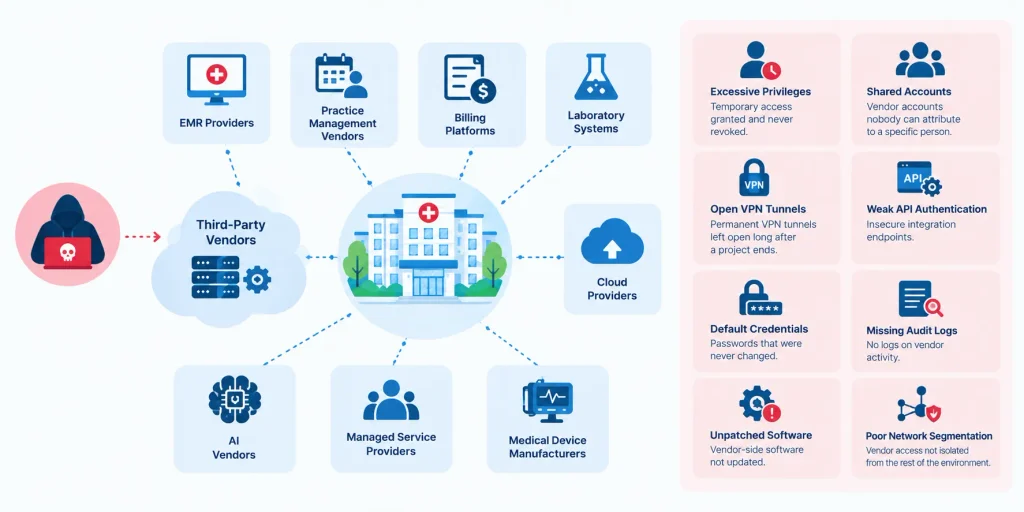
EMR providers, practice management vendors, billing platforms, laboratory systems, cloud providers, AI vendors, managed service providers, and medical device manufacturers all touch patient data or systems in some way. Third-party risk healthcare software isn’t a niche concern anymore — it’s one of the largest components of the overall attack surface, because attackers have learned it’s often easier to breach a smaller vendor than a well-defended hospital directly.
Where third-party healthcare connections become dangerous
The pattern repeats across incident after incident: excessive privileges granted “temporarily” and never revoked, shared vendor accounts nobody can attribute to a specific person, permanent VPN tunnels left open long after a project ends, weak API authentication on integration endpoints, default credentials that were never changed, missing audit logs on vendor activity, unpatched vendor-side software, and poor network segmentation between vendor access and the rest of the environment.
The hidden PHI exposure points inside vendor ecosystems — another face of digital health platform security risks
Trace a typical data path: hospital → EMR vendor → cloud provider → analytics provider → AI platform. Each handoff is a new place where data could leak, be mishandled, or sit improperly secured — and each one adds to the total PHI exposure points across the ecosystem, whether or not the hospital’s own systems were ever touched. Multiply that across a dozen vendors and the cumulative digital health platform security risks can rival anything generated internally.
Quick question: “Does using a cloud-based EMR mean the vendor is fully responsible for security?”— No. Most cloud and SaaS contracts split responsibility — the vendor typically secures the infrastructure, while the hospital remains responsible for access control, user permissions, and how data is used on top of it. Read the shared-responsibility clause before assuming anything is covered.
Why outsourcing security does not outsource accountability
Regulators and patients don’t care that “the vendor got breached.” The healthcare organization is still the one accountable for that data. That means contracts need explicit security requirements, incident notification obligations with real timelines, and audit rights — not vague language about “industry-standard security.” Contracts that skip these terms simply transfer digital health platform security risks onto the healthcare organization without anyone noticing until it’s too late.
Building a healthcare vendor risk program
A working program covers ten things: a complete vendor inventory, data-flow mapping for each vendor relationship, risk classification based on data sensitivity and access level, structured security questionnaires, evidence validation (not just self-attestation), penetration-test requirements for critical vendors, periodic access reviews, continuous monitoring rather than annual check-ins, contractual incident notification clauses, and a formal offboarding process so access doesn’t quietly linger after a contract ends. Skipping any one of these ten steps is exactly how third-party risk healthcare software gaps go unnoticed for years.
If your organization is evaluating EMR software solutions in UAE, vendor security posture belongs in the evaluation criteria alongside features and price — a feature-rich EMR with a weak vendor security program is still a liability sitting on your network.
Breach Zone 3: IoMT and Connected Medical Devices
Every infusion pump, monitor, and imaging system on a ward is now a network endpoint — and most of them were designed by engineers thinking about clinical function, not cyber resilience. That mismatch is a major, and often underestimated, contributor to digital health platform security risks across any connected hospital.
The medical device attack surface and its digital health platform security risks
This zone covers infusion pumps, patient monitors, imaging systems, connected diagnostics, medical workstations, building management systems, and remote monitoring devices used for at-home or ambulatory care.
Five IoMT vulnerability categories
These five categories cover almost every connected-device incident and map directly onto broader digital health platform security risks across the platform.
- Device-level weaknesses — outdated firmware, hardcoded credentials, unpatched operating systems
- Network-level weaknesses — devices sitting on flat, unsegmented networks
- Data-level exposure — patient data transmitted or stored without adequate encryption
- Application-level weaknesses — companion apps and device management software with their own bugs
- Availability/clinical continuity risks — a compromised device isn’t just a data problem, it can directly affect patient care
Why legacy medical devices are difficult to secure
Many clinical devices run unsupported operating systems that can’t be patched without voiding a manufacturer warranty or requiring regulatory recertification. Add long device lifecycles — some equipment stays in service for ten-plus years — and clinical availability requirements that make “just reboot it” an unacceptable answer, and you get a device fleet that ages out of security far faster than it ages out of clinical usefulness. That aging mismatch is exactly where digital health platform security risks quietly accumulate year after year.
Flat networks and lateral movement (a classic digital health platform security risk)
The most damaging IoMT incidents rarely start with the device itself. They start with a compromised workstation, move onto the medical device network because there’s no segmentation stopping them, then pivot into clinical systems and eventually the EHR or PACS. That lateral path is a direct, practical application of healthcare threat modeling — mapping not just “is this device vulnerable” but “what can an attacker reach once they’re inside it.”
Building an IoMT security inventory
A real inventory tracks device type, manufacturer, firmware version, operating system, network location, clinical function, internet exposure status, known vulnerabilities (CVEs), and vendor support status. If your team can’t answer “which of our devices are still receiving security patches” in under a minute, the inventory isn’t doing its job yet. Building that inventory is the first real step toward healthcare attack surface management for the device fleet, not an optional nice-to-have.
How healthcare attack surface management can include IoMT
Continuous asset discovery, proper network segmentation, vulnerability prioritization based on clinical criticality (not just CVSS score), and ongoing monitoring bring IoMT into the same governance model as every other part of the platform instead of treating it as a separate, forgotten category.
This is also where remote patient monitoring security deserves its own line item — as home-based cardiac monitors, glucose sensors, and wearables send clinical data back into hospital systems, the attack surface extends into patients’ homes and personal networks, well outside anything a hospital IT team directly controls.
Breach Zone 4: Cloud Infrastructure, Storage and Clinical Workloads
Moving to the cloud didn’t shrink the attack surface — it just changed its shape.
Why cloud adoption expands the healthcare attack surface and digital health platform security risks
Hospital information systems, EHRs, PACS, analytics platforms, data lakes, APIs, AI workloads, and backups increasingly all run in the cloud. Each of those is a workload that needs its own access controls, encryption settings, and monitoring — and a misconfiguration in any one of them can expose everything sitting next to it. Cloud adoption hasn’t reduced digital health platform security risks; it has simply relocated them into configuration settings instead of physical server rooms.
The cloud misconfigurations that expose healthcare data (and fuel digital health platform security risks)
The recurring offenders: publicly accessible storage buckets, IAM permissions granted far more broadly than needed, unsegmented workloads sitting side by side, exposed databases with no network restrictions, weak or missing encryption, poor secrets management (API keys sitting in code repositories), insecure APIs, and misconfigured backups that are just as exposed as production data. Any one of these misconfigurations, left alone, becomes a direct path to serious digital health platform security risks.
Segmentation of clinical workloads
EHR, PACS, analytics, APIs, IoMT, and administrative systems should be logically separated, so that a breach in one — say, the administrative billing environment — doesn’t automatically hand an attacker a path into clinical systems holding live patient records. Proper segmentation is one of the highest-leverage ways to contain digital health platform security risks once a cloud workload is already compromised.
Cloud data residency and UAE healthcare requirements
Data location, cloud architecture, encryption standards, access control, and vendor responsibility all need to be assessed against the specific regulatory framework governing your license and entity type. Requirements differ by emirate and by the type of health data involved, so treat this as a per-project assessment rather than a blanket rule to copy from another organization.
Quick question: “Is data hosted in a UAE-based data center automatically compliant with local healthcare regulations?”— Not automatically. Physical location is one factor among several — encryption, access controls, audit logging, and contractual terms with the cloud provider all matter too. Location alone doesn’t satisfy a compliance requirement.
Cloud security checklist for digital health platforms
Cloud Security Posture Management (CSPM) tooling, encryption at rest and in transit, tightly scoped IAM roles, proper secrets management, network segmentation, centralized logging, backup protection, and continuous configuration monitoring — not a one-time setup review. Skipping continuous monitoring is how yesterday’s clean configuration becomes tomorrow’s digital health platform security risks.
Organizations building or modernizing core clinical systems in the cloud should treat this stage as foundational, not an afterthought — which is exactly the moment to bring in a team that specializes in Custom Hospital Management System Development, where segmentation and access architecture get designed in from the first sprint instead of retrofitted after go-live.
Breach Zone 5: Identity, Authentication and Access Management
Firewalls keep people out. Identity determines what happens once someone’s already in — and that’s where most real damage gets done. Identity is also where a huge share of digital health platform security risks actually materialize, long after the perimeter has already been crossed.
Why identity is the new healthcare perimeter for digital health platform security risks
Attackers increasingly go straight for credentials, active sessions, tokens, privileged accounts, vendor identities, and service accounts, because a valid login is far quieter than trying to break through a technical control.
Common identity weaknesses in healthcare that drive digital health platform security risks
Shared staff credentials on clinical workstations, credential reuse across systems, weak passwords, missing multi-factor authentication, excessive privileges assigned by default rather than by need, stale accounts left active after staff leave, poor session management, and token leakage through logs or URLs. Any single item on that list is enough to turn routine access into one of the harder-to-detect digital health platform security risks a security team will face.
EHR vulnerabilities caused by access-control weaknesses
This is worth stating plainly: an EHR can be technically well-built and still leak data, purely because authorization logic around who can see what was designed loosely. A large share of real-world EHR vulnerabilities trace back to access control decisions, not to flaws in the underlying software architecture itself.
Secure session and token management
Short-lived tokens, secure cookie attributes, proper revocation on logout, session timeouts on idle clinical workstations, device binding where it’s practical, and — critically — never putting PHI in URLs or application logs where it can leak through something as mundane as a server access log. Sloppy session handling is one of the quieter causes of EHR vulnerabilities that never show up on a vulnerability scanner.
Applying Zero Trust to digital healthcare platforms
The Zero Trust model boils down to one sentence: never trust, continuously verify, grant least privilege, and monitor every access path — regardless of whether the request comes from inside or outside the network. Zero trust healthcare architecture treats every request, internal or external, as something to verify, not something to assume is safe because it came from “inside.”
IAM controls CIOs should validate
A short assessment list worth running quarterly: Is MFA enforced for every privileged account? Are stale accounts reviewed and disabled on a schedule? Are access reviews tied to role changes, not just annual audits? Is session activity logged and monitored? Are service accounts rotated and scoped tightly? A clean answer to every one of these questions is the clearest sign an organization has its digital health platform security risks under control at the identity layer.
Getting these fundamentals right at the identity layer is often cheaper and more effective than any downstream detection tool — because a well-scoped access model stops a stolen credential from turning into a full-blown breach in the first place, and it does more for long-term digital health platform security risks than almost any single tool purchase.
Breach Zone 6: Shadow AI and Generative AI Integrations
This is the newest breach zone on the map, and it’s growing faster than most security programs can keep pace with. It’s also becoming one of the fastest-growing sources of digital health platform security risks any healthcare CIO has to manage.
Why AI has created a new healthcare attack surface
Healthcare organizations are connecting AI tools to EHRs, clinical notes, patient portals, internal knowledge bases, FHIR APIs, retrieval-augmented generation (RAG) systems, and increasingly, autonomous agentic workflows that can take actions on their own. Every one of those connections is a fresh entry in the running list of digital health platform security risks an AI program introduces.
The six AI security layers healthcare organizations need to map
- User prompts and uploaded content
- Models and AI-enabled applications
- RAG systems and knowledge stores
- Autonomous agents and connected tools
- AI vendors, plugins, and dependencies
- Cloud/API/compute infrastructure underneath it all
Shadow AI and accidental PHI exposure — a fast-growing digital health platform security risk
This happens more often than most organizations want to admit: a clinician pastes patient notes into a public AI tool to save time on a summary, a clinical summary gets uploaded to an unauthorized platform, an AI-generated document ends up containing PHI with zero audit trail, and there’s no data-processing agreement covering any of it. None of this is malicious. All of it is a breach. Each of these habits creates fresh PHI exposure points that sit completely outside official monitoring.
AI agents connected to healthcare APIs
Autonomous AI agents wired into clinical systems raise the stakes considerably when they’re given broad FHIR permissions, persistent credentials that never expire, access spanning multiple systems, write permissions instead of read-only, and limited or no monitoring of what they actually do with that access. An agent with write access and no oversight is one bad prompt away from a serious incident. That single misconfiguration can turn a helpful AI feature into one of the most serious digital health platform security risks on the entire platform.
Securing AI integrations in healthcare
An approved AI inventory (know what’s actually in use, not what’s officially sanctioned), data classification before anything reaches an AI system, DLP controls, tightly scoped access controls, restricted OAuth scopes specifically for AI tools, prompt and input filtering, output validation, formal AI vendor assessment, comprehensive logging, and human approval gates for any sensitive action an agent wants to take.
Shadow AI governance checklist
A practical starting checklist: audit network traffic for unsanctioned AI tool usage, survey clinical staff on what tools they actually use day-to-day (not what’s on the approved list), review AI vendor contracts for data handling terms, and set clear, communicated policy on what patient data can never leave an approved system.
Organizations deploying AI healthcare solutions — whether clinical documentation assistants, diagnostic support tools, or patient-facing chatbots — need this governance layer built in before deployment, not added after the first uncomfortable audit finding.
Breach Zone 7: Humans, Clinical Workstations and Social Engineering
Every technical control in this article can be flawless, and a single convincing email can still undo it. The human layer is proof that digital health platform security risks aren’t purely a technology problem.
Why the human layer remains part of the attack surface
Phishing, credential theft, malicious attachments, social engineering calls, and unsafe AI usage bypass sophisticated technology by targeting the one thing that’s hardest to patch — human judgment under time pressure. The same weaknesses show up in telemedicine security too, where a clinician conducting a consultation from a personal device or shared network can undo every control built into the platform itself.
Clinical workstation exposure points and everyday digital health platform security risks
Unlocked sessions on shared ward computers, browser sessions left logged in, sensitive data cached in local storage, unrestricted USB device access, cached credentials, and generally weak endpoint controls on machines that get used by dozens of different staff members across a shift. Multiply that exposure across an entire hospital floor and the human layer’s contribution to digital health platform security risks becomes obvious fast.
PHI exposure through employee workflows
Everyday habits — forwarding a patient file over personal email to work from home, screenshotting a chart to send on a messaging app, printing records that then sit on an unattended desk — quietly stack up into real PHI exposure points that no firewall was ever going to catch.
Building a human-layer defense
MFA everywhere it’s practical, ongoing security awareness training (not a once-a-year slideshow), regular phishing simulations, endpoint detection and response tooling, automatic session timeout controls, data-loss prevention policies, and least-privilege access as the default, not the exception. None of these controls are exotic — they’re simply the baseline for managing digital health platform security risks at the point where people, not systems, make the final decision.
How Attackers Chain These Seven Breach Zones Together
Individually, none of these weaknesses sound catastrophic. Chained together, they are. This is where isolated digital health platform security risks turn into full incident-response events.
Attack path example 1 — API to EHR (a textbook digital health platform security risk)
Stolen credential → API access → BOLA exploited → patient records exposed → bulk extraction begins.
Attack path example 2 — Vendor to hospital network
Compromised vendor → trusted network connection abused → stolen credentials → lateral movement → EHR/PACS compromised.
Attack path example 3 — Shadow AI to PHI
Employee pastes notes into a public AI tool → PHI uploaded outside any approved system → unauthorized processing → data exposure with no audit trail.
Attack path example 4 — IoMT to clinical infrastructure
Exposed device discovered on the internet → vulnerable, unsegmented network segment → lateral movement → clinical systems compromised.
Each of these four paths starts differently but ends the same way — which is exactly why healthcare threat modeling treats them as one connected risk picture instead of four separate incidents. Seen this way, digital health platform security risks stop being a list and start being a map you can actually act on.
Why healthcare threat modeling should focus on attack paths
Listing vulnerabilities tells you what’s broken. Mapping attack paths tells you what actually matters — because a critical vulnerability on an isolated, low-value system is a very different risk than a moderate vulnerability sitting on the direct path to your EHR. Ranking digital health platform security risks by path, not by count, is what separates a useful assessment from a long PDF nobody reads. This distinction is the difference between a report full of red flags and a security program that actually reduces risk. It’s also, not incidentally, the exact scenario hospital ransomware protection strategies are built to interrupt — cutting the chain before it reaches the point where an attacker can encrypt production systems and demand payment.
How to Conduct a Healthcare Cyber Risk Assessment
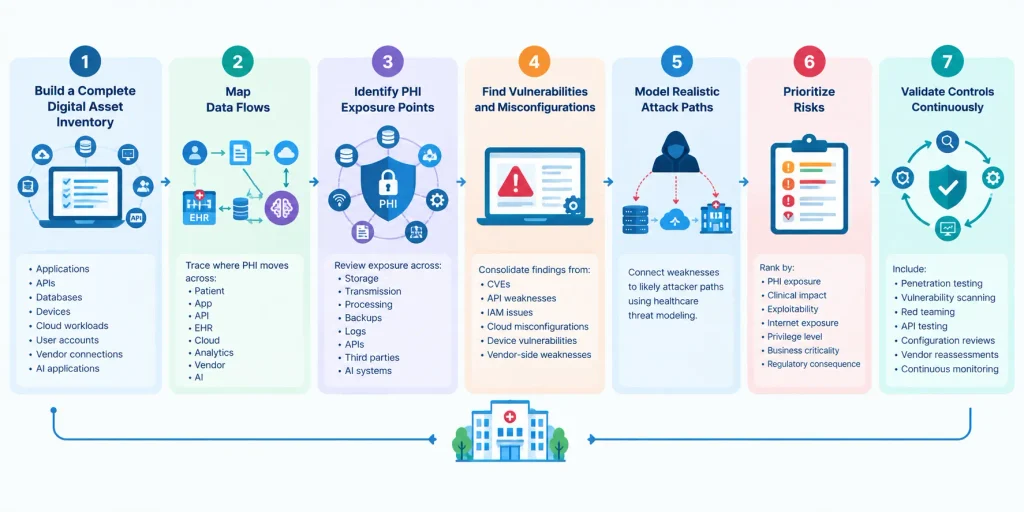
Knowing the breach zones is theory. This is the practice. A properly run healthcare cyber risk assessment turns that theory into a prioritized action list, and it’s the fastest way to shrink real digital health platform security risks.
Step 1 — Build a complete digital asset inventory
Map every application, API, database, device, cloud workload, user account, vendor connection, and AI application your organization actually runs — not just the ones in the official architecture diagram. Skipping this step is the single most common reason a healthcare cyber risk assessment misses something important.
Step 2 — Map data flows
Trace where PHI actually moves: patient → app → API → EHR → cloud → analytics → vendor → AI. Most organizations are surprised by how many hops their data makes before it’s fully at rest.
Step 3 — Identify PHI exposure points
Classify exposure across storage, transmission, processing, backups, logs, APIs, third parties, and AI systems — each category needs its own review, because the controls that protect data at rest don’t protect it in transit.
Step 4 — Identify vulnerabilities and misconfigurations behind current digital health platform security risks
Pull together CVEs, API weaknesses, IAM issues, cloud misconfigurations, device vulnerabilities, and vendor-side weaknesses into a single consolidated view rather than seven disconnected reports. That consolidated view is what turns scattered findings into digital health platform security risks leadership can actually prioritize.
Step 5 — Model realistic attack paths
Apply healthcare threat modeling to connect the individual weaknesses found in Step 4 into the paths an actual attacker would follow.
Step 6 — Prioritize risks
Rank by PHI exposure, clinical impact, exploitability, internet exposure, privilege level, business criticality, and regulatory consequence — in that rough order, because a vulnerability that threatens patient safety outranks one that’s merely embarrassing. This prioritization step is what turns a long list of digital health platform security risks into a roadmap a board can actually approve budget against.
Step 7 — Validate controls continuously
Penetration testing, ongoing vulnerability scanning, red teaming, dedicated API testing, configuration reviews, vendor reassessments, and continuous security monitoring — repeated on a cycle, not a calendar reminder once a year.
A structured healthcare cybersecurity assessment, run this way, turns a vague sense of “we should probably look into security” into a prioritized, defensible roadmap leadership can actually act on.
Healthcare Attack Surface Management Framework for UAE Digital Health Platforms
This is where discovery, classification, and monitoring come together into a repeatable healthcare attack surface management system — and where digital health platform security risks stop being abstract and start being measurable.
Discover every connected asset to see the full range of digital health platform security risks
Traditional CMDBs weren’t built for this era — they routinely miss IoMT devices, Shadow AI usage, external APIs, vendor connections, and SaaS applications that were never formally provisioned through IT. Missing even one of these categories leaves real digital health platform security risks completely invisible to the security team.
Classify assets by clinical and data criticality
Group assets into tiers: patient-critical (directly affects care), PHI-critical (holds sensitive data), business-critical (affects operations), and supporting infrastructure — so remediation effort goes where the stakes are highest first. Classification like this keeps digital health platform security risks from being treated with equal urgency when they clearly aren’t equal.
Continuously monitor the external attack surface
Keep a live view of internet-facing systems, APIs, domains, cloud assets, certificates, exposed services, and vendor connections — the things an outside attacker can actually see and probe without ever touching your internal network.
Connect vulnerability data with business context
A high-severity vulnerability sitting on an internal test server is a very different problem than the same vulnerability sitting on an internet-facing EHR component. Context changes urgency, and treating every finding with the same priority just buries the ones that actually matter.
Create a unified healthcare attack surface dashboard
One view, ideally, covering critical vulnerabilities, exposed assets, API risks, vendor risks, IoMT risks, IAM risks, AI risks, compliance gaps, and open remediation items — so leadership can see the whole picture in one place instead of piecing it together from seven different tools. Many UAE hospitals get this dashboard built and tuned by bringing in specialist Cybersecurity Services Dubai teams rather than trying to stitch it together internally from scratch.
UAE Regulatory Considerations for Healthcare Cybersecurity
Regulation in this space isn’t a single rulebook — it’s several overlapping ones. Meeting all of them is necessary, but it doesn’t automatically shrink digital health platform security risks the way many organizations assume.
Why UAE healthcare organizations need a regulatory-aware security program for real digital health platform security risks
Depending on your license, location, and entity type, your security program may need to account for NABIDH, ADHICS, federal healthcare and data-protection requirements, the UAE’s PDPL, and emirate-specific obligations layered on top of all of it.
Dubai vs Abu Dhabi incident-response considerations
Reported notification timelines differ across frameworks and have been known to change. Rather than relying on a generic number quoted somewhere online, verify the current applicable requirement for your specific license, entity type, and the nature of the incident before you’re in the middle of one. Getting this wrong during an active incident compounds digital health platform security risks at exactly the moment an organization can least afford it.
Security controls should map to compliance requirements
The cleanest way to stay audit-ready is a direct mapping: asset → risk → control → evidence → regulatory requirement. When every control ties back to a specific requirement, demonstrating compliance stops being a scramble. For platforms exchanging data across facilities, this mapping usually starts with the interoperability layer itself — which is exactly why many organizations bring in dedicated HL7 FHIR interface software development services in UAE to get that foundation built correctly the first time.
Why compliance alone does not equal security
Passing an assessment proves you met a point-in-time standard. It doesn’t mean you’re detecting new exposures as they appear or responding effectively when something does go wrong — those are ongoing capabilities, not a certificate on the wall. Genuinely reducing digital health platform security risks means treating compliance as a floor, not a finish line.
Healthcare Digital Platform Security Risk Assessment Checklist
A practical, category-by-category checklist for CIOs and CISOs to run against their own environment — treat it as a working audit of your current digital health platform security risks, not a one-time exercise:
API and Interoperability — FHIR authorization, BOLA protection, OAuth scope review, token lifetime limits, bulk export monitoring, HL7 encryption, active API monitoring. This single category alone resolves a large share of the digital health platform security risks covered earlier in this article.
Third-Party Risk — Current vendor inventory, periodic access review, validated security evidence, contractual obligations, incident notification clauses, continuous monitoring.
IoMT — Device inventory, firmware status tracking, network segmentation, vulnerability tracking, vendor support status.
Cloud — Workload segmentation, storage exposure review, IAM scoping, encryption everywhere, secrets management, backup protection — the categories that most often hide digital health platform security risks.
Identity — MFA enforcement, privileged access review, session management, token security, account lifecycle management, and baseline EHR security controls validated on a fixed schedule.
AI — Approved AI inventory, PHI restrictions, DLP controls, AI vendor assessment, API permission scoping, comprehensive logging.
Incident Response — Detection capability, escalation process, evidence collection procedures, regulatory notification workflow, communication plan, recovery process, post-incident review. Running through all seven categories on a fixed cadence is the single most effective way to keep digital health platform security risks from quietly piling up between formal audits.
Six Security Investment Gaps UAE Healthcare Platforms Should Address
These are the gaps that show up most often once an assessment is actually run. Each one, left unaddressed, becomes its own persistent source of digital health platform security risks.
Gap 1 — Healthcare API and FHIR Security
API gateways, proper FHIR authorization, disciplined scope management, runtime monitoring, and dedicated API threat detection. Together, these controls close the most commonly exploited healthcare API vulnerabilities before they ever reach production.
Gap 2 — Third-Party Healthcare Risk Management
Continuous vendor visibility and access monitoring, rather than a security questionnaire filled out once at contract signing and never revisited. This is the fastest way to shrink third-party risk healthcare software exposure without slowing down vendor onboarding.
Gap 3 — IoMT Asset Discovery and Threat Modeling for device-level digital health platform security risks
A single, unified view of device security posture across every ward and department, instead of biomedical engineering and IT security maintaining two separate, disconnected inventories.
Gap 4 — Shadow AI Detection and Governance
AI discovery tooling, PHI protection controls, approved AI workflows staff actually want to use, DLP, and formal AI vendor controls. Getting this right early keeps AI innovation from quietly becoming one of your biggest digital health platform security risks.
Gap 5 — Automated Incident Response and Notification
Alerting that actually reaches the right person, evidence collection built into the workflow, automation for repetitive response steps, stakeholder notification, and support for regulatory response timelines.
Gap 6 — Compliance Control Mapping
A living map of security controls against every applicable UAE healthcare requirement, updated as regulations shift rather than reconstructed from scratch at renewal time. Without this mapping, digital health platform security risks and compliance obligations drift apart until an audit forces a reckoning.
Closing these gaps is rarely a single project — it usually takes specialist security expertise to run the assessment and design the program, paired with engineering effort to actually implement the fixes across API, cloud, and identity layers, and paired with disciplined healthcare attack surface management to keep the gaps from reopening.
How to Build a Future-Ready Healthcare Security Architecture
Everything above points toward one architectural shift.
Move from perimeter security to continuous visibility into digital health platform security risks
The old model assumed a defined boundary you could defend. The new model assumes the boundary is constantly changing, and visibility has to keep up with it in real time. That shift alone addresses a huge share of the digital health platform security risks this article has walked through.
Combine API, identity, cloud, IoMT and AI security
Siloed point tools each cover their own slice well and miss everything in between. The gaps between domains are exactly where the attack paths in this article live. Those gaps are also where the highest-impact digital health platform security risks tend to hide.
Make security part of the product lifecycle
Secure architecture decisions, threat modeling, secure coding practices, dedicated API testing, DevSecOps pipelines, continuous monitoring, and regular incident simulations — built into how software gets built, not bolted on before launch. This is the essence of secure healthcare software development — treating security as a design input from sprint one, not a checklist run right before go-live.
Build security around clinical workflows
Controls need to protect two things simultaneously: patient information and clinical availability. A security measure that locks clinicians out during an emergency has failed just as badly as one that leaks data. Balancing both sides of that equation is the real, ongoing work of managing digital health platform security risks in a clinical environment.
Video consultations, messaging, and remote monitoring all move sensitive data over networks the organization doesn’t control, which raises the bar for security well above what a standard web app needs.
Treat healthcare security as continuous risk management
Digital health platform security risks shift the moment a new API ships, a new vendor gets onboarded, a new device joins the network, or a new AI capability goes live. Security has to move at the same pace as the product, not trail behind it by a quarter.
Planning security spend up front — encryption, access control, monitoring, and compliance — belongs in the build budget from the start, not as a surprise line item after an incident forces the conversation.

Final Takeaway
Digital health platform security risks now extend well beyond traditional IT perimeters, and healthcare attack surfaces reflect that reality every day. APIs and interoperability requirements open new exposure paths every time a new integration ships. Vendors create trusted routes into your network that attackers actively look for. IoMT expands the number of connected assets faster than most inventories can track. Cloud misconfiguration can expose PHI in a single wrong setting. IAM weaknesses can bypass otherwise strong infrastructure entirely. Left unmanaged, these digital health platform security risks compound quickly. Shadow AI introduces data-processing risk nobody signed off on. Human workflows remain a major layer no technical control fully closes. And regulatory obligations make fast detection and response more important than ever.
An effective strategy ties all of it together: discovery, mapping, threat modeling, risk prioritization, continuous monitoring, and response — as one ongoing cycle, not six separate projects. That’s what healthcare attack surface management and a properly run healthcare cyber risk assessment actually deliver, and it’s the foundation everything else in this article — API security, vendor risk management, and continuous security engineering — is built on.
If you’re evaluating where your own platform stands against this map — or trying to understand secure telemedicine platform cost before greenlighting a new build — that assessment is the logical next step before the next integration, vendor, or AI tool gets added to the network, and it’s the clearest way to keep digital health platform security risks from outrunning your roadmap.
Frequently Asked Questions
What are digital health platform security risks?
They’re vulnerabilities spread across APIs, vendors, cloud infrastructure, IoMT devices, identity systems, AI tools, and human workflows that connect a modern healthcare platform, rather than a single risk confined to one hospital network or system.
What is the most common cause of healthcare data breaches?
Weak API authorization, especially Broken Object-Level Authorization, is one of the leading causes, alongside compromised vendor credentials, misconfigured cloud storage, and stolen identities that give attackers a trusted path into clinical systems.
How often should a healthcare cyber risk assessment be conducted?
Continuously, not annually. Asset inventories, vendor access, and AI usage change constantly, so ongoing monitoring paired with a structured formal assessment at least twice a year catches exposures before attackers do.
Is a UAE-based data center enough to meet healthcare compliance?
No. Data location is only one factor. Encryption, access controls, audit logging, and contractual terms with the cloud provider all matter too, and requirements vary by emirate, license type, and entity.
What is Zero Trust in healthcare cybersecurity?
A security model that never automatically trusts any user or device, inside or outside the network. It continuously verifies identity, enforces least-privilege access, and monitors every request before granting system access.
How does Shadow AI create healthcare security risks?
Staff pasting patient notes into unauthorized public AI tools creates PHI exposure with no audit trail, no data-processing agreement, and no monitoring, turning a routine productivity shortcut into an unreported data breach.
Why are medical IoT devices hard to secure?
Many run outdated, unsupported operating systems that can’t be patched without voiding warranties, sit on flat unsegmented networks, and stay in clinical service for a decade or more past their software support.
Who is responsible for security when using a cloud-based EMR?
Responsibility is shared. The vendor typically secures the underlying infrastructure, while the healthcare organization remains accountable for access control, user permissions, and how data is actually used on top of it.
What is healthcare attack surface management?
A continuous process of discovering, classifying, and monitoring every connected asset, API, vendor, and AI tool in an organization’s ecosystem, rather than a one-time vulnerability scan or annual compliance audit.
How much does building a secure telemedicine platform cost?
It depends on scope, but budgeting should include encryption, identity management, API security, compliance mapping, and ongoing monitoring from day one, since retrofitting security after launch typically costs far more later.