


Key Takeaways
- Zero trust healthcare replaces implicit network trust with continuous, identity-based verification — every access request is checked against identity, device posture, and risk, not just network location.
- Healthcare SSO and passwordless authentication reduce login fatigue without loosening control over who reaches EHR, PACS, pharmacy, or lab systems.
- Risk-based MFA protects high-stakes actions while leaving routine, low-risk clinical work largely uninterrupted.
- Privileged access management closes the gap that shared admin accounts and standing vendor permissions leave open.
- Segmentation and machine-identity controls stop lateral movement if one account or device is compromised.
- Governed break-glass access keeps emergency care possible without creating permanent security exceptions.
- A phased rollout — assess, pilot, scale, measure — lets hospitals improve efficiency, strengthen the patient experience, and keep pace with a healthcare sector where digital risk is growing faster than most IT teams can staff for.
It’s 2 a.m. in a Dubai hospital’s emergency department. A nurse pulls up a trauma patient’s chart on a shared workstation, gets logged out mid-task by a session timeout, and re-authenticates for the third time in an hour. Multiply that friction across a 400-bed facility and you get exactly the outcome security teams dread most: clinicians finding workarounds — shared logins, sticky notes with passwords, browser tabs left open all shift — because the security model wasn’t built around how care actually happens.
It’s also the kind of gap that turns into a much bigger story: a single unattended session or shared credential is often the entry point behind the ransomware incidents that have hit hospitals across the region, which is exactly why hospital ransomware protection conversations increasingly start with identity, not just backups and endpoint tools. This is the problem zero trust healthcare is meant to solve.
Not by adding more prompts, but by making access decisions smarter: based on who you are, what device you’re on, what you’re trying to reach, and how risky that request looks right now. Done right, it tightens security around patient data while clinicians barely notice it’s there. Done wrong, it becomes another obstacle between a doctor and a chart.
This article breaks down what a working zero trust healthcare model actually looks like inside a hospital — identity architecture, authentication, privileged access, emergency workflows, and a realistic path to get there without disrupting care delivery.
Why Hospitals Need Zero Trust Healthcare Beyond Traditional Network Security
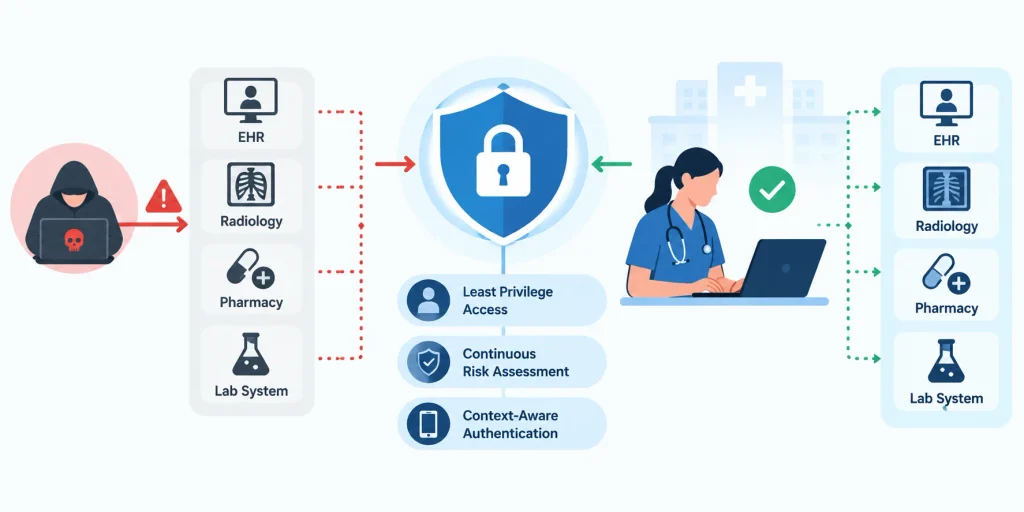
Most hospital networks were built on an assumption that no longer holds: if a device or user is inside the network, they can be trusted. That assumption made more sense a decade ago, before EHRs, PACS, connected infusion pumps, and dozens of third-party vendor integrations all sat on the same flat network.
Where Traditional Hospital Security Models Fall Short
A single compromised nurse’s-station login, in a perimeter-based model, can often move laterally into radiology, pharmacy dispensing, or the lab information system — because once you’re “inside,” very little stops you from reaching further. Shared workstations compound the problem. So do unmanaged personal devices, contractors with standing VPN access nobody remembers granting, and permissions that were “just easier” to hand out broadly than to scope precisely — the exact kind of drift that a hospital only tends to notice once it brings in outside cybersecurity services dubai teams to run an independent look at the network. One stolen credential shouldn’t be able to touch four clinical systems.
In too many hospitals, it still can — and this is exactly the kind of exposure a zero trust healthcare assessment is designed to catch, well before it shows up in a digital health platform security risks review tied to a new IAM investment.
What Zero Trust Healthcare Means in a Clinical Environment
Zero trust healthcare flips the assumption: verify every request, every time, regardless of where it originates. It’s not a firewall upgrade or a single product you buy and install. It’s an operating model built on three habits — least-privilege access (give people only what their role needs, nothing more), continuous risk assessment (keep checking, not just at login), and context-aware authentication (factor in device health, location, and behavior, not just a password). A radiologist’s credentials being valid doesn’t automatically mean their laptop, at 3 a.m., from an unrecognized network, should get the same trust as a hospital-issued workstation during a normal shift.
Quick Question: “Is zero trust the same as multi-factor authentication?”— No. MFA is one control inside a zero trust model. Zero trust healthcare also covers device posture, least-privilege access, segmentation, and continuous monitoring — MFA alone doesn’t stop lateral movement once someone’s logged in.
Healthcare Identity and Access Management Across Clinical Systems
You can’t secure access to systems you haven’t mapped. Healthcare identity and access management is the foundation any zero trust healthcare program is built on, and it starts with a genuinely complete inventory — not the one from three reorganizations ago.
Identify Every User, Application, and Device
That inventory has to include doctors, nurses, pharmacists, lab techs, contractors, patients with portal access, and administrative staff — but also the identities nobody thinks about until an audit forces the question: API clients pulling lab results, service accounts running nightly EHR syncs, and connected medical devices with their own network credentials. Skipping this step is the single most common reason zero trust healthcare rollouts stall six months in — teams build policies around users and forget the machines.
Apply Role-Based and Context-Aware Access Controls
Role-based access control (RBAC) assigns permissions by job function; attribute-based access control (ABAC) goes further, factoring in department, whether the clinician has an active care relationship with the patient, device trust level, and how sensitive the data is.
A radiologist needs broad access to imaging studies across the hospital. A pharmacist needs deep access to medication records but has no legitimate reason to open imaging files. Neither should default to “access everything” just because it’s simpler to configure — that kind of shortcut is exactly what a zero trust healthcare model is meant to eliminate — and the same discipline applies upstream, which is why custom EHR development security decisions (how the record system itself enforces field-level permissions) matter as much as the IAM layer sitting on top of it.
Support Accountability in NABIDH-Connected Workflows
For hospitals connected to Dubai’s NABIDH health information exchange, identity management carries an added responsibility: unique user identification, role-based authorization, and need-to-know access aren’t just good practice, they support the auditability that interoperability with a shared health data platform requires. Requirements evolve, so it’s worth reviewing current NABIDH technical and governance guidance directly with your compliance team rather than assuming last year’s checklist still applies — this is one area where a generic zero trust healthcare template simply won’t hold up to a real audit.
Healthcare SSO and Passwordless Access for Faster Clinical Workflows
Security teams sometimes treat convenience as the enemy of control. In a hospital, the opposite is often true — friction is what pushes clinicians toward risky shortcuts, and a big part of a working zero trust healthcare rollout is removing that friction without loosening the underlying controls.
How Healthcare SSO Simplifies Clinical Access
Healthcare SSO lets a clinician authenticate once and move between EHR, imaging, lab, and pharmacy systems without re-entering credentials at each stop. Centralized policy and session management mean IT isn’t managing ten separate password rules — it’s managing one identity policy that applies everywhere. Done properly, SSO doesn’t mean “logged into everything forever.” Session boundaries, timeouts, and re-authentication triggers still apply; SSO just removes the repetition, not the control.
Passwordless Authentication for Shared Clinical Workstations
Shared terminals are where password fatigue hits hardest. Badge tap-and-go access, smart cards, passkeys, and supported biometrics let a clinician switch users on a shared workstation in seconds instead of typing a password every time — while automatic session locking and termination close the gap that unattended, still-logged-in terminals create. This is also where hospitals evaluating EMR software developers in UAE should be asking pointed questions: does the platform actually support passwordless session handoff, or does it just support a login screen with a fingerprint icon bolted on?
Measure the Impact on Clinician Productivity
Before-and-after numbers matter here. Track median sign-in time, failed login attempts, and how often clinicians report interrupted workflows. If those numbers don’t improve within the first quarter of a zero trust healthcare deployment, the policy configuration — not the concept — needs revisiting.
MFA for Clinicians Without Creating Login Fatigue
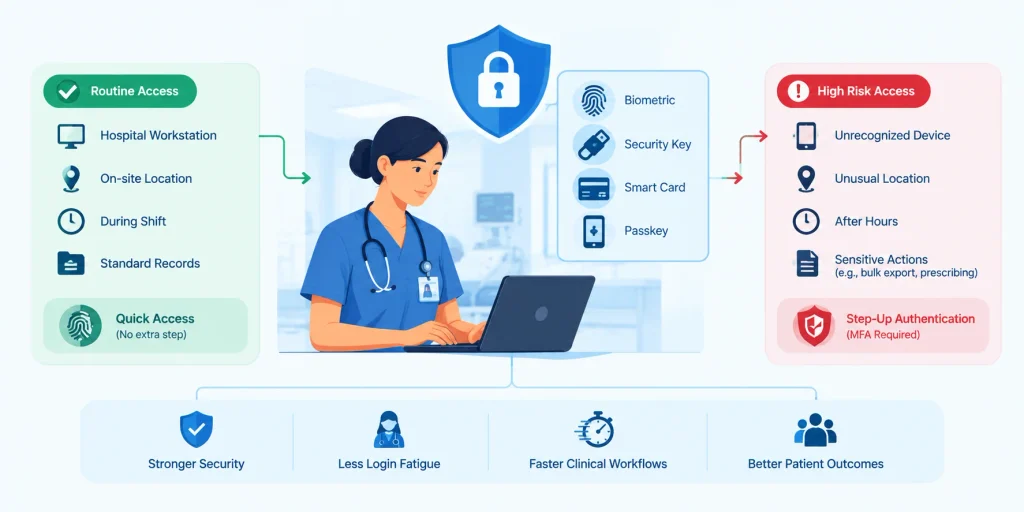
Ask any hospital IT director what clinicians complain about most, and “too many logins” usually beats “not secure enough.” The fix isn’t removing MFA. It’s making it smarter — which is really the whole point of layering risk-based authentication into a zero trust healthcare model instead of applying one blanket rule to every login.
Use Risk-Based Authentication Instead of Repeated MFA Prompts
Adaptive authentication weighs identity, device health, location, and the sensitivity of what’s being requested, then decides whether a step-up challenge is actually warranted. Routine chart access from a managed hospital workstation, mid-shift, doesn’t need the same scrutiny as a login attempt from an unrecognized device at an unusual hour, or a request to export a large batch of patient records.
Choose Phishing-Resistant MFA Methods
MFA for clinicians should lean on phishing-resistant methods — FIDO2 security keys, passkeys, smart cards, certificate-based authentication — rather than SMS codes, which remain vulnerable to interception and SIM-swap attacks and shouldn’t be the sole safeguard on high-risk accounts. This becomes even more relevant as hospitals expand virtual care; telehealth security requirements for remote consultations demand the same phishing-resistant standard, since a clinician prescribing remotely is just as high-value a target as one on-site.
Define Authentication Policies for Different Clinical Roles
Not every role carries the same risk. Remote prescribing, bulk record exports, and privileged system changes justify stronger authentication than routine ward rounds. Emergency access, though, has to stay reachable through a controlled workflow — a locked-out clinician during a code blue isn’t a security win, it’s a patient safety failure.
Privileged Access Management Healthcare for Administrators and Vendors
Clinicians aren’t the highest-risk accounts in most hospitals. IT administrators, cloud engineers, EHR support staff, and biomedical equipment vendors usually are — because their accounts can touch everything, which makes privileged access one of the first places a zero trust healthcare program should focus, not an afterthought once clinical access is sorted.
Secure Administrator and Vendor Accounts
Shared admin logins and permanent elevated permissions are common in hospitals that grew their systems faster than their governance. Privileged access management healthcare exists specifically to close that gap: identifying every privileged account, then controlling what it can do and for how long.
Implement Just-in-Time Access and Session Monitoring
Time-bound permissions, approval workflows, credential vaulting, and automatic revocation replace the old model of “give the vendor a login and remember to disable it later” — which, in practice, rarely gets remembered. Session recording on high-risk administrative activity means there’s an audit trail if something does go wrong, and vendors get access scoped tightly to an approved maintenance window instead of standing access that outlives the maintenance contract.
Quick Question: “How often should hospitals review privileged accounts?”— At minimum, quarterly — and immediately after any vendor contract ends or staff role changes. Dormant privileged accounts are one of the most common findings once someone actually goes looking, and they’re also one of the cheapest risks to fix once found.
Reduce Privilege Creep Through Regular Access Reviews
Permissions accumulate. A clinician who covered a different department for three months keeps that access long after returning to their original role, unless someone actively reviews and removes it. Periodic entitlement reviews, dormant account cleanup, and separation of duties keep the access map matching reality instead of drifting further from it every year.
Zero Trust Architecture Hospital Design for Connected Clinical Systems
The pieces above only work together if the underlying architecture is built to support them. This is where zero trust healthcare stops being a policy document and becomes something IT teams actually have to design and maintain.
Build an Identity-Centered Security Architecture
A working zero trust architecture hospital design connects identity providers, IAM, SSO, MFA, and policy engines so that every access decision runs through the same evaluation — identity plus device posture plus context — rather than relying on implicit trust because a request came from inside the building.
Apply Healthcare Network Segmentation to Limit Lateral Movement
Healthcare network segmentation separates clinical systems, administrative networks, connected medical devices, guest Wi-Fi, and vendor access into distinct zones, so a compromise in one doesn’t automatically expose the rest. PACS, lab systems, and pharmacy applications deserve their own protected segments — not a shared subnet with the guest network three switches away.
Protect API, Service Account, and Machine Identities
FHIR APIs, application integrations, and device certificates all need their own authentication and authorization rules. That means credential rotation, scoped permissions instead of blanket access, and a real inventory of machine identities — a category most hospitals track far less rigorously than human accounts, and one that increasingly matters as connected clinical platforms are built by teams specializing in HL7 software development company in UAE work, where interoperability standards and access scoping have to be designed in from day one, not retrofitted.
Emergency Break-Glass Access, Downtime, and Patient Safety
Every zero trust healthcare policy eventually meets a scenario it wasn’t designed for: a code, a downtime event, an emergency that doesn’t wait for standard authorization. Get this part wrong and the rest of the zero trust healthcare program loses clinical buy-in fast.
Design Controlled Break-Glass Access
Break-glass access lets a clinician reach patient records outside their normal permissions when circumstances demand it — but it should never be an unrestricted bypass. Reason capture, time-limited elevation, detailed logging, and mandatory post-event review keep it governed rather than exploited.
Maintain Access During Identity or Network Outages
Identity provider failures and network disruptions happen. Documented downtime procedures, tested — not just written and filed away — keep clinical access available when authentication services go down, with reconciliation and review once systems recover. This is a common weak point flagged in a hospital management system software in UAE resilience review: the HIS itself might have solid uptime, but the identity layer it depends on often hasn’t been stress-tested the same way.
Balance Security Controls With Clinical Safety
Emergency departments, ICUs, and medication administration workflows need break-glass procedures tested with clinical leadership at the table, not designed by IT in isolation and handed down. A policy that looks airtight on paper but has never been rehearsed during an actual code is a policy nobody trusts when it matters.
Healthcare IAM Implementation Roadmap for Dubai Hospitals
None of this happens in one deployment. A zero trust healthcare rollout that tries to do everything at once tends to either stall or break clinical workflows — a phased approach protects both security posture and clinical continuity.
Phase 1 — Assess Identity Risks and Map Clinical Workflows. Inventory users, applications, devices, and privileged identities. Map access journeys through emergency care, wards, radiology, pharmacy, and remote support. A structured healthcare cybersecurity assessment at this stage — rather than assumptions carried over from the last IT audit — gives the whole program an accurate starting point.
Phase 2 — Define Policies and Prioritize High-Risk Access. Set role-based, least-privilege, and risk-based authentication policies. Start with the accounts that carry the most exposure: privileged users, remote access, and third-party integrations.
Phase 3 — Pilot SSO, MFA, and Privileged Access Controls. Choose one clinical unit. Test healthcare SSO, MFA for clinicians, and privileged access controls there first, and gather direct feedback from the people using them before expanding — a pilot that skips clinician feedback almost always needs to be redone.
Phase 4 — Integrate Monitoring and Scale Across Systems. Connect identity, endpoint, and privileged-session logs into one monitoring view. Extend controls across EHR, PACS, pharmacy, and connected devices as confidence grows.
Phase 5 — Measure Results and Continuously Improve. Track authentication success rates, revocation time, orphaned accounts, and break-glass review completion. Zero trust healthcare isn’t a project with an end date — it’s a program that gets tuned as the hospital’s systems and threats change.
How to Evaluate a Zero Trust Healthcare Implementation Partner
Choosing the wrong partner here is expensive twice over — once in budget, once in clinician trust if the rollout disrupts care. A zero trust healthcare initiative is only as good as the team implementing it.
Assess Healthcare Integration and Security Expertise
Look for hands-on experience integrating IAM with EHR, PACS, pharmacy, and lab platforms — not general enterprise IT security experience applied to zero trust healthcare for the first time. A genuine Zero Trust Security Provider Dubai option should be able to speak specifically to legacy system integration, third-party vendor access, and machine identity management, not just recite the theory.
Validate Clinical Workflow and Compliance Readiness
Ask directly how they protect emergency access and minimize authentication friction — a vague answer here is a warning sign. Request a clear testing methodology, audit evidence, and measurable milestones, and confirm how they approach applicable NABIDH requirements and broader healthcare data protection obligations. A partner who can’t answer specifically isn’t ready for a hospital environment yet.

Conclusion
Zero trust healthcare comes down to a simple shift: access decisions based on identity, permissions, device trust, and risk — not on which side of the firewall a request came from. Healthcare SSO and risk-based MFA cut login friction. Privileged access management and segmentation close the gaps that shared credentials and flat networks leave open. Governed break-glass access keeps emergency care possible without permanent exceptions.
None of it works without the groundwork: mapping clinical workflows honestly, rolling out in phases, and measuring what actually changes for clinicians and patients. Hospitals that get this right through a capable Healthcare Software Development Dubai partner tend to see the same pattern — fewer login complaints, fewer orphaned accounts, and a security posture that holds up under an audit instead of just looking good in a policy document.
Frequently Asked Questions
What is zero trust healthcare?
Zero trust healthcare is a security model that verifies every access request based on identity, device health, and risk, instead of trusting users automatically because they’re inside the hospital network.
Does zero trust slow down clinicians?
Not when configured correctly. Risk-based authentication, healthcare SSO, and passwordless login reduce repeated prompts for routine access, reserving extra verification for genuinely high-risk requests.
What’s the difference between zero trust and a VPN?
A VPN grants broad network access once connected. Zero trust healthcare checks identity, device, and context continuously, limiting access to only what a specific role needs, request by request.
How does break-glass access work in a zero trust model?
Clinicians get temporary, logged access beyond their normal permissions during emergencies. Every use requires a reason, gets time-limited, and triggers a mandatory review afterward.
What is privileged access management in a hospital setting?
It controls elevated accounts used by IT admins and vendors — enforcing just-in-time access, session monitoring, and automatic revocation instead of permanent, standing administrative permissions.
Why do hospitals need network segmentation alongside identity controls?
Segmentation isolates clinical systems like PACS and pharmacy from guest networks and IoMT devices, so one compromised account or device can’t move laterally across the whole hospital.
Is MFA alone enough for healthcare cybersecurity?
No. MFA verifies identity at login but doesn’t stop lateral movement afterward. Zero trust healthcare pairs MFA with segmentation, least privilege, and continuous monitoring for real protection.
How long does a hospital IAM implementation typically take?
It varies by size, but a phased rollout — assessment, policy design, pilot, scale, measurement — usually spans several months to a year for a multi-department hospital.
What should hospitals look for in a zero trust implementation partner?
Direct experience integrating IAM with EHR, PACS, and pharmacy systems, a clear testing methodology, and a concrete answer for how they protect emergency clinical access.
Does zero trust healthcare help with NABIDH compliance?
It supports it. Unique user identification, role-based authorization, and detailed access logging align with the accountability NABIDH-connected workflows require, though specific requirements should be confirmed with your compliance team.