


Key Takeaways
- EHR security is an architecture built from identity, authorization, audit and emergency-access controls working together — not a single product or checkbox.
- Role-based access alone isn’t enough for hospitals in Dubai; care relationship, purpose of use, and consent status need to shape every access decision.
- Every patient-record event should be logged in a way that’s investigation-ready, not just “turned on.”
- Break-glass access should exist for emergencies, but it needs guardrails: time limits, justification, and mandatory review.
- Encryption protects data at rest and in transit, but it cannot replace strong authorization and monitoring.
- A phased assessment-to-implementation roadmap helps healthcare IT teams close gaps faster, improve clinician experience, and stay aligned with DHA and NABIDH expectations as the UAE’s digital health landscape keeps shifting.
Why EHR Security Architecture Needs More Than Basic Access Controls
A physician in a Dubai emergency department needs a patient’s chart in seconds, not minutes. That single requirement — fast, legitimate access with nothing left uncontrolled — is the whole problem in miniature. Get it wrong in either direction and you either slow down care or open a door that shouldn’t exist.
EHR security sits at the intersection of several concerns at once. It’s a patient-safety issue, because clinicians need accurate data at the point of care. It’s a privacy issue, because health records are among the most sensitive data any organization holds. It’s an identity-management problem, because the wrong person with the right credentials is still the wrong person. And it’s an operational security issue, because hospitals run integrations, remote access points, and third-party vendor connections around the clock.
The architectural principle that ties this together: secure EHR access should evaluate identity, role, care relationship, purpose, consent, context, and emergency conditions — not simply whether a user has an assigned role in the system. That’s a meaningfully different standard than most legacy EMR deployments were built around.
This distinguishes EHR security from generic application security. A retail app worries about account takeover. A hospital system has to account for clinical workflows, multi-site integrations, remote clinical access, privileged administrators, vendor support teams, and health-information exchange connections — often all touching the same patient record within a single day.
This guide walks through three architectural pillars: EHR access control, EHR audit logging, and break-glass governance — with a look at how they come together in a reference architecture built for UAE healthcare providers.
What Does EHR Security Architecture Actually Include?
EHR security isn’t one feature you switch on. It’s a set of interlocking controls, and a gap in any one of them weakens the rest.
Identity and Authentication
This layer answers “who is this, really?” It covers centralized identity management, single sign-on, multi-factor authentication, clinical identity verification, the full workforce identity lifecycle (onboarding through offboarding), service accounts, and device identity.
Authentication alone, though, doesn’t determine whether someone should see a particular patient’s chart. Confirming identity is step one, and it’s the layer most legacy EHR security deployments get right while everything downstream stays weak.
Authorization and Context-Aware Access
This is the policy layer, and it’s where a modern architecture starts to look different from a decade-old EMR deployment. Authorization decisions should weigh role, care relationship, purpose of use, consent status, the sensitivity of the specific patient’s data, device trust level, location, and real-time risk signals.
This is also where a zero trust healthcare model earns its keep — every access request gets evaluated on its own merits, regardless of network location or prior session history, instead of assuming that anyone already inside the hospital network is automatically trustworthy. That single shift strengthens EHR access control far beyond what traditional role-based access control (RBAC) can deliver on its own.
Monitoring, Detection and Evidence
EHR security doesn’t stop at prevention — it has to prove what happened after the fact. This layer covers SIEM integration, security alerting, immutable audit storage, compliance review workflows, incident response, and access analytics. A hospital that can’t reconstruct exactly who touched a record, when, and why, doesn’t have a defensible security posture, no matter how strong the front-door controls look.
EHR Security Reference Architecture for Modern Healthcare
Core Components
A practical EHR security architecture typically includes:
- The EHR/EMR platform itself
- IAM, SSO and MFA services
- A Policy Decision Point that evaluates each access request
- A consent management service
- A health information exchange integration gateway — in the UAE, this usually means a NABIDH connection for Dubai facilities
- Privileged Access Management (PAM)
- SIEM/SOC monitoring
- An immutable audit-log repository
- A case-management or review workflow for flagged access
How the Components Work Together
The access decision flow generally runs like this: a user authenticates, identity gets verified, the policy engine evaluates role, care relationship, purpose, consent and context together, an access decision gets made, the system connects to the EHR or the wider exchange, and an audit event fires into SIEM and immutable storage. This is the sequence that makes EHR security enforceable in practice, not just written down in a policy document.
For UAE hospitals connecting to DHA’s NABIDH platform or Abu Dhabi’s Malaffi, this exchange layer isn’t optional infrastructure — it’s often a regulatory expectation. Getting it right requires purpose-built HIE Software Solutions in UAE that can handle consent enforcement and cross-facility audit trails without slowing down clinical staff.
Where Controls Should Be Enforced
Enforcement needs to happen at the application layer, the API layer, the identity layer, the data layer, the integration/HIE layer, and the administrative layer. Relying on just one — say, application-level checks alone — leaves gaps that a compromised API key or a misconfigured integration can walk straight through, and gaps like that are where EHR security programs quietly fail audits.
Designing EHR Access Control Beyond Traditional RBAC
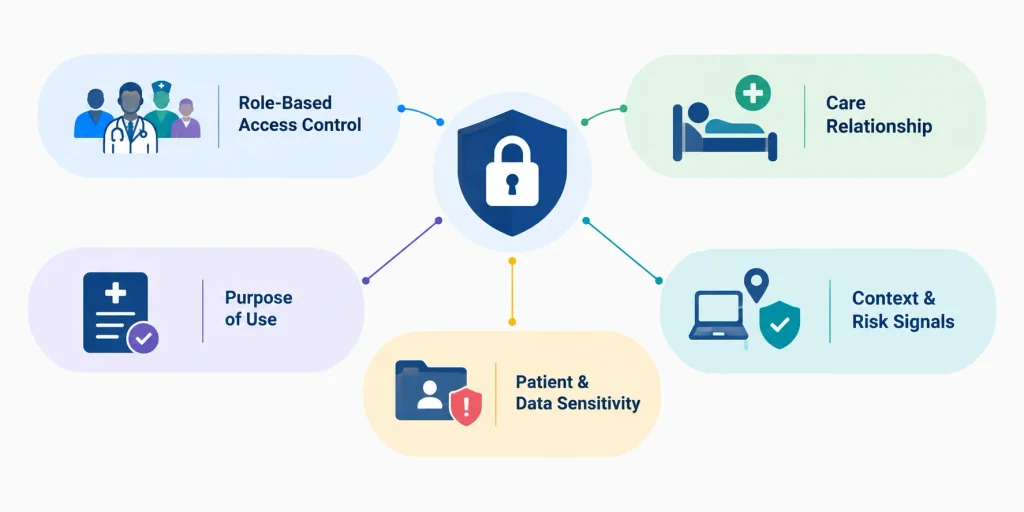
Start With Role-Based Access Control
RBAC remains the foundation of EHR security. Physicians, nurses, pharmacists, billing staff, medical records personnel, EHR administrators, and integration engineers each need different baseline permissions. That much hasn’t changed. What has changed is the expectation that role alone shouldn’t be the final word on every access decision.
Add Care Relationship to the Decision
A physician assigned to a patient’s care team needs different access than a physician with no connection to that patient at all. Consider an emergency department encounter, a referral relationship, or a historical care episode that ended months ago. Factoring in the actual care relationship — not just job title — cuts down on unnecessary chart access dramatically.
Add Purpose of Use
Access for treatment looks different from access for billing, operations, technical support, or an audit investigation. Purpose-based controls let a system grant the minimum necessary access for the task at hand, rather than the maximum access the role technically allows — and that distinction is where mature EHR security starts to show.
Consider Patient and Data Sensitivity
Some records need extra scrutiny regardless of who’s asking: VIP patients, employee health records, restricted clinical information, and specially protected data categories. A well-designed EHR security system flags these automatically rather than relying on staff to remember which charts are sensitive.
Add Context and Risk Signals
Managed versus unmanaged device, known versus unusual login location, normal versus abnormal behavior patterns, remote session risk, and time-of-day anomalies all belong in the authorization decision. Interoperability standards matter here too — as more UAE providers adopt FHIR security profiles for API-level authorization, context-aware scopes can be enforced at the data-exchange layer itself, not just inside the application.
Quick Question: “Does adding all these factors slow clinicians down?”— Not if it’s designed correctly. Context-aware authorization runs in milliseconds behind the scenes; clinicians on the normal care team, on a managed device, during a normal shift, see no friction at all. The extra checks only surface when something looks genuinely unusual.
EHR Audit Logging: What Should the System Actually Record?
“Enable audit logs” isn’t a strategy. The real question is what those logs need to capture to be useful when something goes wrong.
Essential Audit Events
A properly configured system logs successful and failed authentication attempts, patient-record views, record creation and modification, data disclosure and export, data deletion, permission changes, administrative actions, API access, and break-glass activation. These are the baseline events any serious EHR security program should capture without exception.
Recommended Audit Event Schema
| Audit Field | What It Establishes |
|---|---|
| Actor/User ID | Who performed the action |
| Patient/Chart ID | Which record was accessed |
| Action | What happened |
| Data Object | What information was involved |
| Purpose/Reason | Why access occurred |
| Timestamp | When it occurred |
| Application/Source | Where access originated |
| IP/Device | Access context |
| Outcome | Success or failure |
| Consent State | Applicable authorization |
| Correlation ID | Links related events |
| Break-Glass Case ID | Connects emergency access to review |
This level of detail is what turns a log file into evidence. If a compliance officer or DHA auditor needs to reconstruct an incident, a system with this schema can answer the question in minutes. One with generic logging often can’t answer it at all.
Protecting the Audit Trail
Logs need restricted modification rights, immutable or WORM storage, centralized monitoring, defined retention policies, synchronized timestamps across systems, regular review cycles, and separation of duties between the people who can access records and the people who review the logs of that access. This is the layer that keeps EHR security defensible when an auditor asks hard questions.
Before any of this gets built, most UAE healthcare organizations benefit from a structured healthcare cyber risk assessment to map where the current audit gaps actually sit — rather than guessing which systems need attention first.
Break-Glass Access in Healthcare: Designing Emergency Access Without Creating a Security Loophole
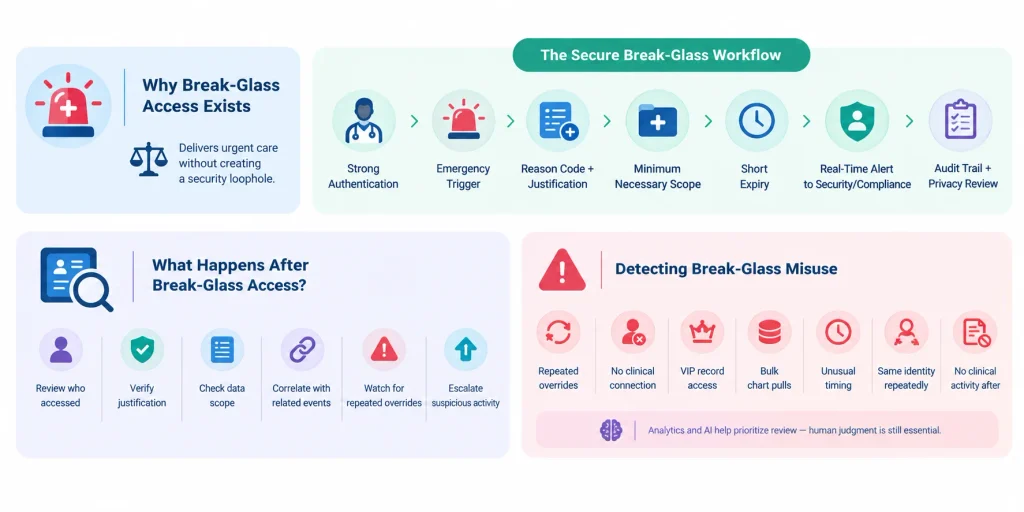
Why Break-Glass Access Exists
Emergency treatment sometimes requires access outside a clinician’s normal authorization scope. Too restrictive, and urgent care gets delayed. Too permissive, and you’ve built an insider-risk problem into your architecture. Break-glass exists to resolve that tension deliberately, instead of leaving it to chance, and balancing both sides well is one of the harder EHR security challenges any acute-care facility faces.
The Secure Break-Glass Workflow
A well-designed workflow includes strong clinician authentication, an explicit emergency-access trigger, a mandatory reason code, free-text justification where appropriate, minimum-necessary record scope, short automatic expiry, a real-time alert to a security or compliance team, a complete audit trail, and a retrospective privacy review. In multi-facility UAE networks, this workflow needs to fire consistently across systems, which is usually built by teams offering HL7 FHIR interface software development services in UAE who understand how emergency-access events should propagate through connected records without breaking the audit chain.
What Happens After Break-Glass Access?
The event doesn’t end when the chart closes. Someone needs to review who accessed the record, verify the emergency justification actually holds up, check the scope of data accessed, correlate it with related events, watch for repeated overrides from the same identity, and escalate anything that looks suspicious.
Detecting Break-Glass Misuse
Red flags include repeated emergency overrides, access to patients with no clinical connection, VIP-record access, bulk chart pulls, unusual timing, the same identity triggering overrides again and again, and access with no corresponding clinical activity afterward. Analytics and AI can help prioritize which events deserve a human look first — they shouldn’t replace the human review itself.
Quick Question: “How long should break-glass access stay open?”— Most well-designed systems cap it at a short, fixed window — often under an hour — with automatic expiry and re-authentication required to extend it. Longer windows increase the chance emergency access outlives the emergency it was meant for.
EHR Encryption and Data Protection Across the Architecture
Encryption in Transit
TLS should protect API communication, EHR-to-HIE data exchange, remote clinical access sessions, and integration channels between systems — encryption in transit is a baseline expectation of EHR security, not an advanced feature to negotiate for.
Encryption at Rest
Databases, backups, audit repositories, file and object storage, and disaster-recovery environments all need encryption at rest — not just the primary production database.
Key Management and Access Separation
Encryption-key management, regular key rotation, administrative separation between who manages keys and who manages data, least-privilege access, and backup protection round out this layer. Getting this right early is part of what distinguishes genuinely secure healthcare software development from a build that treats encryption as an afterthought bolted on before launch.
It’s worth being direct about a limitation here: encryption protects data confidentiality. It does nothing for authorization or monitoring. A properly encrypted database that grants the wrong person access is still a breach.
EHR Security Requirements for Different User and Access Types
Treating every user identically is where a lot of EHR security architectures quietly fail.
Clinical users need strong authentication, role-based access tied to their specialty, care-relationship checks, and emergency-access pathways when needed.
Administrative users need restricted PHI access, purpose limitation, strong authentication, and active monitoring — they touch records for operational reasons, not clinical ones.
EHR administrators and privileged users need PAM controls, just-in-time access rather than standing permissions, session recording, formal approval workflows, and continuous privileged-activity monitoring.
Vendors and remote support teams need time-limited access, named individual accounts (never shared logins), MFA, approval-based access requests, session monitoring, and automatic expiry once the support window closes.
APIs, integration engines, and service accounts are non-human identities that still need credential rotation, scope limitation, API-level authorization, and monitoring — they’re frequently the weakest link precisely because they’re easy to overlook.
A hospital evaluating this level of differentiated control often reaches a point where internal IT capacity isn’t enough on its own, which is usually when a specialized Cyber Security Company Dubai gets brought in to run the assessment and design work in parallel with day-to-day operations.
Custom EHR Development Security Considerations
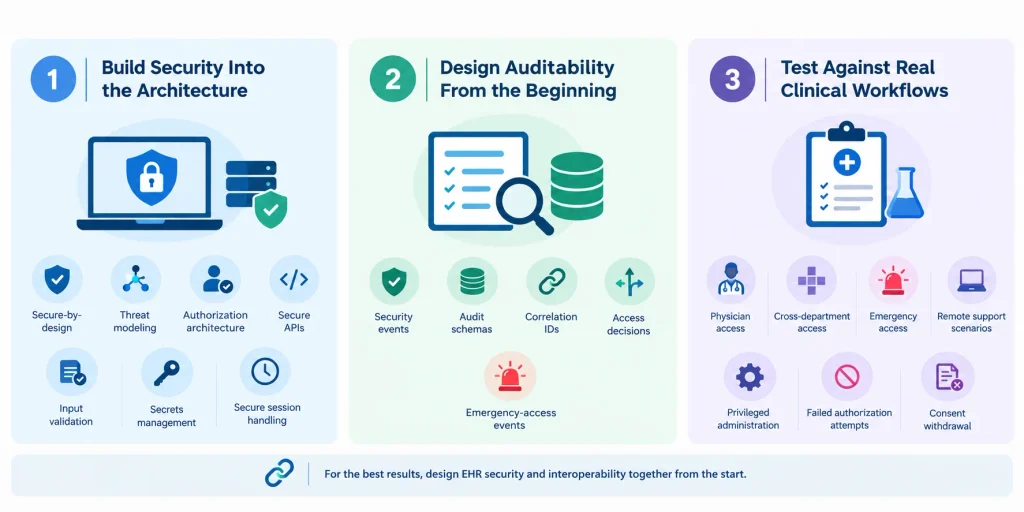
Build Security Into the Architecture
Secure-by-design development, threat modeling, a clearly defined authorization architecture, secure APIs, input validation, secrets management, and secure session handling all need to be part of the build from day one. This is where EHR security either gets built in or bolted on — and bolted-on security is nearly always more expensive to fix later.
Design Auditability From the Beginning
Security events, audit schemas, correlation IDs, access decisions, and emergency-access events should be defined during architecture design, not added as an afterthought once the system is already in production.
Test Against Real Clinical Workflows
Validation should cover normal physician access, cross-department access, emergency access, remote support scenarios, privileged administration, failed authorization attempts, and consent withdrawal — testing EHR security controls and clinical usability together, not as separate exercises.
For organizations building or rebuilding from scratch, Custom Healthcare Software Dubai projects tend to succeed when EHR security and interoperability are designed side by side from the first architecture diagram, rather than treated as two separate workstreams that get reconciled right before launch.
EHR Security vs EMR Security and PHR Security
The terms “EHR security” and “EMR security” get used interchangeably across the market, and in practice, the security requirements depend far more on a system’s functionality, integrations, users, and data flows than on which acronym is on the label. A comprehensive EMR software solutions in UAE deployment needs the same layered approach outlined throughout this guide, regardless of what the vendor calls it.
PHR security introduces its own wrinkle, because patients directly access, download, share, or connect their health information through consumer-facing apps. That raises separate questions around patient authentication, consent, API access for third-party apps, data sharing permissions, and session security. All three — EHR, EMR, and PHR — ultimately feed back into the same broader architecture.
How to Assess Your EHR Security Architecture
Assessment Checklist
A thorough EHR security review works through identity lifecycle management, MFA coverage, RBAC design, context-aware authorization, consent enforcement, care-relationship controls, encryption, audit completeness, log integrity, SIEM integration, break-glass governance, PAM, vendor access controls, API/service-account security, incident response readiness, and retention/evidence management.
Questions to Ask EHR Vendors
- Can authorization decisions factor in care relationship and purpose of use, or only role?
- Can emergency access be time-limited and auto-expired?
- Is every chart-view event auditable, not just modifications?
- Can audit logs be altered by system administrators?
- How are privileged accounts controlled and monitored?
- Can vendor access expire automatically without manual intervention?
- Can security events be correlated in a SIEM?
- Can the system produce a complete evidence package on request?
If your team can’t confidently answer most of these today, that gap is exactly what a formal architecture assessment is built to close.

EHR Security Implementation Roadmap
Phase 1 — Assess: map users and identities, identify sensitive data, review current authorization models, assess existing audit capabilities, identify break-glass gaps.
Phase 2 — Architect: define the IAM model, design the policy engine, establish consent controls, define the audit schema, design PAM and SIEM integration.
Phase 3 — Implement: deploy MFA, implement contextual access, configure audit logging, integrate SIEM, build the break-glass workflow.
Phase 4 — Validate and Monitor: test clinical scenarios end to end, conduct access reviews, test emergency workflows under realistic conditions, monitor for anomalous behavior, and run recurring compliance assessments.
This isn’t a project with a finish line. EHR security needs continuous monitoring and periodic reinvestment — particularly for facilities managing hospital ransomware protection as a standing operational priority rather than a one-time project, given how frequently healthcare remains a target for ransomware operators globally.
Request an EHR Security Architecture Assessment
If your organization is evaluating an EHR modernization project, integrating with NABIDH or Malaffi, or simply isn’t confident in how access decisions, audit trails, and emergency workflows are currently governed, a structured architecture assessment is the fastest way to find out where the real gaps are.
A thorough assessment typically covers EHR/EMR architecture review, access-control evaluation, IAM/SSO/MFA design, HIE integration review, audit-log and SIEM assessment, break-glass workflow design, PAM and third-party access review, custom EHR development security, and compliance evidence readiness — with a practical, prioritized remediation roadmap at the end of it, not just a findings document.
Request an EHR Security Architecture Assessment to identify gaps across identity, access control, consent, audit trails, privileged access, and emergency workflows — and get a roadmap built for how your hospital or clinic actually operates in Dubai and across the UAE.
Frequently Asked Questions
What is EHR security architecture?
EHR security architecture is the combined framework of identity management, authorization, audit logging, encryption, and break-glass controls that governs how clinicians, staff, and systems access and protect electronic health records.
How is EHR security different from EMR security?
The terms are largely interchangeable in practice. Security requirements depend on a system’s actual functionality, integrations, and users rather than on whether it’s labeled EHR or EMR, so both need identical layered protections.
What is break-glass access in healthcare?
Break-glass access lets clinicians override normal permissions during emergencies to reach patient data outside their usual authorization scope, provided the system logs the reason, limits the scope, and expires access automatically.
Why isn’t role-based access control enough for EHR security?
RBAC only checks job title, not context. Modern EHR security also weighs care relationship, purpose of use, consent status, device trust, and location before granting access to a specific patient record.
What should EHR audit logs actually capture?
Audit logs should record the actor, patient ID, action taken, timestamp, purpose, source system, IP/device, outcome, consent state, and correlation ID — enough detail to reconstruct any incident during a compliance review.
How does zero trust apply to healthcare EHR systems?
Zero trust evaluates every access request individually, regardless of network location, instead of trusting anyone already inside the hospital network. It strengthens EHR access control beyond what traditional perimeter security provides.
Does encryption alone secure an EHR system?
No. Encryption protects data confidentiality in transit and at rest, but it does nothing for authorization or monitoring. A properly encrypted database still becomes a breach if the wrong person is granted access.
How does NABIDH affect EHR security for Dubai hospitals?
NABIDH is Dubai’s health information exchange, so facilities connecting to it need EHR security architecture that supports consent enforcement, cross-facility audit trails, and secure data exchange at the integration layer.
What questions should we ask an EHR vendor about security?
Ask whether authorization considers care relationship and purpose of use, whether emergency access auto-expires, whether every chart view is auditable, and whether the vendor can produce a complete evidence package on request.
How often should a hospital assess its EHR security architecture?
EHR security needs continuous monitoring rather than a one-time review. Most healthcare organizations in the UAE benefit from a formal architecture assessment annually, plus after any major system change or integration.