


Key Takeaways
- Ransomware attacks on UAE logistics firms have jumped 63%, making Data Security and Compliance in Logistics a boardroom priority.
- Digital transformation (cloud, IoT, mobile, APIs, AI) has outpaced legacy security models, expanding the attack surface and raising the stakes for Data Security and Compliance in Logistics.
- Weak/stolen third-party credentials are the most common breach entry point — not sophisticated exploits.
- UAE PDPL (2027 deadline) requires data localization, encryption, a DPO in some cases, and 72-hour breach notification, with penalties in the millions of dirhams — core pillars of Data Security and Compliance in Logistics.
- Security-by-design — least-privilege access, encryption, secured APIs, VAPT, immutable backups — is central to real Data Security and Compliance in Logistics.
- A 90-day roadmap (audit → strengthen infrastructure → test response) helps companies build Data Security and Compliance in Logistics before the deadline.
- Enterprise clients now vet security before signing contracts, making Data Security and Compliance in Logistics a competitive advantage, not just a cost.
Dubai’s logistics sector has gone digital faster than almost any other industry in the Gulf. Freight forwarders track containers in real time. Warehouses run on connected sensors instead of clipboards. AI models now decide which truck takes which route before a dispatcher even looks at the screen. It’s a genuinely impressive shift — and it’s also the reason Data Security and Compliance in Logistics has quietly become one of the most urgent conversations in the industry.
Here’s the uncomfortable part: security infrastructure hasn’t kept pace with the technology it’s supposed to protect. Ransomware attacks targeting the UAE logistics sector have jumped 63% in recent years, and freight companies — sitting on customer data, shipment manifests, customs records, and financial details — are exactly the kind of target attackers look for.
That’s why Data Security and Compliance in Logistics has stopped being a conversation that stays inside the IT department. It’s now a boardroom issue, tied directly to a 2027 deadline under the UAE Personal Data Protection Law (PDPL) that every logistics application in the country needs to meet. This guide walks through why the risk has grown, which threats matter most right now, what PDPL actually requires, and how to build logistics software that treats security as a foundation instead of an afterthought.
Why Data Security and Compliance in Logistics Has Become a Business-Critical Priority in Dubai
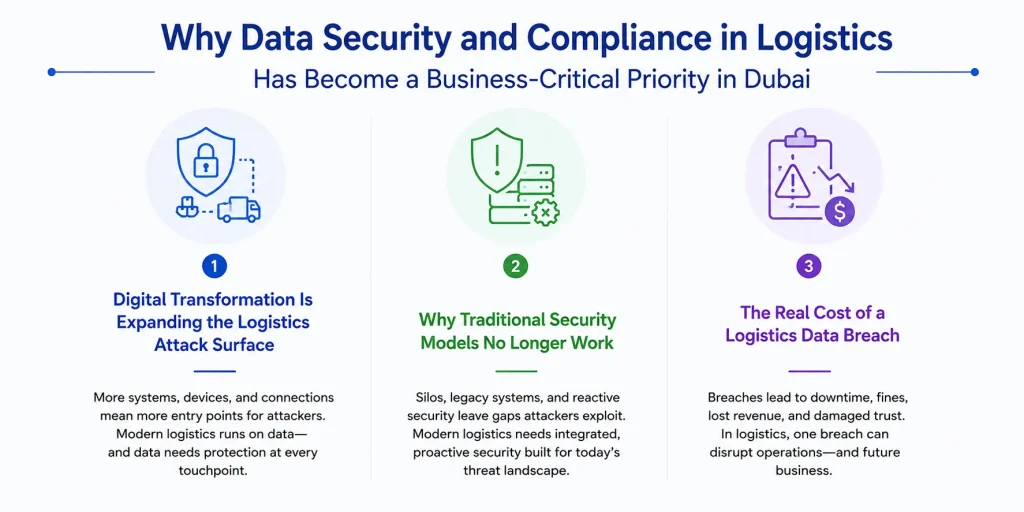
Digital Transformation Is Expanding the Logistics Attack Surface
Every system a logistics company adds is also a new door someone could walk through. Cloud-based logistics platforms hold live shipment and customer data outside a company’s own four walls. Connected warehouses run on IoT sensors that rarely get security patches on schedule. Mobile apps put dispatch and tracking data in the hands of drivers and customers, often on personal devices. API-driven ecosystems connect freight forwarders, customs brokers, and carriers, so one weak API can expose an entire network.
Add AI-powered supply chains ingesting data from dozens of sources, and the attack surface has grown far faster than most security teams are staffed to handle. Data Security and Compliance in Logistics has to scale with that surface, not chase it after the fact.
Why Traditional Security Models No Longer Work
Most logistics companies in Dubai are still running security models built for a world of on-premise servers and paper manifests. Legacy systems weren’t designed with today’s threats in mind. Applications operate in silos — the warehouse management system doesn’t talk to the fleet platform, which doesn’t talk to the customer portal — so there’s no single view of what’s happening across the network. Security itself tends to be reactive: teams respond after a breach instead of building defenses that prevent one. This is exactly the gap that data security in logistics strategy needs to close, and it’s why Data Security and Compliance in Logistics now demands a dedicated budget line rather than a shared IT task.
The Real Cost of a Logistics Data Breach
A breach doesn’t just mean a compromised database. It means trucks sitting idle because dispatch systems are locked. It means financial losses from ransom payments, lost contracts, and regulatory fines. It means UAE regulators asking hard questions about PDPL compliance. And it means customers — many of them enterprise clients with their own security requirements — quietly moving their freight to a competitor they trust more.
Logistics Technology Trends in Dubai That Are Creating New Security Challenges in 2026
AI-Powered Supply Chain Orchestration and New Security Risks
AI is now doing real work inside Dubai’s logistics companies — predictive routing that adjusts in real time, inventory forecasting that flags shortages before they happen, and autonomous decisions that used to require a human dispatcher. AI in logistics software is genuinely valuable, but it also means models ingest sensitive operational and customer data continuously, often from third-party sources nobody has audited. If the model’s decision layer gets compromised, the damage propagates through every downstream decision it makes — which makes data security and compliance for logistics applications Dubai operators depend on genuinely non-negotiable.
Paperless Customs and Fully Digital Documentation
Dubai Customs has pushed hard toward the Advance Trade and Logistics Platform (ATLP) and fully electronic customs declarations. That’s great for speed. It also means trade documentation that used to live in filing cabinets — commercial invoices, certificates of origin, bills of lading — now lives entirely in digital systems that need locking down to the same standard as financial records. Data Security and Compliance in Logistics now has to cover customs data, not just customer records.
Real-Time Visibility Platforms and WhatsApp-Based Freight Coordination
Real-time shipment tracking has become table stakes for cross-border supply chain visibility in the UAE. But a lot of day-to-day freight coordination in Dubai still happens over WhatsApp — shipment updates, customer communication, even documents shared in group chats. That’s a mobile security risk most companies haven’t accounted for, since consumer messaging apps sit completely outside the compliance perimeter of the core logistics platform.
Blockchain, Smart Contracts, and Trade Transparency
Blockchain is starting to show up in Dubai’s trade finance and logistics stack, mostly for distributed ledgers that track custody of goods and smart contracts that automate payment on delivery. The immutable record-keeping is a genuine upgrade over paper trails, but it introduces its own governance questions — who controls the keys, and what happens when a contract needs correcting?
Autonomous Warehouses, Robotics, and Digital Twins
Warehouse automation — robotics, autonomous forklifts, digital twins that simulate operations in real time — depends on a dense mesh of connected devices. Every device is a potential entry point, and most warehouse operators haven’t inventoried, let alone secured, what’s actually connected to their network. Data Security and Compliance in Logistics planning at this scale has to start with a device inventory before anything else.
The Biggest Security Threats Facing Logistics Applications in Dubai
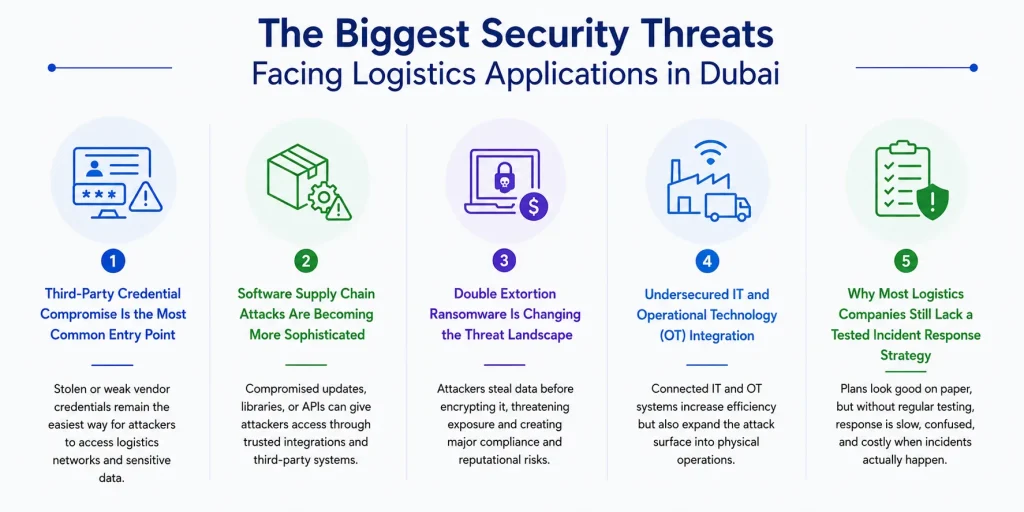
Third-Party Credential Compromise Is the Most Common Entry Point
Freight portals, vendor logins, and supplier accounts are, in practice, the easiest way into a logistics network. A single reused password on a freight forwarder’s portal can hand an attacker access to shipment data across dozens of clients. This is consistently the most common way attackers get in — not sophisticated zero-days, just stolen or weak credentials. Any serious approach to Data Security and Compliance in Logistics starts here; it’s the cheapest fix with the biggest payoff.
Software Supply Chain Attacks Are Becoming More Sophisticated
A compromised software update, a poisoned third-party library, or a breached API integration can quietly hand attackers access without a single phishing email. Logistics platforms typically integrate with dozens of external systems — customs, carriers, payment processors — and each one inherits that vendor’s security posture, for better or worse. This is where data security compliance logistics applications teams often discover risk they never signed off on.
Double Extortion Ransomware Is Changing the Threat Landscape
Older ransomware just encrypted files. The current playbook is double extortion: steal the data first, encrypt it second, then threaten to publish shipment and customer records unless a ransom gets paid. For a logistics company under PDPL, the stolen data alone is a reportable breach — the ransom demand is almost secondary to the compliance exposure. Data Security and Compliance in Logistics frameworks that plan only for encryption, not theft, are already a step behind.
Undersecured IT and Operational Technology (OT) Integration
Warehouse systems, terminal operating systems, and fleet management platforms increasingly connect directly to corporate IT networks. That convergence is efficient, but OT systems were rarely built with modern cybersecurity in mind, and a breach on the IT side can now reach machinery and physical operations in a way it couldn’t a decade ago.
Why Most Logistics Companies Still Lack a Tested Incident Response Strategy
Recovery planning, business continuity, and disaster recovery all sound obvious on paper. In practice, most mid-sized logistics operators in Dubai have a security policy document somewhere, but no one has run a drill. When an incident hits, that gap shows immediately — confusion, delayed reporting, and decisions made under pressure instead of according to a plan.
UAE PDPL Requirements Every Logistics Application Must Meet Before 2027
Understanding the UAE Personal Data Protection Law (PDPL)
The UAE Personal Data Protection Law applies to any organization processing personal data of individuals inside the UAE, and its scope reaches beyond companies headquartered there — a logistics firm outside the UAE handling shipments for UAE-based customers falls under it too. For logistics companies, that means customer names, addresses, phone numbers, and payment details captured anywhere in the shipment lifecycle are in scope. Compliance considerations for logistics applications start with mapping exactly what personal data the platform collects and where it flows — the single most practical step toward real Data Security and Compliance in Logistics.
Data Localization Requirements for Logistics Companies
PDPL doesn’t mandate blanket data localization the way some regional frameworks do, but sector-specific rules and government contracts increasingly expect UAE-based data residency. Any logistics company evaluating cloud infrastructure needs to know exactly where its data sits and whether that location satisfies its regulatory obligations — a question worth raising with any Supply Chain Software Development Company in Dubai before signing a contract, not after deployment.
Encryption Requirements for Shipment and Customer Data
Shipment records and customer data need encryption both at rest and in transit — not just on the primary database, but across backups, logs, and any system that touches that data downstream. This is one of the more concrete, checkable pieces of data protection and compliance logistics teams can implement without waiting on broader organizational change, and it’s often the fastest win on the road to full Data Security and Compliance in Logistics.
When Does a Logistics Company Need a Data Protection Officer?
Under PDPL, a Data Protection Officer becomes mandatory when a company processes large volumes of personal data or handles sensitive data as a core activity. For most mid-to-large logistics operators — moving thousands of shipments with attached customer records — that threshold is easy to cross without realizing it.
The 72-Hour Data Breach Notification Requirement Explained
If personal data is compromised, PDPL requires notifying the UAE Data Office within 72 hours of becoming aware of it. That clock starts at discovery, not confirmation — precisely why an untested incident response plan becomes a compliance failure, not just an operational one.
Cross-Border Data Transfers and International Logistics Operations
International freight forwarders routinely move data across borders — a shipment booked in Dubai might be processed on a server in Europe and delivered by a partner in Asia. PDPL places conditions on those transfers, and logistics companies running on global cloud infrastructure need contractual and technical safeguards before data leaves UAE jurisdiction. Firms evaluating supply chain software development UAE partners for a rebuild should ask directly how cross-border transfers are handled.
Understanding PDPL Penalties and Regulatory Risks
Penalties under PDPL can run into the millions of dirhams for serious violations, and the operational consequences — suspended data processing activities, mandatory audits — often hurt more than the fine itself. For a logistics company, a suspended ability to process shipment data is a halted operation, and it’s the clearest illustration of why Data Security and Compliance in Logistics belongs on the executive agenda.
How to Build Security-by-Design Logistics Applications in Dubai
Implement Role-Based and Least-Privilege Access Controls
Not every employee needs access to every shipment record. Role-based permissions, paired with multi-factor authentication and a proper identity and access management layer, limit what a compromised account can actually reach. This single control does more to contain data security compliance logistics applications risk than almost any other investment, and it’s usually the first thing worth prioritizing under any Data Security and Compliance in Logistics roadmap.
Encrypt Every Data Layer Inside the Logistics Ecosystem
Databases, APIs, cloud storage, and backup environments all need encryption — not just the customer-facing application. A shipment record that’s encrypted in the primary database but sitting in plaintext in a backup file is still an exposed record, and still a Data Security and Compliance in Logistics gap waiting to be found by an auditor or an attacker.
Secure APIs and Third-Party Integrations
API gateways, token-based authentication, and formal vendor security reviews should gate every integration a logistics platform relies on. Given how many third-party systems a typical freight operation connects to, this is often the highest-leverage place to invest.
Conduct Regular Vulnerability Assessments and Penetration Testing
Vulnerability assessment and penetration testing (VAPT), run on a regular schedule rather than once a year, paired with continuous monitoring, catches gaps a one-time audit misses. Threats evolve month to month — testing needs to keep the same pace, and it’s a recurring line item any mature Data Security and Compliance in Logistics program should budget for.
Build a 72-Hour Breach Response Framework Into the Application Architecture
Automated alerting, predefined incident workflows, and built-in compliance reporting shouldn’t be bolted on after a breach happens. They need to be part of the application’s architecture from day one, so the 72-hour PDPL clock is something the system helps you meet, not race against manually.
Develop an Immutable Backup and Disaster Recovery Strategy
Offline, immutable backups — the kind ransomware can’t reach or encrypt — combined with tested recovery procedures and a real business continuity plan, are what gets a logistics operation back online fast after an incident. This is a core piece of what any capable partner offering logistics software for UAE enterprises should build in from the start, not add as an afterthought.

A 90-Day Security and Compliance Roadmap for Dubai Logistics Companies
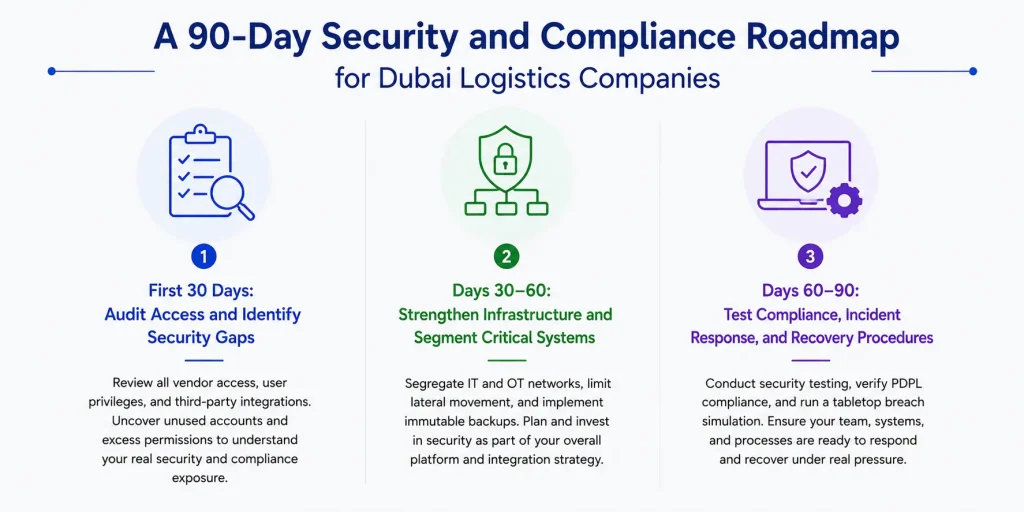
First 30 Days: Audit Access and Identify Security Gaps
Start with a full vendor access review, a user privilege audit across every system, and a third-party assessment of any integration partner that touches customer or shipment data. Most companies find accounts and permissions no one remembers granting. This audit is also the moment most operators finally see the true scope of their Data Security and Compliance in Logistics exposure.
Days 30–60: Strengthen Infrastructure and Segment Critical Systems
Network segmentation and OT/IT separation limit how far an attacker can move once inside. This is also the window to implement the immutable backup strategy Days 1–30 likely revealed was missing, and to budget properly — a question that inevitably comes up alongside how much does logistics software cost in Dubai, since security work is rarely a separate line item from the platform build itself.
Days 60–90: Test Compliance, Incident Response, and Recovery Procedures
Run actual security testing, a compliance audit against PDPL requirements, and — critically — a tabletop exercise simulating a real breach. Compliance considerations for logistics applications only mean something once tested under pressure, not just documented in a policy.
Why Security-First Logistics Applications Will Become a Competitive Advantage in Dubai
Compliance Is Becoming a Customer Expectation
Enterprise shippers now build security questionnaires into vendor evaluation before they’ll sign a contract. A logistics provider that can’t answer those questions clearly is losing deals before pricing even comes up — proof that Data Security and Compliance in Logistics has become a sales conversation, not just a technical one.
Security Is No Longer Just an IT Investment
Every dirham spent on Data Security and Compliance in Logistics protects revenue, brand reputation, and customer retention directly. A single breach can undo years of trust built with enterprise clients in a matter of days.
Security-by-Design Will Separate Market Leaders From Everyone Else
Trust is becoming a genuine differentiator in a crowded logistics market, and data protection and compliance logistics practices built in from the start — not patched on later — separate the operators winning enterprise contracts from the ones still explaining last year’s incident.
Conclusion
Dubai’s logistics industry isn’t slowing down, and neither is the complexity it’s creating. AI, automation, and real-time visibility are reshaping how freight moves through the region — and every advance adds another layer that has to be secured and made compliant.
Security and compliance can’t be bolted on after a platform ships. The companies that treat Data Security and Compliance in Logistics as a foundation — not a checkbox — will be the ones still standing when the 2027 PDPL deadline arrives, and the ones enterprise clients trust with their freight in the years after. That’s the real return on getting Data Security and Compliance in Logistics right this early: fewer fire drills, fewer lost contracts, and a platform that scales without dragging risk along with it.
If your logistics platform hasn’t been audited against PDPL requirements yet, that’s the place to start. A focused Data Security and Compliance in Logistics review now costs far less than a breach notification later — get in touch for a consultation before the deadline closes in.
Frequently Asked Questions
What is the UAE PDPL deadline for logistics companies?
The Personal Data Protection Law’s key compliance requirements must be met before 2027, covering data localization, encryption, breach notification, and data protection officer obligations for qualifying logistics companies.
What’s the most common cause of logistics data breaches?
Third-party credential compromise — weak or reused passwords on freight portals, vendor logins, and supplier accounts — remains the most common entry point attackers use to breach logistics networks.
How much time do companies have to report a data breach under PDPL?
Logistics companies must notify the UAE Data Office within 72 hours of becoming aware of a personal data breach, not from when it’s fully confirmed or investigated.
Does every logistics company need a Data Protection Officer?
Only companies processing large volumes of personal data or handling sensitive data categories as a core activity need a DPO — a threshold many mid-to-large logistics operators cross unknowingly.
What are the penalties for PDPL non-compliance?
Penalties can reach millions of dirhams for serious violations, alongside operational consequences like suspended data processing activities and mandatory audits, which often disrupt operations more than the fine itself.
Can logistics data be stored outside the UAE?
PDPL doesn’t mandate blanket data localization, but sector rules and government contracts increasingly expect UAE-based residency, so cloud infrastructure choices need careful regulatory review.
Why is AI in logistics software a security concern?
AI models continuously ingest sensitive operational and customer data, often from unaudited third-party sources — if compromised, that risk propagates through every automated decision the system makes.