


key takeaways
- AI in logistics software shifts operations from reactive record-keeping to predictive, decision-making systems that flag delays before they happen.
- Dubai’s traffic, cross-border trade, and free-zone complexity make AI in logistics software more valuable here than in most other markets.
- Route optimization powered by AI in logistics software recalculates continuously, not just once, keeping deliveries on track despite Dubai traffic.
- Customs documentation is one of the strongest UAE use cases for AI in logistics software, cutting manual review time for freight forwarders.
- Agentic AI enables semi-autonomous dispatch, but relies on solid integration architecture for AI in logistics software to work reliably in production.
- Predictive maintenance and last-mile delivery are two of the fastest, most measurable wins from AI in logistics software adoption.
- SMEs don’t need a full transformation — modular AI in logistics software adoption, one workflow at a time, works best.
- Successful implementation follows four steps: assess data readiness → pick one workflow → run a controlled pilot → measure ROI before scaling AI in logistics software further.
- Cost of AI in logistics software varies by integration complexity, data infrastructure, and deployment model — there’s no flat number.
Dubai’s logistics network doesn’t leave much room for guesswork. Between dense urban traffic, packed delivery windows, cross-border trade through Jebel Ali and DXB, and customs paperwork that can stall a shipment for days, the margin for error keeps shrinking while customer expectations keep climbing. That’s exactly the gap AI in logistics software is starting to fill — not as a buzzword bolted onto old systems, but as a working layer that predicts problems, recommends fixes, and increasingly takes action on its own.
Traditional logistics platforms were built to record what happened. AI in logistics software is built to anticipate what’s about to happen — a delayed container, a missed delivery window, a driver about to run into gridlock on Sheikh Zayed Road. This article walks through ten practical AI use cases already reshaping operations across the UAE, where each one adds real business value, and where the biggest gaps in the local market still sit.
Why AI in Logistics Software Matters More in Dubai in 2026
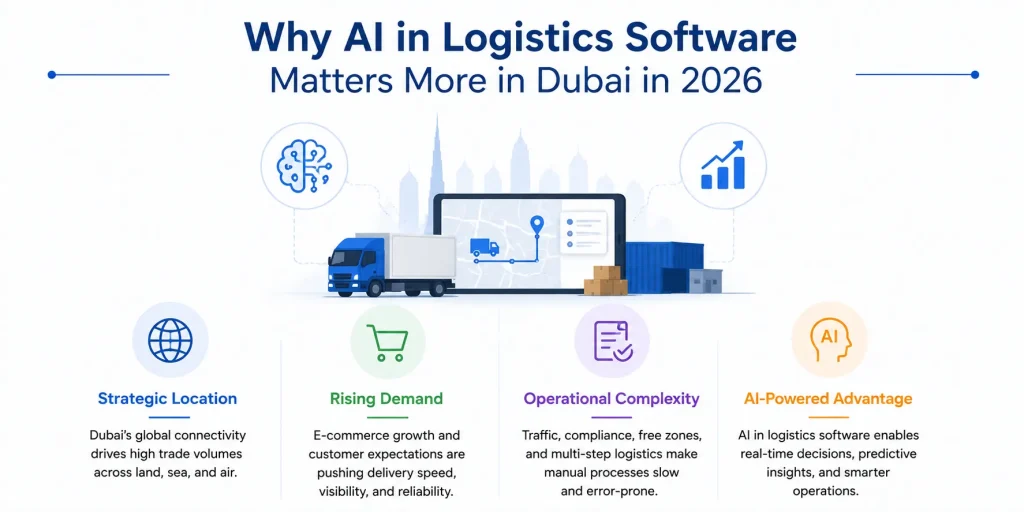
Dubai isn’t a generic logistics market, and generic software struggles here. The city sits at the crossroads of three continents, runs some of the busiest ports and airports in the region, and hosts a free-zone ecosystem that adds its own layer of trade complexity. Add booming e-commerce volumes and drivers navigating unpredictable road conditions, and you get an environment where static, rules-based software simply can’t keep pace. It’s also why so many operators end up working with a specialized Supply Chain Software Development Company in Dubai rather than trying to bolt AI onto off-the-shelf platforms built for other markets.
Dubai’s Logistics Complexity Is Increasing
A few things are converging at once. Urban delivery volumes are climbing faster than road infrastructure can expand. Traffic patterns shift by the hour, not the season. E-commerce has pushed customer expectations toward same-day and next-day delivery as a baseline, not a premium. On top of that, free zones and cross-border shipments bring documentation requirements that don’t exist in most other markets, and port-to-warehouse-to-last-mile connectivity has to stay tight or SLAs start slipping.
From Automation to Prediction and Decision-Making
Older logistics software does four things well: it records, tracks, notifies, and reports. Useful, but passive. AI in logistics software goes further — it predicts delays before they happen, recommends the next best action, flags anomalies a dispatcher would otherwise miss, and in some cases, makes the decision itself. That shift, from reactive record-keeping to active decision support, is the real story behind why UAE logistics operators are investing here in 2026.
None of this means the old systems disappear. Most operators are layering AI in logistics software on top of an existing TMS or WMS rather than ripping and replacing what already works. The AI layer reads the same operational data those systems already collect — it just does something more useful with it.
10 AI Use Cases Reshaping UAE Logistics
1. AI Route Optimization Using Real-Time Dubai Traffic Data
Static GPS routing gives you a path from A to B. AI route optimization for logistics does something different — it keeps recalculating that path as conditions change. Live traffic, road closures, construction zones, delivery time windows, vehicle capacity, driver availability, and even toll costs all feed into the model continuously, not just once at the start of a route.
That matters in Dubai specifically. A route planned at 7 a.m. can be obsolete by 8:30 once Sheikh Zayed Road backs up. AI in logistics software that recalculates in real time, rather than generating a single fixed plan, is what keeps multi-stop delivery operations on schedule when traffic doesn’t cooperate — which, in this city, is most days.
Fleet managers running dozens of vehicles across multiple emirates feel this most. A dispatcher manually re-planning routes every time traffic shifts simply can’t keep up with the volume — the recalculation has to happen automatically, in the background, without someone watching a map all day.
2. AI-Powered Warehouse Management in Dubai
Warehouse teams have been fighting the same battles for years: overstock in one aisle, stockouts in another, pickers walking further than they need to. AI-powered warehouse management Dubai solutions attack this from several angles — intelligent inventory forecasting, dynamic slotting that adjusts based on actual order patterns, pick-path optimization, workforce planning, and automated flags when stock levels look off.
The bigger shift is connection, not just automation. AI in logistics software links warehouse data with transportation and order data, so a slotting decision in the warehouse actually reflects what’s about to ship out that day rather than what shipped last quarter.
3. AI-Powered Customs and Trade Documentation
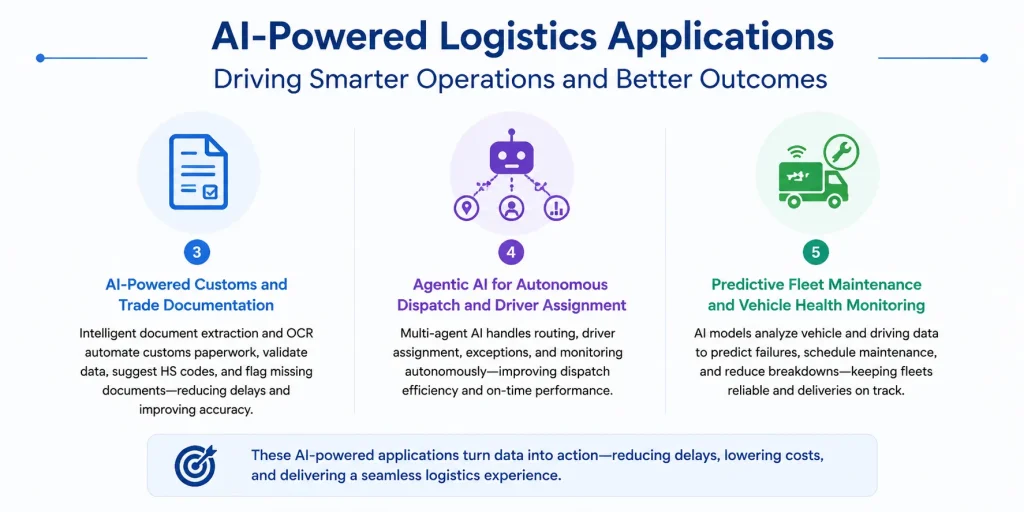
This is one of the strongest UAE-specific opportunities on this list, and it’s underused. Customs paperwork — bills of lading, commercial invoices, packing lists, certificates of origin — still eats hours of manual review at most freight forwarders and import/export businesses.
Intelligent document extraction and OCR can pull structured data from these documents automatically, validate it against expected fields, suggest HS codes, and flag missing paperwork before a shipment gets held up. None of this requires unsupported claims about tapping directly into specific government systems — the value comes from getting documents accurate and complete before they enter any customs workflow. Data security in logistics matters just as much here, since these documents carry commercial and customer data that needs proper access controls the moment it’s digitized. For freight forwarders juggling dozens of shipments a week, this is one of the clearest, most measurable applications of AI in logistics software available today.
4. Agentic AI for Autonomous Dispatch and Driver Assignment
Agentic AI is where the category is heading next, and it’s worth understanding early. Instead of one model doing everything, a multi-agent setup splits the work: a Routing Agent determines the optimal path, an Assignment Agent matches the right driver and vehicle to the job, an Exception Agent handles delays or disruptions as they happen, and a Monitoring Agent tracks SLA performance across the board. Getting a setup like this to actually function reliably comes down to logistics software integration architecture decisions made early — how these agents share data and hand off decisions to each other, not just how smart any single agent is on its own.
This is what moves AI in logistics software from “here’s a recommendation” to semi-autonomous operational decisions. Some UAE logistics vendors have published case studies showing measurable dispatch efficiency gains from this kind of setup — worth noting, though, that vendor-reported numbers and independently verified industry benchmarks aren’t the same thing, and it’s fair to treat early results with some caution until more third-party data exists.
5. Predictive Fleet Maintenance and Vehicle Health Monitoring
A breakdown mid-route doesn’t just cost a repair bill — it costs missed delivery windows, a driver stuck on the road, and a customer who now has a bad story to tell. Predictive maintenance models pull from engine data, mileage, fuel consumption, driving behavior, historical breakdown records, and telematics sensors to flag likely failures before they happen.
The value compounds when this sits inside the same AI in logistics software the fleet already runs on, rather than as a separate analytics dashboard nobody checks. Connected data means maintenance scheduling, fleet utilization, and delivery planning can actually talk to each other.
6. AI for Last-Mile Delivery and Customer Experience
Last-mile is where logistics operations either win or lose a customer. Failed deliveries, tight availability windows, confusing addresses, and unpredictable traffic all collide in this stage — and Dubai’s mix of villa communities, high-rise towers, and free-zone addresses doesn’t make it easier.
Last mile delivery AI Dubai solutions help by predicting realistic delivery windows, sending proactive customer notifications, reallocating drivers dynamically when something changes, and flagging deliveries likely to fail before the driver even leaves the depot. This is also where AI in logistics software earns its keep by connecting the customer-facing side of the business with dispatch and fleet operations, instead of leaving them as two disconnected systems.
7. Arabic-English AI Customer Service and Returns Automation
Anyone running logistics or e-commerce operations in the UAE knows bilingual support isn’t optional — it’s table stakes. AI-driven customer service tools handling shipment tracking questions, delivery status updates, return requests, refund queries, address changes, and complaint routing in both Arabic and English can absorb a huge share of repetitive inbound volume.
Done well, this doesn’t replace human agents — it filters the routine questions out so agents spend their time on the complex cases that actually need a person. That kind of conversational layer, wired into the broader AI in logistics software stack, is becoming a baseline expectation rather than a nice-to-have for UAE-facing platforms.
8. Predictive Demand Forecasting and Inventory Optimization
Guessing demand is expensive in both directions — overstock ties up warehouse space and capital, understock means missed sales and rushed replenishment. AI models trained on historical order data, seasonal patterns, promotions, customer behavior, and geographic demand signals can forecast with far more precision than spreadsheet-based planning ever managed.
The real payoff shows up when forecasting connects to the physical side of operations — inventory positioning, warehouse capacity planning, vehicle scheduling, and procurement timing. That’s the bridge AI in logistics software builds between a demand signal and what actually happens on the warehouse floor.
Ramadan, back-to-school season, and the year-end retail rush all move UAE demand in patterns a static spreadsheet won’t catch early enough. A model trained on several cycles of local seasonal data picks up on these shifts weeks before a manual planner would notice them.
9. AI-Powered Exception Management and Shipment Visibility
Basic tracking tells you where a shipment is right now. It doesn’t tell you it’s about to miss its window. AI-driven exception management goes further, catching delayed shipments, unusual transit times, route deviations, missed delivery windows, and warehouse bottlenecks before they turn into a customer complaint.
Call it predictive shipment visibility — spotting the problem before the customer or the ops team does. What separates useful AI in logistics software from a wall of alerts nobody reads is prioritization: surfacing exceptions by business impact instead of flagging every minor deviation with equal urgency.
10. AI for Logistics Sustainability and Carbon Optimization
Sustainability in logistics used to mean a report generated once a year for compliance. That’s changing. Route efficiency, fuel consumption, vehicle utilization, empty-mile reduction, and load optimization can all be measured continuously rather than estimated after the fact.
As the UAE pushes further on its sustainability agenda, logistics operators are under growing pressure to show real numbers, not good intentions. Folding carbon and efficiency analytics directly into AI in logistics software turns sustainability into something measurable day to day, instead of a separate reporting exercise bolted on at year-end. A fleet that cuts empty miles by even a small percentage sees the fuel savings and the emissions drop reflected in the same dashboard, not in two separate reports nobody cross-checks.
Where the Biggest AI Opportunities Are in UAE Logistics
The SME AI Adoption Gap
Large enterprise logistics players in the UAE have started adopting AI at pace. Mid-market and SME operators, on the other hand, are mostly stuck — not because the technology doesn’t apply to them, but because of implementation cost, thin AI talent pools, messy underlying data, legacy systems, and software that doesn’t talk to anything else. Understanding how to build logistics software in Dubai that fits a smaller budget usually starts with rejecting the idea of a full transformation program on day one. The opportunity here isn’t an expensive, all-at-once overhaul — it’s modular AI in logistics software that a smaller operator can adopt one workflow at a time.
Vertical-Specific Logistics AI Is Still Underdeveloped
Generic AI tools miss the constraints that matter in specific verticals. Pharma cold chain has temperature and compliance requirements a general-purpose model won’t understand out of the box. Food and perishables logistics runs on tight shelf-life windows. Oil and gas logistics deals with hazardous materials handling. Cross-border e-commerce and freight forwarding each carry their own documentation and timing rules. Specialized AI in logistics software, built with these constraints baked in, outperforms off-the-shelf tools precisely because it accounts for what actually matters in that vertical.
Government and Trade-System Integration
The bigger opportunity isn’t another chatbot bolted onto an existing platform — it’s connecting intelligent systems to the workflows companies already rely on for customs, trade documentation, free-zone operations, and import/export processing. How data flows between TMS, WMS, customs systems, and fleet platforms determines whether AI in logistics software actually works in production or just looks good in a demo.
What Does It Take to Implement AI in Logistics Software Successfully?
Step 1 — Assess Data Readiness
Before evaluating any AI vendor, look honestly at what data actually exists and how clean it is: fleet telematics, order history, warehouse records, customer data, GPS feeds, and whatever’s sitting in the current TMS or WMS. Most failed AI pilots trace back to this step being skipped, not to the model itself.
Step 2 — Start With One High-Value Workflow
Trying to automate everything at once is how projects stall. Teams that get this right tend to start with one measurable problem — route optimization, customs documentation, predictive maintenance, or warehouse forecasting — prove it works, then expand from there.
Step 3 — Build a Controlled AI Pilot
A pilot needs defined scope, clear KPIs, human oversight at every decision point, and realistic integration requirements — shipment data, customer information, and fleet telematics all carry exposure risk if access controls and encryption aren’t built in from the start rather than added later.
Step 4 — Measure ROI Before Scaling
Track fuel consumption, delivery time, fleet utilization, manual processing hours, documentation error rates, warehouse productivity, and SLA compliance before committing to a wider rollout. A clear logistics software development roadmap at this stage — phased, with checkpoints tied to actual numbers — keeps scaling decisions grounded in results instead of momentum. Success with AI in logistics software should be judged by what changed operationally, not by whether a model got deployed somewhere in the stack.
AI in UAE Logistics: What Should Companies Do Next?
Trying to run all ten of these use cases at once is the fastest way to stall a project before it delivers anything. A better approach: prioritize based on where the pain is worst, what data you already have, how complex the integration will be, and what kind of return you can realistically expect.
Smaller operators tend to do best starting with one modular capability and proving it out. Larger enterprises have the scale to build toward an integrated AI layer that spans TMS, WMS, fleet, and customer systems over time. Either way, the technology works best when it’s treated as an operational capability woven into daily decisions — not a trend to chase for its own sake.
Final Thoughts
Dubai’s logistics operators don’t have the luxury of standing still — traffic, trade volume, and customer expectations are all moving faster than manual systems can handle. AI in logistics software isn’t a future bet anymore; it’s already running routes, catching customs errors, and predicting breakdowns for operators who got in early.
The mistake most companies make isn’t hesitation — it’s trying to do everything at once. The ones seeing real returns picked one workflow, proved it worked, and built from there. Whether that’s route optimization, warehouse forecasting, or customs automation depends on where the pain is worst in your operation right now.
Ten use cases, one common thread: the winners in 2026 won’t be the companies with the most AI features. They’ll be the ones who used AI in logistics software to fix the specific bottleneck that’s actually costing them money.
Frequently Asked Questions
What is AI in logistics software?
It’s software built for transportation, warehousing, fleet, and supply chain operations that goes beyond tracking and reporting — using machine learning to predict delays, recommend actions, detect anomalies, and in some cases act on decisions automatically.
What are the most important AI use cases in UAE logistics?
Route optimization, warehouse intelligence, customs automation, predictive fleet maintenance, and last-mile delivery consistently deliver the clearest, fastest-to-measure returns for UAE operators.
How can AI improve logistics operations in Dubai?
By adapting to real-time traffic conditions, optimizing delivery sequencing, improving warehouse throughput, extending fleet uptime, and giving customers more accurate delivery expectations.
Is AI suitable for small and mid-sized logistics companies in the UAE?
Yes — the key is starting modular. Cloud-based deployment and a single high-value workflow, rather than a full-stack transformation, make AI accessible to SMEs without enterprise-level budgets.
How much does AI logistics software development cost in the UAE?
There’s no single honest number here — cost depends on the complexity of the AI models, how many systems need integration, existing data infrastructure, interface requirements, security controls, and whether deployment is cloud, on-premise, or hybrid. Any vendor quoting a flat figure before understanding your setup is guessing.
Does AI in logistics software replace human dispatchers and planners?
No — even in agentic setups, human oversight stays in the loop for exceptions, edge cases, and decisions with real financial or safety consequences. The goal is fewer repetitive tasks for the team, not fewer people watching the operation.