


Key Takeaways
- Businesses should build real-time shipment visibility platform capabilities instead of relying on static tracking pages or disconnected carrier portals.
- Multi-carrier, cross-border, and mixed sea/road/air operations make it necessary to build real-time shipment visibility platform infrastructure at scale.
- A real platform needs 5 core layers: unified data model → full source integration → API-first connectivity → real-time event streaming → customer-facing tracking.
- Predictive intelligence (AI-based ETAs, exception flagging, delay prediction) is what separates a true visibility platform from basic tracking.
- UAE-specific needs matter when you build real-time shipment visibility platform solutions: data localization, Dubai Customs/free-zone integration, GCC cross-border handling, WhatsApp-first communication.
- Rollout works best in phases — assess, integrate top carriers, add prediction, scale, then measure ROI (OTIF, WISMO calls, delivery success, carrier performance).
- Companies that build real-time shipment visibility platform systems see fewer WISMO calls, higher OTIF, lower ops cost, and stronger customer trust.
Ten years ago, a tracking page that updated once a day counted as good service. Now a customer expects to watch their shipment move almost as it happens — and if the number on the screen doesn’t match reality, they call before you even know something’s wrong.
That shift in expectations is one reason so many logistics companies in the UAE are working to build a real-time shipment visibility platform instead of patching together carrier portals and spreadsheets. Add in the freight disruptions around the Red Sea and the Strait of Hormuz, and cargo that used to move predictably now needs constant re-routing, re-planning, and re-communicating.
Static tracking pages can’t keep up with that pace. Businesses still relying on disconnected carrier logins are the ones fielding the most “where is my order” calls, missing OTIF targets, and losing customer trust one late delivery at a time.
This guide walks through what it actually takes to build a real-time shipment visibility platform — the data model, the integrations, the predictive layer, and the UAE-specific details that separate a real tracking page from a genuine visibility platform.
Why Real-Time Shipment Visibility Has Become a Business Requirement Instead of a Competitive Advantage
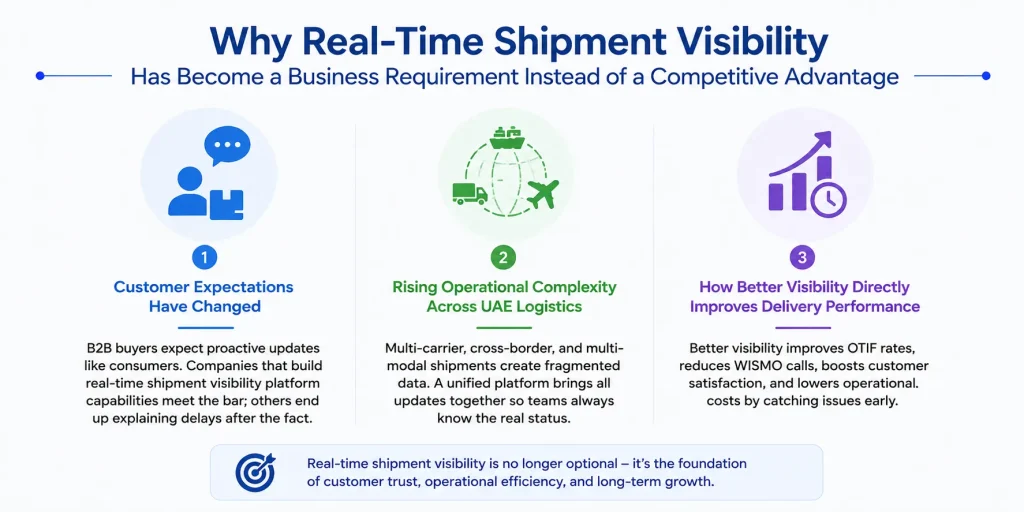
Customer Expectations Have Changed
B2B buyers now expect the same proactive updates they get as consumers ordering a phone case. A procurement manager waiting on machine parts wants a push notification the moment a shipment clears customs, not a phone call three days later explaining a delay. Retail customers are even less patient — a missed delivery window is often enough to lose the next order entirely. Companies that build real-time shipment visibility platform capabilities are the ones meeting that bar; the ones that don’t are stuck explaining themselves after the fact.
Rising Operational Complexity Across UAE Logistics
Teams that build a real-time shipment visibility platform early tend to handle this shift far more comfortably than teams still catching up. Most UAE logistics operations aren’t running one carrier on one lane anymore — a single shipment might touch a local trucking partner, a regional GCC carrier, a sea freight forwarder, and an air cargo operator for the last stretch. Multi-carrier operations, cross-border GCC movement, and mixed sea, road, and air legs all generate data in their own formats, on their own timelines. Without a system pulling that together, no one in the operation actually knows where a shipment stands at 2 p.m. on a Tuesday.
How Better Visibility Directly Improves Delivery Performance
This isn’t just an IT upgrade — it shows up on the P&L. Companies that improve delivery performance with shipment tracking typically see measurable gains in on-time-in-full (OTIF) rates within the first two quarters. WISMO (“where is my order”) calls drop, sometimes by more than half, once customers can self-serve accurate status. Customer satisfaction scores climb because problems get flagged before the customer notices them. And operational costs fall, because dispatchers stop spending their mornings chasing carriers for updates that a platform should have surfaced automatically.
Common Visibility Challenges That Modern Logistics Platforms Still Fail to Solve
Multiple Carrier Portals Create Data Silos
Most operations teams still log into four, five, sometimes eight different carrier websites to piece together a single shipment’s status. Each portal has its own login, its own data format, its own refresh rate. None of them talk to each other. This is precisely the problem that pushes companies to build a real-time shipment visibility platform in the first place — one shipment record instead of eight browser tabs.
The Last-Mile Visibility Gap
Visibility often falls apart in the final few kilometers, right when the customer cares most. A shipment can look perfectly tracked through customs and the main-haul leg, then go dark the moment it’s handed to a last-mile courier. That gap is where most delivery complaints originate, and it’s exactly what a real-time transportation visibility platform is built to close.
Reactive Tracking Instead of Predictive Operations
Traditional tracking tells you what already happened. A shipment is “in transit” or it’s “delayed” — after the delay has occurred. Real visibility means knowing a delay is coming before it shows up on a status page, giving dispatch time to act instead of react.
Compliance and Data Localization Challenges in the UAE
UAE businesses also have to work within data residency rules, Dubai Customs integration requirements, and free-zone-specific reporting. A platform that stores shipment data in the wrong region, or can’t produce the audit trail a free zone requires, creates compliance risk on top of the operational one. Any serious plan to build real-time shipment visibility platform infrastructure in this market has to design for these constraints from day one, not retrofit them later.
How to Build Real-Time Shipment Visibility Platform: The Complete Architecture
This is the part most guides skip. Here’s the actual architecture behind a platform that works.
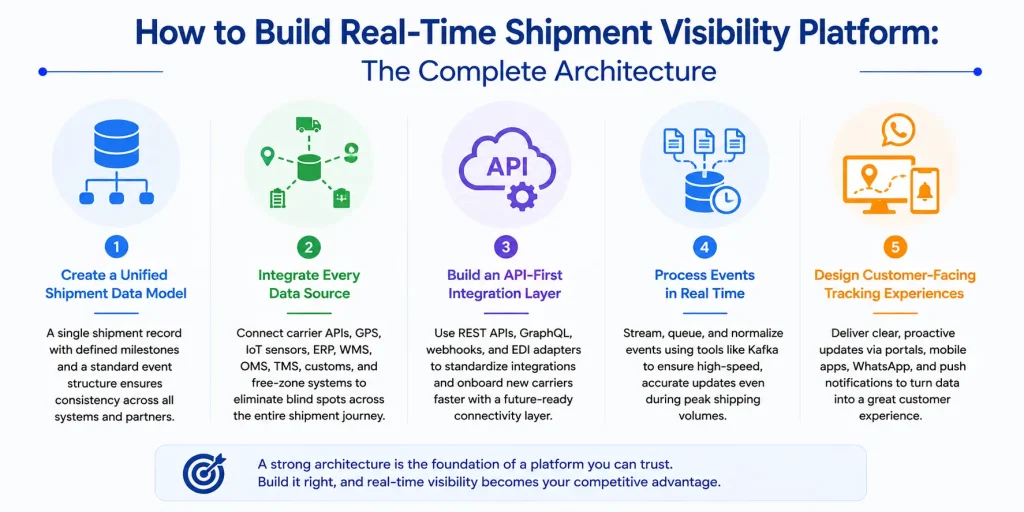
Step 1 — Create a Unified Shipment Data Model
Everything starts with one thing: a single shipment record that every system feeds into and reads from. That record needs a clear milestone structure (booked, picked up, in transit, customs cleared, out for delivery, delivered, exception) and a canonical event structure so a “delay” from one carrier’s API means the same thing as a “delay” from another’s. Without this step, you can build real-time shipment visibility platform features on top of messy data and still end up with a tracking page that lies to customers half the time.
Step 2 — Integrate Every Data Source
A real visibility platform pulls from everywhere shipment data lives: carrier APIs, GPS devices, IoT sensors on temperature-sensitive cargo, the ERP, the WMS, the OMS, the TMS, customs systems, and free-zone platforms. Skipping even one of these creates a blind spot — usually the exact leg where something goes wrong. This is the point where companies genuinely start to build a real-time shipment visibility platform rather than just a status page with a nicer UI.
Step 3 — Build an API-First Integration Layer
Standardize how every source talks to the platform. REST APIs handle most modern carrier integrations; GraphQL suits a customer-facing app querying several data types in one call. Webhooks push updates the moment they happen instead of forcing the platform to poll on a schedule. Legacy partners still running on EDI need adapter services translating their formats into your unified data model. This API-first layer is what makes it possible to add a new carrier in weeks instead of months — a core part of any modern logistics platform features roadmap.
Step 4 — Process Events in Real Time
Once the data is flowing in, it needs to move through the system fast enough to matter. Event streaming tools like Kafka handle the volume and speed logistics data demands — thousands of GPS pings, scan events, and status updates per minute across an active fleet. Queue processing keeps things from backing up during peak periods, and event normalization makes sure a “customs hold” event looks the same whether it came from a UAE broker or a partner in Riyadh. Skip this layer and you’ll build a real-time shipment visibility platform that’s only real-time in name — updates will lag by hours during exactly the periods customers care about most.
Step 5 — Design Customer-Facing Tracking Experiences
All that backend work is wasted if customers can’t see it clearly. A customer portal with live status, a mobile app for repeat B2B clients, WhatsApp updates, and proactive push notifications turn accurate backend data into something customers actually feel. In the UAE specifically, WhatsApp integration tends to outperform email for delivery updates by a wide margin — one more reason the customer-facing layer deserves as much attention as the backend when you build a real-time shipment visibility platform.
Building Predictive Intelligence Instead of Basic Shipment Tracking
A platform that only shows what already happened is still playing catch-up. The next step is prediction.
AI-Based ETA Prediction
Static ETAs — pickup date plus a fixed transit time — ignore weather, port congestion, customs backlogs, and traffic. Predictive ETA for logistics platforms use historical transit data, live traffic and weather feeds, and current shipment conditions to recalculate arrival windows continuously, not once at booking. This is one of the clearest examples of AI in logistics software actually changing an operational number customers see and trust.
This is usually the moment a basic tracker starts to feel outdated — proof that the effort to build a real-time shipment visibility platform pays off well beyond the tracking page itself.
Exception Management
Instead of surfacing every single scan event, a well-built system flags only what needs a human decision: a shipment sitting at customs longer than its historical average, a truck that’s stopped moving on a route with no scheduled break, a temperature reading drifting outside range on a cold-chain shipment.
Delay Prediction Before Customers Notice
The best platforms flag a probable delay while there’s still time to act — rebooking a connecting leg, notifying the customer with a revised window, or expediting a replacement shipment — rather than after the delivery window has already passed.
Recommended Actions Instead of Static Alerts
An alert that just says “delayed” isn’t much help to a dispatcher juggling forty active shipments. Predictive analytics in logistics can go further, suggesting the next best action: reroute through an alternate port, switch carriers on the final leg, or proactively message the customer. Companies that build a real-time shipment visibility platform with this layer included stop treating exceptions as fires to put out and start treating them as decisions to make early.
UAE-Specific Considerations When You Build Real-Time Shipment Visibility Platform Capabilities
UAE Data Localization
Certain shipment and customer data needs to stay within regional data residency boundaries depending on the sector and free zone involved. Cloud architecture decisions — which region hosts what, how data replicates — have to be made with this in mind from the start, not bolted on after a compliance review flags a problem.
Dubai Customs and Free Zones
Direct integration with Dubai Customs systems and free-zone platforms like Jafza or DAFZA turns customs clearance from a mystery into a visible milestone — exactly the kind of detail that separates a generic tracker from a real-time shipment visibility platform built properly for this market. Customers waiting on cross-border shipments care about this step more than almost any other, since it’s historically the least visible part of the journey.
GCC Cross-Border Visibility
Shipments moving between the UAE, Saudi Arabia, and other GCC states cross multiple customs regimes and carrier networks in a single trip. A platform built for real-time visibility for last-mile delivery UAE operations also needs to handle the cross-border legs cleanly, or visibility falls apart the moment a shipment leaves UAE territory.
WhatsApp-First Customer Communication
In this market, WhatsApp is often the primary channel customers check first — ahead of email and sometimes ahead of SMS. Any enterprise logistics software dubai guide worth following will treat WhatsApp integration as a core requirement, not an add-on feature, when the goal is to build a real-time shipment visibility platform people actually use.
Technology Stack Required to Build a Real-Time Shipment Visibility Platform
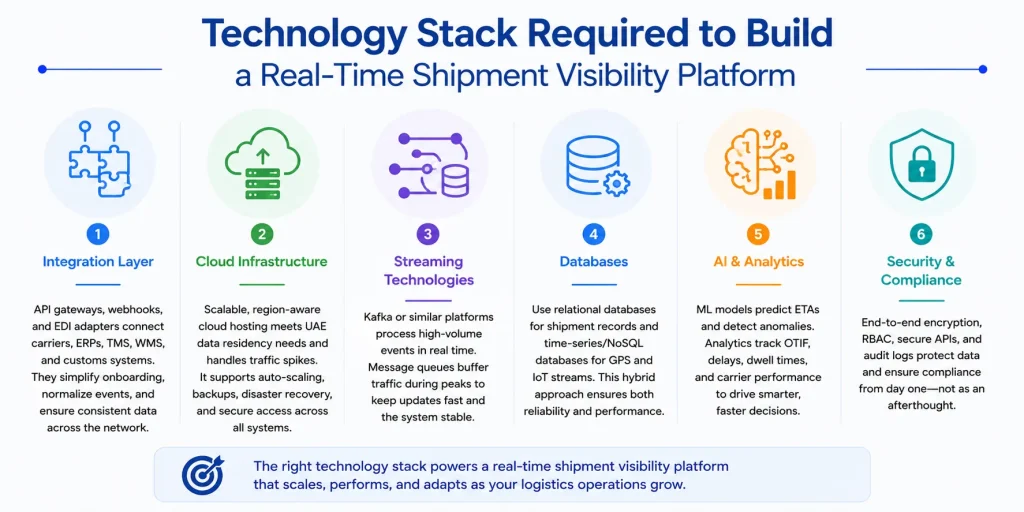
Integration Layer
API gateways, webhook management, and EDI adapters that connect carriers, ERPs, TMS, WMS, and customs systems without requiring custom code for every new partner. A well-designed integration layer also makes it easier to onboard new carriers, normalize shipment events, and maintain consistent data across the platform as the logistics network grows.
Cloud Infrastructure
Scalable, region-aware cloud hosting that can handle traffic spikes during peak shipping seasons and satisfy UAE data residency requirements. This is where a cloud-based logistics software UAE strategy pays off — providing elastic capacity without the cost of maintaining physical servers for peak load year-round. The infrastructure should also support automated scaling, reliable backups, disaster recovery, and secure data access across logistics teams and connected systems.
Streaming Technologies
Kafka or similar event-streaming platforms, plus a message queue for buffering during high-volume periods. This allows the platform to process carrier updates, GPS signals, IoT readings, and delivery events continuously without overwhelming core application services. A resilient streaming layer is especially important when shipment volumes increase suddenly or multiple data sources send updates simultaneously.
Databases
A mix of relational databases for structured shipment records and time-series or NoSQL databases for high-volume GPS and IoT event streams — one database rarely handles both well. This approach keeps transactional shipment information reliable while allowing the platform to store and query large volumes of location, temperature, and sensor data efficiently.
AI & Analytics
Machine learning models for ETA prediction and anomaly detection, along with an analytics layer for tracking KPIs like OTIF, delay rates, dwell times, and carrier performance over time. This is where real-time logistics visibility architecture and predictive intelligence start to overlap. Instead of simply showing where a shipment is, the system can identify potential delays and help operations teams decide what action to take next.
Security & Compliance
End-to-end encryption, role-based access control, secure API authentication, and audit logging — not optional extras, given how much customer, shipment, and customs data flows through a platform like this. Security controls should be built into the architecture from the beginning rather than added after the platform is already handling sensitive logistics information.
Get these six layers right and you have a real-time shipment visibility platform that holds up under real shipment volume, not just a demo. More importantly, the architecture gives logistics companies the flexibility to add carriers, data sources, routes, and predictive capabilities as their operations scale.
A Practical Implementation Roadmap for Logistics Companies
Phase 1 — Assess Existing Systems
Map every current data source, every carrier integration, and every manual workaround the team relies on today. You can’t build a real-time shipment visibility platform on top of systems nobody has fully documented.
Phase 2 — Integrate High-Priority Carriers
Start with the carriers moving the highest shipment volume, not every carrier at once. A phased integration proves the model works before scaling it across the full network.
Phase 3 — Launch Predictive Visibility
Once live tracking is stable, layer in ETA prediction and exception management. This is usually where companies working with a Custom Logistics Software Development in Dubai partner see the fastest jump in customer satisfaction scores.
Phase 4 — Scale Across Warehouses and Corridors
Extend the platform to every warehouse, every trade corridor, and every carrier relationship, rather than leaving the rollout half-finished across regions. This is the phase where companies that build a real-time shipment visibility platform in stages start to see it function as one connected system instead of a collection of pilots.
Phase 5 — Measure ROI and Optimize
Track OTIF, delay rate, WISMO call volume, delivery success rate, carrier performance scores, and customer satisfaction on an ongoing basis. A platform built to improve delivery performance with shipment tracking should show measurable movement on every one of these numbers within two to three quarters — if it doesn’t, something in the earlier phases needs revisiting.
Best Practices to Improve Delivery Performance with Shipment Tracking
Focus on Exceptions Instead of Monitoring Everything
Dispatchers can’t watch a thousand shipments manually. Any team that set out to build a real-time shipment visibility platform for scale, not just for a demo, needs it to surface the twenty shipments that need attention, not the thousand that don’t. Exception-based monitoring helps teams prioritize delayed, high-risk, temperature-sensitive, or stalled shipments before they turn into larger delivery problems.
Automate Customer Notifications
Every milestone — pickup, customs clearance, in transit, out for delivery, and delivery confirmation — should trigger an automatic update. Manual status updates don’t scale past a handful of shipments a day and often create unnecessary communication gaps. Automated notifications through email, SMS, WhatsApp, or customer portals keep customers informed while reducing repetitive work for logistics teams.
Continuously Improve ETA Accuracy
Feed actual delivery outcomes back into the prediction model regularly. An ETA engine that never learns from its own misses will stay inaccurate indefinitely. Compare predicted and actual arrival times, identify recurring sources of deviation, and continuously refine the model using factors such as carrier performance, route conditions, congestion, weather, and historical transit patterns.
Use Analytics to Improve Carrier Performance
Track on-time rates, damage rates, dwell times, failed deliveries, and communication reliability by carrier, and use that data during contract renewals and performance reviews. Companies that build a real-time shipment visibility platform gain leverage in these conversations that they simply didn’t have with fragmented, portal-based tracking. Over time, this data can also help logistics teams identify underperforming lanes, improve carrier allocation, and make more informed operational decisions.
Conclusion
Fragmented carrier portals and static tracking pages were never built for how logistics works today — multi-carrier, cross-border, and increasingly disrupted by events outside anyone’s control. Businesses that build a real-time shipment visibility platform stop reacting to problems after customers report them and start catching those problems first.
The payoff shows up in ways that are easy to measure: fewer WISMO calls, better OTIF rates, faster decision-making during disruptions, and lower operational cost per shipment. Customers notice the difference too — a business that tells them about a delay before they have to ask earns a different kind of trust than one that doesn’t.
If your current tracking setup still means logging into five carrier portals to answer one customer question, that’s the clearest sign it’s time to build a real-time shipment visibility platform of your own — scalable, API-first, and designed around how your shipments actually move. Get in touch to talk through what that would look like for your operation.
FAQs
What is a real-time shipment visibility platform?
It’s a system that unifies data from carriers, GPS, IoT, and ERPs into one live shipment record, giving businesses and customers accurate, continuously updated status instead of static tracking pages.
How does real-time visibility improve delivery performance?
It improves OTIF rates, cuts WISMO calls, catches delays before customers notice, and lowers operational costs by removing manual carrier-portal checking and reactive firefighting from daily operations.
What technology is needed to build one?
API integrations, event-streaming tools like Kafka, a unified shipment data model, cloud infrastructure, AI-based ETA prediction, and a customer-facing layer covering web, mobile, and WhatsApp notifications.
What UAE-specific factors matter most?
Data localization rules, Dubai Customs and free-zone integration, GCC cross-border visibility across multiple customs regimes, and WhatsApp-first customer communication, which outperforms email in this market.
How long does implementation typically take?
Most companies roll out in phases: assess systems, integrate top carriers, layer in predictive visibility, then scale — with measurable OTIF and WISMO improvements visible within two to three quarters.