


Key Takeaways
- UAE logistics firms don’t need new software — they need a logistics software integration architecture connecting what they already have.
- Disconnected ERP, CRM, and GPS systems cause manual re-entry, delayed updates, and poor customer visibility.
- A solid logistics software integration architecture runs on four layers: Experience, Business Logic, Integration/Event, and Data/Analytics.
- APIs and event-driven tools (like Kafka) replace slow manual syncing with real-time data exchange between systems.
- GPS, TMS, and WMS data only becomes useful intelligence — predictive ETAs, route optimization, inventory accuracy — once properly integrated.
- UAE-specific factors (PDPL compliance, free zone vs. mainland rules, port connectivity) mean generic platforms rarely fit without rework.
- The payoff: better delivery performance, lower costs, stronger customer experience, and infrastructure that scales without a rebuild.
Most UAE logistics companies don’t have a software problem. They have a disconnection problem.
Walk into almost any freight forwarder or 3PL in Dubai and you’ll find an ERP running finance, a CRM tracking customer accounts, and a GPS platform watching the fleet — three capable tools that never actually talk to each other. Dispatch hears about a delay from a driver’s phone call, not the system. Finance re-enters shipment data that already exists somewhere else. Customer service promises an ETA nobody can confirm.
The fix isn’t another app. It’s logistics software integration architecture — the structural layer that connects ERP, CRM, GPS, TMS, and WMS platforms so they behave like one system instead of five.
This matters more in Dubai than almost anywhere else. Jebel Ali Port alone moves over 15 million TEUs a year, e-commerce volumes keep climbing, and customers now expect Amazon-level delivery visibility from B2B freight partners too. Companies that still run on spreadsheets and phone calls between departments simply can’t keep pace with that volume or that expectation.
In this guide, we’ll break down how ERP, CRM, GPS, TMS, and WMS systems actually connect, which architecture patterns hold up in production, and what a well-designed logistics software integration architecture makes possible for UAE supply chains — from real-time visibility to genuine automation.
Why Logistics Companies in UAE Need Integrated Software Architecture
Disconnected systems don’t just cause minor friction — they quietly cap how big and how efficient a logistics business can get.
In a typical unintegrated setup, someone keys the same order into the ERP, then again into the CRM, then again into a tracking spreadsheet — three chances to introduce an error. Shipment updates arrive late because GPS data sits in a dashboard nobody checks hourly. A customer calls asking “where’s my container?” and the service rep has to ping three teams to find out. Fleet managers plan routes on yesterday’s data because there’s no live feed from the vehicles. Forecasting runs on incomplete numbers, because sales data in the CRM never reaches the demand-planning module in the ERP.
None of these are software failures. They’re integration failures — and they compound. A five-minute manual re-entry task, done fifty times a day across a fleet of 200 vehicles, adds up to real payroll cost and real customer frustration.
This is exactly the gap that logistics software integration architecture closes. Instead of treating ERP, CRM, and GPS as three separate purchases, it treats them as components of one connected digital supply chain, where data created in one system becomes instantly usable in the others. Businesses looking at how to reduce logistics bottlenecks usually find the fix isn’t hiring more staff — it’s building the logistics software integration architecture that removes manual handoffs between systems that shouldn’t exist in the first place.
Moving From Separate Systems to Connected Logistics Operations
Traditionally, the ERP runs financials and inventory in isolation. The CRM holds customer history that operations rarely sees. GPS tracks where a truck is, but with zero context about what’s on it, who it’s for, or whether it’s running late against an SLA.
A connected model flips that. Systems exchange information in real time. A shipment delay detected by GPS can automatically trigger a CRM notification to the customer and an exception flag in the ERP — no human has to notice, remember, and manually update three tools. Every team, from dispatch to finance to customer service, works off a single source of truth instead of three partial ones.
That shift — from isolated tools to an orchestrated system — is what integration architecture for logistics software is built to deliver. It’s the difference between owning three tools and running one supply chain, and it’s the starting point for any real logistics software integration architecture.
Understanding Logistics Software Integration Architecture
Here’s a straightforward definition: logistics software integration architecture is the technical framework that connects logistics applications, databases, APIs, and operational systems so they can exchange data automatically, in real time, without manual intervention.
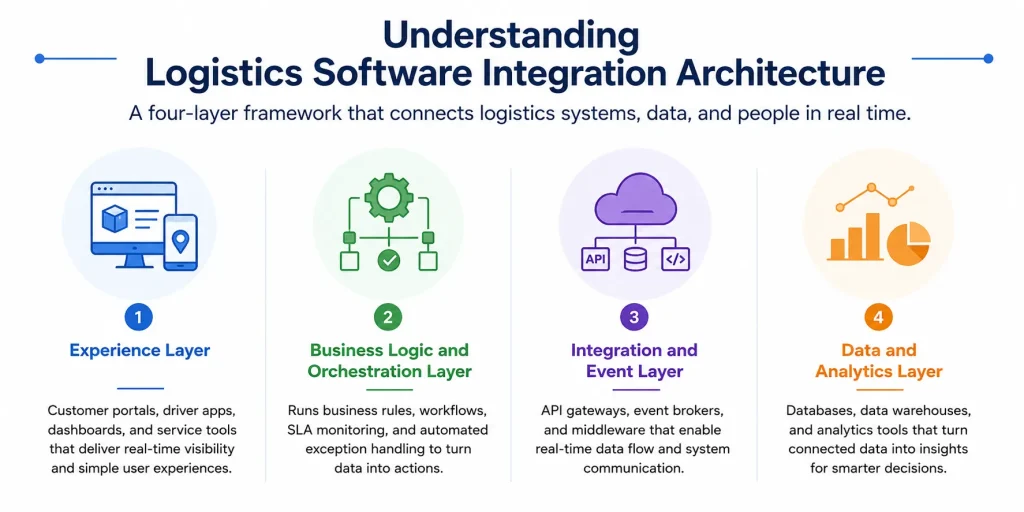
It’s easiest to think about as four layers of logistics software integration architecture, each doing a distinct job.
Experience Layer
This is what people actually touch — customer portals showing live shipment status, driver mobile apps for proof-of-delivery, dispatch dashboards, and service-desk tools for handling exceptions. When the layers underneath are properly integrated, this layer feels boringly simple: a customer opens a tracking link and sees accurate information pulled straight from GPS and TMS data, not an update someone typed an hour ago.
Business Logic and Orchestration Layer
This layer of the logistics software integration architecture runs the business rules: order processing workflows, shipment lifecycle stages, SLA monitoring, and automated exception handling. A rule like “if a shipment is more than 30 minutes behind schedule, alert the account manager and notify the customer” lives and executes here, instead of depending on someone noticing a delay on a screen.
Integration and Event Layer
This is the connective tissue — API gateways, event brokers, and middleware that move data between systems the instant something happens. A growing number of UAE logistics operators use Kafka-based event streaming here, because batch syncing every few hours isn’t fast enough when a customer expects a delay notification within minutes. Shipment status changes, delivery delays, cold-chain temperature alerts, and route deviations all flow through this layer to whichever system needs to react.
Data and Analytics Layer
At the base sit the operational databases, data warehouses, and analytics tools that turn raw transactional data into something decision-makers can act on. Control tower dashboards, demand forecasting models, and AI-driven route or capacity planning all depend on this layer having clean, connected data flowing in from everywhere above it. Companies running on cloud-based logistics software tend to get this layer right almost by default, since cloud platforms are built for exactly this kind of continuous data flow between systems, rather than the periodic exports and imports that on-premise legacy setups rely on.
Connecting ERP, CRM, and GPS Systems in UAE Logistics Operations
The theory is straightforward. The execution is where most projects stall — ERP, CRM, and GPS platforms were never designed with each other in mind, and getting them to cooperate takes deliberate logistics software integration architecture, not a plug-and-play connector.
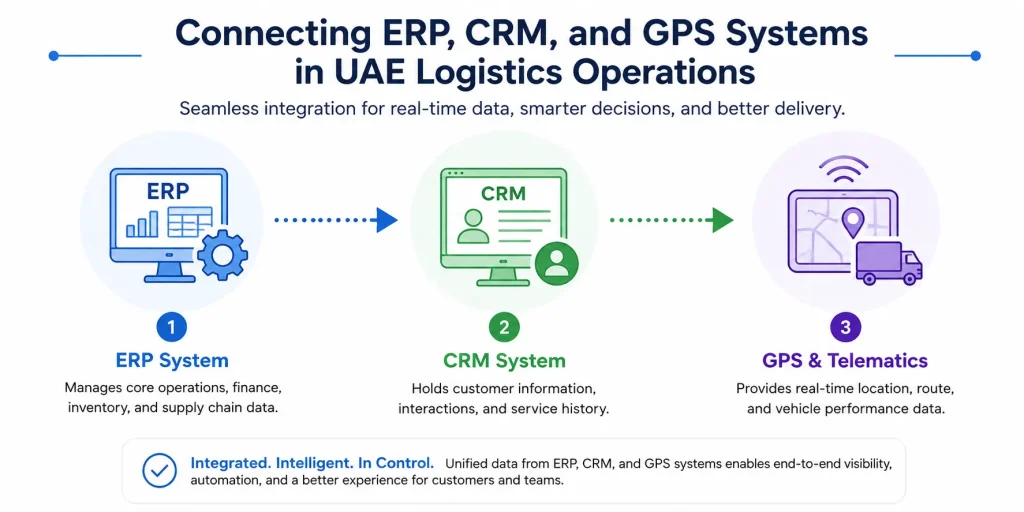
ERP Integration for Logistics Operations
Whether a company runs SAP, Oracle, or Microsoft Dynamics, the ERP is usually the financial and operational backbone. Getting it integrated means data has to flow both directions.
From the ERP outward: customer orders, inventory levels, pricing, and financial terms need to reach the logistics platform. From the logistics system back into the ERP: shipment costs, proof-of-delivery confirmations, freight invoices, and job costing need to land automatically, instead of being re-keyed by an accounts team at month-end.
This is where ERP CRM GPS integration logistics Dubai projects succeed or fail based on the connection method chosen. API-based connections are the modern default, giving near-real-time sync. Webhooks push updates the instant something changes, rather than waiting for a scheduled poll. Change Data Capture (CDC) tracks database-level changes for high-volume environments, and EDI still matters for companies working with large retail or government partners who require it contractually. Getting this combination right is a core part of any serious Custom Logistics Software Development in Dubai engagement, since off-the-shelf connectors rarely handle UAE-specific ERP configurations out of the box.
CRM Integration for Better Customer Experience
The CRM holds the relationship — customer contacts, service requests, account history, and every prior communication. Cut off from operational data, service reps are negotiating blind. Integrated, shipment status flows straight into the customer’s record, notifications go out automatically, and account managers see the full delivery picture without opening four tools.
Logistics system integration ERP CRM GPS done well means a customer service rep can answer “where’s my shipment and why is it delayed” in one screen, sourced live from GPS and TMS data, not from asking someone in dispatch to check and call back.
GPS and Telematics Integration for Real-Time Visibility
GPS and telematics feed in from fleet tracking devices, IoT sensors, and onboard vehicle systems — location, route performance, driver behavior, fuel consumption, and, for cold-chain operators, cargo temperature. Alone, these are just data points on a map. Integrated with the ERP and TMS, they become operational intelligence: predictive ETAs based on actual route history rather than static transit times, dynamic route optimization, and continuous cold-chain monitoring with automatic alerts.
This is also where predictive analytics in logistics earns its keep. Feeding historical GPS and delivery data into forecasting models lets a business anticipate which routes are likely to run late before they do, rather than reacting after a customer complaint.
Role of APIs in Modern Logistics Integration Architecture
APIs are the backbone of any working logistics software integration architecture. Without them, “integration” usually means manual exports, CSV files, and someone copying numbers between spreadsheets — slow, error-prone, and impossible to scale.
API Integration for Logistics Systems Dubai
Well-designed APIs give logistics platforms real-time communication, secure data exchange, faster implementation, and room to scale without a rebuild every time a new system gets added. In practice: the ERP’s API pushes a new order the moment it’s confirmed, the GPS platform’s API streams live vehicle location, and the CRM’s API pulls that data into the customer’s record automatically — no manual step anywhere in the chain.
For UAE operators specifically, API integration for logistics systems Dubai increasingly means building around REST and event-driven APIs rather than older point-to-point integrations, since point-to-point connections get exponentially harder to maintain as more systems join the stack. Add a sixth system to a point-to-point setup and you’re not adding one connection — you’re adding five new ones.
Event-Driven Architecture: The Future of UAE Logistics Integration
Traditional integrations rely on batch updates — data syncs every hour, every few hours, or overnight. That was tolerable when customers accepted next-day status updates. It isn’t anymore.
Event-driven architecture flips the model: instead of systems checking in periodically, they react instantly to things that actually happen. A shipment gets delayed, the system detects the risk immediately, the customer gets notified within minutes, an alternative route gets suggested automatically, and the operations team sees an alert on their dashboard — all without a person watching a screen and deciding to act.
This is where logistics software integration architecture stops being a back-office efficiency project and starts becoming a genuine competitive advantage. Kafka, message brokers, and event streaming platforms are what make this real-time reaction possible at scale, processing thousands of events a day across a large fleet without buckling.
TMS, WMS, ERP, and CRM Integration for UAE Supply Chains
Two more systems round out most logistics software integration architecture builds: the Transportation Management System (TMS) and the Warehouse Management System (WMS).
TMS Integration
The TMS handles transportation planning, carrier management, route optimization, and delivery tracking. Left disconnected from the ERP and CRM, it becomes an island that plans routes without knowing real order priorities or customer SLAs.
WMS Integration
The WMS governs inventory visibility, warehouse operations, and picking-and-packing workflows. Integrated properly, a pick confirmed in the warehouse should instantly update inventory in the ERP and shipment readiness in the TMS — not sit in a separate system until someone runs an end-of-day report.
TMS WMS ERP CRM Integration UAE: Creating a Unified Supply Chain
Bring all four together and the payoff compounds: fewer operational delays, tighter inventory accuracy, more reliable delivery windows, and automation that holds up under UAE-specific complexity — multi-location operations across the Emirates, free-zone versus mainland rules, dual Arabic/English documentation, and the compliance layer that comes with it. Generic platforms tend to fall short here, which is why many operators turn to enterprise logistics software Dubai providers who build architecture around these local realities instead of retrofitting a Western template.
UAE-Specific Considerations When Designing Logistics Integration Architecture
A logistics integration built for a US or European market rarely transfers cleanly to the UAE without real rework.
Data Residency and PDPL Compliance
The UAE’s Personal Data Protection Law (PDPL) sets requirements around how personal data is stored, accessed, and managed. Any integration architecture handling customer or driver information needs access controls and data-handling practices built in from day one, not bolted on afterward. This is closely tied to data security in logistics more broadly — every additional system connected into the architecture is another potential access point, so encryption, role-based permissions, and audit logging need to be part of the design, not an afterthought.
Free Zone and Mainland Logistics Requirements
Free zone and mainland operations often carry different documentation requirements, customs workflows, and tax treatment. An integration architecture that ignores this distinction ends up forcing manual workarounds precisely where automation matters most.
Port and Government System Connectivity
Operators moving freight through Jebel Ali or connecting to UAE customs platforms and logistics community systems need architecture that can talk to these government and port systems directly, not just internal business software. This is a big part of why localized logistics software integration architecture — designed around UAE workflows from the start — consistently outperforms generic international platforms retrofitted for the region.
Business Benefits of Implementing Logistics Software Integration Architecture
For decision-makers weighing the investment, the returns on a well-built logistics software integration architecture tend to show up in four places. Beyond connecting systems, it helps create smoother operations, faster decision-making, and greater visibility across the entire supply chain.
Improved delivery performance. Real-time visibility across ERP, CRM, and GPS translates directly into better OTIF (on-time, in-full) rates and faster resolution when something does go wrong. Teams can identify disruptions earlier and respond before they affect customers.
Reduced operational costs. Less manual data entry, better route planning from live GPS data, and improved resource utilization all show up on the cost line—often within the first two or three quarters after go-live. Automation also reduces repetitive tasks and minimizes costly operational errors.
Better customer experience. Real-time tracking, automated notifications, and transparent communication turn “where’s my shipment” from a support ticket into information the customer already has. This improves customer confidence and reduces the workload on support teams.
Scalable digital infrastructure. Adding a new warehouse, a new fleet, or a new customer account shouldn’t mean rebuilding the integration layer from scratch. A properly architected system absorbs growth instead of straining under it, making future expansion faster and more manageable.

How to Choose the Right Logistics Integration Partner in Dubai
A few things separate a partner who builds durable logistics software integration architecture from one who leaves you with a fragile, half-connected system. Industry understanding matters first A partner should understand UAE logistics workflows, port operations, fleet management, and local supply chain challenges—not be learning the industry on your project.
Technical expertise has to be verifiable Look for proven experience with APIs, cloud-native architecture, microservices, ERP integrations, and event-driven systems—ask for real project examples, not just logos on a presentation. Long-term scalability should be the default, not an add-on Avoid solutions that solve today’s problem but create tomorrow’s rebuild. The right logistics software integration architecture should support future warehouses, fleet expansions, and new business requirements with minimal disruption.
Final Thoughts
The direction is clear: UAE logistics companies are moving away from siloed tools and toward connected, intelligent ecosystems. Integrating ERP, CRM, GPS, TMS, and WMS isn’t a future upgrade anymore — it’s what separates operators who scale smoothly from those stuck firefighting the same manual problems every quarter.
A well-designed integration architecture doesn’t just tidy up data flow. It creates the visibility, automation, and scalability that let a logistics business actually grow instead of just getting busier. If your current systems still require someone to manually check three dashboards to answer one customer question, that’s usually the clearest sign it’s time to look at how they’re connected — and what a properly architected alternative could do instead.
Frequently Asked Questions
What is logistics software integration architecture?
It’s the technical framework connecting logistics applications — ERP, CRM, GPS, TMS, and WMS — so they exchange data automatically and in real time, instead of operating as separate, disconnected tools.
Why should UAE logistics companies integrate ERP, CRM, and GPS systems?
Because disconnected systems create manual data entry, delayed updates, poor customer visibility, and inefficient fleet management — problems that compound as a business scales and volumes grow, especially around a hub as busy as Jebel Ali.
How does API integration improve logistics operations in Dubai?
APIs enable real-time communication between platforms — orders, vehicle locations, and customer records update automatically across systems instead of relying on manual exports or end-of-day batch syncs.
What systems can be connected through logistics integration architecture?
Typically ERP, CRM, GPS/telematics, TMS, and WMS platforms, along with customer portals, driver apps, and analytics or data warehouse tools sitting on top of them.
How long does it take to implement logistics software integration architecture?
It depends on the number of systems involved and their complexity, but most UAE logistics integration projects run anywhere from a few months for a focused ERP-CRM-GPS connection to longer timelines for a full TMS-WMS-ERP-CRM rollout across multiple locations.