

Key Takeaways
- FHIR security isn’t automatic — FHIR and HL7 standardize data exchange, but authentication, authorization, consent, and monitoring still have to be built around them.
- Broken authorization, token leakage, and excessive data exposure cause more real-world incidents in healthcare API integrations than sophisticated attacks do.
- A layered FHIR security architecture — gateway, identity, policy, audit — improves operational efficiency by making every new integration faster and safer to onboard.
- OAuth 2.0 and SMART on FHIR authorization form the backbone of least-privilege access for clinical applications and connected devices.
- Consent- and context-aware authorization (RBAC + ABAC) enhances both the clinician and patient experience by granting access based on relationship and purpose, not role alone.
- In Dubai and the wider UAE, NABIDH connectivity raises the compliance bar, but strong FHIR security still requires its own independent architecture.
- Organizations that treat FHIR security as continuous architecture — not a one-time project — stay ahead as interoperability requirements keep expanding.
Why FHIR and HL7 Security Matters for Modern Healthcare APIs
Healthcare interoperability is expanding the API attack surface
A hospital connecting its EHR/HIS to a national exchange isn’t running one integration — it’s running dozens. Lab systems, RIS/PACS, pharmacy platforms, patient-facing apps, medical devices, and partner organizations all exchange clinical data through APIs, and every one of those connections adds a new identity, a new credential, a new endpoint, and a new trust relationship to manage. Interoperability and security are not the same project, even though they’re often planned as one. FHIR and HL7 enable data exchange; they don’t automatically make that exchange secure. That distinction is the starting point for any serious digital health platform security risks assessment.
Why healthcare API security requires more than encryption
TLS protects data while it’s moving between systems, but it says nothing about who’s allowed to request a given patient’s record, or why. Real healthcare API security depends on what sits around that encrypted pipe: authentication, authorization, consent, data minimization, monitoring, and auditing. Treating FHIR security as a layered architecture concern — not a box to check during API development — is what separates organizations that scale integrations safely from ones that find out about their exposure during an incident.
FHIR vs HL7 Security: What the Standards Actually Cover
HL7 v2 and the security challenges of legacy interfaces
HL7 v2 messaging still carries the bulk of clinical traffic in most hospitals, moving data between EHR/HIS, LIS, RIS/PACS, and other systems through interfaces that have often been running unchanged for years. That stability is also the risk: many of these interfaces were built for a network perimeter that no longer exists, with weak message validation and inconsistent endpoint authentication. Strong EHR security means treating every HL7 interface as live infrastructure that needs message validation, network segmentation, and secure transport — not a legacy system left alone because it’s never caused a problem. HL7 v2 TLS matters here, but it protects the pipe, not the decision about who should be on either end of it.
FHIR security and RESTful healthcare APIs
FHIR moves the same categories of clinical data over REST APIs using JSON or XML, which is a genuine improvement for developers — but FHIR itself is a data model and exchange specification, not a complete security protocol. Nothing in the FHIR standard tells an implementer how to authenticate a requesting application, what scopes it should hold, or how access should be logged. Good FHIR security has to be designed around the resources: authentication, authorization, access control, consent enforcement, auditing, and infrastructure hardening all sit outside the spec itself and depend entirely on how the implementation is built.
Why healthcare organizations need both approaches
Almost no healthcare organization runs on FHIR alone. Most run FHIR at the edges — patient apps, external partners — while HL7 v2 still moves the majority of internal clinical data through an integration engine. That translation layer between the two is a real security boundary, and it’s frequently the least scrutinized part of the whole environment. Migrating to FHIR doesn’t retire the HL7 risk sitting underneath it; the two need to be secured together, not sequentially.
Common Security Threats Across FHIR and HL7 Integrations
Broken authorization and excessive data access
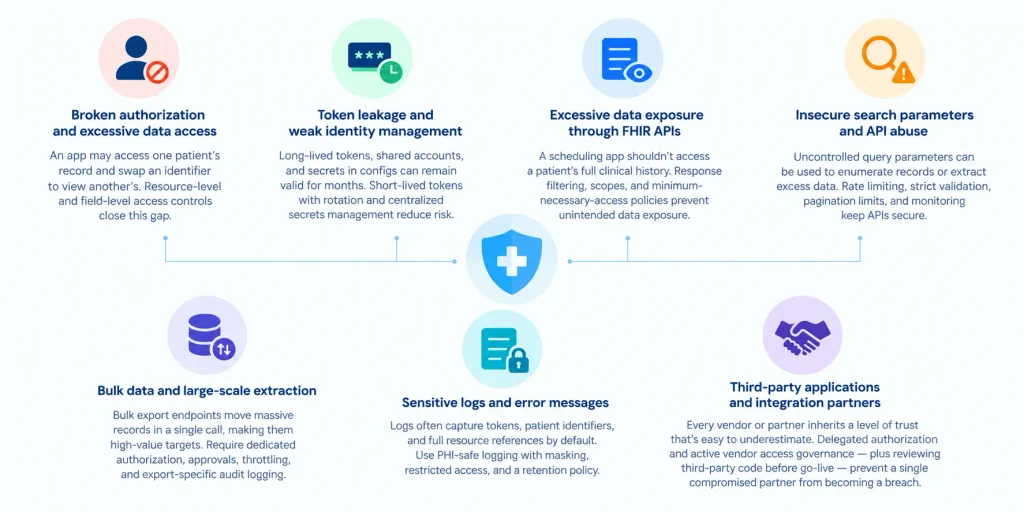
The most common real-world failure in FHIR security isn’t a sophisticated exploit — it’s an application that legitimately accesses one patient’s resource, then finds it can swap an identifier and pull up someone else’s record. This is object-level authorization failure, and it’s one of the most frequently reported issues in healthcare API assessments. Resource-level and field-level access controls close this gap; relying on authentication alone to handle it doesn’t.
Token leakage and weak identity management
Long-lived access tokens, shared service accounts, and secrets sitting in integration configs are still common across production healthcare environments. When one of those leaks, it stays valid until someone notices — which can be months. Short-lived tokens with automatic rotation, paired with centralized secrets management, shrink that exposure window dramatically.
Excessive data exposure through FHIR APIs
A scheduling app that only needs appointment slots shouldn’t be able to pull a patient’s complete clinical history because a query defaulted to returning everything. Response filtering tied to scopes, and a genuine minimum-necessary-access policy, fix this at the API layer instead of trusting the client application to behave responsibly on its own.
Insecure search parameters and API abuse
Uncontrolled query parameters on FHIR search endpoints can be manipulated to enumerate records or extract far more data than a single legitimate request should return. Rate limiting, strict parameter validation, pagination limits, and ongoing monitoring are basic hygiene for FHIR security — not advanced controls reserved for larger organizations.
Bulk data and large-scale extraction
Bulk FHIR export endpoints move enormous volumes of records in a single call, which makes them a high-value target. They need dedicated authorization, approval workflows, throttling, and export-specific audit logging. Treating a bulk endpoint like a regular API route is one of the more common ways large-scale data exposure actually happens.
Sensitive logs and error messages
API logs routinely capture tokens, patient identifiers, and full resource references without anyone deciding that should happen — it’s just a byproduct of default logging configurations. PHI-safe logging, with masking, restricted access, and a defined retention policy, needs to be a deliberate design decision baked into FHIR security planning, not something discovered during an audit.
Third-party applications and integration partners
Every vendor app, mobile client, or partner system connected to your APIs inherits a level of trust that’s easy to underestimate. Delegated authorization and active vendor access governance are what stop a single compromised partner from becoming an organization-wide breach. This is where secure healthcare software development practices — reviewing third-party code and scope before go-live, not after — actually pay off.
Quick Question: “Is a single data breach usually caused by weak encryption?”— Rarely. Most healthcare API incidents trace back to broken authorization or overexposed data — encryption was working fine; access control wasn’t.
Secure FHIR and HL7 Integration Architecture
Source systems — EHR/HIS, LIS, RIS/PACS, pharmacy, ERP, and remote-monitoring devices — feed into an integration engine that handles HL7 v2 validation, data transformation, FHIR mapping, terminology checks, message routing, and interface monitoring. From there, traffic passes through a FHIR API gateway: TLS termination, a web application firewall, schema validation, rate limiting, request-size restrictions, threat detection, and API version management, all enforced at one controlled entry point.
Designing the FHIR API gateway security layer
The gateway should function as the front door to your FHIR security architecture, not the whole house. It’s the natural place to enforce authentication, throttling, schema validation, threat detection, and centralized API policy — but it shouldn’t be treated as the only control standing between an external request and patient data. Teams evaluating API development solutions Dubai providers offer sometimes assume a well-configured gateway is sufficient on its own; it’s the first layer, not the last one.
Identity and access management
This layer covers OAuth 2.0/OIDC, SMART on FHIR, mutual TLS for machine-to-machine connections, MFA for privileged users, short-lived tokens, and centralized secrets management. Weak identity management upstream undermines every other control downstream, no matter how well the gateway or server are configured.
Policy and authorization layer
Combining role-based access with attribute-based rules — organization, user role, care relationship, patient context, purpose of use, data sensitivity, consent status, and break-glass exceptions — lets the same clinician get different access depending on whether they’re actively treating the patient or not. This layer is where FHIR security stops being theoretical and starts reflecting how care actually happens.
FHIR server and data protection
Encryption at rest, resource-level security, security labels, restricted bulk export, network segmentation, database access controls, and backup protection all sit at the server level — the controls that matter after a request has already been authorized and needs to be enforced against the actual data.
Security operations and auditability
FHIR AuditEvent resources, immutable audit trails, SIEM integration, anomaly detection on token behavior, and a functioning incident-response workflow tie the whole architecture together. Without this layer, every other control in your FHIR security stack is invisible until something has already gone wrong.
OAuth 2.0 and SMART on FHIR Authorization Explained
How FHIR OAuth 2.0 scopes control API access
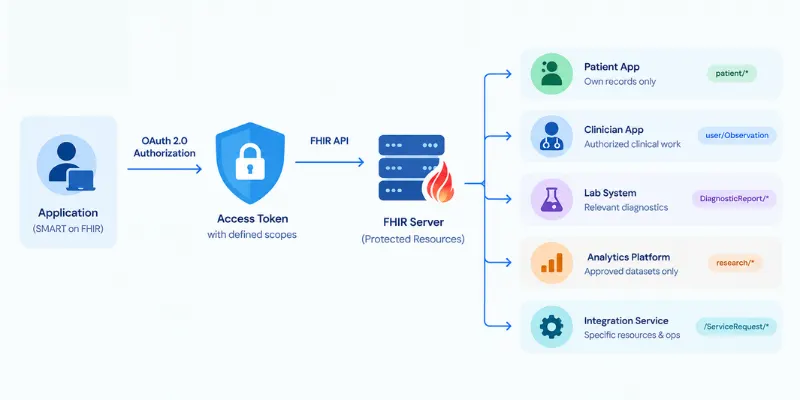
OAuth 2.0 is an authorization framework, not a login mechanism. An access token carries scopes — narrowly defined permissions — and the entire discipline of FHIR OAuth 2.0 scopes is keeping those permissions as tight as the use case allows. A broad scope handed to a convenience app quietly undermines strong authentication elsewhere: the door was locked, but the key that got issued opens every room in the building.
SMART on FHIR authorization for clinical applications
SMART on FHIR builds directly on OAuth 2.0 for clinical use specifically, establishing client identity, issuing scoped tokens, and governing access to protected FHIR endpoints. It also draws a clear line between user-facing applications — a patient portal, for instance — and backend system-to-system integrations, which carry a different trust model entirely and shouldn’t be authorized the same way.
Designing least-privilege access
In practice, this means a patient application reaches only that patient’s own permitted records. A clinician application reaches records relevant to their authorized clinical work, not the full hospital roster. A laboratory system reaches relevant diagnostic resources. An analytics platform reaches only explicitly approved datasets. An integration service touches only the resources and operations it was actually built for. None of this is exotic engineering — it’s scope design done deliberately. Working with a dedicated Cybersecurity Solutions Dubai partner on regular scope audits catches over-permissioned apps before they become the weak point in an otherwise solid FHIR security setup.
Consent, Break-Glass Access, and Fine-Grained Authorization
Why RBAC alone is not enough for clinical data
Role-based access answers “what can a nurse generally do,” not “should this specific nurse see this specific patient’s record right now.” That gap is exactly why RBAC needs to be combined with attribute-based authorization rather than relied on alone.
Making consent part of the access decision
Patient consent, purpose of use, organization, patient relationship, data sensitivity, application type, and the specific resource requested should all factor into the access decision itself — not live in a policy document that’s disconnected from how the system actually behaves.
Controlling emergency or break-glass access
Emergency care sometimes requires overriding normal access rules, and that’s legitimate — but it needs guardrails: explicit justification captured at the point of access, enhanced audit events generated automatically, real-time alerts to security teams where warranted, and retrospective review of every single emergency access event. Break-glass access without review afterward is just an unmonitored backdoor with a good excuse attached to it.
Quick Question: “Does break-glass access weaken FHIR security overall?”— Not if it’s logged and reviewed. The risk isn’t the exception itself — it’s an emergency-access pathway nobody audits afterward.
Securing HL7 v2 Interfaces and the Integration Layer
Validate HL7 messages before they enter downstream systems
Message structure validation, required-field enforcement, detection of unexpected input, data-type validation, and terminology checks all need to happen before a message reaches a downstream clinical system. Skipping this step means a malformed or malicious message can propagate straight into patient records.
Protect HL7 transport and interface endpoints
HL7 v2 TLS, network segmentation, mutual authentication where it’s warranted, IP restrictions, hardened interface engines, and active certificate lifecycle management all belong at the transport layer. An expired certificate that nobody noticed for six months is a more common failure than most teams expect, and it’s entirely preventable.
Secure the HL7-to-FHIR transformation layer
Preventing unauthorized resource creation, validating every mapping, preserving provenance, and watching for data leakage or silent transformation errors all deserve specific attention at this layer. Organizations evaluating hl7 integration services in UAE providers should ask directly how the transformation layer is tested — not just how quickly new integrations can go live.
FHIR Server Security Controls Every Healthcare Organization Should Review
Authentication and authorization
OAuth 2.0/OIDC, SMART on FHIR, mTLS, MFA, and short-lived credentials need to work together at the server level, not rely on any single mechanism to carry the whole load.
Data and resource protection
Encryption at rest, encryption in transit, security labels, resource-level authorization, and data minimization by default form the core of server-side FHIR security. None of these are optional extras once real clinical data is flowing through the server.
API protection
Rate limiting, input validation, query restrictions, pagination, bulk-export controls, and disciplined API version management sit on top of the data protections and stop abuse before it reaches the data layer at all.
Monitoring and auditability
AuditEvent generation, centralized logging, SIEM integration, anomaly detection, and clear incident-response triggers close the loop. This matters even more as connected devices multiply — remote patient monitoring security depends on the same server-side controls, since a wearable streaming vitals into a FHIR server is just another client that needs proper scoping, authentication, and monitoring like any other.
Dubai and UAE Healthcare Interoperability Security Considerations
Where NABIDH fits into the security architecture
NABIDH sits at the center of Dubai’s health information exchange environment, and any organization connecting systems to it needs solid identity management, controlled data exchange, access governance, and auditability underneath that connection. NABIDH participation doesn’t dictate every technical control an organization should run for FHIR security — that’s still an architecture decision — but it raises the baseline for what being “connected” needs to mean operationally.
Designing security around interoperability requirements
Data exchange controls, identity and access governance, auditability, secure APIs, integration monitoring, and third-party access all need to be addressed as one coherent set. Organizations building or upgrading their HIE Software Solutions in UAE capability should treat DHA and NABIDH requirements as a floor for FHIR security, not a ceiling.
Avoiding a “compliance-only” approach
Meeting NABIDH requirements is necessary, but it’s one input into a broader security architecture — not a substitute for addressing operational threats, application-layer vulnerabilities, vendor risk, and cloud exposure that regulation doesn’t explicitly cover.
FHIR and HL7 Security Control Matrix
| Security Risk | Recommended Control | Relevant Layer |
|---|---|---|
| Unauthorized API access | OAuth 2.0/OIDC | Identity |
| Excessive permissions | SMART scopes + ABAC | Authorization |
| HL7 interception | TLS/mTLS | Transport |
| Token theft | Short-lived tokens + rotation | Identity |
| Excessive data exposure | Data minimization | API/FHIR |
| API abuse | Rate limiting + WAF | Gateway |
| Sensitive logs | PHI-safe logging | Operations |
| Untracked access | AuditEvent + SIEM | Monitoring |
| Emergency access misuse | Break-glass controls | Authorization |
| Bulk extraction | Restricted export policies | FHIR/API |
This matrix is meant to make FHIR security decision-ready rather than theoretical — every row maps a real risk to a specific control and the layer it belongs in.
A Practical 30-60-90 Day FHIR and HL7 Security Roadmap
Days 1–30: Discover and assess
Inventory every API and HL7 interface. Map data flows end to end. Identify every external application and vendor with access. Review current authentication and authorization. Find exposed endpoints. Check what’s actually being logged versus what should be.
Days 31–60: Harden the architecture
Implement gateway controls. Strengthen OAuth/OIDC configurations. Review every SMART scope currently in use. Introduce stronger service identities for machine-to-machine connections. Secure HL7 transport end to end. Improve secrets management. Fix the highest-risk API vulnerabilities first, not the easiest ones.
Days 61–90: Validate and monitor
Run FHIR API penetration testing. Test authorization boundaries directly rather than assuming they hold. Validate consent and break-glass workflows against real scenarios. Integrate security events with SIEM. Establish continuous monitoring. Document incident-response procedures that people have actually walked through at least once.
Questions to Ask a FHIR and HL7 Integration Security Provider
Architecture and interoperability How do you secure HL7-to-FHIR transformations? How do you isolate integration engines from the rest of the network? How exactly do you protect FHIR endpoints once they’re in production?
Identity and authorization How d o you implement SMART on FHIR authorization in practice, not just in theory? How are FHIR OAuth 2.0 scopes designed for each client type? How are machine identities managed and rotated? How are privileged users controlled and periodically reviewed?
Security testing Do you perform FHIR API penetration testing, and how often? How specifically do you test for broken object-level authorization? How is token handling validated? How are bulk-data controls tested under realistic load?
Operations How are FHIR AuditEvent records handled and retained? Can security events integrate with an existing SIEM? How are incidents investigated once flagged? How are third-party integrations reviewed on an ongoing basis, not just at onboarding?

FHIR and HL7 Security Implementation Checklist
A secure FHIR and HL7 environment starts with a complete inventory of APIs, interfaces, and clinical data flows. Validate HL7 v2 messages, enforce secure transport, and implement OAuth 2.0/OIDC with SMART on FHIR authorization and least-privilege FHIR OAuth 2.0 scopes. Combine RBAC with ABAC and include consent and break-glass access in authorization decisions.
Healthcare organizations should also protect service identities, secrets, and certificates while deploying a properly configured FHIR API gateway and strengthening FHIR server security. Restrict bulk data access, prevent sensitive information from entering logs, enable AuditEvent, and integrate security events with a SIEM. Finally, test APIs for authorization vulnerabilities and maintain documented incident-response procedures to continuously strengthen healthcare API security.
Secure Your Healthcare API Integration Architecture
Every new integration — a lab feed, a monitoring device, a partner API — adds another identity, another trust relationship, another place for FHIR security to break down quietly. Before connecting the next system, it’s worth knowing exactly where the authorization gaps, exposed APIs, weak service identities, insecure transformations, and logging risks already sit in the current architecture.
As a Healthcare Software Company Dubai organizations turn to for interoperability and security work together, we offer two starting points depending on where you are: a Healthcare API Security Assessment to map your current exposure, or a full FHIR/HL7 Integration Architecture Review if you’re planning new connections and want the architecture right before you build it.
Frequently Asked Questions
Is FHIR secure by default?
No. FHIR provides the structure for interoperability, but FHIR security — authentication, authorization, transport protection, consent, and monitoring — has to be built around it deliberately.
What is the difference between FHIR security and HL7 security?
FHIR security centers on REST APIs, OAuth-based authorization, and JSON/XML payloads. HL7 security centers on message-based interfaces, transport protection, and endpoint authentication. Both need overlapping controls: validation, encryption, access governance, and auditing.
How does OAuth 2.0 secure FHIR APIs?
It issues scoped, time-limited access tokens tied to a verified client identity, so an application can only perform the specific actions its token authorizes — nothing beyond that.
What are FHIR OAuth 2.0 scopes?
Scopes define exactly which resources and operations a token can access — read-only patient demographics, for instance, versus write access to clinical notes. Narrow scopes limit what a compromised token or misbehaving app can actually do.
Why is SMART on FHIR authorization important?
It’s the standard mechanism for connecting third-party clinical applications to protected FHIR resources securely, without every vendor inventing its own authorization scheme from scratch.
Does TLS make an HL7 or FHIR integration secure?
No. TLS protects data in transit, but it doesn’t determine who should be authorized to access what, doesn’t enforce consent, and doesn’t stop excessive data exposure once a connection is already authenticated.
How can healthcare organizations test FHIR API security?
Through penetration testing, authorization boundary testing, token handling reviews, API abuse simulation, configuration audits, and assessments of the entire integration layer — not just the public-facing endpoint.