


Key Takeaways
- UAE logistics enterprises can no longer run on disconnected tools — customer expectations, D33 Agenda targets, and Net Zero 2050 goals all demand integrated, scalable platforms.
- Core features like AI route optimization, real-time fleet tracking, warehouse management, and freight auditing deliver measurable ROI (10–15% fuel savings, 98%+ inventory accuracy, 2–5% freight recovery).
- Arabic-first UX and WhatsApp-based notifications aren’t optional extras — they’re what actually reaches UAE customers.
- Predictive analytics and control tower dashboards turn logistics from a reactive cost center into a function leadership can plan around.
- Advanced capabilities (digital twins, AI copilots, autonomous warehousing) are future-proofing investments, not day-one requirements.
- The build vs. buy decision hinges on growth horizon — custom platforms cost more upfront but avoid painful migrations as the business scales.
The UAE’s logistics industry is evolving rapidly as eCommerce grows, cross-border trade expands, and customer expectations continue to rise. Businesses can no longer rely on disconnected systems or manual processes if they want to stay competitive. Modern logistics platform features have become essential for improving visibility, efficiency, and delivery performance.
However, choosing a logistics platform isn’t about finding the longest feature list. The best logistics platform features are those that align with your operational workflows, fleet size, compliance requirements, and long-term business goals, rather than adding unnecessary complexity.
With initiatives like the Dubai D33 Agenda, Net Zero 2050, and smart logistics investments accelerating digital transformation, UAE enterprises need future-ready solutions. This guide explores the essential logistics platform features every enterprise should prioritize in 2026 to build a scalable, efficient, and competitive logistics operation.
Why UAE Enterprises Need Modern Logistics Platform Features in 2026
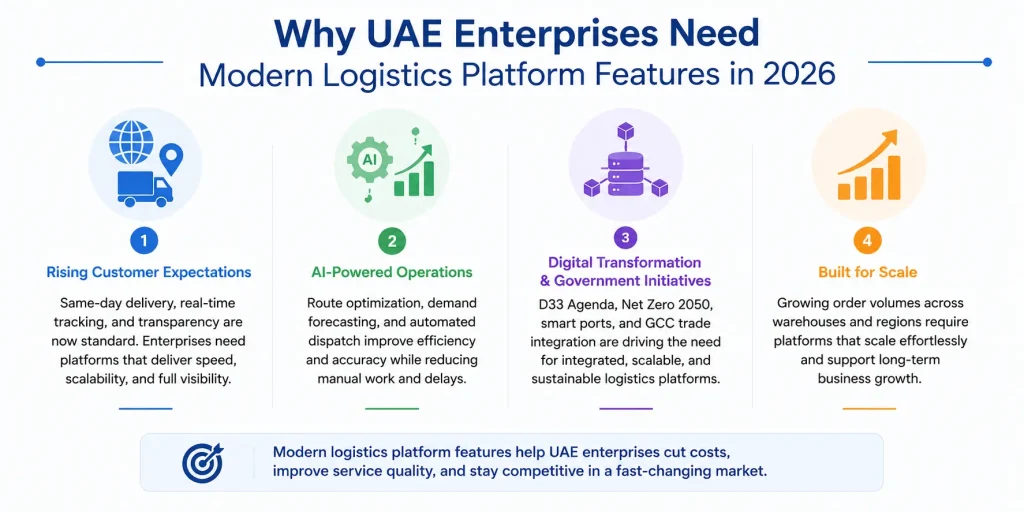
The UAE’s logistics sector is no longer just growing—it’s becoming one of the region’s most competitive industries, driven by Dubai’s role as a global trade hub connecting Asia, Europe, and Africa. As customer expectations rise, same-day delivery, real-time tracking, and operational transparency have become standard rather than premium services. To stay competitive, enterprises need modern logistics platform features that support speed, scalability, and visibility.
AI-powered route optimization, predictive demand forecasting, and automated dispatch are now essential capabilities. Businesses still relying on disconnected tools for fleet management, warehousing, and freight audits often struggle with data silos, manual processes, and missed service-level agreements. This is where What Is Custom Logistics Software becomes an important question. Unlike generic platforms, custom logistics software is built around an enterprise’s unique workflows, integrations, and long-term growth requirements, helping eliminate operational bottlenecks.
Government initiatives are accelerating digital transformation as well. The Dubai D33 Agenda, UAE Net Zero 2050 strategy, smart ports like Jebel Ali, and stronger GCC cross-border trade coordination all demand logistics platforms that can integrate seamlessly, scale efficiently, and support sustainability reporting.
As order volumes grow from hundreds to thousands per day across multiple warehouses and regions, basic off-the-shelf solutions quickly reach their limits. Enterprises that invest in the right logistics platform features today will be better positioned to reduce costs, improve customer satisfaction, and scale confidently in the years ahead.
Core Logistics Platform Features Every Enterprise Should Prioritize
Not every feature on a vendor’s pitch deck delivers equal business value. Some are essential to daily operations; others sound impressive but rarely get used past the demo. Below are the logistics platform features that UAE enterprises should actually evaluate before signing a contract or greenlighting a custom build.
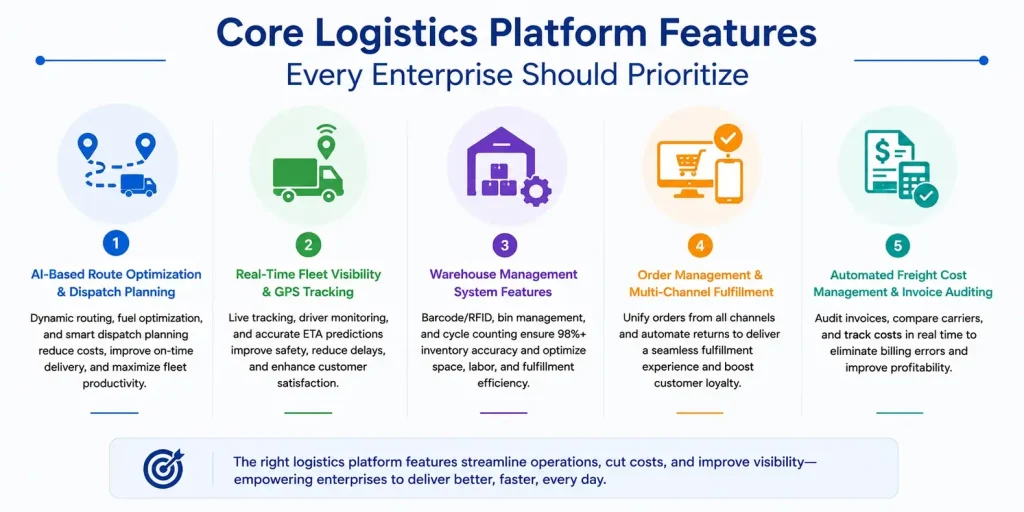
AI-Based Route Optimization & Dispatch Planning
Static routes don’t survive contact with Sheikh Zayed Road traffic at 5 p.m. Dynamic routing engines recalculate in real time, factoring in live traffic conditions, weather, and delivery windows to keep drivers moving instead of idling at a standstill they could have avoided with a five-minute detour.
This is where the operational savings actually show up. Fuel optimization alone can cut route costs by 10–15% for mid-sized fleets, and smarter driver allocation and delivery sequencing reduce the number of trucks needed to cover the same volume. Dispatch planning that accounts for driver shift limits, vehicle capacity, and delivery priority (same-day vs. next-day) also cuts down on the manual back-and-forth dispatchers currently spend on WhatsApp groups trying to reassign a route mid-shift.
For enterprises running dozens or hundreds of daily routes, that’s not a marginal improvement — it’s the difference between hitting SLAs and apologizing for missing them. And in a market where customers can switch delivery providers with one tap, missed SLAs compound into churn faster than most operations teams realize.
Real-Time Fleet Visibility & GPS Tracking
You can’t manage what you can’t see. Live GPS tracking gives dispatchers a real-time map of every vehicle, while driver monitoring flags unsafe behavior — harsh braking, speeding, extended idle time — before it becomes a liability claim or, worse, an actual accident.
Accurate ETA prediction matters just as much for the customer side. When a shipment gets delayed, exception alerts should fire automatically, giving ops teams time to notify the customer before they call in asking where their order is. That single shift — proactive notification instead of reactive explanation — changes how customers experience a delay entirely; a heads-up feels like good service, while silence feels like a broken promise.
Customer-facing tracking links reduce inbound support tickets significantly, freeing your team to handle actual problems instead of status-check calls. For enterprises managing high delivery volumes during peak periods like Ramadan or the year-end retail surge, that support capacity difference can be the gap between a smooth quarter and a support team drowning in “where is my order” messages.
Warehouse Management System Features for Intelligent Inventory Control
Warehouse management system features are where a lot of enterprises quietly bleed money. Manual counts, misplaced SKUs, and inaccurate stock levels compound into stockouts, overselling, and wasted labor hours that never show up as a clean line item on a P&L — they just show up as slower fulfillment and unhappy customers.
Barcode scanning and RFID tagging solve the accuracy problem at the source — every item movement gets logged automatically instead of relying on someone remembering to update a spreadsheet at the end of a shift. Bin management and cycle counting keep inventory data current without shutting down the warehouse for a full physical count, which for a mid-sized distribution center can otherwise mean a full day of lost throughput.
Enterprises running modern warehouse management system features typically report inventory accuracy above 98%, compared to the 85–90% range that’s common with manual processes. Space optimization tools go a step further, recommending slotting changes that cut picker travel time and shrink the warehouse footprint you actually need — which matters a great deal when warehouse rents in Dubai South or Jebel Ali Free Zone keep climbing.
Order Management & Multi-Channel Fulfillment
If you’re selling through your own site, a marketplace, retail partners, and wholesale channels, order management can’t live in four different systems. A unified order management layer consolidates eCommerce, marketplace, retail, and wholesale orders into a single fulfillment queue, so warehouse staff aren’t juggling logins across platforms just to pick and pack one afternoon’s worth of orders.
Returns deserve equal attention here. Reverse logistics is often an afterthought in platform design, but for retail and eCommerce enterprises, a clunky returns process is one of the fastest ways to lose repeat customers — and one of the slowest problems to fix once customer trust has already taken a hit. A platform that automates return authorization, restocking, and refund triggers turns what used to be a manual headache into a process that barely needs human intervention.
Automated Freight Cost Management & Invoice Auditing
Freight billing errors are more common than most finance teams realize. Automated freight calculation and invoice auditing tools cross-check every carrier invoice against contracted rates, flagging discrepancies before they get paid instead of six months later during a quarterly audit.
Carrier comparison features let procurement teams see, side by side, which carriers are actually delivering the best rate-to-performance ratio — not just the lowest quoted price. A carrier that’s 5% cheaper but misses delivery windows twice as often isn’t actually saving you money once you factor in customer service costs and reshipments.
The ROI case is concrete: enterprises that implement automated freight auditing typically recover 2–5% of total freight spend in overcharges that would otherwise have gone unnoticed. For an enterprise spending AED 10 million annually on freight, that’s a real, recoverable number — not a hypothetical efficiency gain.
Predictive Analytics & Demand Forecasting
Predictive analytics in logistics has moved from “nice to have” to a core planning tool for enterprises managing seasonal swings — Ramadan spikes, back-to-school demand, year-end retail surges. AI forecasting models pull historical sales data, market trends, and even weather patterns to project demand weeks or months ahead, rather than leaving warehouse managers to guess based on last year’s numbers and gut instinct.
That forecast feeds directly into inventory planning and procurement decisions, reducing both overstock (which ties up working capital that could be used elsewhere) and stockouts (which drive customers to competitors within minutes on a marketplace). For manufacturing and distribution enterprises, tighter demand forecasting also means fewer emergency production runs and less reliance on expensive expedited freight to cover a shortfall nobody saw coming.
The best forecasting tools also flag anomalies — a sudden spike that doesn’t match seasonal patterns, or a regional demand shift that warrants attention before it becomes a full-blown stockout. That early-warning function is often worth more than the baseline forecast itself.
Control Tower Dashboard & Business Intelligence
Enterprise logistics generates enormous amounts of operational data — and most of it goes unused because it’s scattered across five different tools that were never designed to share information. A control tower dashboard pulls everything into one operational view: live shipment status, KPI monitoring, SLA compliance, and exception tracking, all visible without switching screens or waiting on someone to compile a weekly report.
Custom reporting matters here too. A warehouse manager needs different metrics than a CFO reviewing quarterly logistics spend, and a good platform lets each stakeholder build the view that’s relevant to their decisions, pulling from the same underlying data instead of maintaining separate, occasionally conflicting spreadsheets. Executive-level insights — cost per shipment, on-time delivery trends, carrier performance over a quarter — turn logistics from a cost center that’s hard to explain into a function leadership can actually steer.
Seamless ERP, CRM & eCommerce Integrations
A logistics platform that can’t talk to your existing systems creates more work, not less. Integration with SAP, Oracle, and Microsoft Dynamics keeps financial and inventory data synchronized across the enterprise, while Shopify and WooCommerce integrations connect the platform directly to your online storefronts without a developer manually syncing order data every night.
Without these integrations, teams end up manually re-entering data between systems — a process that’s slow, error-prone, and impossible to scale as order volume grows. For enterprises running multiple business units, integration flexibility isn’t a convenience; it’s what determines whether the platform can actually support the business three years from now, or whether it becomes another system that needs replacing once the enterprise outgrows it.
Sustainability & Carbon Emissions Reporting
Sustainability reporting has shifted from a marketing talking point to a contractual requirement. Large enterprise clients and government tenders increasingly ask logistics partners to provide carbon dashboards aligned with the GHG Protocol, covering fleet emissions across every mile driven, not just a rough annual estimate.
For UAE enterprises specifically, this ties directly back to national Net Zero 2050 commitments. Platforms with built-in ESG reporting let logistics providers respond to compliance requests in minutes instead of compiling manual emissions estimates every time a client asks — and increasingly, clients are asking before they’ll sign a contract, not after.
Arabic-First UX & Multi-Language Support
This is one of the sharpest differentiators between generic international platforms and tools actually built for the UAE market. Arabic UI with proper right-to-left (RTL) support isn’t a translation layer bolted onto an English interface — it needs to be designed into the platform from the start, or navigation, forms, and reports end up feeling awkward and half-finished for Arabic-speaking users.
Arabic documentation matters for driver-facing apps and warehouse floor tools, where English-only interfaces slow down staff who are more comfortable working in Arabic and end up relying on guesswork or colleagues for basic navigation. WhatsApp integration and local SMS providers round this out, since WhatsApp is the dominant communication channel across the region for both customer notifications and driver coordination — far more than email ever will be here. A platform that ignores this reality is optimizing for a customer base that doesn’t fully match the one actually placing orders.
Enterprise Security & UAE Data Compliance
Security can’t be an afterthought when a platform touches customer data, shipment contents, and financial records. Role-based access control ensures warehouse staff, dispatchers, and finance teams only see what’s relevant to their role, while multi-factor authentication (MFA) closes off the most common entry point for account compromise.
Encryption and audit logs protect data in transit and give compliance teams a full trail of who accessed what, and when — which matters both for internal accountability and for satisfying enterprise clients who ask about your security posture before signing. For enterprises operating under UAE data residency expectations, sovereign cloud hosting keeps sensitive data within regional infrastructure rather than routing it through servers on the other side of the world. Disaster recovery planning rounds this out — because a platform outage during peak season isn’t just inconvenient, it’s a direct revenue hit measured in thousands of missed deliveries.
AI Customer Support & Automated Notifications
“Where is my order?” (WISMO) tickets are one of the biggest silent costs in customer support. Automated notifications sent via WhatsApp, SMS, and email keep customers updated at every delivery milestone without a human having to trigger each message manually, order by order.
Chatbots handle routine status inquiries instantly, escalating only genuine exceptions to a live agent — a lost package, a damaged item, a delivery address change. Enterprises that implement proactive, multi-channel delivery notifications typically see WISMO-related support tickets drop by 35–50%, freeing support teams to focus on cases that actually need human judgment instead of repeating the same tracking link forty times a day.
Advanced Logistics Platform Features That Future-Proof Enterprise Operations
Once the essential logistics platform features are in place, enterprises should focus on advanced technologies that support long-term growth. Capabilities such as digital twins, IoT asset monitoring, and AI copilots improve operational visibility, automate decision-making, and help logistics teams optimize warehouses, fleets, and supply chains with greater accuracy.
Warehouse automation, including robotics-assisted picking, computer vision, and AI-driven inventory management, enables faster fulfillment while reducing manual errors. For industries like pharmaceuticals and food logistics, IoT monitoring also helps maintain cold-chain compliance and product quality throughout transit.
Emerging technologies such as blockchain-based shipment verification and micro-fulfillment optimization are giving UAE enterprises a competitive edge in security and last-mile delivery. For businesses planning to build logistics software, incorporating these advanced capabilities from the beginning provides greater flexibility, easier scalability, and a stronger return on investment than adding them later.
Build vs Buy: Which Logistics Platform Is Right for UAE Enterprises?
The custom vs off-the-shelf logistics software decision is one of the most important choices for UAE enterprises. It impacts your implementation timeline, budget, scalability, and how well your platform supports future business growth.
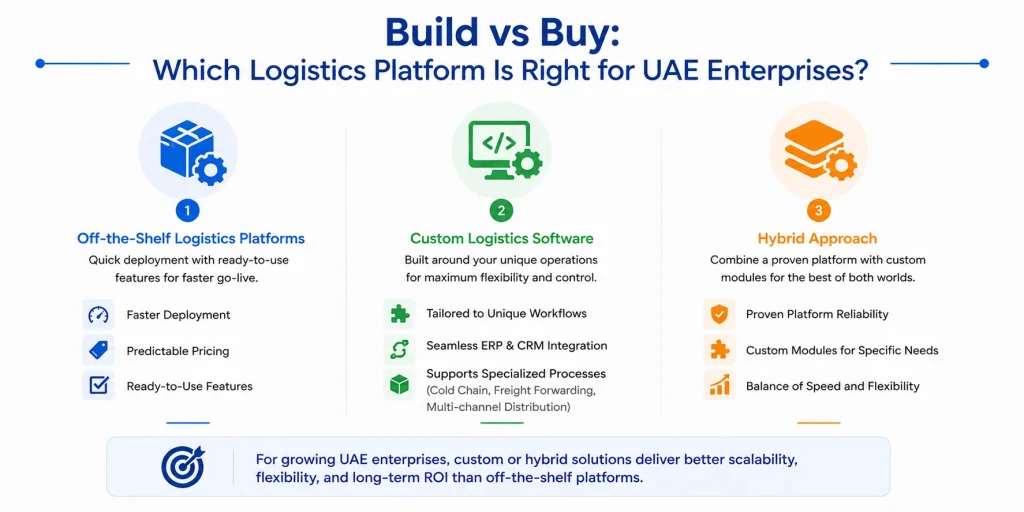
Off-the-shelf logistics platforms offer faster deployment, predictable pricing, and ready-to-use logistics platform features, making them suitable for businesses that need a quick implementation. However, they often provide limited flexibility when it comes to custom workflows, integrations, and industry-specific requirements.
Custom logistics software is designed around your unique operations, enabling seamless integration with existing ERP and CRM systems while supporting specialized processes such as cold chain logistics, freight forwarding, and multi-channel distribution. A hybrid approach combines the reliability of a proven platform with customized modules for specific business needs. For growing UAE enterprises, the custom vs off-the-shelf logistics software decision often favors custom or hybrid solutions because they offer better scalability, flexibility, and long-term ROI.
Logistics Platform Evaluation Checklist for 2026
Use this as a working framework when comparing vendors, scoping a Custom Logistics Software Development in Dubai project, or simply auditing what you already have in place.
Must-Have Features
- AI route optimization — cuts fuel and labor costs on every route, every day
- Real-time fleet tracking — the baseline customers now expect without asking
- Warehouse management — the difference between 98% and 88% inventory accuracy
- ERP integration — keeps finance, inventory, and operations data in sync
- Real-time analytics — turns scattered data into decisions leadership can act on
- Enterprise security — protects customer, shipment, and financial data by default
- Carbon emissions reporting — increasingly a contractual requirement, not optional
High-Value Features
- Predictive demand analytics — smooths seasonal swings before they become emergencies
- Arabic-first UX — reaches the customer base actually placing orders
- Freight cost auditing — recovers money already being lost quietly
- Customer self-service tracking — cuts support ticket volume without cutting service quality
Future Roadmap Features
- Digital twins
- AI copilots
- Computer vision
- Autonomous warehousing
- Blockchain shipment verification
Score each vendor or proposal against these three tiers, and weight the must-haves heavily — a platform that nails every future-roadmap item but skips basic fleet tracking isn’t actually enterprise-ready, no matter how impressive the demo looks.
Build a Future-Ready Logistics Platform for Your UAE Business
Every logistics operation runs on its own mix of workflows, systems, and growth targets — which is exactly why off-the-shelf platforms so often force compromises somewhere. Maybe it’s the Arabic UX, maybe it’s a freight auditing workflow your finance team actually needs, maybe it’s an ERP integration the vendor just doesn’t support.
The right starting point isn’t a feature comparison spreadsheet — it’s a conversation about your actual operation, your fleet, your customers, and where you expect your business to be in three years. Getting the foundation right now saves you a painful, expensive migration later.
Conclusion
Technology stopped being a back-office line item for logistics operations a while ago. It’s now the thing that decides whether an enterprise wins the next contract, keeps a retail client happy through peak season, or loses market share to a competitor who can promise a tighter delivery window and actually deliver on it.
The features covered here aren’t a wish list — they’re the baseline UAE enterprises need to compete in 2026 and beyond. Route optimization, fleet visibility, accurate warehousing, freight auditing, sustainability reporting, and genuine Arabic-first design all compound together into faster operations, lower costs, and fewer customer complaints. None of them work in isolation; a platform with brilliant route optimization but no warehouse visibility just moves the bottleneck further down the supply chain instead of removing it.
Take the checklist above and score your current setup honestly. Where are the gaps? Which features would move the needle fastest for your specific operation — cold chain, 3PL, retail, or manufacturing? The enterprises that treat this as a strategic evaluation, not a box-ticking exercise, are the ones that will still be scaling comfortably three years from now, while their competitors are still explaining a missed delivery window.
FAQs
What are the most important logistics platform features for UAE enterprises in 2026?
AI route optimization, real-time fleet tracking, warehouse management, ERP integration, freight auditing, carbon reporting, and enterprise security form the essential baseline every UAE logistics enterprise needs.
Should UAE enterprises build custom logistics software or buy off-the-shelf?
It depends on growth horizon. Off-the-shelf suits fast, predictable rollouts; custom platforms suit enterprises needing unique workflows, deeper integrations, and long-term scalability without costly migrations later.
How does predictive analytics help logistics operations?
Predictive analytics forecasts seasonal demand spikes, reduces overstock and stockouts, and improves procurement planning, helping enterprises avoid emergency production runs and expensive last-minute expedited freight costs.
Why is Arabic-first UX important for UAE logistics platforms?
Arabic-first UX with RTL support and WhatsApp integration reaches customers and warehouse staff who prefer Arabic, improving usability, communication, and adoption across driver, warehouse, and customer touchpoints.